Lions & Tigers & Bears – No Way

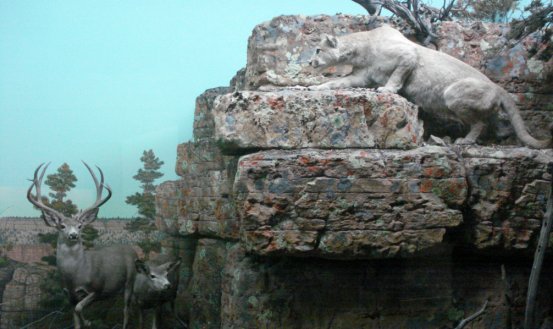
I spent a lot of time at the Milwaukee Museum as a kid.  It was a big part of my education and many of the images have stuck with me, so I was happy to see significant continuity in the exhibits.  The familiar animals stare out of their dioramas.  I went down to the museum with my sister and saw the old friends.

The one that stuck in my mind the most was the cougar, frozen in time about to jump on a couple of mule deer. When I hike in the west, in places where there is a resurgent cougar population, I think about that image and unfortunately cast myself in the role of the deer. The cougar is a stealth hunter. He is literally digging his claws on your back before you are aware of his presence. 

Cougars were once common throughout North America.  Our ancestors wisely drove them out to the lonely places of the continent and I am unenthusiastic about their return to settled areas.  I understand that there is an established population now in the Black Hills and sooner or later some fool will reintroduce them to the Appalachians, whence they will infiltrate into place where I walk.  I know they are beautiful and graceful, but I don’t favor any animal sharing the forest with me that can easily kill me and might have incentive to try. I don’t believe, as some deep green environmentalists imply, that it would be ennobling for me to become “one with nature” by becoming big cat food and ultimately being converted to cougar sh*t. 

I am indeed a “speciesist” in this sense.  I want to stay at the apex of the food pyramid. Let big, dangerous cats stay in the North Cascades or other special ranges where we can be on the lookout for them.  It has been more than a century since any of their kind snarled their defiance in the Eastern Mountains. Good. Let’s keep it that way.

I have no similar problem with wolves, BTW.  Little Red Riding Hood notwithstanding, they may be a threat to livestock, but just don’t attack people.  At least they have not done so in North America in our 400 years of reliable record-keeping.  The wolf has suffered mightily from bad public relations.  In Europe, where they lived in intimate contact with dispersed and technologically less sophisticated human populations I suppose they may have been a threat on occasion, but not here and now.

So to sum up in simple terms, IMO, MOST carnivores – wolves, coyotes, bobcats, lynx, fishers, martens, badgers and such like are good and should be encouraged on your land unless you have livestock or small pets that might be endangered.  Large bears and – especially – cougars are bad anywhere near where you want to live, hike or take a nap.
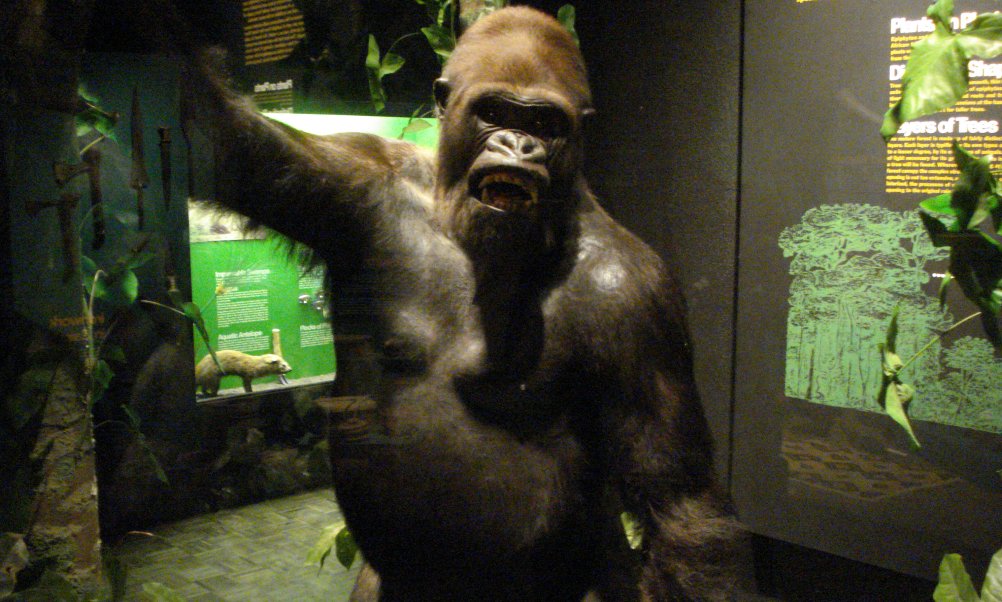
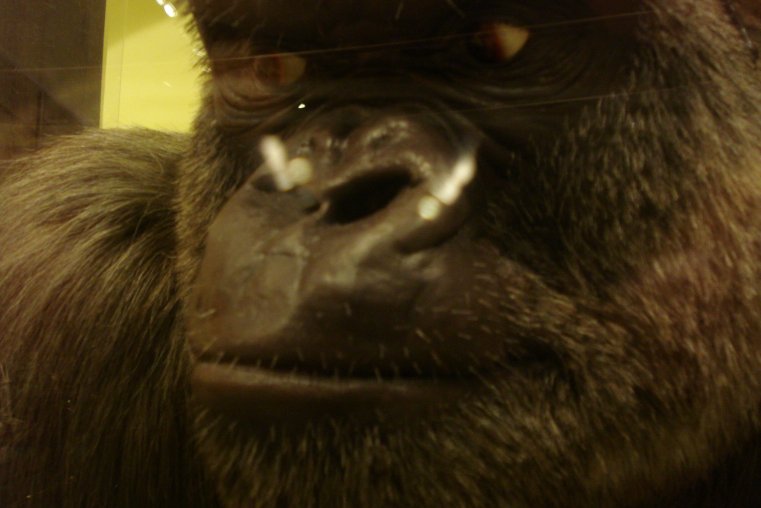
Above is “Sambo”.  He was a gorilla in the Milwaukee Zoo. He died back in 1959 (I think of lung disease) and soon appeared in the Museum as the “lowland gorilla”. I never saw Sambo alive, but got to know him in the flesh, so to speak, later.  Below is “Sampson”.   He was Sambo’s zoo-mate (I think he might have been his brother), but lived a lot longer.  Sampson died in 1981 of a massive heart attack. He was evidently overweight.  I don’t recall if he smoked or didn’t exercise.  He was one of the most popular residents of the zoo, with a lot of mourning fans when he died.  Now he also stands in the museum. My own goal, BTW, is to become a museum exhibit someday. They can make a diorama with me as a character. 
Chicago to Milwaukee

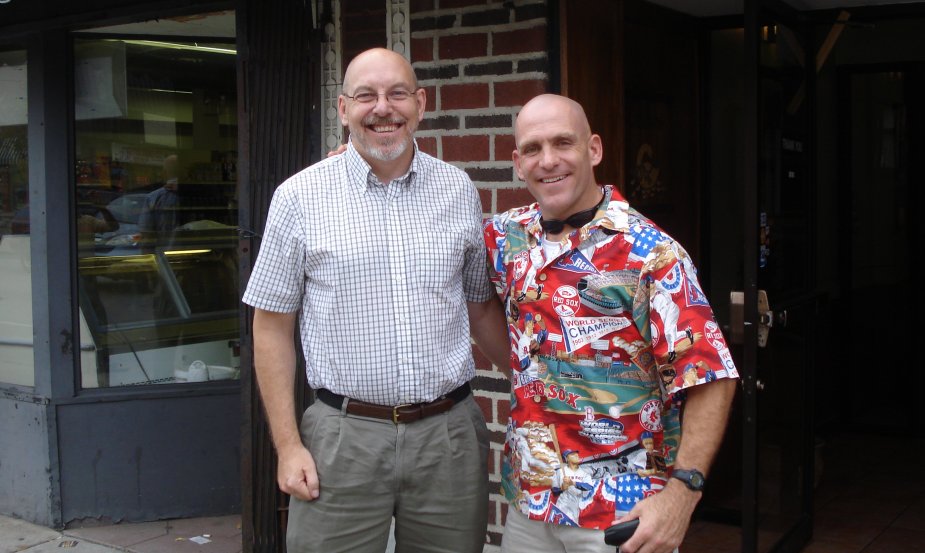
In Chicago I stopped off to visit Bob McCarthy, the friend from Iraq, who is working with Marine reserve units in Wisconsin, Indiana and Illinois.  Bob made my stay in Iraq a lot more comfortable and rewarding.  We had lunch at a local Lebanese restaurant in the interesting transitional neighborhood near the Marine station.  There are Hispanic immigrants mixed with more recent arrivals from the Middle East, leavened with Hassidic Jews and some recent arrivals from Eastern Europe.  I think the waitress was Russian.  Only in America.

You can see in the picture below the twin moons in Chicago.  Bald is beautiful. Bob actually could grow hair if he wanted.  Interesting shirt.  Where do you even buy something like that?

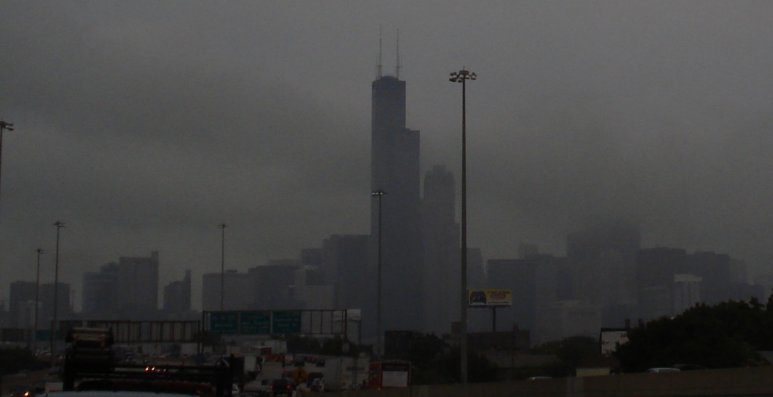
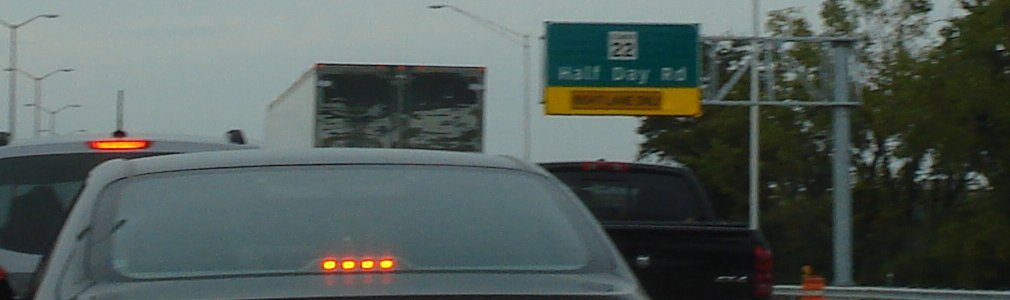
Chicago is a lot like Milwaukee, only bigger, dirtier and more crowded.   It took a long time to get out of town because of the traffic jam and a lot of construction.  I don’t think this is anything unusual for Chicago.  You have to pay toll on Chicago area highways.  It cost me more than $5 to get through.  You would think that toll roads would be better maintained than the free variety, but you would be wrong.  I guess Chicago politics needs its patronage sources.   If you look at the picture I have included, you notice the sign “Half Day Road.”  It is very descriptive, since that is about as long as it takes to get out of Chicago.   I got clean across Ohio in the time it took to creep through a few dozen miles to get out of Chicago.

I finally got to Milwaukee in early evening.  I look forward to seeing family and doing the Milwaukee things.   That means walking around the old neighborhood, running on the trails in Grant and Warnimont and eating.  I have to go to Rocky Rococo, George Webb and Cousins Subs and I need my 1960s Schlitz beer and Rippin’ Good mint cookies.

A general shortage of mint chocolate has developed.  I have been having trouble finding ordinary mint chocolate and it has always been impossible to get the Rippin’ Good mint cookies outside Wisconsin.  The mint girl scout cookies are not really an adequate substitute.  

I don’t really like the Schlitz beer that much. I drink it out of homage to the old man.  This is supposed to be the original 1960s recipe.  The old man told me that Schlitz was good until the early 1970s, when they sped up the brewing process – replaced the braumeisters with chemists, according to the Old Man – and made it inconsistent. The old man changed to Pabst and soon Schlitz went out of business, acquired by Stroh’s.   The building where for almost a century they brewed the “beer that made Milwaukee famous” is now upscale condos.

Politics + Science = Perdition + Tyranny

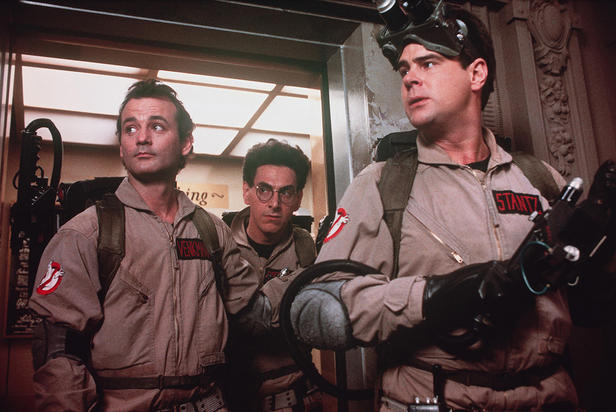
Back off Man; I’m a Scientist …

Should scientists be politically active? Individual scientists should participate in debates as citizens. They should bring their knowledge and expertise to every subject, just like others do. But “scientists” as a group should not be political animals because there is a big difference between “A” scientist and “THE” scientist.

… Dr Peter Venkman

What is a scientist anyway? Do you have to have a science degree? Is BS enough or do you need a PhD? Do you have to do experiments? What kind of science qualifies as science? Sociologists and psychologists sometimes call themselves scientists. Political scientists even have that name in their titles. Some historians thought they were scientists. The term is very elastic.

Western civilization is based on the scientific method

Anybody who uses the “scientific method” in his work or to draw conclusions could legitimately call himself a scientist, but that would make scientists out of a lot of business people, most engineers, many farmers and almost everybody who works with actuarial tables. There is a field called “scientific management.” For that matter, all those body builders at Gold’s Gym are scientists, given their constant experimentation with their bodies and familiarity with chemicals. Successful modern farmers, builders & business people certainly approach their work scientifically? Everybody could be included sometimes and any definition that includes everybody is not a useful definition. This is not what most people have in mind.

Science and politics are methods to address different problems

But even when we exclude sociologist, body builders, engineers etc, we still have a problem and the problem is that science and politics are almost polar opposites. Science is iterative. It never comes to final conclusions. It tends to narrow inquiry and make scientists experts on narrow fields. Science doesn’t permit extrapolation. Extrapolation is what politics is all about. Politicians are rarely troubled when they are not sure of the precise truthfulness of their statements. Scientists MUST be.

Science provides options, not decisions

Probably the most important impediment to science in politics is the very nature of decision making. You cannot “let science decide” because decisions are exactly what science does NOT do. Science provides inputs into decisions. Science can give you a probability that if you do X you will sacrifice Y, but somebody has to decide on the relative values. Maybe X just doesn’t matter to you. Science cannot make that decision.

Think of a decision about a medical procedure. The doctor can use science to tell you that there is an 80% chance the operation will be a success, but a 70% chance you will be incapacitated by the procedure. On the other hand, if you do something less invasive, you have only a 50% chance of survival, but you can make a full recovery if you survive. You could come up with a complete breakdown of the odds, but you still have to decide, based on non-science values, what you want to do. One person might choose the greater risk of death for the greater health later. Others do the opposite Science cannot help. Once it gives you the options and odds, the job of science is done unless new information comes to light.

BTW – when we reach a near certainty, we no longer have decision making. We all agree that we will apply the rule of physics when flying in an airplane. No matter what anybody says about alternative reality, he doesn’t believe it when it comes to that. Decisions are ONLY needed in areas of disagreement or uncertainty.

Science informs; it doesn’t decide

Most “scientists” understand this limitation. Those scientists who want to be political might not get it. They want to use science as a trump card, but it doesn’t work. Decisions are made based on values. Science is value neutral. Therefore science cannot decide.

20th Century tyranny was “science-based”

When science becomes political, it stops being science and starts to become tyranny. In fact, science works a lot like religion when mixed with politics. It invests too much “certainty” into a human political process. It might start off “good” but politics corrupts it, because politics is not science, but politicians – especially bad ones – like to use science, as they once used religion – as a weapon to pummel their opponents into silence.

Stalin and Hitler had scientists working for them. Marxist and Nazi systems were “science-based” in the minds of their creators. Nazi science was chillingly precise. There was “scientific racism” and the eugenics movement was firmly rooting in the science of the time. We now tend to call them “pseudo- scientists” but they were trained and passed scientific muster at the universities of their times. They were pseudo BECAUSE they were political, not because they were not trained as scientists.

I would also point to the case of Nobel Prize winning chemist Fritz Haber. W/o his work literally half the world population would probably go hungry. Some of his other inventions were less felicitous. He had the most impeccable scientific credentials, but his political judgment was perhaps not so good.

Leave the lying to the politicians

This broad political road that leads to perdition is posted and brightly blazed all the way. Scientist should stay on the steep and narrow trail to truth. Leave the lying to the politicians. That is what they are good at.

HWY 70, Holiday Inn & the Fall of World Communism

It has been almost exactly twenty-five years since I drove on I-70, going the other way to take up my new job as an FSO.  We were living in West Lafayette, Indiana, where I had a very brief job as a market researcher at a firm called Microdatabasesystems (MDBS).  They made, as the name suggests, data base software.  Since I was the only guy in the marketing research department, I suppose I was the director.  Never trust titles. 

The firm had been founded by a couple of professors from Perdue.  They knew computers, but were not so strong on marketing.  I worked there a couple of weeks and learned the software only through the indulgence and kindness of the engineers who explained it so often.  Then the owners called me in and asked my opinion about their firm.  I was flattered and they were very nice and open.   I told them the truth.  That the software was wonderful in what it could do (for the time) but that it was too hard to use, maybe they should put in some menus or something.   One of the guys, very nicely but w/o attempting humor said, “If people are too dumb to use our product, perhaps they shouldn’t buy it.”  I am not sure of the exact words, but it was something close.  

I went back to my office and called the State Department. I had taken and passed the FSO tests, but they were doing a security check.   I asked when they would be done.   There was the usual pause while they looked up my stuff and then the woman told me that the security check was done and that I had been offered a job. I never saw the job offer.   It must have gone to my old address in Minneapolis. I was supposed to have responded by “yesterday.”  I asked for and got a one-day extension.   The next day I took the FS job and told my soon-to-be former employer that I was moving on.  I felt bad, but they were not that upset.  To my surprise, they asked me to stay as long as I could.   I don’t think I earned my salary, but if they wanted me to stay, I hung on for three more weeks.

So on a Friday, I finished work at MDBS and in the predawn darkness the next day got in the Toyota Corolla diesel (the first car I had ever owned) I had recently bought and headed down HWY 65-70.  Chrissy was still in Minneapolis finishing college, so I was alone.   The car didn’t have a radio.  Well, it had a radio but no antenna (don’t ask why) but it did have a tape player.  I had three tapes: Beethoven’s 9th Symphony, Linda Ronstadt’s County Songs and Michael Jackson’s Thriller.  Beethoven was on when the sun came up over the hills in eastern Ohio.   Michael & Linda got me through the darkness until then. 

When we think back to 1984, it all seems so easy.  But back then things were not so clear.  We were just coming out of a really bad economic time (worse & longer unemployment than today. Look at the chart.) and the pundits were telling us we would soon sink into something even worse.  Internationally it looked like the Soviet Union would last forever and they often seemed to be winning the ideological war.  I wanted to fight world communism, which I hated ever since Prof Artajani (I am spelling the name wrong) made me read Marx and I found out what a fraud the old fool was.  I think the professor thought we would be impressed, but any good and true son of the real working class can tell right quick that Marx stinks on ice.   I am pleased to say that within five years that benighted system was largely defeated.   I don’t know why it took others so long. The rest is history.

Anyway, I am staying at a Holiday Inn in Springfield Ohio and thinking about those times.   It features a “Holidome.”  I know that is so 1970s, but those are the times I became an adult and as far as I am concerned the Holidome is the ultimate in class, so I am content.  Tomorrow I will have breakfast in the Holidome before I head out to Wisconsin.

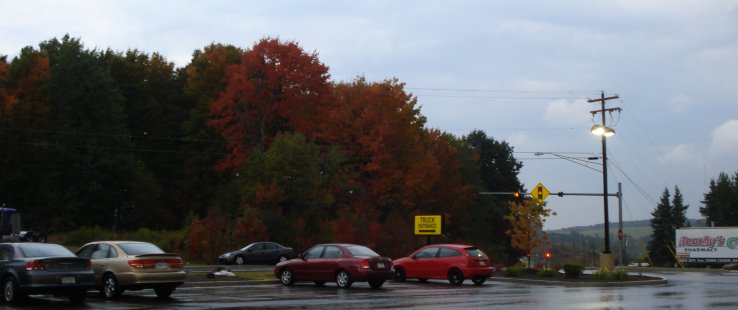
Pictures: the one on top shows turning leaves in Garrett County Maryland.  Fall comes early in the hills and seems to be coming early this year. 

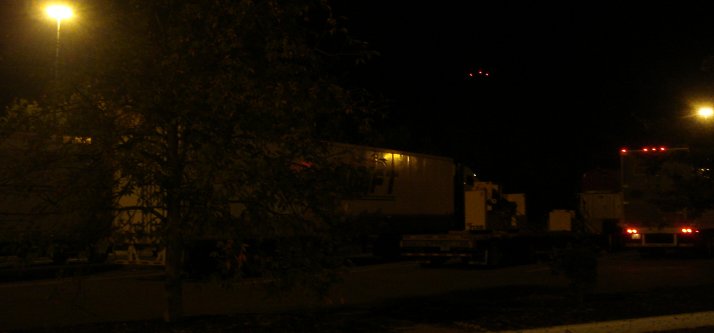
Above is a rest stop in Ohio.  It is nice to have a rest stop.  Many in Virginia have been sold because of budget cuts. 

We’re Cooked

I went to a discussion of the costs of cap & trade. There were experts from Brookings, CBO, EPA, Energy Information Agency, the National Black Chamber of Commerce & Heritage Foundation, so we got the full spectrum of analysis.  Lots of the assumptions were different and the ideology was contrasting, but they all came up with the same ballpark conclusions: cap & trade as it is now formulated in the House bill will cost a lot and probably will not work very well to control climate change.

As I have written many times before, I favor a broad carbon tax, which is why I could never run for office.   I support cap & trade BECAUSE it is a type of carbon tax, albeit a less efficient and possibly corrupt way to do it, but it looks like there is enough inefficiency in corruption in the House bill to question it.

One flaw in the bill is that it includes almost nothing about nuclear power.  In the long run, we will need to go with renewable power.  In the medium run, there is no way to achieve the needed carbon reductions w/o nuclear power, which emits no greenhouse gas.  Many environmentalists stupidly reject nuclear power.    No form of power is w/o risks and costs, but if you believe that global warming is the existential threat some people say it is, doesn’t that almost certain risk of climate change trump the hypothetical risk of nuclear power?   Not one person has died in the whole history of nuclear power in the U.S.  Nobody was even seriously injured in the worst “disaster” in nuclear power history at Three Mile Island.

But a probably more serious problem is the phenomenal growth of emissions from developing countries such as China or India.  China is the world’s leading emitter of CO2 and their emissions are growing rapidly.   China adds the equivalent of two 500 megawatt coal fired plants EVERY WEEK.  In one year it adds the equivalent of the whole British power network and by 2030 China alone could emit as much CO2 as the whole world does today. In other words, if everybody else cut to zero, it wouldn’t matter.

Talk is cheap, BTW.  China has promised to cut emissions relative to GDP.  That is good.  But the U.S. has been cutting emissions relative to GDP since 1973 and in 2006, the U.S. was the only nation to cut emissions in absolute numbers during a time of economic growth. 

So my conclusion is that we are cooked.  We should think about adaptations to a warmer world.   And we should be working on alternatives AND building nuclear power stations.  Congress should go back to work and enact a true carbon tax that would get the government out of the business of picking winning and losing companies and technologies. Government has an abysmal record in doing this (consider the recent debacle re ethanol) and there is no reason to believe it has gotten any better. The current bill doesn’t inspire confidence. I like the idea of markets for environmental services in general. I was tentatively in favor of the climate bill. It has some good aspects, but it needs smarter leadership and some hard thinking.

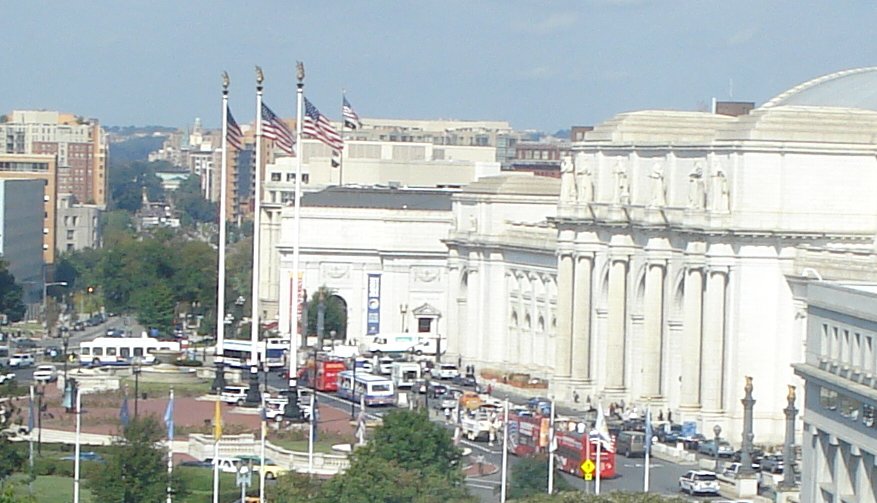
BTW – the picture is Union Station from the window of Heritage Foundation, where the panel was held. 

Drop the Donut, Fatboy

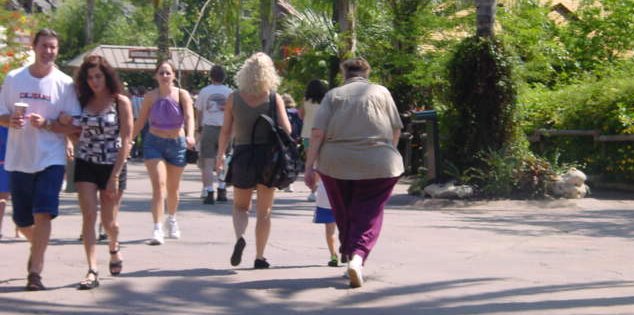
Much of the growth in health care costs comes from lifestyle choices.   Being fat, not exercising, smoking, drinking too much taking drugs and lots of other choices make people sick or sicker.  The debate is whether or not lifestyle should affect health premiums. 

You get a familiar breakdown.  Believers in individual responsibility say that people should try harder.  Just say no to the donuts and yes to the walk.   Others respond that it is not their fault.  That some people cannot afford to eat right or don’t have the time to exercise. (IMO, if you can afford to be fat, you can afford not to be, since it tends to cost less not to eat as much.)

Let’s stipulate that we are not talking perfection.   Few people can be in top-shape for extended periods, even if we could define what top-shape means.  But most people can indeed eat reasonably well and exercise moderately.  If we could just bring the rate of obesity down to 1980 levels, we would be a lot better off.  This is not perfection.  It should be attainable by all or most.   It is also true that no matter what you do sometimes you will get sick, maybe seriously sick.  We need protection from that. Reasonable.

Another stipulation is that I hate the use of the passive voice in health care and the language of victimization.  When I hear someone say that he wasn’t “offered the opportunity” of a good lifestyle or – worse – when they say “it’s is not my fault” or “I was denied the chance,” I know I am talking to a loser.   

That is my prejudice.   Not everyone can be perfect but everyone can change their lifestyles to improve. 

So let’s strip down the debate.   We don’t have the personal responsibility crowd v the caring people.  What we really have is the incentive folks v the determinists.  If you believe that incentives can change behaviors, you tend to fall on the side of responsibility.  If you believe that large forces determine your behavior, you are a determinist.

A false moral argument is that we need to take care of each other and help to the “least fortunate among us” (another phrase I dislike). This argument is usually made with a cry in the voice and it is meant to stop debate. Don’t let it. It is not really wrong, but it is incomplete.

I think we DO indeed have responsibilities to each other, but it should not be unconditional.  If you fall through the ice on a frozen lake, I should help pull you out.  But you should have shown reasonable care in not getting out on that lake and risking both our lives, and if you fall through too much, maybe we should let you make an ice cube of yourself.  We have a duty to help the sick and downtrodden, but if the sick and downtrodden have fallen into that position because of their foreseeable bad behavior, THEY have let down the team.  A person who becomes sick because of something like drug abuse, obesity or heavy smoking is probably more a perpetrator than a victim since he demands resources that could be used in better ways but for his misbehavior.

It is clear to me that big forces do determine many general directions.   But within those big directions, we have a lot of choice and we can and do respond to incentives.   Sometimes you have to “blame the victim” because the victim consistently puts himself in positions or places were bad things happen.  We do have to be judgmental and have the duty to stigmatize bad behavior and reward good behavior.  It does nobody any good to pretend that the obese person is a victim of society or that his/her behavior will not increase the chances of premature death and higher health care costs.

So we should all do our parts.  As in a good team, we don’t demand everybody make equal contributions, but we do demand that everybody do what they can.   There is no virtue in letting yourself become a victim through indolence, ignorance or lack of discipline.  Those people are stealing from those who get sick because of true bad luck or forces beyond their control.  

Trimming the Tree

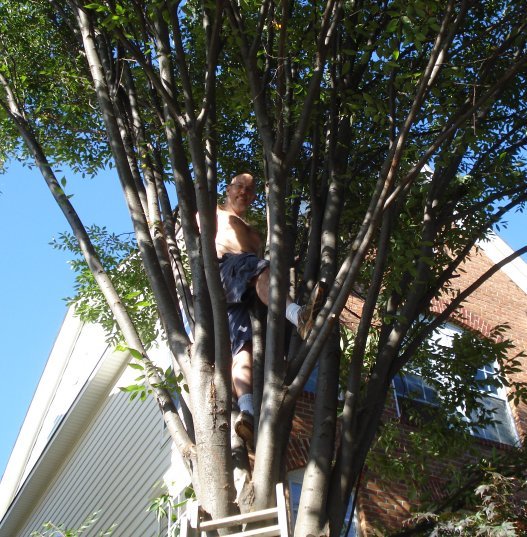
Chrissy & I trimmed the branches in our trees today.  One of our neighbors lent us a 12-foot ladder so I could climb into the tree and get at the internal branches that were crossing and rubbing onto each other. 

All the zelkova trees around here have a problem of crossing and interfering branches.  I think that the reason is the way they sell them from nurseries.   They trim them up nicely and encourage branching so that they look good at the date of sale.  That means they are fuller than they would otherwise be.   As they grow, the branches expand into each other’s space.  Now this one is taken care of.   Sarah, the woman next door is now very happy.  She was worried re the branches hitting her house.

I was surprised how much I cut out and how little it seemed to change the tree.  That is the sign of a good pruning.  If the tree still looks natural after the work is done, the work has been done well.  Although I probably should have waited another month to prune, I think it will work out.  We are having an early fall this year and the fall pruning should make it grow really fast next spring at the ends of the branches and it is too late for the sucker branches to grow now, so it will be okay.

I am getting too old to climb around in the branches.  Chrissy held the ladder and passed up the tools. I was glad to have her.  It always worried me that the ladder would fall when I was high in the branches or – worse – when I was standing on the ladder.  Now my only worry was that branches and sawdust would land on Chrissy.

We cut the branches up and loaded them into the truck – filled the whole bed. I am going down to the farm tomorrow and will dump them down there.  It is good to have a truck and good to have land. My plan is to drive really fast backwards and then slam on the breaks, releasing the branches onto the ground.  

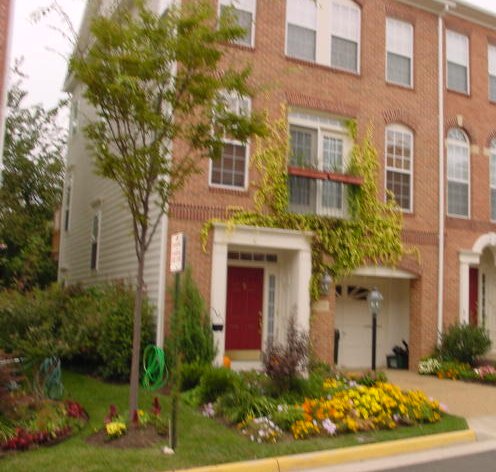
On the left is the same tree nine years ago.  I trimmed off the lower branches, but you can see the future branch tangle. 

Good Polish Friends

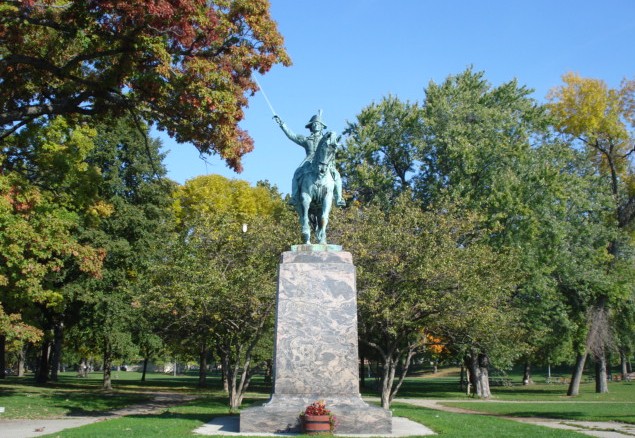
I think it is more important to stand with your proven friend than try to curry favor with adversaries who have shown little inclination to cooperate in the past.  America has few friends as steadfast as Poland.   Polish support for our country goes back before the revolution, when Kosciuszko and Pulaski came to fight along with George Washington just because they loved liberty.  

Yet Poland was devoured by its neighbors, Austria, Prussia and Russia, and it remained an imprisoned nation for 123 years.  Rebirth came in 1918, at the end of World War I, but it was not an easy time.  About two decades later, Nazi armies invaded Poland from the west and the Soviets stabbed them in the back from the east. This happened on September 17, 1939. Remember that date. 

Although Poland was conquered again devoured, partitioned by the two extremes of revolutionary socialism, Poles fought back.   The Nazis lost more troops invading Poland than they did conquering France in the next year and the Poles never gave up. Great heroes like Jan Karski and Jan Nowak-Jeziorański (I had the privilege of meeting both these heroes) warned Franklin Roosevelt about the holocaust and what the Nazis were doing in their conquered territories.  Although Poland was under the Nazi jackboot, Polish soldiers fought in all the allied armies.  Polish pilots were crucial during the Battle of Britain.  Poles served with Americans at Monte Casino and Arnhem.  They always took heavy casualties, fighting bravely and – frankly – being used more freely as cannon fodder. Had Polish soldiers been counted, they would have made up the fourth largest army in the Allied camp.

In September 1944, the Polish home army rose against the Nazi occupiers. Stalin halted his advance, hoping to allow the Nazis to kill off Polish patriots.  He thought it would slow him down for a couple of days.   The Poles held out for months. The Nazis completely destroyed Warsaw and murdered hundreds of thousands.  But the Red Army was halted on the Vistula long enough to lose the campaigning season. This had the unexpected effect of holding Stalin back, allowing American and British troops to advance to the Elbe. Had Stalin not slowed, he may have reached the Rhine, making the post war Soviet tyranny much more powerful and dangerous.

After World War II, Poland fell into the Soviet sphere and they suffered in that communist purgatory until 1989.   The iron curtain cracked in Poland. Solidarity pushed the communist to the wall and then the Poles elected a non-communist government. But they still didn’t feel secure in their new freedom. They wanted to have friends and allies. They became NATO allies in 1999 and proved their worth. Polish troops served in the Balkans and they fought and died along side us in Iraq.  They also agreed to support us with missile defense on their land. I suppose not everyone is as grateful to them as I am. Maybe some actually hold it against them.    It is a fault in our system that we sometimes identify America’s friends as connected with particular American leaders or their policies.

Remember that September 17, 1939 date? On September 17, 2009 we decided to pull out of an agreement to deploy missile defense in Poland.  

We made a big effort to help secure Central Europe. It was a success of both the Clinton and Bush administrations. Security is as often about perceptions as it is about capabilities. If an adversary believes the cost of aggression will be great and he refrains from aggression you win w/o spending the blood and treasure needed to fight the real war. 

We sometimes think the age of aggression is over. The Poles have a more tragic history than we do and they are not as certain as some of us might be. 

As I wrote at the beginning, it is better to stand with proven friends. You cannot make friend with everybody.  Some people and some regimes are just playing a zero sum game with us. If we give; they take and ask for more.  They are “satisfied” only when they reach the limits of what they can grab. If you give you can be asked to give again. It is not impossible to reach agreements or to live together in peace and mutual respect. But that respect must be mutual. One-way respect is just for chumps.

I recommend a good article by Ron Asmus, one of President Clinton’s smartest advisers in the Washington Post. 

America Still a Melting Pot

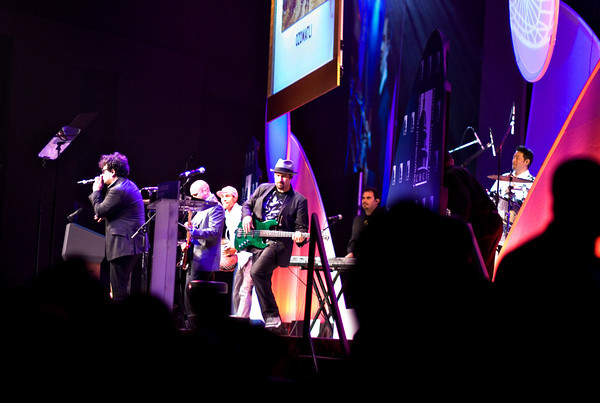
Tim Receveur got tickets for the Hispanic Caucus Awards Gala and shared one with me.  He got them from a band IIP works with called Ozomatli.  Tim has been one of their biggest supporters.  They are a multicultural band, which goes well with our programs and very easy to work with, which makes our PAOs overseas happier.  Their music was very good.

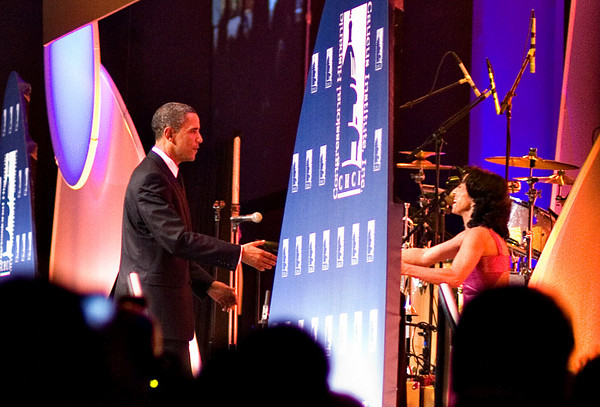
President Obama was there and gave a speech.  It was mostly about health care, but he added a Latino twist.  Evidently a significant number of the uninsured are Latinos, especially if “undocumented workers” are included.  The President’s speech didn’t go into much detail, but he did repeat “todos somos Americanos” on several occasions, which was a crowd pleaser.  

Unfortunately, he went the other way as he left the building, so I didn’t get to shake his hand.   I was figuring that a close encounter might cure the minor arthritis in my left knee, but no such luck.

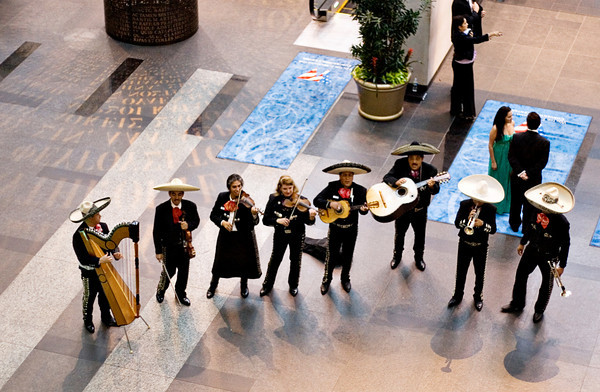
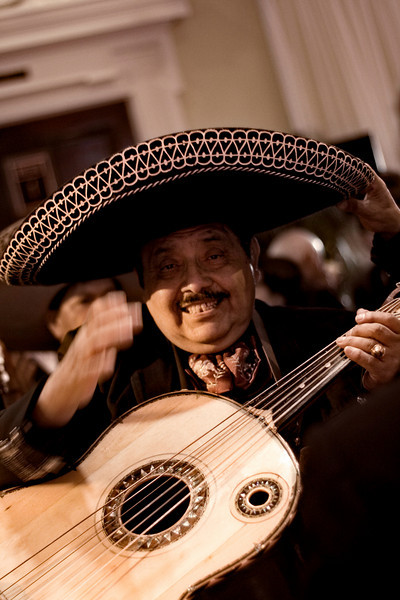
I had a good time, even if I didn’t get to meet the big man personally.  The night started off with a mariachi band.   I am fond of that music.   It has down-home sounds. The old man listened to a lot of country and western music and a lot of his cowboy music shared the southwest roots.   Marty Robbins, Gene Autry and the great Bob Wills all played on the familiar themes, often with Spanish speaking musicians or even lyrics.  Another familiar aspect was the recent immigrant vigor you could feel.   The American dream is still alive and people come from all around to take part in it.

Sonia Sotamayer was there, so were Marc Anthony and Jenifer Lopez. Soladad O’Brien won an award.  I always wondered re her unusual name combination.   Her mother is Cuban.  Her father is Irish-Australian.   In America they met and married.

What I noticed was a lot of old fashioned assimilation.   It is not fashionable to call our country a melting pot anymore, but it is nevertheless.  The crowd was a lot like I remember immigrant families from Poland or Italy in Milwaukee. The older people maintain their ties of the home country.   The younger people have a second-hand connection but a lot less real feeling for the place.  And when they marry out of the community, the children don’t think much at all about ethnicity.  The difference in the Hispanic community had been that immigration renewed the ties constantly. This may be changing now, as birth rates are dropping in Mexico and Central America.  

The process is best illustrated by a simple statistic.   It was repeated a couple of times that Hispanics are America’s largest ethnic group, with something like 47 million. This is not entirely accurate.   Germans are the largest ethnic group in the U.S. 58 million Americans claimed German ancestry on the 1990 census, which is the last time I think they asked the question. This is significant because it is NOT significant, i.e. nobody really cares.  Germans have enriched America with their cultural contributions (decent beer, kindergarten, hot dogs & sauerkraut) and their hard work, but they are so thoroughly American now that it passes completely w/o notice.  When I mention it, people roll their eyes and discount it. They say that it doesn’t really count and they are right.  It made a big difference in 1909.  Who cares today?  The same will happen with Hispanics. At some point they may indeed become a quarter of the U.S. population, as the Germans were 100 years ago.  But nobody will really pay attention by the time that happens. This is America. Todos somos Americanos.  That is how we roll.

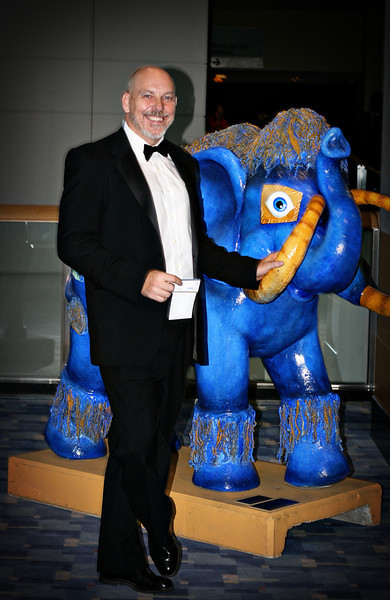
Anyway, it was an interesting event.   Everybody had to wear tuxedos.   This made for an elegant evening, but it presented an unexpected problem.    When everybody has a black tuxedo, you cannot tell who is the waiter.   When people come around with plates of food, you might just be stealing somebody’s snacks.

BTW – Tim’s wife April took the pictures, if you notice the better quality.  She does this professionally.  You can find her other work at this link.