
Public Diplomacy Not Broken … So Can’t be Fixed

I attended another of those meetings on public diplomacy where earnest colleagues talk about what we can do to improve, reform or fix public diplomacy. I am not saying that we should not be seeking always to improve, but I have been hearing this same story ever since I started paying attention to such things more than a quarter century ago and I think it has been going on a lot longer than that.  When Ben Franklin returned from Paris, some people gave him a hard time about his activities there and complained that we just were not making the impact we should.   The pattern is that we decry the present or the recent past and then say how we have hope for the future.   I don’t think we can succeed in fixing the problem because it is not a problem that can be solved.  It is an ongoing situation that will never end until we are gone, all gone – in that eternal sense. That which cannot be changed must be welcomed.

Maybe we cannot fix public diplomacy any more than we can fix the need to eat.  It is just an endless need.  If we eat a big meal today, being hungry again tomorrow does not indicate a failure or eating or the need to reform our consumption methods.  

We often assume if we just explained better or understood our fellow man better, things would be okay.  Experience does not bear this out.  In most of history’s truly monumental conflicts, the warring sides understood each other only too well.  It was not a failure to communicate that got Xerxes in trouble with the Spartans at Thermopylae.  Ghengis Khan was fairly clear about what he wanted but it was not easy to find a mutually agreeable compromise with him.You can have some real conflicts of interests and real differences that do not represent a failure to communicate.   IMO, very often the more you talk about differences, the sharper they become.    Maybe simply ignoring them or kicking the can down the road is the solution, more on that below.  But let’s think about agreement first.

Agreeing about Most Things is Easy

First the good news.  The world is not a zero sum game.   We can get a lot when we work together and cooperate.  We agree MOST of the time and when we agree there are no controversies and not much scope for politics, persuasion or public diplomacy.    We have all kinds of non-controversial agreements.   On the local level, most of us agree to stop at red lights.  Although we have to persuade the occasional miscreant that the law applies to him too, there is no real controversy.   We have long standing agreements about very important things like telecommunications, navigation, air traffic control and postal services.   I can send a letter anyplace in the world because all of us agree that is a good thing.   

These agreements require constant maintenance, but it is more or less like painting your house or keeping your car tuned up – very little drama.  They work in the background, very much like whatever software is running your computer as you read this, and we rarely think about them.

Politics, diplomacy and violence are reserved for the places where we don’t easily agree.  It should come as no surprise that this relatively small subset of our activities gets most of our attention nor should we be too distressed that we constantly face new problems of this sort.   On those occasions when we succeed in solving one of these problems, it moves into the category in the earlier paragraph and we no longer pay any attention.  It is sort of like when you always find your keys in the last place you look and then you stop looking.  Human nature being what it is, after a problem is solved most people come to think that it was never really much of a problem in the first place and that it would have taken care of itself anyway.  Even really massive changes, such as the fall of the Berlin Wall, start to look inevitable and easy as events recede into history.


Not Everybody is Nice

We are left with new problems and since yesterday’s solution is often today’s problem, we are also left with the impression that we are not making any progress.   In fact, we are NOT making progress because there is not end-state toward which we can progress.  I am not big on sports analogies, but one leaps to mind.   The Red Sox can never win an ultimate victory over the Yankees.    The Packers will never finally dispatch the Vikings.   A new season follows and the cycle never ends. Even if the players change, the general geography remains and familiar patterns persist.  All this doesn’t mean you can do nothing or you should be complacent unless – to stretch my sports analogy – you want to become the Chicago Cubs of world politics.   In fact, eternal vigilance is indeed the price of liberty.   And it is possible to have victories and good seasons.   We are not the victims of fate or mere random chance.  There just is no way out of the game until you are physically removed … and then it continues w/o you. 

To sum up, most of us CAN agree with others on MOST things. Those things you cannot agree about become the property of persuasion, politics, coercion and violence. They are problems by definition. It is best to keep as much as possible away from the politics, coercion and violence, but it is not always possible.  Of course peaceful, respectful persuasion is the best, if you can get it, but you can usually get it only in situations that are not the most severe and the others are always lurking in the background.   Just because you reject violence doesn’t mean it has been removed from the equation. Unfortunately, politics can be easier than working to create a solution, coercion is a very potent persuader and violence a very compelling public affairs message.

Sometimes it goes away if you ignore it

I once foiled a robbery attempt in the bookstore where I worked in Madison by not getting it.   A couple guys came in and hung around near the cash register.  When I asked them what they wanted, they said they wanted all the money in the register.  They didn’t brandish any weapons and they didn’t seem especially tough, so I just laughed at them and told them to beat it.   They went away.  I thought it was a joke until I saw on the news that police were seeking a couple of young men who had robbed a store down the street.  

I would like to put in a plug for avoidance & denial, when possible.  Don’t go looking for trouble.  Call it pluralism if you like.   I simply mean that we don’t have to agree on everything and there can be a wide sphere where people can do different, ostensibly contradictory things.  We should constantly seek to expand the areas where we can say, “I don’t like what you are doing, but I just don’t care enough to do anything about it” or better yet, “It is just none of my business.”  This can flow from, “I don’t know very much about what you are doing, but it doesn’t seem to be a problem for me” or “I don’t care what you do, as long as you stay over there.”   We don’t have to resolve all our differences if we can create environments where most differences don’t matter.    I understand that the attitude I describe will probably not make you famous and will make some people think you just are not paying attention but it makes most people happier and often works better than the more active and aggressive alternatives.   I am not advocating that we actually BE ignorant, as I was in my robbery example above.  I do advocate that we have enough self-awareness and humility to know that we cannot understand everything and may well be wrong in our judgments.  We don’t have to drill down and solve every problem.  I really don’t think the trouble is that the world hears too LITTLE from and about the U.S. 

Engaging is Easy

The latest buzzword for public diplomacy is engagement.   I like engagement.  It can be fun and you can learn a lot.   But it is not a panacea and it can be overdone if you start invading the pluralism “don’t know; don’t care” turf mentioned above.   Remember what Aristotle said about anger?   It applies to engagement too, so let me paraphrase.   Anybody can be engaged – that is easy, but to be engaged with the right people and to the right degree and at the right time and for the right purpose, and in the right way – that is not within everybody’s power and is not easy.
Wood in the Ecological Value Chain

This is the draft of an article I wrote for the next issue of “Virginia Forests.”  It is substantially based on a post I did a couple months ago, so regular readers might get a feeling of déjà vu. IMO, this one is somewhat improved and the editors will improve it even more.

Wood in the Ecological Value Chain

A chain is only as good as its weakest link, as the old saying goes, and you have to look at the whole chain from start to finish.  This is true in any business and it is even more crucial when talking about something’s impact on the environmental affairs.  Some products may look very green when you look at the finished product, but are not so environmentally friendly when you consider where they are coming from or where they are going, in other words when you look at the whole environmental value chain. 

Tree farmers can take satisfaction from knowing that wood is the most environmentally friendly building or structural product available when you look at the ecological value chain from start to finish.  

Start at the beginning.   Growing trees is an environmental friendly thing to do.   A growing forest removes pollution from the air, sequesters CO2, keeps water clean, provides wildlife habitat and makes the world more beautiful.  Think of the forest as the factory where wood is made.  Is there any more beautiful factory than the one on our timber lands?  The raw materials to make plastic, concrete or metal must be pulled from the earth and processed in noisy, dirty and energy intensive factories.  Wood is good.  

It is true that harvesting of trees requires the use of fuels, which will emit CO2 and may result in particulate pollution released into the air, and even the most well-managed forest harvests will impact local water quality to some extent.   These are serious issues, but they can be minimized and serious Virginia loggers are very careful to tread lightly in the woods.   Beyond that, these activities occur only once in many decades on any particular piece of ground and are much more than compensated by the many years of beneficial growth in between harvests. If you look over a thirty-five or forty year pine rotation, it is clear that the net environmental benefits of producing wood are overwhelming.

If you compare forestry to almost any other land use, forestry wins out as the most sustainable and environmentally friendly activity. No other ecosystem better protects and enhances soil and water.  Water that flows through a forest usually comes out cleaner than it went in.   Compared to the land use for other products, the difference is so extreme that we might actually miss it.   Twenty years after operations are completed, a mine, quarry or oil well is still only a hole in the ground unless costly reconstruction has been done.

Twenty years after a harvest a forest is … again a forest with young trees growing robustly.  

This renewal is what always impresses me when I interview the Virginia Tree Farmers of the Year. These guys have usually been in the business for many years and they have pictures from many years past.  I am astonished to see the old pictures and hearing about the changes.   I recall standing in a mature pine forest in Greenville County and talking to Mike Jones (2007 Tree Farmer of the Year) about his land.   He showed me an old photo of his grandfather standing in the “same” grove of trees where we stood as we talked.   But these were not the same trees.    This land had been harvested TWICE since the old man stood proudly among his pines.   His grandson could stand among his pines and future generations would still have the chance to stand among their pines.   That is what renewable means. Wood is completely renewable and renewable is even better than recyclable.

Let’s complete the ecological value chain.  We have seen that wood is ecologically good in its production, sustainable in its harvest and completely renewable, but what happens after you are done with a piece of wood?  We like to think our houses will last forever, but they won’t.  Wood may be with us for centuries but when its usefulness to us is done it is easily disposed of or cycled back into the natural world.   It can be burned as fuel.  It releases CO2 at that time, but this is the same CO2 recently absorbed.    That is why burning wood is recognized as carbon neutral.  If thrown away, wood decays.  It doesn’t take long before yesterday’s wood is fertilizer for tomorrow’s growing trees.  This again is in striking contrast to other materials. Steel can be recycled at a high energy cost.   If thrown away, it will rust away after many years. Concrete also can be recycled with much effort.  If you dump it, it will lay until the next ice age. Plastic is the most persistent product.  Some plastics will remain in the environment almost forever.   Recycling is a good when possible, but it really only postpones the problem. The plastic water bottle may be turned into a carpet or a computer keyboard, but eventually it will end up in a landfill where it will stay … forever. 

We need to use all sorts of materials: metal, plastic, glass, stone, concrete, various composites and wood.   They are all appropriate for some uses.   When you look at the total ecological value chain, wood deserves to come out on top in many cases.  Our Virginia tree farms can grow wood, sustainable, now and forever.   That beats the alternatives most of the time. 

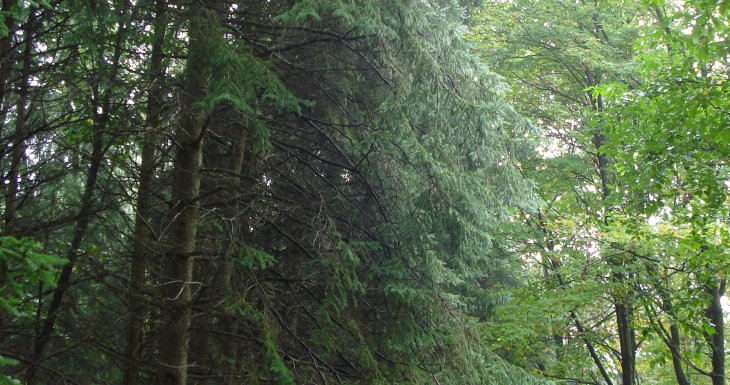
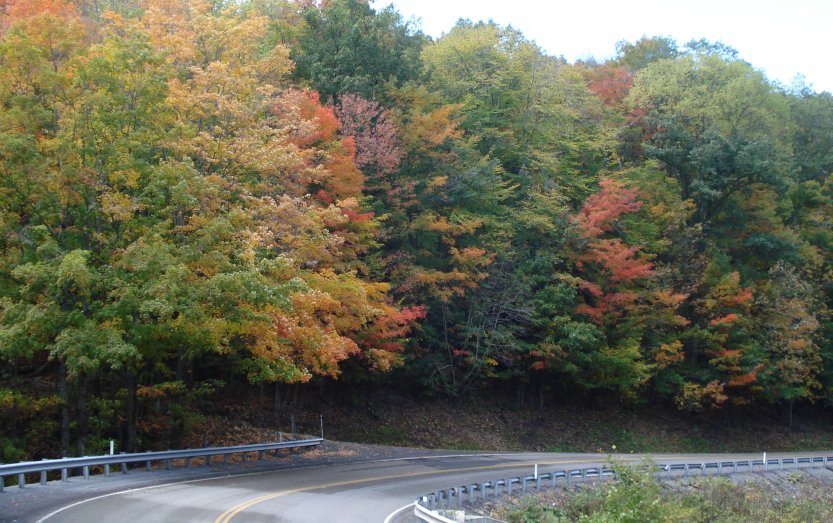
The top picture is a spruce plantation in the kettle-moraines in Wisconsin. The bottom picture shows turning leaves along US 50 in West Virginia.

What is Art?

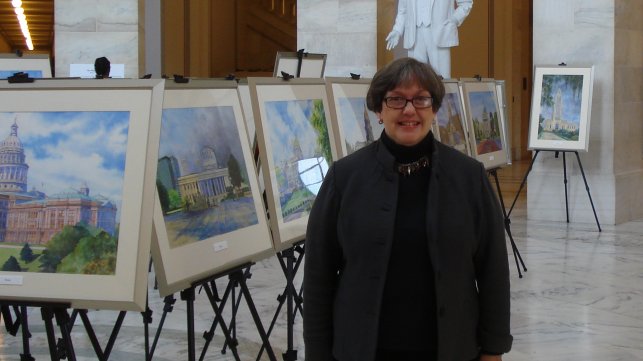
I saw an exhibit of state capitol buildings.  The artist, a woman called Susan Cassidy Wilhoit, shown in the picture, went around the country and painted all fifty of them.   I told her that the journey around the U.S. to all the states to paint the pictures would be a great story in itself.  I like representational art with a story.

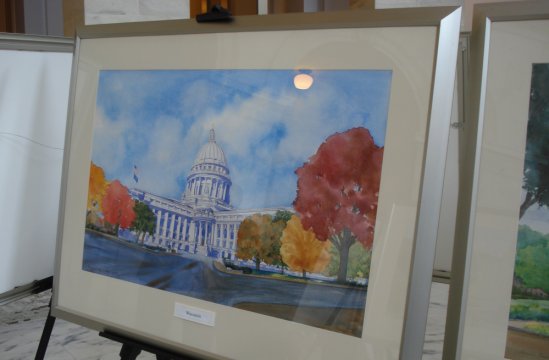
Most of the capitols look a lot alike.   Classical domes – more or less resembling the national capitol – are most popular, but there is a significant share of non-descript tall office buildings.   North Dakota & Nebraska have particularly drab capitols.   That is Nebraska’s against the far war, BTW.  In fact, I wonder if those buildings even deserve the name capitol, which implies a more august building. Below is Wisconsin’s capitol.

I suppose some people would decry the lack of imagination among legislatures.   I don’t.  When you got a good thing, stick with it.  Most “innovative” architecture sucks, especially when a government is paying the bills and the architects can run wild with the public purse.  Left unchecked, they often indulge their idiosyncratic proclivities and pursue novelty w/o value.  It gets to be like the “Emperor’s New Clothes.”   Few people like those awful buildings, but who wants to say so out loud and appear to be a philistine in front of the cool sophisticates?   

Most great art and great architecture derives from the tension between artists trying push the limits to express their own particular vision and someone paying the bills and mitigating the creative but selfish impulses of the visionary, which, IMO, is why artists work better when they have to satisfy patrons, markets or somebody else in general.  Give an artist a no-strings-attached grant and they fall off the deep end of autoerotic peculiarity.   

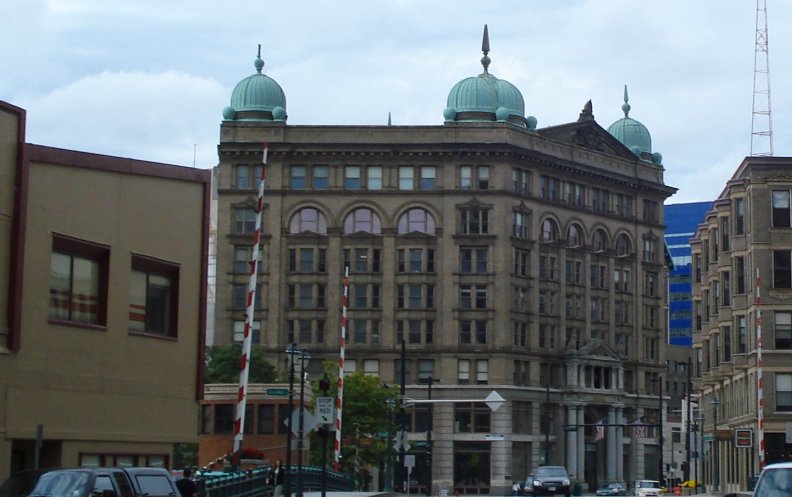
Above is the Germania Building in Milwaukee, built in 1898. This is interesting, although not unique, architecture. The domes look like Kaiser helmets and my mother told me that there was some gnashing of teeth about that during WWI.  The vagaries of memory are funny.  When I looked at this building last week it stimulated a previously buried memory from when I was eleven years old.  My mother used to take me downtown to visit a Dr Rath.  He was bone specialist who looked after me after I broke my leg. His job was to make sure my legs stayed more or less the same length and he succeeded. I would get to take a day off from school and my mother would take me around downtown after the appointment.  Of course, she didn’t have any more personal memory of the WWI history of the Germania building than I do, and I cannot find confirmation on the Internet, but I think it is true. 

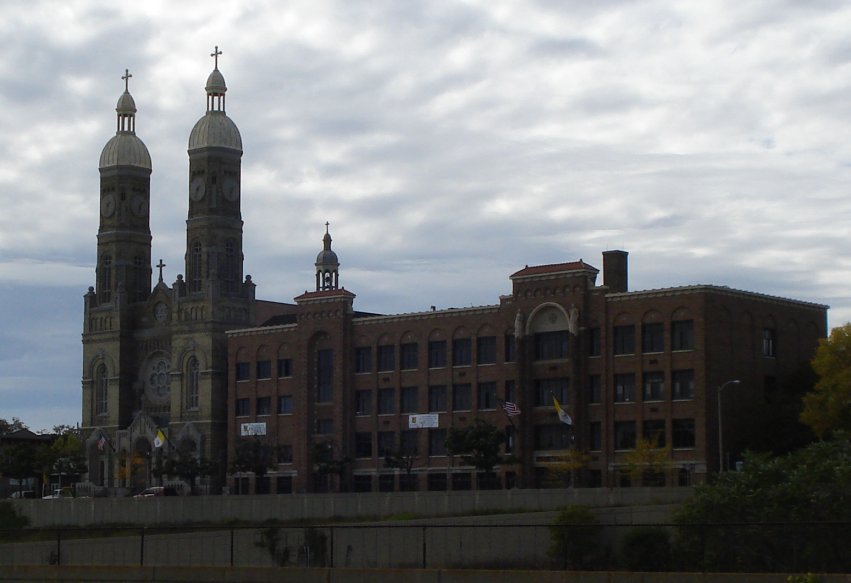
Another example of derivative but beautiful architecture is St. Stanislaw Church below.  

Blue Highways

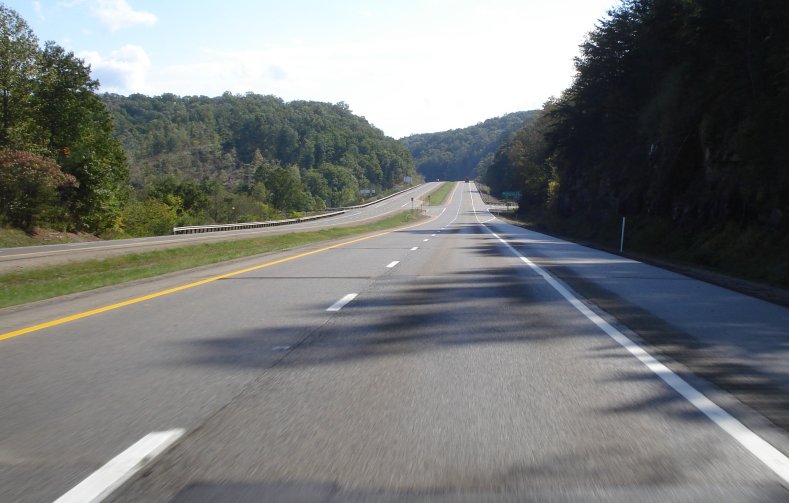
I took US 50 through southern Ohio and West Virginia. You get a different impression of the geography from the older highway system.  The Interstate System flattens the hills, straightens the curves and bypasses the towns.  The older highways pass through the older America. The Interstates have drained both the traffic and the vitality from the highways, especially when they run parallel, as US 50 does to I-70 and I-68. 

US 50 was very peaceful through Ohio and I often had the whole road to myself, so I enjoyed driving leisurely past the farms and small towns. The land looked very lush and green. US 50 is mostly single lane, but it turns into a divided highway part of the way and it gets to be essentially a superhighway in parts of West Virginia.   West Virginia is a unique case.  Senator Robert Byrd got to be so powerful that he could direct an unusually large amount of Federal dollars to the Mountain State.

There are lots of really nice, empty highways connecting little towns in West virginia. Lots of the off ramps lead to a couple of houses or sometimes to almost nothing at all.  US 50 from Parkersburg to Clarksburg is probably the loneliest stretch to fantastically built highway in America.  It must have cost a million dollars per car, our tax dollars at work. There is an even more impressive highway to nowhere a few miles south, the so called Highway 55 corridor.You can drive from Wardensville to Moorefield and on to Seneca Rocks in complete comfort and near perfect isolation. Maybe we should move that modern perfect highway to Chicago, where the roads weren’t so good.

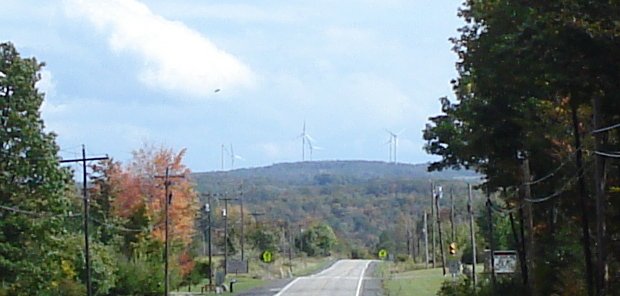
I stayed on 50 after Clarksburg, which was a mistake because it becomes a truly local road. This is some of the roughest geography in North America.  The folded mountains make road building a challenge. Even Robert Byrd didn’t try to make this a superhighway. It is very pretty, very steep and very curvy. And there was an amazing amount of road construction and repair to slow what traffic there was.   All things considered, I am still glad I went this way, but it probably added a couple hours to my journey.   I got to see lots of nice vistas and even the Allegheny front windmill farm.

You Can be a Victim of Public Policy or an Engaged Player in the System

Our Virginia Tree Farm delegation met with staff members from the offices of Jerry Connolly (my congressman), Mark Warner, Jim Webb & Eric Cantor.  The ATFS convention was held in Washington this year and they wanted to take advantage of the presence of hundreds of tree farmers in the capital (how exciting!).  We had tree farmers from most states in our nation’s capital. I suppose our meeting with only staffers shows our relative lack of political clout.  Tree farmers are not a feared interest group. Two actual members took the time to meet with us personally: Robert Wittman & Robert Goodlatte. I was impressed with both, and not only because they were nice enough to talk with us.  

All politicians are charming.  That is how they get and keep their jobs.  In addition, however, these guys really seemed to understand forestry issues and were genuinely interested in protecting the environment. I suppose that is one reason they talked to us. I think it may also be because they both come from rural districts, where get some real experience with agriculture, forestry and hunting.  They were really on top of some of our esoteric issues, such as the use of woody biomass in energy and biosolids applied to the land.

And we are interested in some esoteric issues.  For example, forestry prefers a broad definition of biomass to include woody biomass. The woody biomass we are talking about, BTW, is mostly the branches, bark and odd pieces left after forest harvests.  Biomass is already used to fuel mills that make paper or process wood, but more could be done. The advantage of woody biomass is that it is produced widely and could be used in small plants.  This is also a disadvantage. It tends to be locally available and heavy to move. 

This is a bigger issue than it seems for the Federal government, because government picks winners and losers in the energy market.  Other sources of alternative energy get privileged by government money and programs.  Woody biomass makes a lot of sense for Virginia and the Southeast, where there are lots of forests and would be used more widely if other forms of energy didn’t get direct and indirect government favors and subsidies and/or if the government “help” was applied evenly.  Anyway, that was one of the things I explained.  I also emphasized that forestry in Virginia is sustainable, now and forever.   That is simple and true, but it must be repeated.

Most of the real work of the Congress is done by very young staffers and those are the kinds of people we met.  They are really smart, but I worry about their lack of experience.  Maybe ferocious intelligence coupled with lack of experience can actually be a disadvantage.  I don’t know.  They seem to do okay. They need the energy of youth to cope with their daunting schedule. You only have a short time to make your point and then get out.   It seems like a superficial way to get constituent input.   Of course, Otto von Bismarck warned that you should never watch either laws or sausage being made.

We also met the famous Joe Wilson. One of our colleagues used to rent a house from Joe Wilson in South Carolina so when we passed him in the hall, he stopped to talk.  It was a short meeting and I didn’t ask about the Obama comment.  He seemed a nice guy.  But, as I wrote above, all politicians are charming in person.  

IMO, politicians don’t get the credit they deserve. Most are smart and motivated – at least initially – by the desire to do good.  And it is a hard job, maybe a job that has grown too big as the reach of government has expanded into parts of our daily lives where it may not belong. Too many people come around asking too many things.  And if others come, you have to be there too. Even if you don’t want to ask anything directly from government, you have to have lobbyists to protect yourself from what others who have lobbyists asking government to do that impact you. 

One consultant told us that we could be either, “victims of public policy or engaged players in the system.”  He implied there was no third option.  Pity. A citizen is free to the extent that he can safely ignore politics.  That sphere is shrinking.

I don’t know when politicians really have time to think, what with all the tight schedules and need to posture for the media. The wealth of activity has created a poverty of attention.  When good people don’t have time to do a good job, maybe the system is overloaded, overextended and overreaching.  If you can’t do more well, maybe it is best to choose to do less better and expand that sphere where citizens can ignore politics.  But thinking that could happen is probably the triumph of hope over experience. 

Anyway, we played our part.  We “deployed our talking points,” so now everybody in Congress understands forestry, supports all our legitimate positions and will do the right things.  But I wouldn’t like to be a full-time lobbyist.  I couldn’t take the constant shallow dives.  I enjoyed the experience of doing it for one day. That is enough. The Constitution gives me the right to petition my government, but I don’t much like the drive by fashion such petitioning has acquired.

Milwaukee Renaissance

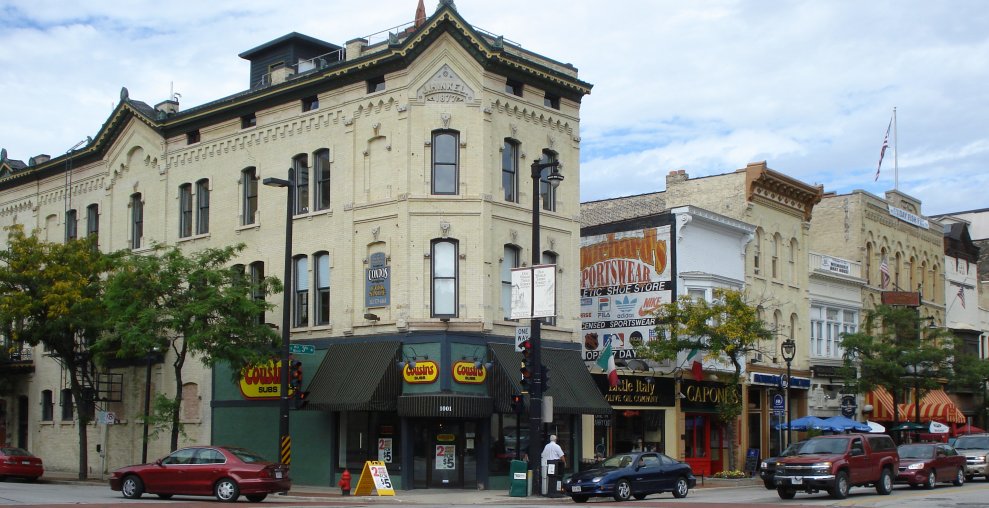
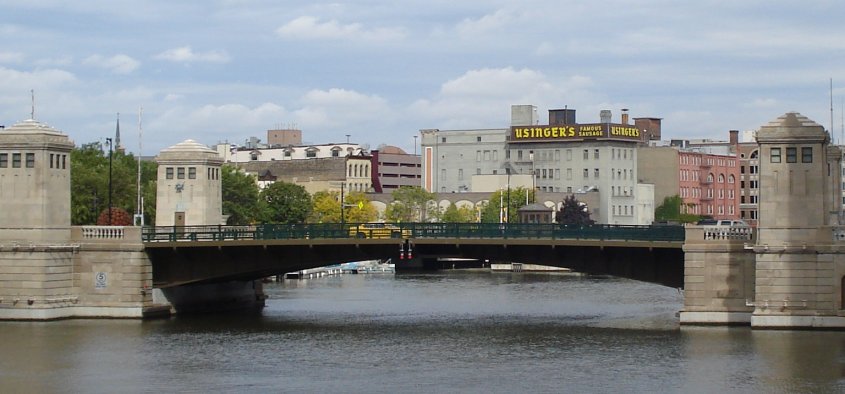
Chrissy & I went up to North 3rd Street.  This was the German part of the city and it still has some German restaurants and Usinger is still there making the world’s best liverwurst and second best (after Clements) bratwurst.  Despite that, we had lunch as Cousins Subs, which is another of my Milwaukee favorites.

Cousins is in an old building that used to be a glove and hat shop.   They even had fireproof gloves.  I think they were made with asbestos fiber, in the days when asbestos was not known to be so dangerous.   Their slogan was something like “Gloves to burn, and some that don’t.” 

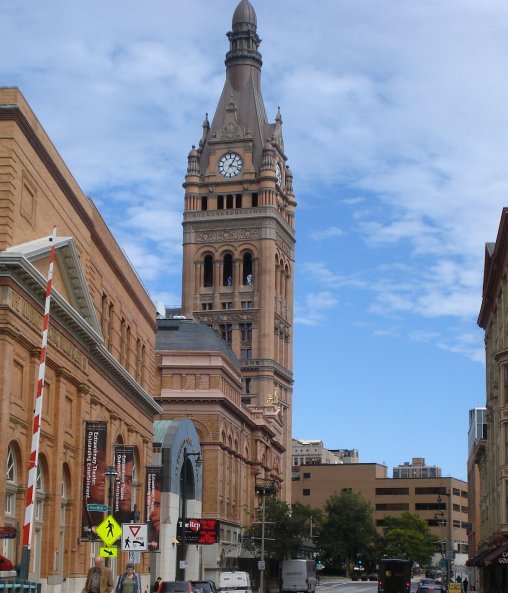
You can see the City Hall building on left

The area just north of the river is nice and clean.  I remember when the the industrial sewage stench coming off the river mixed with the yeast stink from the breweries, the pungent fragrance of the tanneries and the sweeter aroma from Ambrosia Chocolate Factory. The Cream City Brick used to be black from the coal smoke.  I actually thought the bricks were naturally black, but most of Milwaukee is built with tan colored bricks, as has now been revealed.  Everything is different now.  The area no longer stinks and it is clean & fresh because all the industry is gone.   The knowledge of what was and is now is no more drains some of the celebration.   The new and improved surroundings are sterile in a couple senses of the word.

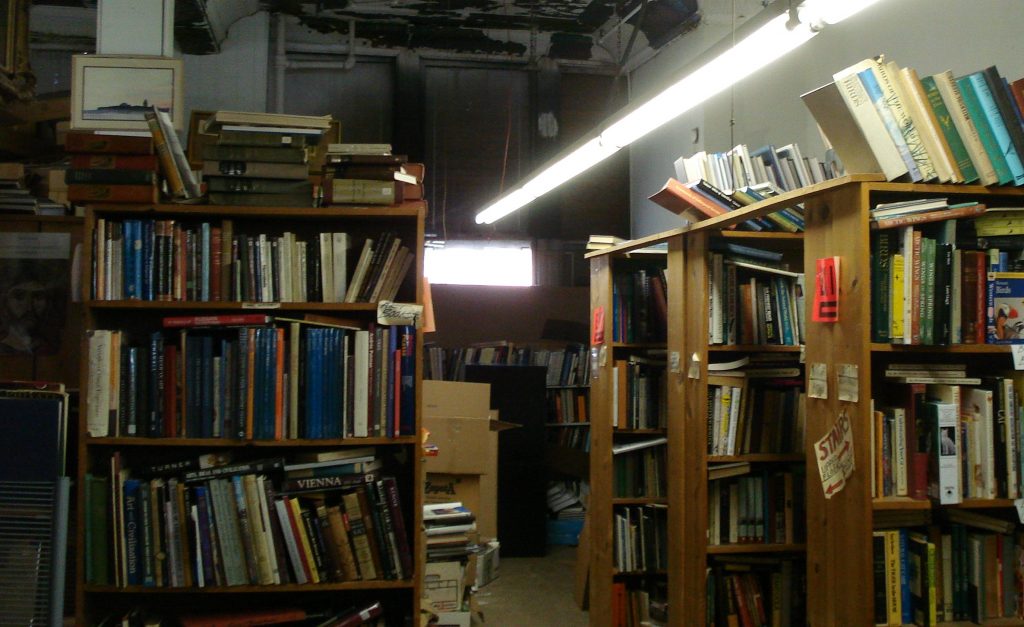
I was surprised that the Renaissance Book Shop was still in business.  It is a three story warehouse full of used books.  This is the kind of shop I used to love, but now the Internet has largely supplanted such places. Going into it today is like a magical mystery tour, but not something I really want to do often anymore.  It is fascinating to look at the piles of knowledge.   I was looking for a specific book, “The Epic of Man,” a book I had as a kid.  It takes mankind from the Stone Age through the early civilizations.  And I found it in a pile of books on the third floor.  It is not a great book, but I liked the pictures and wanted to get it out of a sense of nostalgia.  As l looked through the book that I have not seen for at least thirty years, I realized how many of my historical impressions were triggered by the pictures.   It really is true that first impressions are important.

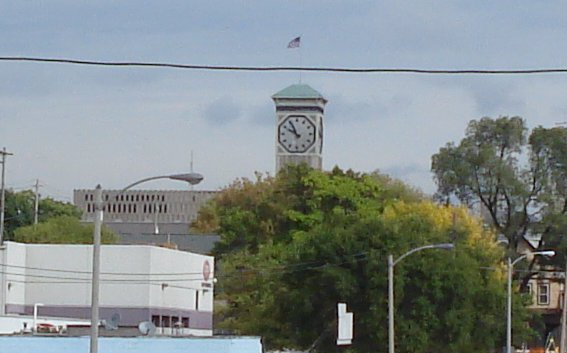
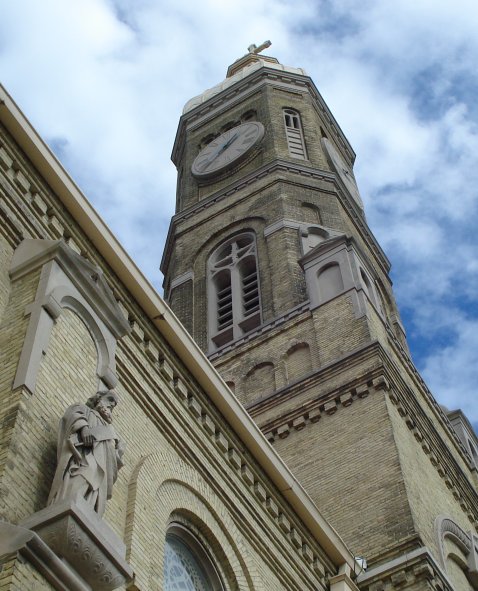
On the way back we stopped to look at the old man’s childhood home.  It used to be the third house from the corner and it used to be in the middle of a neighborhood of similar houses. (It is on 4th St, but my father’s dog-tags say “Port” St.  The old man evidently didn’t speak with a clear and crisp accent.)  Since his time, they widened the road at the side, knocking down two houses, and built the freeway across the street, so it is really different.  St Stanislaw, where my father went to school and his family went to church, is not just across the freeway in easy view.   The neighborhood is now dominated by a view of St Stan’s and the Allen Bradley clock.

There used to be a natatorium nearby, but they are gone, no longer needed.  In the old days, many of the houses didn’t have showers or baths.  Natatoriums were public bathhouses, with showers and a pool.   Men and women had them on alternate days, but men always got Saturdays and they were closed on Sundays.  They were still around when I was a kid.  We used to go swimming at the natatorium on 10th and Hayes.  Old guys would still come in just to use the showers.  Now it is closed down and the building is torn down.  All the houses in Milwaukee now have bathtubs and showers.

Things have changed.

On the left is St Stanislaw Church.

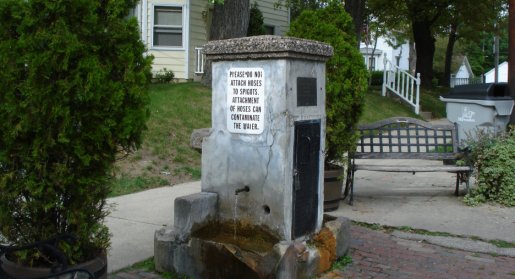
Another relic of old Milwaukee is the iron water spring on Pryor Ave.  Some people think it is healthier and old people come to fill gallon jugs with the water.  The funny thing is that it is always old people doing it.  It was old people doing it when I was a kid and it is old people doing it now. Presumably, the old people of yore have shuffled off this mortal coil and they must have been replaced by others.  Is there some minimum age when you start to like this kind of thing?   Or maybe the water really does work and the old folks who drink it just live forever.  The water tastes like rust and it is always icy cold.  I always take a drink when I go by, but I don’t think I would want to slook too much of it.  Below is the water.

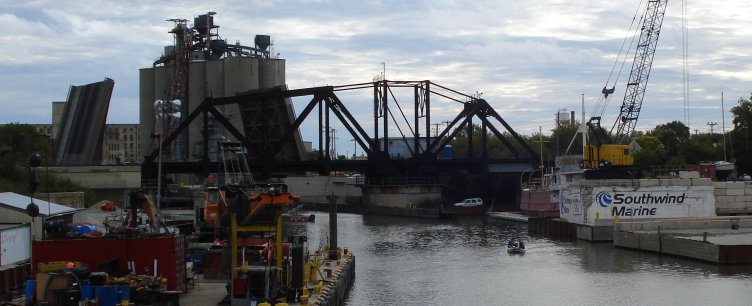
Below is Kinnikinnick River looking from 2nd St.  In the distance is Medusa Cement where my father worked for thirty-six years and where I worked for four summers.

Indian Mounds

I first saw Indian mounds when I was in 4th grade.  We went up to Lizard Mound State Park on field trip.  It scared me for days.  They had one mound opened and inside was a skeleton mounded up.  In my childish way, I figured that skeleton would follow me since I desecrated the mound by looking at it.   A lot of movies have a plot sort of like that.   I think that is the basic premise of “Poltergeists”

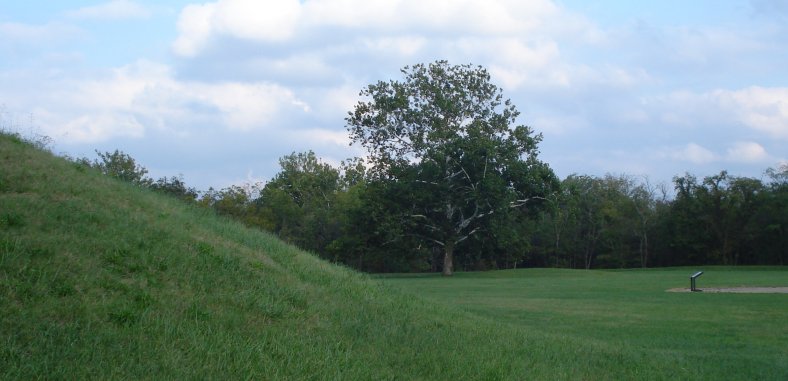
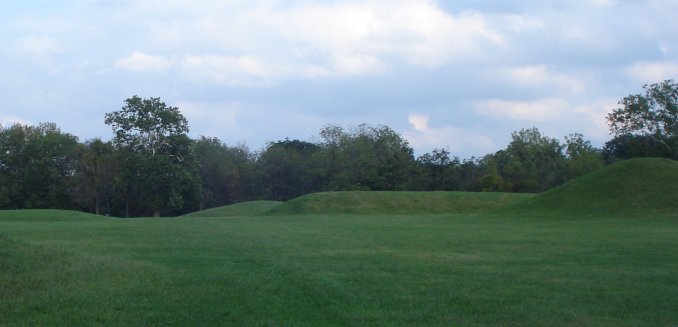
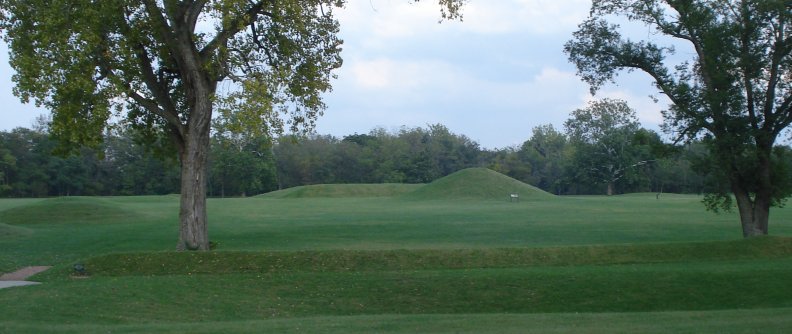
Now the mounds are no longer scary, just interesting, which is why I went to visit the Hopewell Mounds near Chillicothe, Ohio.   There was a whole mound building culture about 1500 years ago.   The mounds in Ohio were loosely affiliated with those in Wisconsin in that they had a trading network. 

I won’t go into too much detail about the mounds.  You can Google them.   The mound building stopped around 1500 years ago.  Nobody is sure why.   The leading theories have to do with climate change (it got cooler around that time) and maybe just the usual exhaustion and overpopulation.

The mounds are now grass covered, but according to the notes the used to be covered with gravel, making them more like little pyramids.   Not all the mounds are burial mounds.  The whole complex has a earthen berm around it.

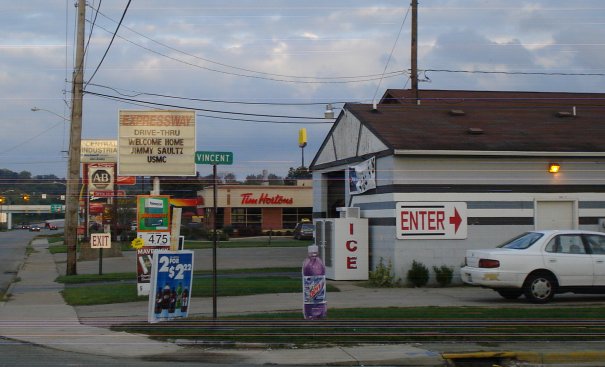
Besides the mounds, there is not much in the town of Chillicothe.  It has the usual chain restaurants.    The town’s big industry is a paper mill.   One of the novelties was this expressway.   It is like a drive through Seven-Eleven.    There was a woman inside who brings the stuff right to your car as you drive through.  It looks like it was originally a car wash.

Car Ferry Across Lake Michigan

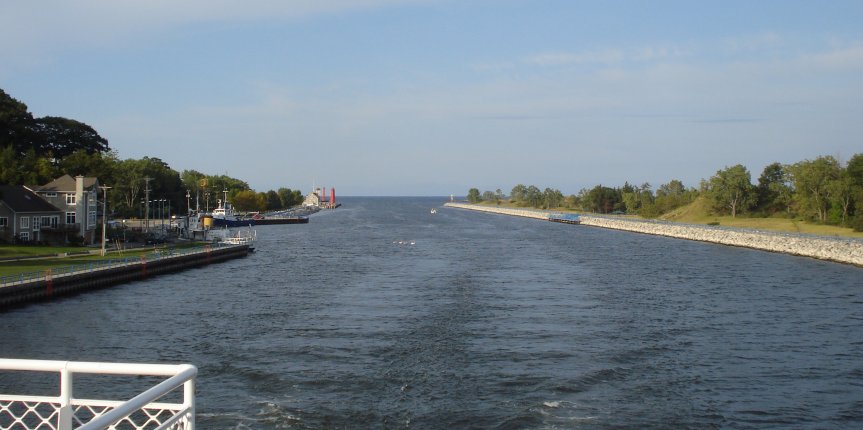
I don’t save any time by crossing the Lake, but I lived all my childhood years next to Lake Michigan and was always curious about what was on the other side, so I signed up for the car ferry and I am sitting in the terminal waiting.   The Lake Express allows you to bypass Chicago and avoid driving clean around the southern tip of Lake Michigan.   That doesn’t matter as much to me, since I have to go way south anyway and going through Chicago on Sunday morning probably is not a big deal.   But as I wrote above, I want to cross the lake.

The Ferry leaves at 6 am and goes from Milwaukee to Muskegon, Michigan in about two and a half hours.   The terminal is near the Coast Guard station.  It cost me $191 for the car and me.  I drove over with my sister a couple days ago and it is lucky that I did.  Thought the terminal was on the other side of the harbor at the edge of the Kinnikinnick River.  That is where the old car ferry landed.   It is better to make your mistakes and get lost in the light of day when you have no time pressure than to be driving around like crazy in the pre-dawn darkness.

I thought it might be hard to get a good spot on the deck to watch the sunrise, but I shared the place with only one other guy.  Most people stayed below where they read the paper, played cards or slept.  I suppose it is like an airplane ride to most customers. Some seemed to have been regulars.

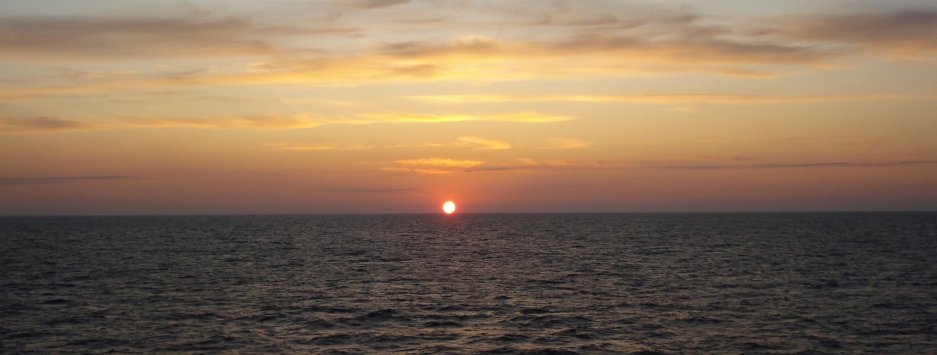
Metaphors from Homer came to mind as I stood on the deck, sailing the wine-dark sea and rosy fingered dawn spread across the horizon.  The sunrise was like none I had seen on land.  I waited and then suddenly there was a red band laying on the horizon.   The sun came up fast after that and it was finished. 

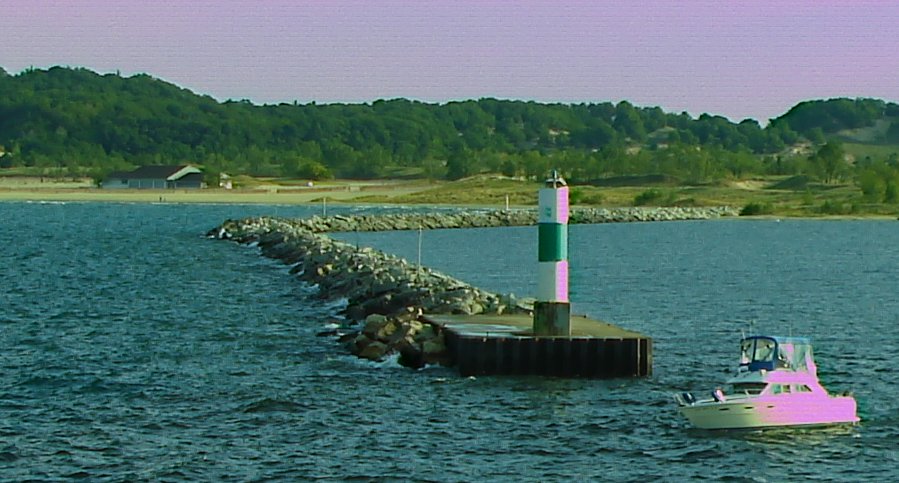
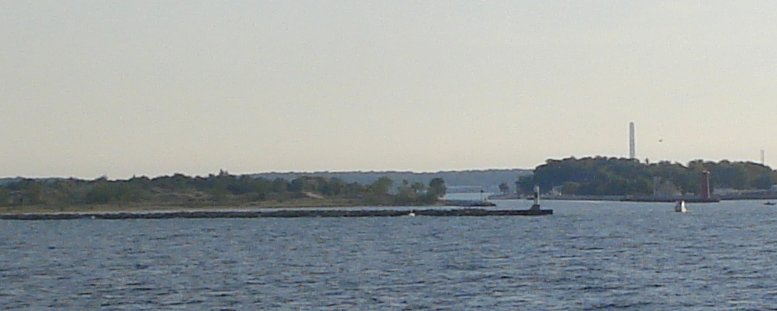
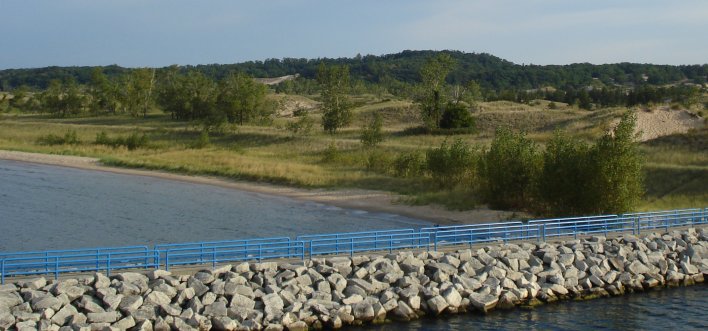
Muskegon looks like a vacation paradise.  There are big sand dunes, some covered with vegetation.   This side of the lake gets the prevailing winds and I suppose that over time that means much more sand is distributed on the far side.   You can see on the dunes the effects of natural succession.   Some dunes just have sand.  Grass comes in and holds them down, then after a few years if undisturbed cottonwood trees come in, then pines and finally hardwoods.   I wrote a little about natural succession in yesterday’s post. 

Fire & Ice: Always Becoming; Never Being

Climate change is not something we face only today. Warmer temperatures helped during the rise of the Roman Empire and cooler ones probably contributed to its downfall.  It was warm around the year 1000, when the Viking colonized Greenland and they were later wiped out by the advance of the Greenland ice. Interestingly, archeology in Greenland is now revealing Viking settlement patterns that were buried by ice for hundreds of years. Yes, it was as warm back then as it is now with our warmer temperatures.

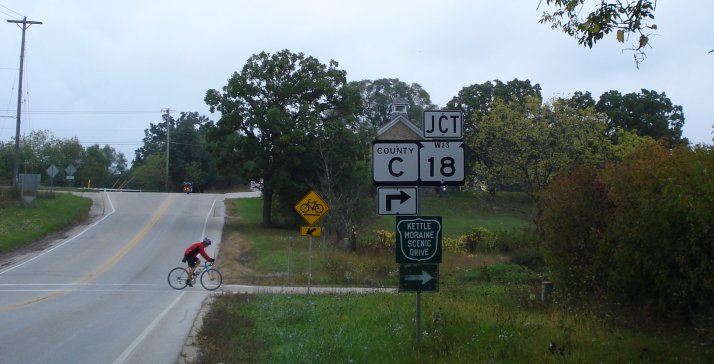
North and west of Milwaukee are the kettle-moraines. This is where the last ice age stopped. The ice sheets dithered over the land here making sort of waves in the landscapes. Where glaciers stopped are moraines, long hill waves. An ancient glacial river, where sediment settled, is called an esker. These snake around like raised rivers across the farmlands. Where there was a depression in the glacier and dirt accumulated is called a drumlin. These are now round hills. Finally there are kettles, depressions carved by ice as the glacier retreated. What happened was that shards of ice got stuck in the ground, like glass in tar. When they melted they left holes. Some became lakes or marshes; others are just holes. 

Most lakes are the gift of the glaciers, which is why you find so many in Wisconsin and Minnesota and not so many farther south. Over time, all lakes fill in and unless glaciers, man or an earthquake makes a new one, there are no more little lakes. I used to really enjoy the study of this stuff. Natural succession occurs when a lake fills in and gradually, through a succession of plant communities, becomes a forest. This can take thousands of years, which is why the lakes are still here.

The ice retreated from Wisconsin only about 10,000 years ago and the last ice age is called the Wisconsin glaciation, since there is so much evidence of it in Wisconsin. Besides the kettle-moraines, the area around Lacrosse, where Chrissy is from, is called the driftless area because the glaciers did not cover it and leave glacial dirt, also called “drift.” It was like a hole in the ice, but it was much affected by the glaciers. As the glaciers melted, water raced down forming long narrow valleys called coolies. Grand Coolie in Washington State is a really big example of the phenomenon. It was formed when a giant ice dam broke and washed away pretty much everything in its path. The area of Western Wisconsin is clearly different from the East.  Rolling hill give way to a more ragged landscape.

I road my bike from Lacrosse to Milwaukee a couple of times and felt the geography. It is hard going, up and down, until you get past Reedsburg. Then you go down a long hill, which I understand is the Baraboo Ridge, and the peddling gets easier. There are hills, but they are not quite as steep or abrupt.

Anyway, talk about climate change! 10,000 years ago is not really that long in the great scheme of geologic time. The glaciers also created the Great Lakes and are formed the basis for that great fertile soil you find in the Upper Midwest. I suppose you could blame them for the poorer soils farther north, since that is where it was pushed from. All changes produce winners and losers.  Climate change is no different. All things considered, we are better off now than during the ice ages. 

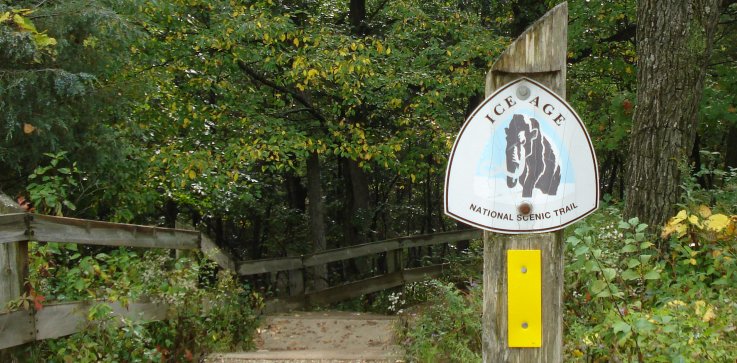
Ice Age Trail

The Ice Age trail follows the edge of the glaciers throughout Wisconsin. I went to the Waukesha part, the Latham district. Latham was a naturalist of the 19th Century. He was instrumental in founding the national weather service.

I feel very at home in the Kettle-Moraines. That was my first contact with natural communities. We went out here on field trips from school and when I could ride my bike far enough I made my own visits. The landscape meshed well with my childhood love of natural history. The soil on the terminal moraines tend to be rocky and gravel and not so good. Ironically, that is one of the reasons we have ice age parks. The soil was not good for farming, so the land reverted to state ownership when the owners just walked away or else sold it cheap.

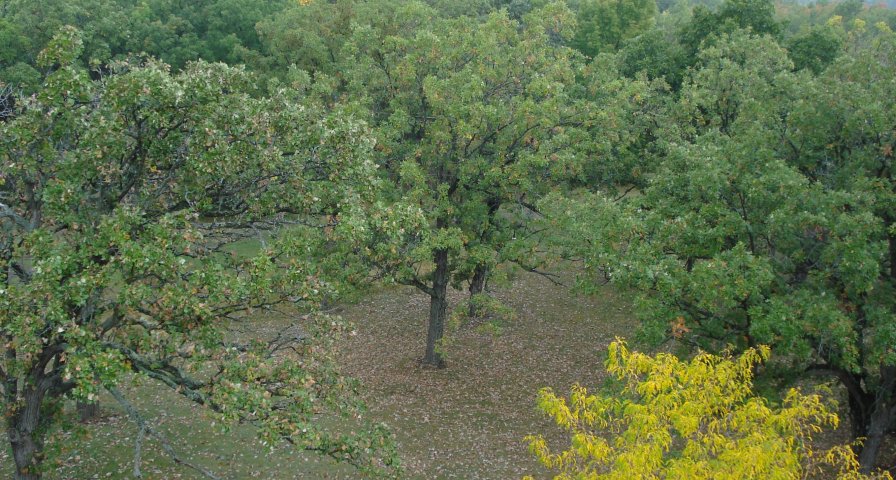
The natural cover in the Waukesha kettle-moraines is oak-savanna, locally called “oak openings.”  The trees are spread apart in a park-like setting.  The trees do not get very big because of the poverty of the soil, so a century old tree might be only thirty feet high, but they get very picturesque.   Until settlement, the oak savanna was maintained by fires, set naturally by lighting or more often set deliberately or accidentally by Native Americans. I wrote about that in a series of posts about fire in the woods.  Indians burned the land to improve hunting and once a fire started it could burn for a long time. Since there were no roads and few clearings to stop it, a fire burned until the next heavy rain. For a long time after the European settlement, we excluded fire from the landscape and a lot of brush has grown up.  According to signs I saw along the trails, the State of Wisconsin is trying to reestablish the “natural” or at least the pre-settlement ecosystems.   This means the judicial use of ecological fire.

I think I should say something about natural succession, since not everybody is as familiar with it.   Basically, there is a succession of natural communities that establish themselves on any piece of land. Each natural community creates conditions that allow the next stage to prosper while, ironically, creating conditions where its own continuation is disadvantaged. For example, pine trees fill in a field, but as they grow together they create shade where young pines cannot grow, but the sheltered forest and the improving soil is a good environment for maples, which come to replace pines. 

If you start with bare dirt, the first things that come in are weeds, then perennial grass and so on.   In a reasonably fertile piece of dirt in Eastern Wisconsin, you will get the weeds, perennial plants, box elders and ash and finally maples-beech-basswood if there is sufficient moisture and soil depth, otherwise oak-hickory.  But in some places you won’t really get forest at all.  Wisconsin has a lot of prairie ecosystems.  Of course, we really don’t know what the “natural” succession would be because no human has ever studied one. The Native Americans burned too, as above.  

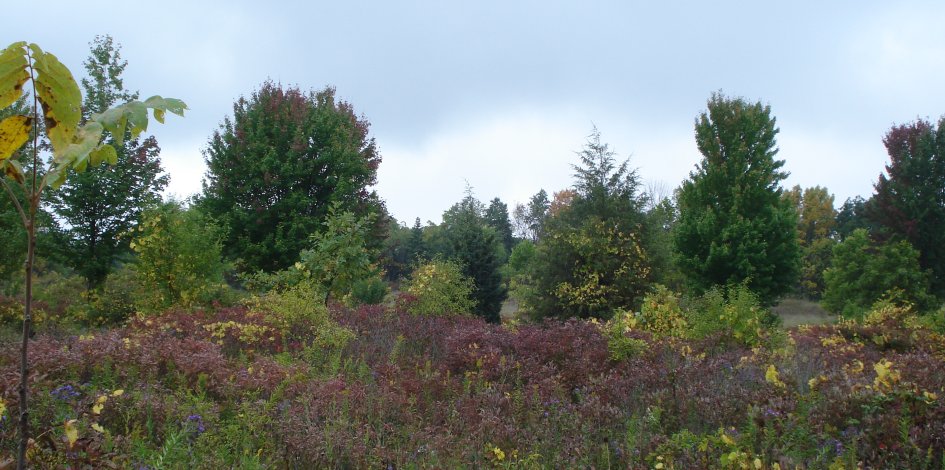
You can see above a field that might be in the process of becoming an open forest. When I studied natural succession, we talked about climax forests.  That was the ecosystem that supposedly was the ultimate goal. Once established, the climax forest would remain until disturbed by nature or man.  This implied permanence unjustified by the evidence.  We now have a more subtle understanding of ecology. There really is no “goal”. Everything is just becoming something else.

Progress

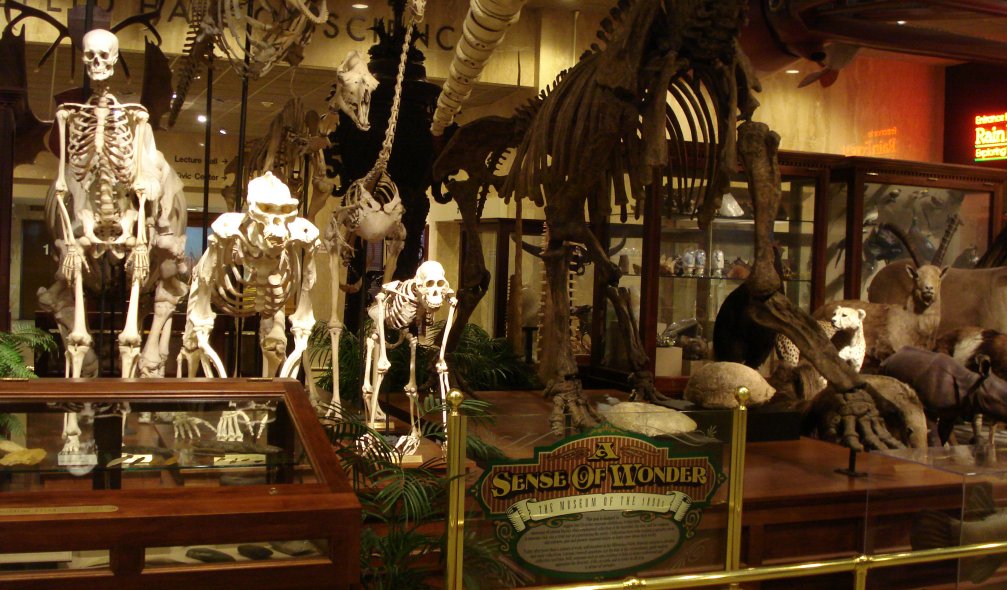
As I mentioned in the previous post, I went to the museum with my sister.  I have changed a lot, but stayed the same in key aspects.  The change I don’t like it the disappearance of the “Trip Through Time.”  You used to start with earth geology and go right through to the modern age.   I recall you could look in on cavemen drawing on the cave walls, see Roman house and a medieval counting house.  When you got through all history until about 1600, when you wandered over to  America and ultimately to the streets of old Milwaukee.  Yes, the impression you got at the Milwaukee Museum was that all human history culminated in Milwaukee of around 1900. 

The “Streets of Old Milwaukee” exhibits are still the same.  It is kind of a “Twilight Zone” moment to see the old lady on the rocking chair, an eternal look of bemused befuddlement on her face.   She sat there when I visited with my school class in sixth grade and there is a good chance she will abide on that porch long after I am gone.

The Museum is 125 years old this year and they featured the kind of exhibit you would have seen at that time.   I kind of like the old fashioned display.  The Victorians self-confidently stood astride the world and brought back pieces of their discoveries for others to see.  Their world-view – at least those who stocked useums – included a strong idea of progress and evolution.  They saw things in linear fashion.  Privative man advanced to become modern man.   Backward peoples and cultures were just earlier stages of the European civilization, which stood at the apex of history. 

The whole idea of progress was shaken by the carnage in the trenches of World War I and then virtually destroyed by the various horrors of the 20th Century. The wars and dictatorships corrupted human virtues like courage, duty and honor.  It was a tragedy, but we should not throw out the whole system.   The idea of linear progress has many flaws, but the judgment-free multicultural relativism that has generally replaced it is not a workable outlook in the long run.   A hierarchy of progress does not exist, but the sundry random, planned and pernicious aspects of societies worldwide are not all created equal. 

Some adaptations are better than others and that means that some cultures are better than others for particular situations.   Multiculturalism is dishonest conceptually.  Cultures are constantly changing and adapting.   Presumably, we should all borrow the most appropriate aspects of any culture we encounter and abandon those of our own that are no longer working out.    In a context of cultural contact, you won’t maintain multiple cultures, salad bowl style.  Rather the cultures will mix and merge creating something richer and fuller of options than any of the ingredients.  But the original cultures will atrophy.  They will not and should not be maintained, except in the museum sense, much like the unchanging and un-living old lady endlessly rocking on the porch in the streets of old Milwaukee.