You Can’t be Generous with Other People’s Money

I don’t begrudge the old folks that extra $250 … well maybe I do.   The cost of living actually went down this year.   That means that Social Security recipients will not get an automatic increase this year, since the increase is tied to the cost of living. 

The President proposes just giving everybody an extra $250, justifying it as a sort of second (or third) stimulus that will not come from the SS trust fund.  It is hard to be against this generosity.  It is great to be generous, but since we already are living on the national credit card the money will come from additional government borrowing.  That means that the younger generation will have to pay this back – with interest. 

$250 doesn’t seem like much money and it is not – until you multiply it by the number of times you are going to give it out.   But the problem is NOT this particular small money.  It is the whole principle behind the quick resort to pushing the gold out the door.  It shows how difficult it is for government to stand up to any powerful group.  Entitlements already make up 2/3 of the Federal budget.   All the wars, parks, roads etc are included in the other 1/3 and that % is ever shrinking (it used to be 2/3 only a generation ago) because politicians like to be generous, but they cannot be.  All they can do is take from some to give to others.  It is not even up to a zero sum transaction, since some significant percentage leaks out in administrative costs or plain waste.    

There is a long tradition for politicians to bribe “the people” with their own money. Roman politicians got themselves into bidding wars for the loyalty of the people.  They lowered the price of grain with state subsidies until they were giving it away for free and sponsoring ever more elaborate entertainment for the mobs of people hanging around the city of Rome. Gladiators killed each other.  Prisoners were killed by wild animals.  The people loved to watch the spectacle while being fed at public expense.  The famous “bread and circuses” corrupted both the Roman state and the Roman people. 

It was easier for Roman politicians to be generous with the public purse than it was to help create the conditions for jobs and prosperity.  In fact, having a bribable mob at their disposal was a positive benefit and a preferred outcome for many.   In other words, some politicians did their best to KEEP the people in a state of resentful dependence. The people receiving this “generosity” thought watching gladiators kill each other was better than working and it became a self-sustaining downward spiral that contributed mightily to the decay and fall of the Roman Republic.  Nero, Caligula and Commodus (the one featured on the movie “Gladiator”) are probably three of the best known Roman emperors today.  They were all very bad and spectacularly corrupt.   But if you look closely at the ancient sources, you find that they remained popular with “the people” because they made sure the bread was plentiful and the circuses exciting. 

There are lots of good things we have inherited from the Romans.   I have written many times about those things.  But we don’t have to take their bad habits with the good and maybe after 2000 years we should not repeat their mistakes.

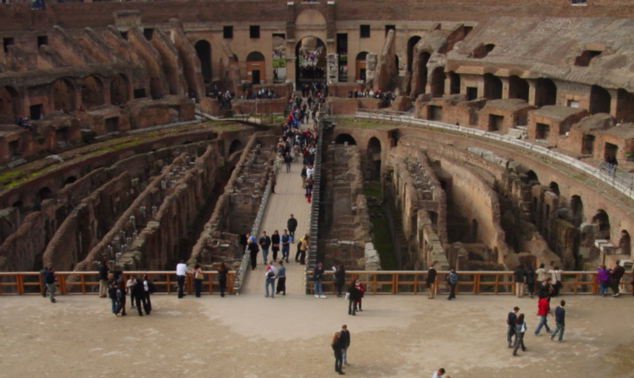
The picture up top is the Coliseum in Rome, BTW.  Despite its impressive structure, it was essentially a place where the Roman mob was placated by watching mass slaughter.  

Early Snow and Trusted Capitalists

It wasn’t the pleasant drive I envisioned.   It rained all the way up past Hersey PA.  Then it began to snow – snow in mid-October.  Where is this global warming stuff when you need it.   (Of course, I best be careful even joking about this subject.  The BBC is under vitriolic attack for pointing out that the globe has not gotten any warmer since 1998.  For the record, I have believed global warming is happening since around 1982.  I think I even pre-date Al Gore.   I believe some of it is influenced by humans and some of it is natural.   It probably can be managed through a combination of mitigation and adaption.  But I think the whole debate has become way too political and ideologically driven, so much so that I think truth takes a second place to politics, and when I hear that activists are trying squash information, I get annoyed.) 

Anyway, it cleared up a little by the time I got to New York.  It is pretty up here.  The leaves are in mid-turn.  They will peak soon.  If the predicted rain and snow doesn’t come, maybe I can enjoy them.

On the way up I stopped at Hersey PA.  You see above that even the streetlights are Hershey kisses on Chocolate Avenue.  Milton Hersey, who founded the chocolate company that bears his name, was a very kind and good man.  He used the profits from his firm to make life pleasant for people around him.  For example, he founded a school, supported hospitals and helped make Hersey PA a place where people want to live. I won’t write all the details.  Check out the article if you want to find out more.  Suffice to say that there are special places in heaven for people like Milton.  I bought and happily ate a Hersey bar in his honor today. Below is Hershey heaven (I guess). It is from a mural at “The Hershey Story” museum.

We took the kids up to Hershey about ten years ago to tour the plant.  I got new respect for Hershey after that.  There just are some firms that are better than others, usually showing the personality of a founder.   Marriott is also like that.  I always stay in Marriott when I can.   It just seems a generous, honest and family friendly company.   As long as I am endorsing good companies, I also admire Charles Schwab, Cabalas, USAA insurance & Samuel Adams beer.  I hesitate to add, because people will give me some crap about it, but I also like United Airlines.  They always treated me fairly, even if travel in general sucks.   I don’t know if being good adds to their bottom line.  I am a loyal customer of Charles Schwab, USAA, Cabalas and Marriott and I advise others to use their services, but they also happen to make things I like to use.  I don’t really like Sam Adams beer, so that doesn’t do them much practical good if I admire the company.  I have indeed specifically bought Hershey bars BECAUSE of the Milton Hershey legacy, but that doesn’t add up to much. 

Everything else being equal, I will buy something made in America and I give specific preference to products from Wisconsin or Virginia, but everything else rarely is equal.  I also understand that in this integrated world, the place of origin is hard to determine, but I never said it was logical.

On the left are products of Central New York, BTW. 

On the other hand, I won’t buy gas at CITGO – even if it is cheaper – because of Hugo Chavez.   I feel a little conflicted because I don’t want to hurt to good American station owners, but I cannot support that guy. Besides the other rotten things, he banned Coke Zero in Venezuela.  I refuse to go to any movie made by Michael Moore or Oliver Stone and I stopped enjoying Two and a Half Men after Charlie Sheen went nuts with the 9/11 conspiracy theories, but I think these are the only non-economic, non-taste factors that influence my purchasing decisions.  I suppose there are lots of unconscious associations.

Of course, we should make most of our product decisions based on the product itself.  It gets way to complicated to try to figure all the permutations of good and bad.  Few people are good enough in their own lives to judge the actions of firms.  Besides, in the real world “Corporate Responsibility” usually just means an opportunity for some activists to shake down a firm and firms often pay protection money to politically correct groups in the name of corporate responsibility.

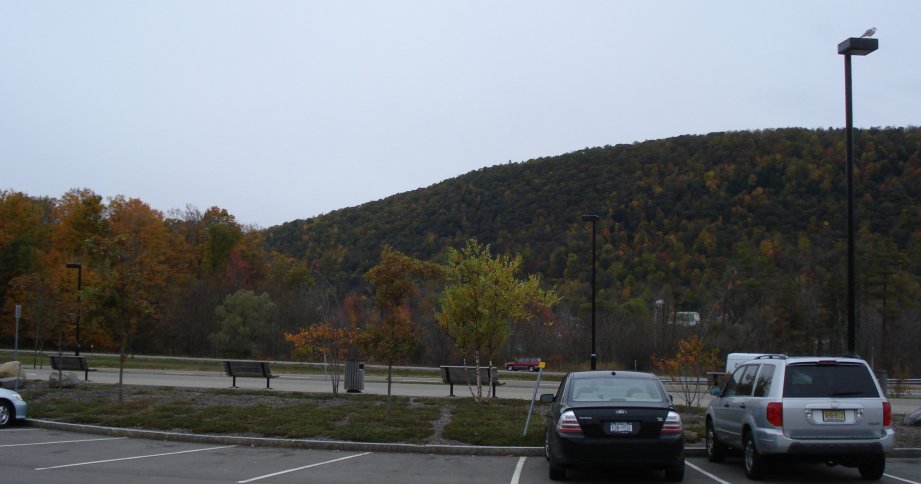
Above is from a rest stop along I-81 a few miles outside Syracuse.  

“Corporate diplomacy can make a lasting impression.  I went to a Jim Beam tasting event six or seven years ago.  They told us about the lore of Bourbon, how it was invented in Kentucky, is aged in charred oak etc.  I didn’t know that Bourbon cannot be aged more than around seven years, or it gets to be too strong.  Scotch keeps getting better for 18 years, but Bourbon ages faster in the warmer Kentucky climate.  BTW – Scotch older than 18 or Bourbon older than 7-8 is just a waste of money.  It gets older and more alcoholic; it just doesn’t get any better.  After the “tasting,” they offered various Bourbons for sale. I bought several bottles of more expensive whiskey than I would have purchased pre-tasting.  It doesn’t take very much tasting to influence your judgment.  But I still feel more favorably disposed toward Jim Beam because of their outreach and I now believe I can tell the difference between black and white label, and between “Booker,” “Baker,” “Knob Creek,” &  Basil Hayden. Notice, I say “I believe”.  It helps if I can see the bottle first.

The guy at the tasting admitted that most people really cannot tell the difference all the time.  You would probably become a drunk before developing the true skill. Much indeed is in the presentation, but that makes sense. Most of the price you pay at a fine restaurant is in the surroundings and service and drinking the best whiskey from a dixie cup just doesn’t cut it. 

The Few, the Proud Get More Numerous

All the armed services have exceeded their recruitment goals and they are recruiting higher quality than ever. The Marines managed to reach their EXPANDED goals years early.  The “Washington Post” article reporting this still suffers some of the old-fashioned thinking that people are somehow driven by dire circumstance into joining up.   In fact most recruits come from middle class or upper middle class backgrounds. The military no longer gets most, or even many, of its recruits from among the poor and uneducated.  Unfortunately for these guys, they cannot pass the tests or requirements to get in. 

Ethnically as well as economically the military looks like America. 

The military is a little more rural and a little more southern than the general population. There is a lot of speculation about why this might be true.  Rural people tend to be patriotic, in my experience, and they also tend to know how to use guns and operate heavy equipment.  These attitudes and skills are useful in the military.   As for the South, military service has been a tradition since the time of George Washington. There are also military families, among which lots of people serves and there are families where nobody does.   Sociologist might explain it. Habits and attitudes cross generations.

You can find a profile of the American military at this link.

My father was in the Army-Air Corps during WWII, but we don’t have a military tradition in our family. I encouraged Alex and Espen to think about the military, but so far they have decided not to. I was ineligible for military service because of what the doctor called an ulcer when I was sixteen.  It is a funny story now.   I was less amused then. I tried to join in 1982 as an Airforce officer.  I passed all the tests and went in for my physical, which I thought would be a piece of cake. It was.  My blood pressure was low.  I didn’t have any physical problems.  BUT I had “history.”   Back when I was sixteen I coughed up some blood.  It scared me and my mother so to the doctor we went.  The doctor at the time called it an ulcer. I drank a lot of milk and ate bland foods for a while and it went away – forever.  But the diagnosis stuck. Ten years later, the military doctors told me that I was too sick for military service and there was nothing I could do to prove otherwise because the records said so.  Just as well.   I went in the FS a couple years later and it was a good fit.  Beyond that, my peculiar talents are probably better employed in this line of work. Still, I think I would have looked good in that blue uniform.

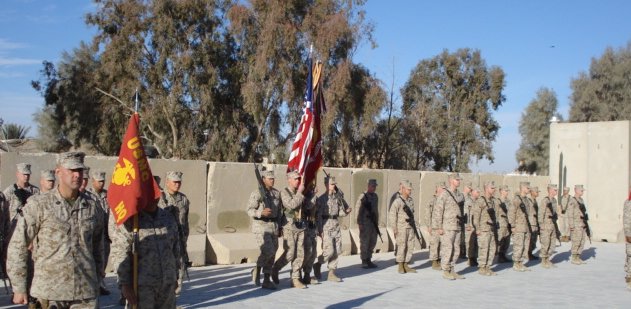
I worked with military attaches a lot in my career, but it was my year with the Marines in Iraq that gave me real first-hand experience with the military in action in their actual environment.  I was impressed by the Marines I got to know and had the privilege of working with in Iraq. The enlisted men are sometimes just kids, but they are a lot more responsible than those you find working at McDonald’s or not working at all.   You can trust your life to them; I did.  The way they deploy to respond to threats is poetry in motion. The officers are smart, but practical and unpretentious.  Generally, the military is better educated and better behaved than comparable civilians. Almost all the enlisted men have HS diplomas, at least.    Nearly all the officers are college educated and many have advanced degrees.   

I get angry when I see the stereotypical portrayal of military officers in much of the media. It is even worse when pinheaded pseudo intellectuals on elite campuses shun connections with the military or out of touch weirdos in places like San Francisco actually try to ban recruiting.  The negative image that engenders is persuasive in many parts of our society and it keeps lots of kids from even thinking the military.  It is a loss to them and our country.

There is a saying that if a country that separates its soldiers from its intellectuals will get fools do the fighting and cowards do the thinking.   I know from experience that the people doing the fighting are NOT fools. It is a shame if some of our self-described intellectuals don’t get to be all they could be because of their own prejudices and outdated ideas.   

Now more young Americans are taking up the challenge.   The few, the proud have become more numerous and that is good for them and for all of us.

Social Media & Public Diplomacy at Syracuse University

I am on a panel about public diplomacy at the Second Public Diplomacy Symposium at Syracuse University in Syracuse, New York on October 16.   Since it is a panel DISCUSSION I don’t want to say too much initially in order to let the discussion develop in ways favored by the participants.   The reflections on public diplomacy on the blog this week are some of the ways I am working through the issues.  Sorry for all the overlap.  I have to produce hours of thought to yield a few minutes of talk.  It takes a lot of preparation to be spontaneous.

Below is what I plan to use as an introduction.  The PowerPoint for the presentation is available at this link.

Social Media & Public Diplomacy

Above are workers constructing the new Institute of Peace building across from my office. They use a variety of tools for their work, choosing the most appropriate for the job at hand.  The TASK is the important thing.  The tools are just a way to get the job done.  A carpenter does not have a specific “hammer strategy.”  We should not have a specific Facebook or Twitter strategy.  Our PD TOOLS should be used … as tools – part of a tool box or portfolio.  Use the ones that work at the right place and time; don’t develop a strategy for them.

****

You are catching me at a time of indecision.   I spent more than twenty-five years working in public diplomacy and have been a pioneer in State Department innovative use of the new media; at least they gave me a couple awards that said so.  But I have doubts.  Electronic distribution & the social/interactive media is not the game changer I hoped.  On reflection, I think we leaned too much about technology and not enough on the social and anthropological aspects of the social media. Technology has made it easy to reach large numbers of people, but it doesn’t mean they are paying attention, turning our information into useful knowledge or doing something new or different based on what they get from us.

We have to do a lot of rethinking but it is hard to think when we are beguiled and distracted by the promise of technology. So let’s set aside all the latest techno-developments and think about the SOCIAL media from the human and audience perspective. Since this will be a DISCUSSION and I have only a few minutes to provoke your questions, let me give you the seven truths about public diplomacy and social media.

1.   Social – less about technologies and more about social interactions with people. 

2.   Iterative – It is a continuous learning, iterative   process, not a plan and not something that can be delegated or finished. 

3.   Engaged – You want to influence others AND you are willing to be influenced by others.

4.   Community -based  – Build a community & be part of a community.   Figure out what you can contribute to the community.  People make decisions in the contexts of their communities.

5.  Simultaneously Inclusive & Exclusive – A community is both inclusive of its members and exclusive to others.   You attract nobody if you appeal to everybody.   You have to earn membership in any community worth being a member. 

6.   Personal – Editors and marketers have tried for years to homogenize for the mass market.   Niche markets – and the new media is just a series of niche markets – requires personality.  There is no such thing as a world product.  Even the ubiquitous Coca-Cola varies by region and country.   We engage a series of niche markets.   This means that we have to work through our country-posts, with people immersed in local cultures, politics and sensibilities and has obvious implications for a Washington-based PD messaging strategy.

7.  Fun – We underestimate the importance of fun & games.   People have choices in the new media.  They often engage because it is fun and if you bore them they will wander off.  

So these are the things that I think shape our use of social media.  Let’s talk.

IIP engages new audiences with social media

Below is a draft of an article we submitted for “State Magazine.”  Regualar readers will recognize some of the themes I monotonously return to in this blog.  The text clearly has that bureaucratic feel necessary when writing for any in-house publication, and I did resisted the urge to put in some of my snarky comments, but it highlights some of the good work my colleagues are doing so I think it is worth posting and worth reading.    Below that is an article I wrote for the “Foreign Service Journal” way back in 2001.  Some of the cliche terms were just starting to be used back then.  In the intervening eight years, some things have changed but the basics remain the same.  We still have not really succeeded and we will never be finished, but there is some progress.

 IIP engages new audiences with social media

By John Matel and William May

Social media is, above all, social.  The increasing popularity of Facebook, Twitter, Short Message Service and podcasts gives public diplomacy practitioners unprecedented direct access to publics, opens doors to new overseas audiences and gives us the chance to engage people around the world in new ways.  It is a opportunity and a challenge to pick the right tools.

The Department has more than 130 official Facebook pages, more than a dozen feeds on the Flickr photo-sharing Web site, nearly 40 Twitter accounts and a growing list of blogs.  The Bureau of International Information Programs is taking the lead in employing these tools for international engagement, using cutting-edge technologies to reach people, remembering always that the medium ‑ the technology ‑ is not the message. We try to match the technology to the audience and the message.

At IIP we have found that using social media effectively often requires risk taking, creativity and a willingness to be on the cutting edge of these technologies.  Fortunately, the Department’s leadership is firmly committed to seeking out and implementing these new approaches that expand our ability to engage in exchanges with foreign publics. As Under Secretary for Public Diplomacy and Public Affairs Judith McHale said recently, “[In] the right circumstances, the use of new media could be smart power at its best, as when employed in dialogue with wired constituencies.”

Global Outreach

An important aspect of the new technologies is the ability and the need to be where the customers are.  IIP’s Digital Outreach Team connects with online users in Arabic, Persian, Urdu and Chinese, inserting the U.S. government’s voice into conversations on prominent blogs and forums and engaging an often skeptical audience on their own ground.  The Iranian government has labeled the team “dangerous and subversive” for its online discussions of the need for greater openness, the economic costs of Iran’s hardliner attitude and Iran’s pursuit of nuclear capability. In fact, the team has engaged in a back-and-forth online dialogue in Persian with President Mahmoud Ahmadinejad’s media advisor.  IIP’s blogging team gives Iranians an unfiltered look at a U.S. perspective on issues such as their nuclear programs and human rights.

“The blogging team’s willingness to address hard issues in an open and transparent way mitigates rancor and helps get our messages heard, copied and amplified,” said IIP Coordinator Jeremy Curtin.

IIP is also developing powerful new media tools for digital diplomats to allow them virtual personal contact with people worldwide.  The bureau has turned Adobe Connect business conferencing software into a multimedia-platform outreach tool that allows U.S. diplomats to cheaply and easily engage with publics via the Internet over high- and low-speed networks.  Dubbed “Co.Nx” (http://co-nx.state.gov), this tool integrates video, audio and print into a flexible platform that can carry the Secretary of State’s Town Hall meetings in Brussels to thousands of participants in Europe or, at slower speeds, transmit small interactive programs in Africa and Afghanistan.

New Meets Traditional 

Working closely with the White House new media team, IIP developed the first worldwide mobile Short Message Service-based event, which was used to engage audiences around the world to discuss the President’s speeches in Cairo and Ghana.  In Africa, where mobile phones are common but few have access to the Internet, the White House and IIP married Short Message Service with traditional radio broadcasts.  People across Africa and the world texted more than 17,000 questions and 50,000 instant messages to the White House in three languages.  President Obama produced a podcast that answered some of the Africans’ questions, and public diplomacy officers in Africa then took the podcast to radio stations, which broadcast it locally.

In another social media effort, IIP launched the “Democracy Video Challenge,” which attracted more than 900 video entries on YouTube (State Magazine tk.).  A second round of the contest began in September.

IIP’s Office of Innovative Engagement, in collaboration with eDiplomacy, has launched the Social Media Hub (http://www.intelink.gov/communities/state/smp/), which contains user manuals for Facebook, Twitter and blogging. It also has best practices, an “Ask the Expert” section and news about training opportunities.  This gives the posts overseas the encouragement and information they need to work effectively with new media.  It also provides a platform to share their experiences with Washington and with each other so that the innovation, imagination, intelligence and specific knowledge of our colleagues around the world can be shared and engaged. 
By using these new social media tools along with more traditional media and outreach, IIP is enhancing its ability to tailor and target public diplomacy messages to specific audiences.   Even as it explores the frontiers of new media, IIP is keeping an eye firmly fixed on the fundamental social aspect of public diplomacy.  At the end of the day, the bureau is still in the business of relating to and engaging with people. 

The new technologies simply make doing that easier – and better.

John Matel is director of the IIP Office of Policy, and William May is director of the IIP Office of Innovative Engagement.

———————————————-

Below is the article I wrote in 2001.

Speaking Out
Public Affairs: Out of the Information Business

By John Matel

It is hard to recall a time before we could read today’s American newspapers anywhere in the world online, or watch coverage of breaking events on CNN or a host of other TV and Internet news channels. Yet until recently, it was enough for information officers to provide — well, information. Sometimes we provided the latest news, or at least news that local media had not yet seen. Press attachés frequently thought of themselves as a species of journalist, faithfully furnishing unbiased, or at least evenhanded, information and official statements to host-country media. Overseas opinion-makers were often regular readers of our products and the local media treated them as supplementary news services.

What a change! Media organizations and the State Department’s own Internet sites now give our former clients 24-hour access to timely and accurate information. They bypass local public affairs officers, who cannot compete with Washington and should not try. Yet if public affairs sections can no longer be “honest information brokers,” they can be effective policy advocates by using the Internet as a public diplomacy tool. Or to put it another way: The Internet will not replace public affairs, but it will revolutionize its practice.

Strategic vs. Tactical

Despite its ubiquitous quality, the Internet has not lived up to its potential as a public affairs tool. A key reason is confusion over strategic versus tactical use of the new methods. Washington Web sites and most mission sites are almost entirely strategic in that they provide content to support general goals and messages, are directed to a wide, self-selected audience, and are independent of specific public affairs campaigns. They are excellent information sources that compare favorably with those of large private enterprises.

A breakdown results when strategic Web efforts are inappropriately applied to tactical situations. An effective tactical Internet campaign must be forward-looking, support specific programs, be interactively targeted to particular audiences and time-sensitive. It also requires active, sustained support by other public affairs activities; in other words, it is a fully integrated part of a larger public affairs campaign that no longer just informs but advocates a point of view. In many respects, Internet, e-mail and user-friendly electronic databases fulfill the promise of the old USIS Distribution Records System: identifying and reaching the relatively small number of key opinion leaders and transmitters who shape the larger society’s attitudes. This is a necessary but not sufficient aspect of public affairs. To be effective, information must also stick with the consumer.

Making Information Stick

The biggest problem with information delivered via the Internet is that it is not “sticky.” Recipients either cannot recall the message or fail to integrate it into their outlook or behavior. The solution is not limited to making our information more exciting or relevant; what usually makes the real difference are the context of the message and the perceived character and credibility of the messenger. In other words, recipients must trust the source and know what to do with the information they receive.

Beaming data to Palm Pilots works for stock prices and sports scores because recipients are waiting for the information and know how to use it. They have context. The kind of information we disseminate as diplomats is more complicated than factual reporting, however, for we seek to influence, not merely inform. Public affairs events, personal meetings and media relations provide the glue, the context that renders message content relevant and makes it stick in the consciousness of opinion-makers. Without human and programmatic context, electronic resources are like encyclopedias. Without electronic resources, conversely, most programming falls seriously short of providing content. They need to be used together. Consider the following:

In a traditional scenario, we meet a contact at an event, promise to provide more information and maybe even remember to send it. By the time it arrives, however, the contact may have lost interest. We created an opening, but were unable to follow up with content. By contrast, the Internet can provide complete and timely information, but not required context. Thus, a contact browsing a State Department Web page might carefully read a piece of information and make a mental note of it, but quickly lose the “mental notepad” because he or she also read 50 other pages the same day.

Now imagine a combined strategy. The public affairs section organizes an event, with its own Web page offering links to information. Key contacts get e-mail invitations with links to the event page. They can browse the page and get a comprehensive idea of what they want to learn. As a result, we meet a fully primed contact at the event, and can concentrate on specific parts of the presentation. We can then follow up with more information provided by our Area Information Resource Center in an e-mail with Web page links later that day. Now the information sticks with the contact because of the additional context of the event and the personal attention. In fact, he or she may well share it with colleagues and friends, and perhaps refer them to the Web page or forward an e-mail. That is success.

Reaching the Right People

Obviously, the combined strategy is best. Beyond that, skillful use of databases and e-mail will maintain relations as long as the contact remains important. With these tools, we can fine-tune our efforts and maintain meaningful contact with a greater number of truly engaged people (opinion leaders) across a wider spectrum of issues, instead of dispersing our resources on a mass audience, most of whom are indifferent to the message or unable to act on it.

Without technology (or several personal assistants), an average person can maintain regular personal contact with 150 to 200 people during any particular period. This maximum is set by the limits in the number of hours in a day and human memory capacity. Working harder or longer will not significantly increase this number, but technology can, by creating the possibility of mass personalization. Targeted e-mail with Internet links can be very precise in creating contact opportunities, since databases are memory enhancers. Thus, using technologically enhanced methods, one officer can maintain meaningful targeted contact with thousands of individuals. Notice that I am not advocating that this contact work be completely automated, however. In the high-tech world, personal attention is actually even more important.

Toward A New Paradigm

Those who think that technology will make overseas officers irrelevant are as misguided as those who believe they can ignore technology. Information technology will never replace public affairs officers. On the contrary, technology increases the value of human interaction while providing tools that liberate public affairs both from the tedium of being a mere conduit for information and the exciting, but uncreative, experience of having journalists clamoring for the latest breaking news. Because the Internet has made information a free commodity, we no longer score points for providing it. We add value only by customizing information and making it recipient-specific.

Ironically, “hard” technology puts a premium on “soft” skills by devaluing rote, programmed procedures and making the product itself (raw information) less important than the channel of delivery (relationships) and customization (personalization). Also, by eliminating the external discipline of the urgent, the new technology necessitates more creative and self-motivated behavior. Making it all work together successfully requires a new paradigm for public affairs, one that blends our traditional communication and people skills with new communication and people skills.

Technology changes the terms of engagement, but our relationships are with people, just as they always have been, not with their computers or fax machines. Effective communication with people is still the only real business we are in.

Why have we applied these methods only sporadically to our public affairs? One reason is simple newness. Only recently has such communication become possible with a significant number of recipients. Everyone must get used to using the new system. But a more pernicious impediment to effective synergy of electronic communications with public affairs has been the structure of the State Department. New technologies mean different ways of doing business and challenge us to be flexible in everything from job descriptions to traditional perks. They cannot just be strapped on old management structures. The department’s hierarchical, sequential culture, where one step must be cleared up the chain before the next one can begin, is not well-suited to a new world where several problems must be solved simultaneously and hierarchy sometimes ignored. (Who should sing tenor in the choir? The ones who can, not necessarily the senior members.) Bosses are uncomfortable when they lack the requisite knowledge to clear the work of their expert subordinates and are therefore reluctant to trust decisions they make in response to uncertain circumstances. The commitment of State’s new management team to addressing this problem is encouraging, but convincing those who prospered under the old system is a tough challenge.

Nevertheless, it is a challenge that must be met. If an integrated approach is not applied, the department’s public affairs efforts will soon be ignored and irrelevant. If the State Department can’t explain and advocate American interests abroad in a timely and effective way, the task will pass to those better suited for the job or not get properly done at all. These are unacceptable alternatives. To succeed we must release the talent and energy we already have. Let’s do it.

John Matel, an FSO since 1984, has served in Porto Alegre, Oslo, Krakow and Washington. He is currently information officer in Warsaw.
Wasted (on) Youth

It is not surprising that an aspiring geezer like me would think that the “youth market” is overemphasized in public affairs, but let me give you some of my reasons. (BTW – notice the suspension of good taste characteristic of the 1970s in the youthful picture on the left  You can’t see the platform shoes, very unpractical on the icy streets of Milwaukee.)

There is no Successor Generation, Just a Succession of Generations

We talk of a successor generation, but what we really have is a succession of generations, i.e. one after another.   Rearranging the words slightly as I just did almost completely changes the paradigm and drains a little of the urgency.   I really have to do the tedious digression in order to explain why we still view the world through this kind of generational prism.

The idea of the successor generation and the concept of generations on steroids in general is suited to a particular historical period that is now ending.   The “greatest generation,” the one that survived the Great Depression and fought World War II, is implicitly taken as the starting point.  The worldwide apocalyptic effects of this conflict and the economic depression preceding it, coupled with the never before reach of mass communication meant that people who experienced the war and its aftermath had a unique common experience that shaped them as a generation in a way not seen before or since. 

The end of the wars, both WWI and WWII that so comprehensively changed the world was a kind of a starting point for a new world. This created the idea of a generational personality and this impression was strengthened when people with the war experience ruled the world and set the pace for an unusually long time. Their numerous children were the baby boom, the largest and most affluent up until that time.  The Boomer conflict with GI-Generation parents played out as a clash of titan generations rather than normal piecemeal generational change.  This was also something very unusual, but since we grew up with it and in its shadow, we think of it as normal.  

When I joined the FS, we were in the stages of transition to the “successor generation.”  Supposedly, the new generations of leaders would be harder to deal with because they lacked strong direct memories of U.S. contributions during the war and American largess in helping rebuild Europe with the Marshall Plan.   Worse, the heroic World War II generation was going to be replaced by the generation of ’68, with its formative memories coming from the riots, disorder and unrest of those days.  Some of the former radicals still talked the talk, but twenty years of experience had made them a lot more reasonable.  Our fears that the radicals would bring down the system were unjustified (unless you meant the socialist systems of the Soviet Empire.)

The Stone Throwers of ’68 Became the Capitalists of ‘88

If the youth that rioted to overthrow capitalism in 1968 – in Europe it was even worse than it was in the U.S. – could turn into the tranquil bankers and bureaucrats of 1988, maybe capturing the youth in their formative ages is not so crucial.  But think of the even greater challenge that history just glosses over. The bureaucrats and bankers, the staunch U.S. allies facing down those rioters in 1968 had grown up during the severe indoctrination of Nazi Germany. It seems that people grow as they mature and they change with changing circumstances. Of course, maybe it is self-selecting bias, as the most extreme trouble makers just dropped out. 

There is an old saying, variously quoted, that if you are not a radical when you are twenty, you have no heart, but if you are still a radical when you are forty, you have no brain.  As I said, it is an old saying, at least a century old.  Some changes don’t change or put more elegantly – plus ça change, plus c’est la même chose.

Anyway, the big, lumpy generational changes that seemed have been the rule during our lifetimes were an anomaly.   It will not be that way going into the future.  Instead we will have more constant change spread across the generational spectrum. The need to make your impression on “the youth” in the first-formative stages of their lives will be less crucial, even if you still think it is crucial at all after looking at the history of the transitions between the self-consciously patriotic generation of ’45 and the self-described ’68 radicals.   

For Everything there is a Season

Experience indicates that the best time to reach people is NOT when they are 18-20, much less an even younger age.  They just get bored. You are a lot better off if you wait until they are 28-30.   Few 18 year olds really care about politics, with good reasons.  They don’t have a real feel for what they want and they have only a vague idea of what directions their lives will take. It is like asking them to choose door #1, #2 or #3, w/o knowing what is behind.  They make better choices when they get better perspective, after experience begins to replace passion.

(BTW – I am not addressing basic tendencies and values, which seem to be established very early and may even be influenced by genetics.  Here we are talking about things that we might express in public affairs messages.)

People are very much subject to natural unfolding development.  There is a right time for everything.  You cannot teach a kid to talk or walk before he is ready and the same goes for a lot of things. It is possible to be too late, but it is more likely that you will be too early.  There are times in their lives when they are ready to hear a message or to make a change and a time when they are not.   

Most 18 year olds are not ready for serious public affairs messages.  I wasn’t.  My kids weren’t.  Reaching out to kids too early is like planting your flower seeds in February.   Most will not germinate and those you plant in April will easily overtake and surpass any that do poke up through the frost.  It is a waste to be too early.   Beyond that, you face the constraint of selection.  Only a minority of a generational cohort will be interested and/or able to act on any public affairs message.  Among 18-year-olds you have an undifferentiated mass.   To extend my garden metaphor, you are not only planting too early, you are also doing it indiscriminately, sowing seeds on rocks, sidewalks, sand and soil.   Seven or ten years later you can make much better choices since you can better see which among them are or will be opinion leaders.

Ephemeral v Enduring

Anyway, patience is a virtue and waiting until the time is right is wisdom.  Youth is overrated.  People are much more influenced by the realities of their own life cycles than by the skinny dipping they made into an ideological pool as callow youth.  If you are selling things that don’t last long, such as trendy clothes, cool games, fast food or various specific forms of entertainment, get those kids.  If you are “selling” ideas meant to last – and be acted on – for a lifetime, wait until the time is right.

Showing Their Red Asses

All of what I know about baboons I learned from watching nature shows, so I am not an expert.  But I don’t like them.   They only good thing you can say about them is that they seem to be fearless, but that might be just because they are stupid and aggressive.  Beyond that, they seem to have most of our petty human failings, except worse.  Baboons are intensely social and hierarchical and enforce their social status by violence and humiliation.  Among their communications methods is displaying their big red asses to the lesser baboons.   This is the kind of nature we hope that culture and civilization will help us rise above.

But I have been in enough group interactions to know that we don’t always rise much above the red assed baboon, but there are particular situations that bring out the better or the worse in us.   When cut through all the fog, obfuscations and commentary, you see the key factor is the sense of objective truth, a goal beyond the particular personal preferences of individual group members.  W/o that, we are victims of popularity, personalities and ephemeral politics.

Think about some easy examples.   Working with engineers, scientists, farmers and foresters is relatively straightforward because you can point to objective results.   You can argue about how best to build the bridge but only within what is permitted by the constraints of topography rules of physics and the characteristics of materials.   Or consider agriculture.   A farmer’s work ethic and decision making is on display literally on the ground.  A flamboyant personality or wonderful aspirations don’t make up for not getting the seeds in at the right time.   

Now consider the opposite side of the spectrum: fashion and entertainment. In these fields of human endeavor success depend on almost nothing but personality or celebrity and everything is open to interpretation and restatement.  An aggressive personality is more important than core competence and winners are willing – often eager – to put down and humiliate subordinates and potential rivals.  Many of the most successful leaders in these fields seem to revel in this and have developed a kind of dark ethical system of insincerity and shallow coolness.  Speaking of “A-list” or “B-list” or even “C-list” celebrities is just a human equivalent of showing your red ass and the display has the same purpose as it does among the baboons.

I am afraid that our society has been drifting away from the tangible truth and more in the direction of power of personality as fewer and fewer of us work on task that yield tangible results and an even smaller minority can see long-term outcomes of their efforts.   It is no surprise if more people behave like selfish baboons.

I don’t consider myself a moralist or an example for that, but I understand that society must be based on transcendent moral principles that allow us to see beyond the problems of today or the personalities or proclivities of the participants.  There should come a bottom line where you can say, “that just ain’t right” or “this is what we have to do” w/o reference to who did it or who you are talking about.   

One of the practical benefits of a moral compass is that it makes life more predictable and helps protect people when their status in the group changes.  Among baboons, it is all about power and position.  Baboons have no objective morality.  Humans should. What the big baboon can enforce is the truth … until he can’t do it anymore.  We humans should be above that and I do say above in the sense of better.  Yes I am making a judgment about a moral position.  

Our experiences reinforce each other and color our judgments of the wider world. I know that my experience with long-term requirements of forestry informs my thinking on many ostensible unrelated issues and helps balance the venality of some of my public affairs work, where staging for today may be rewarded more profusely than building for tomorrow.  If we rarely anymore see the consequences of our ordinary daily choices, we start to lose the capacity to judge moral choices.  Everything starts to be relative and standards drop.  As Daniel Patrick Moynihan said, we define deviancy downward.  The neutral – and wrong – way to put this would be that morality has been redefined to be more inclusive.

Moral decisions should be hard.  We are likely to make many mistakes and none of us can live up to our highest aspirations, provided our aspirations are set properly high. We often won’t make the cut and some people will never make it at all.  Put in traditional terms, we are all sinners and can never overcome our base natures, but we are constrained continually to strive to be better.   

Otherwise we are all just a bunch of red assed baboons.

Bringing Back Bobwhite

Bobwhite quail used to be common in Virginia.  Their population began to crash about forty years ago because of changes in their habitat.   Some of this was obvious.  Farmers became more efficient and in the process eliminated lots of the bugs and weeds that quail need.  Suburbs expanded and suburban dwellers are probably even less tolerant of bugs and weeds.  Both suburban lawn owners and rural landowners also got new and better techniques to achieve their goals, which usually involved creating a “neater” landscape.  The thick green lawns, beautiful but ecologically barren, are widely possible only because of chemicals and techniques developed in the last generation.   

Wildlife habitat in general and quail habitat in particular is ragged and messy from the human perspective.  Above is an early succession field, a lot of goldenrod and ragweed. A lot of people would feel the urge to mow.  Even the gardens of “wild” flowers many of us plant are NOT really natural.   Ideal Virginia quail habitat consists of the weeds and debris that comes the year after a clear cut.  It is the disturbance itself that is the key to success. Many of us demand that this kind of thing be “cleaned up” or avoided in the first place.

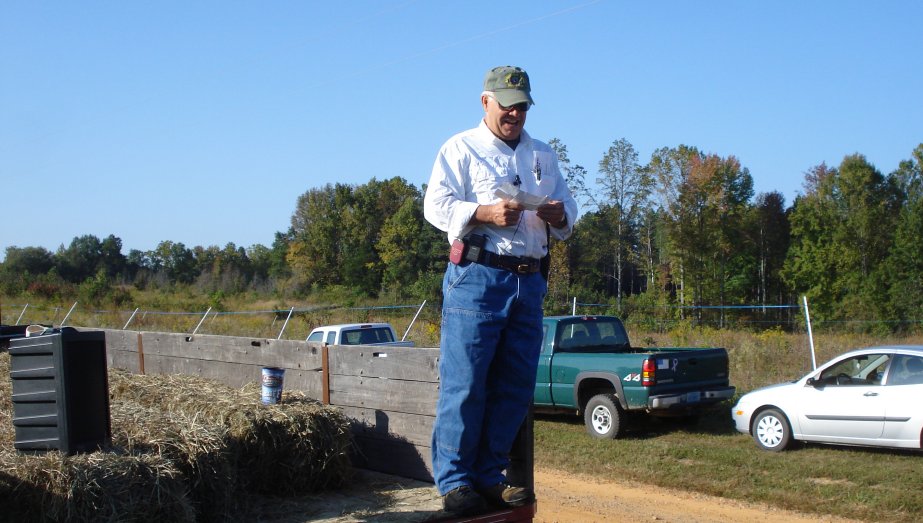
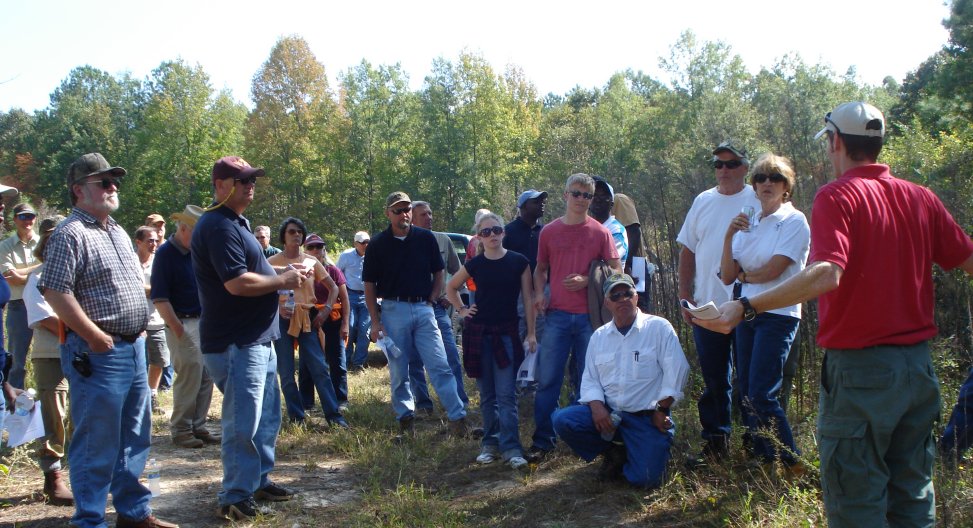
My friend Mike Jones led the wildlife habitat field day to discuss ways landowners could create places for quail and other desirable animals.   This is Mike just above. He is a landowner who recently retired from the NRCS and smartest person I know when it comes to the practical creation and protection of wildlife habitat.  Mike has tried out all of what he talks about on his own land and seen the results over a lifetime. The State of Virginia is wise to take advantage of his expertise and his credibility when explaining programs to landowners. 

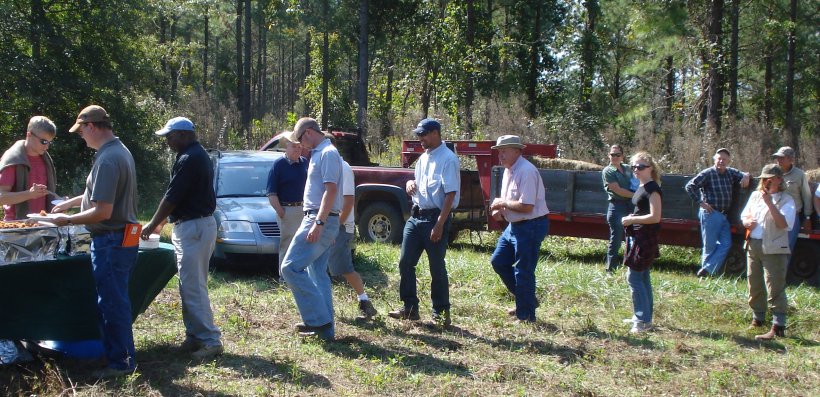
These field days are a sweet deal.  It cost me only $10, which probably didn’t cover much more than the lunch.  The lunch line is pictured above.  But field days are really a kind of advertising and education.  Landowners make decisions about what happens on their land and it is in the best interests of everybody in the state if they make good ones.  I didn’t really comprehend how important this was until I bought the farms.   I have spent thousands of dollars and many hours of time making improvements to protect wildlife and water resources.   I am eager to do that, since I consider improving my land a long-term investment, but I need advice about what to do.   But there is no right way to do anything.  We need to learn from scientists and experts, but they also need to learn from our experience and we have to learn from each other.  These field days are part of the extension outreach done by the State of Virginia and our universities such as Virginia Tech and a great way to share practical knowledge.  

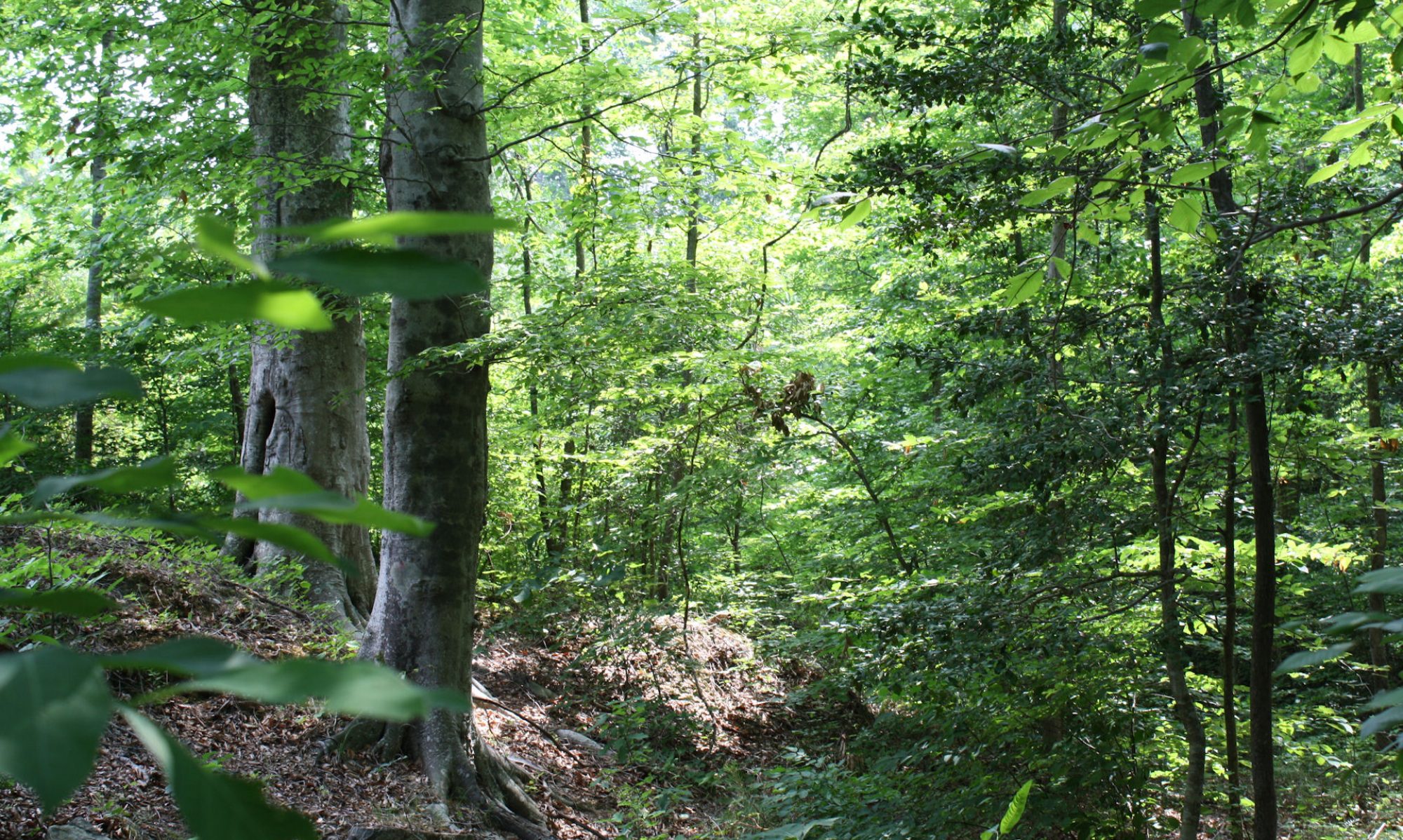
You can make improve the environment and make profit from your land at the same time, but everything is a trade off.  Wildlife tends to thrive in a less dense forest with more space between the trees and some of that ragged and messy weed patches I mentioned above.  Of course, different animals favor different environments too.  All life is trade-off. You can see the open woods at the top of this post and you can easily see how this does not maximize timber production, but most people like it better on their land and they may be able to make back some of the money with hunting leases. I lease both my farms to local hunt clubs.  They provide a local presence and take care of boundaries.  

Hunting is a virtuous circle.  What is good for wildlife habitat is usually good for the environment, so hunters have an incentive to protect the environment.   Above is a wildlife corridor Larry Walker, a member of one of one of our hunt clubs, made for me on our land.  It will provide diverse edge community AND it allows me to get down to the creek w/o bushwacking.  He cut it through a couple of weeks ago and planted the cover that you can see coming up.  The hunters on my land have been there for a long time, in some cases for generations. They make the effort to understand the land in a way that almost nobody else does.  They have to understand and provide for the needs of deer, turkey or quail.   Hunters pays for a lot of wildlife conservation.  They also control numbers.  The deer population has exploded in the last twenty years.  In places w/o enough hunting, they are destroying the forests and preventing regeneration.  Of course, we don’t have that problem with quail.

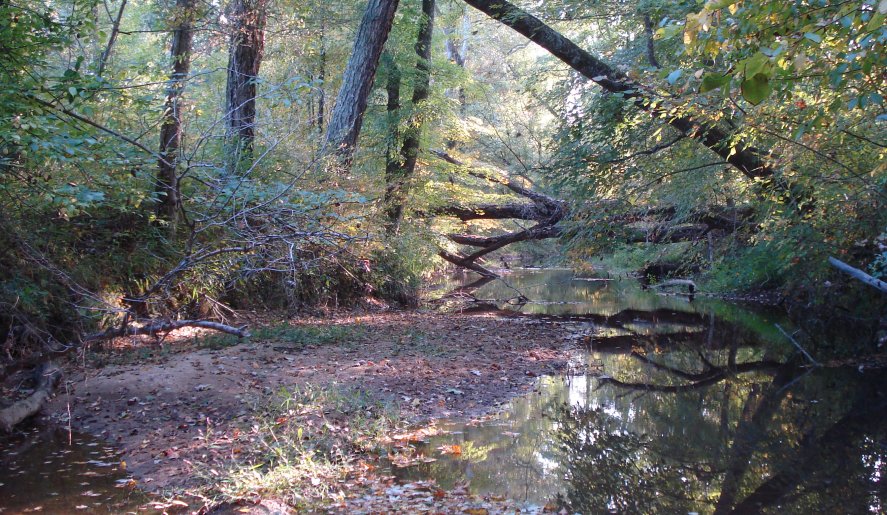
Above is part of Genito Creek that crosses our property.  Larry’s path makes it much easier for me to get down there and it is a nice place to visit. The creek meanders around, moving sand around the bed.  The water undercuts banks and brings down the trees periodically.  The creek used to be the boundary of the property, but around 1960 the whole thing moved around 100 yards in, so now both sides are on my land … for now.

I mentioned some of the reasons for quail decline.   A habitat is only as strong as its weakest link.  When they are chicks, quail need lots of bugs to eat, so they need the mix of plants that bugs like.  This included weeds like goldenrod and especially ragweed, grass not so much.   When they get older they need seeds to eat.  They also need places to breed under cover, which is why they like blueberry thickets and they need brush and trees to hide from predators.  In other words, they need a great diversity of habitat type, with a lot of it in the early stages of natural succession.  By definition, the early stages of natural succession pass quickly, so we need a fair constant cycle of disturbance and recovery.

The State of Virginia wants to bring quail numbers back up.   They have devoted $9 million over the next five years and will hire five regional biologists to study the problem and provide advice to landowners.  They have some cost share programs for landowners targeted to five Virginia counties in order to focus efforts rather than spread them out and lose benefits too thin to do any good.  Brunswick is not among the counties.  Besides, they are aimed at crop land conversions, so I cannot get my forest lands in on any of them.

But my farms do have a lot of good edge habitat, even if they are not part of the program.  The wildlife plots we established last year are doing well and the pre-commercial thinning has done a good job of establishing biological diversity.  I visited the CP farm after the wildlife field day.  As I walked down the road just before sundown, I spooked a covey of quail.  At least a half-dozen exploded out of their cover as I slowly walked by.  I took a picture of the spot and posted it above.  I can be plenty ragged and messy w/o cost share from the state, thank you. You can see that it has the goldenrod and ragweed.  It has the cover trees and the bramble blueberry and the combination of edge communities.  The edge is plenty weedy and ragged. Not bad. I should hold a field day on my farm(s).

Meeting Charles Darwin

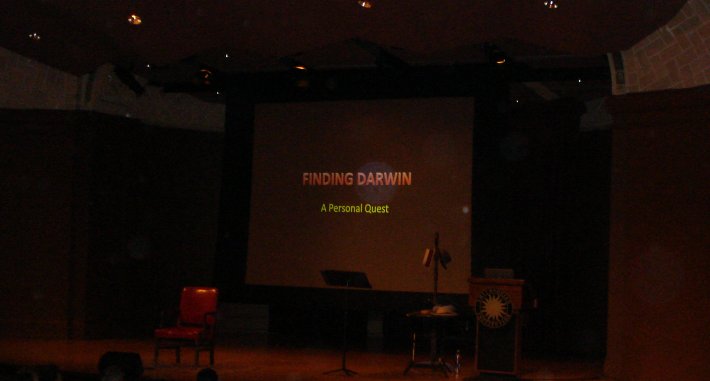
Alex and I went to see a Darwin interpreter at the Smithsonian.  It was very interesting, although not exactly what I expected.   Richard Milner did Gilbert & Sullivan songs about Darwin in between his story telling and interpretation.  

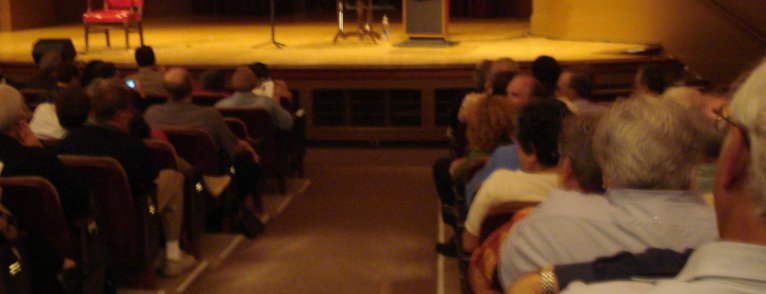
Alex was probably the youngest person in the room, by far.   I might have been in close contention for second place.  I bet the median age was around sixty.   Mr. Milner told lots of jokes that I understood but depended on cultural nuances from before Alex’s time. Jimmy Durante, Bing Crosby & Jack Benny survived into my time but even I know them largely through reruns of old movies.   This kind of thing worries me.  I also have trouble adapting new jokes.   There are humor generations and it is hard to bridge that generation gap.   Our references are just different.

I was crowd watching as much as performer watching.  An evolution audience is peculiar and the performer pandered a bit to their prejudices.  I don’t think there is any doubt that evolution explains our world, i.e. it is true scientifically.   I also believe that Darwin was the greatest thinker of the 19th Century and the only one whose ideas are still broadly useful today.  But I don’t partake in the Darwin hagiography and the kind of snooty superiority on display in this otherwise very polite and reasonable crowd.   Dare I say that they treat Darwin with almost religious reverence.

The Darwinism of the 19th Century, i.e. the original ideas, is wrong in many details.  This doesn’t really subtract from Darwin’s genius.   Almost all the science of genetics, much of statistical analysis and most of the archeological record of early hominids was unavailable to Darwin.   You can look at this in two different ways.   Accolades say that it shows Darwin’s prescience and genius that he could still get so much right even w/o all that science.   I would also praise Darwin’s skill, but say that he was very lucky in his guesses and made some seriously unscientific extrapolations that turned out well.  We don’t have to believe that man was some sort of superman.  We can still admire him.

Speaking of supermen, this is another problem with overdoing Darwin.   Darwinism is closely associated with scientific racism, Nazism, abusive eugenics and so called social Darwinism.    Darwin didn’t take part in this and he didn’t foresee it.   You could say that all these things are ignorant misinterpretations of Darwin, and you would be right.   

But when you look at something in totality, you have to consider what will become of it when it faces the grit and error of the real world.  Academics argue academic theories that are manifest nowhere in reality.  Reality matters.  The best example of how reality can turn a minor intellectual pathogen into a deadly disease is Marxism. In theory, Marxism is just kind of silly.  In practice it is deadly.   Darwinism was not like this, but it was abused in the service of politics.

Let me make one small note about evolution.   The common conception of it is … wrong and that is one of the reasons why the theory got abused.   If you look at the various charts and timelines, you think that evolution is moving toward a goal.   In fact, evolution doesn’t imply progress in any way.  Fitness means only that organisms have reproductive success.   In modern terms, the “Octomom” is the most successful and fittest human woman of our age and perhaps the most successful of any age.  She evidently has fourteen children with a good chance of surviving into adulthood.  Some sleaze who fathers a dozen kids out of wedlock is fitter than the childless Noble prize winner – kind of depressing.  The related wrong idea is that species evolve from each other with the idea of progress, so that a fish or a frog is lower on the evolutionary ladder than monkey or a man.   In fact, the science of evolution doesn’t have anything to do with this kind of idea.   The fish that successfully reproduces is more successful than a man who doesn’t.

Anyway, I take the pragmatic approach to knowledge.  We can never find absolute truth.  Science cannot give that to us, since science is in the process of becoming.  It is always in revision.  We can, however, achieve USEFUL knowledge and that is enough for most of us most of the time.  Just never get too enthusiastic about any particular ideas, don’t attribute infallibility to any human and don’t hold that lack of infallibly against them.  

Even a genius is wrong most of the time because to err is human.  And that is why I don’t feel it is a contradiction to believe in both science and transcendence.

Above is sunset from my office window behind the construction of the Institute of Peace. 

BTW – I found a good article on this subject after I wrote this.  It is at this link.

Who Ought to Sing Tenor in the Quartet

The State Department blog featured an interesting discussion about discrimination against people with disabilities in the FS.  I won’t go into details.  Suffice to say the idea was that people who go to places like Afghanistan and Iraq derive career benefits and that the system is thus unfair since only the able-bodied can do these kinds of assignments. 

This takes the idea too far.  I agree that we should make reasonable accommodations to people with disabilities wherever we can, but there are some places where we can’t.  If we think a job is important enough to be done, we have to allow those who can do it to do it.

My job in Western Iraq was more vigorous than most others because we had to travel across the largest area of operations in Iraq.  I didn’t have to be in top-condition to do the job, but just humping onto a helicopter or into an MRAP with body armor and gear is hard.   The chow hall had a wide selection of food, but we were not always near the chow hall.  It gets pretty hot and dusty in the Iraqi desert.  It is indeed a physical challenge that not everyone can do.   It would be life-threatening to send anybody who couldn’t pull his own weight, for the individual as well has his colleagues.   This is just true.   

I would point out/admit that I have lost some of my ability over the years.   That is what happens as you get older.  Ability and disability are a continuum.    When it comes to running miles in less than six minutes, I have become disabled.   This gradient can be deceptive.   It is hard to identify the exact point where we are not in good enough condition for a particular task.   But that point is reached.  This is not like a made-for-TV movie or an after school special.   Sometimes it doesn’t matter how much you want something or how much you try.  

Nature, war and the laws of physics are not fair.   

So what about the compensation?   I suppose it depends on what you mean by fair.   FSOs are supposed to be worldwide available.   Not all of us are and we might lose our worldwide clearance.   But good health is a definite advantage.   I don’t know how we can get around that.   One reason I have been successful is that I don’t get sick very often.   You may not succeed even if you show up, but you certainly cannot succeed if you don’t, no matter whether the reason is good or bad.

We will all sooner or later become “disabled” if we live long enough and I suppose being dead, i.e. “vitality challenged” is a significant impediment to success, so that is all our fates.  Before that time, we can do our jobs and be productive members of society, and I guess that I think of work as more an obligation than a right.   It makes a lot of sense to help everybody be as productive as they can, but you cannot achieve total equality in results. 

I had great experience but I didn’t get promoted this year for my work in Iraq.  This is okay.  I agree that we don’t necessary deserve a career jump just for going to dangerous or unpleasant places.   And you don’t need to go to Iraq to find places like that.  Many Foreign Service posts are dangerous and unpleasant.  The ability and willingness to go to these places – and do a good job while there – is part of our job, part of our work ethic.  It is worth something.  It should be encouraged.  It deserves consideration and it should not be devalued.  It makes little sense to subtract one of the big virtues of the FS just because not everybody can achieve it. We need to be reasonable about these things.  

Henry Ford said that asking “’who ought to be boss’ is like asking ‘Who ought to be tenor in the quartet?’ Obviously, the man who can sing tenor.”  This goes for most things.  Ability counts and talents & abilities are not evenly distributed.  This is the way it is, whether we like it or not.