Small Scale Beauty and Ugly

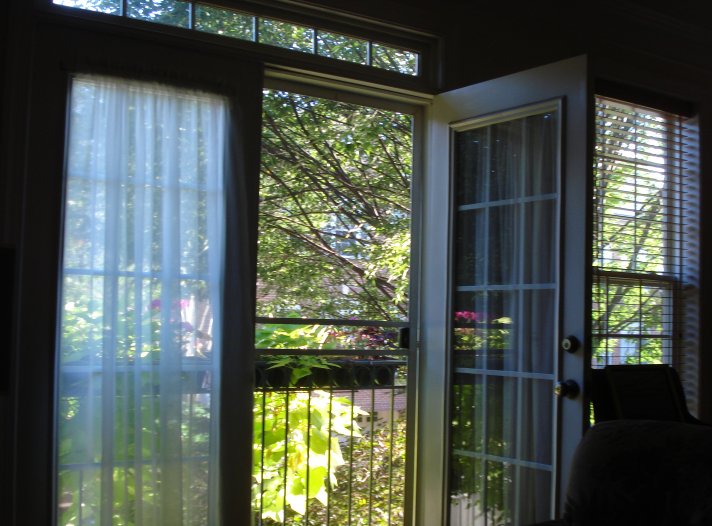
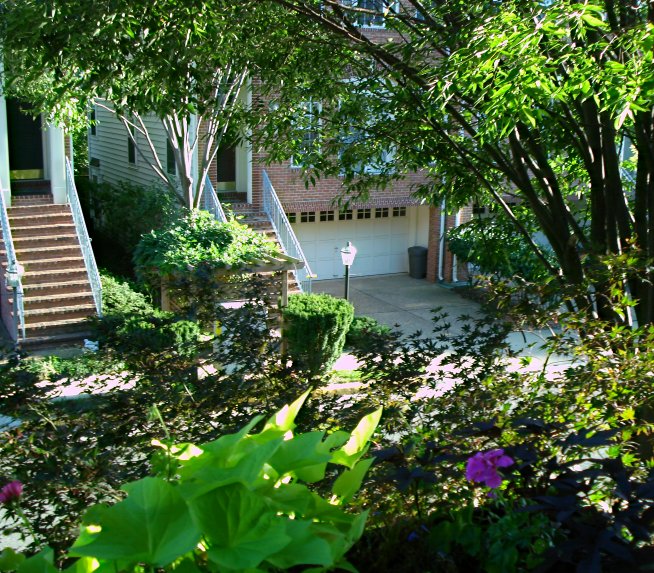
I like to sit in my chair and look out the window.   This time of year, the sun comes in low at the edge of the house and paints the leaves of the plants and trees by the window.  The pictures don’t do it justice.  I am not sure which I like best, now when everything is still green or a few weeks from now when the leaves on the bigger tree will be yellow and those of the Japanese maple will be crimson. 

The tree fills with birds in the evening this time of year.  They sing so loudly you cannot hear the TV if you leave the door open.  I like it, although they do crap all over.   We don’t need to fertilize around that tree.  

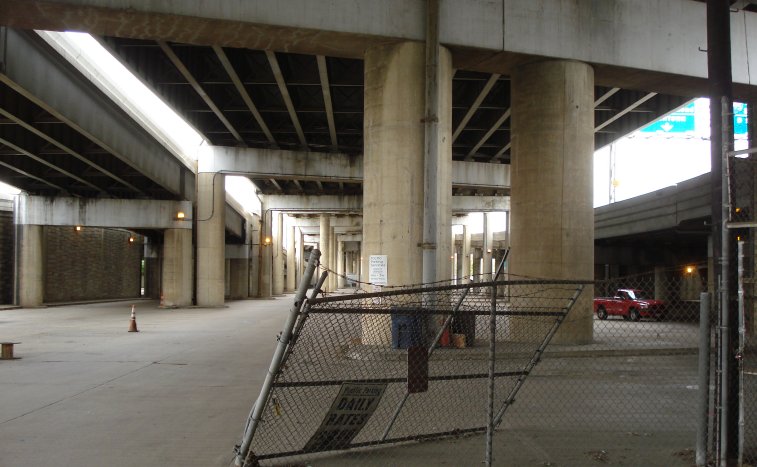
The picture below is parking under the freeway.   It is a brutal scene, but maybe so ugly that it is interesting.   I always kind of liked Chicago under those El Tracks, ugly, but gritty.   I think that is why I liked “The Blues Brothers,” because of Chicago.

Tea Party in Washington

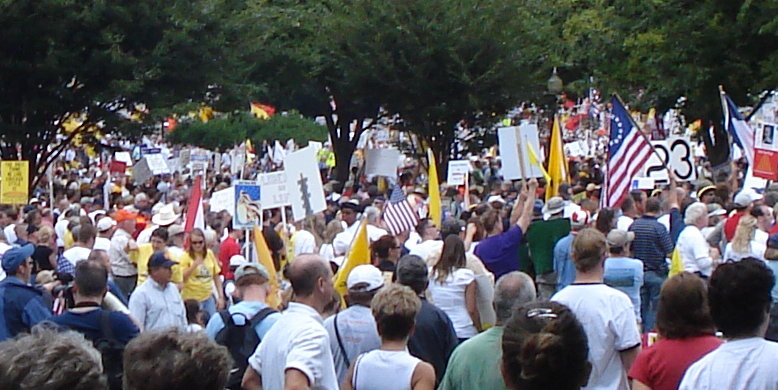
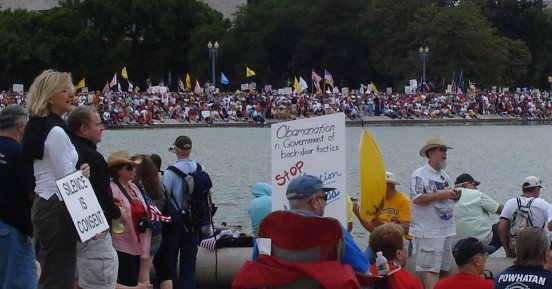
Chrissy and I went down to watch the tea party protest today in Washington. I like to watch protests. I got in the habit when I lived in Madison.  The crowd filled the lawn from the Capitol down past 4th St. None of the anti-war marches were as big.

The demography was the interesting part.  I bet the median age was around forty or fifty and I thought about what I said in Revenge of the Geezers a couple days ago.  It has usually been hard to get a crowd of people over thirty-years-old to come out to protest. Most of the other protests I have seen are staffed by the young and unemployed. This protest was unusual in that included mostly people who probably actually pay taxes and I think it was largely organized online.  This might be the harbinger of political activism of the future.

Once you get a full time job and other responsibilities, you don’t have as much time or inclination to march, chant and protest.  This explains why youth has driven protest movements.  There is no mystery to it.  They have extra energy and time on their hands.  Beyond that, they are vaguely bored and a little bit resentful because they think others don’t pay enough attention to them.  As the older population becomes healthier and retirement stretches on for many more years, this is increasingly a description that applies to old people.

The other thing interesting about this crowd was its lack of professionalism. Most protests I have seen have their core of bused-in experienced protesters, with well constructed signs and organized chants. This one had almost all hand lettered signs.  There was very little unity among the messages. Most clearly didn’t like the President but most of the anger seemed directed at congress.  One of the most original signs had pictures of members of congress and said, “Don’t give your cash to these clunkers”

The crowd was very well behaved, but not very well organized. Most were probably first-time protesters and I got the feeling that many would be taking their children or grandchildren to see the monuments in Washington after they wandered off when the protesting was done.  Some brought lawn chairs.  If someone had fired up a grill, it would have seemed a lot like a July 4th picnic.  Of course we didn’t stay long.  Maybe it got more intense later, but I doubt it.

9/11

People remember where they were on 9/11 (more on that below) but it is harder to remember how you felt and what you thought. At first it was just surprise and then anger.  I don’t remember exactly when we found out Osama bin Laden was behind it.  There was a lot of speculation before that.  It was considered racist to jump to the conclusion that it had been Middle Eastern terrorists, but I think most people jumped in that direction anyway. Go with the probabilities.

I wrote notes to myself that evening, so I have some documentary sources beyond fallible memory.  I wondered if this was going to be a big break with civilization, that would build to something catastrophic like the assassination of Franz Ferdinand let to World War. I understood that militarily all the countries of the Middle East combined could be defeated by a single American carrier group, but I also knew that would not be the type of conflict we faced.   Everybody thought the terrorists would hit again and there was talk about a new normal where it became routine to have terror attacks.

When I look back over the years since 9/11/2001, I am relieved. It was not nearly as bad as we feared.   We did a good job of countering the bad guys.   I know we feel a little guilty now because we treated some of bad guys harshly and nobody can say what would have happened had we been less aggressive, I have to say that we achieved a good result. I would err on the side of caution and if that means some terrorist are uncomfortable, that is just the way it is. In eight years they have been unable to hit us again.  It is not for lack of trying.  Terrorism is a disease that will never go away entirely, but it can be controlled with proper treatment.

When I think back to the crowds and how we felt on 9/11/2001, I bet anyone in the crowd would have happily held anyone responsible or even associated the attacks underwater for as long as it took to make them talk or drown them.  If fact, I bet a majority would have still held them under AFTER they talked.   Considered judgment from a position of safety is usually different from the decisions you make when you are in the fray, when your life or those of your loved ones seem in the balance, and I don’t think we really have the moral right to be too strict when judging methods unless we also can recreate the state of mind.  It is like telling someone that he used too big a caliber in stopping the attacking beast since a smaller one PROBABLY would have worked.   

But it is human nature to second guess and to want to hold someone accountable for producing a result that was not as good as it is possible to imagine.  I don’t hold with that.  IMO people should feel afraid to attack the United States; those who kill Americans should anticipate a lethal response.   And they should get it.    The 9/11 attacks came when the U.S. was ostensibly at peace.   We had just finished saving millions of Muslim lives in Kosovo. We had invaded no Middle Eastern countries.  In fact, we had liberated one (Kuwait) from a particularly brutal tyrant.  Al Qaeda had no reason to attack us, at least no reason a civilized human being would accept.  As I write, I feel the anger return even after years have passed, so let me move along before I post something too bloody minded.  

What I did on September 11

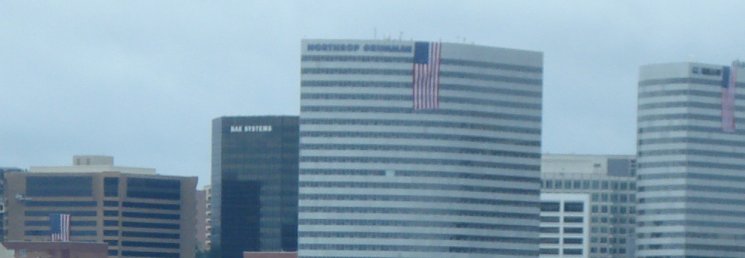
 I was in the middle of a seminar on websites at FSI (yes, even back then) when someone came into the room and said that there had been a terror attack in NYC.   We thought it was something like a suitcase in an airport, but we went out to the common area where CNN was on.   We saw the towers burning and then they just collapsed.   Somebody said that they could not have collapsed and it must just be the smoke hiding them, but it was a collapse.  By then the Pentagon had also been hit so they decided to evacuate FSI, since it also was a Federal facility.  They sent us home. I didn’t have a local home, since I was assigned to Warsaw and was on TDY in Washington from a conference.  My hotel was the Holiday Inn in Roslyn near the Potomac, so I started to walk in that direction.

People were all over the streets, mostly going the opposite direction.   Everyone was asking questions, but nobody knew any answers.   I was surprised how friendly and helpful people were. There was no shoving or fighting even though the crowds and traffic were massive. There was also no panic, which is surprising when I think about it.   When somebody would start to talk about a frightful thing, others would calm him down and say that we all just had to be calm.  It is a couple of miles from FSI to the Potomac, so I passed lots of people walking and standing on porches. Despite the tragedy, or maybe because of it, I felt a peaceful easy feeling of solidarity with my fellow Americans, even as we could hear and see all the emergency vehicles screaming toward the Pentagon.

The Holiday Inn was full of people from posts overseas, since that is where we all were staying. Some worried about paying for the unexpectedly long stay.  The Holiday Inn folks assured us that we could stay as long as we needed to.  Soon State Department guaranteed that our travel orders would be amended to account for any differences.  Those assurances were important. We all called our families to make sure they were okay and to tell them that we were fine. Actually, we tried to call.  The lines were jammed. I don’t remember when I finally got through.  Email worked, however.  I figured the my family, living in Poland, were among the safest people in the world anyway.

I walked over to the Key Bridge. You could see the smoke rising from the Pentagon. It was actually pretty against the clear blue sky. I thanked God for the brave Americans working to protect us, all those firefighters and police in New York, and those ordinary Americans who stood up to the terrorists on Flight 93 and probably saved much destruction and death in downtown Washington. 

I was stuck in DC until September 17.  If you see that Michael Moore movie where he makes a big deal about the bin Laden family getting out “early” on September 21,  know that he is full of crap (about that and everything else, BTW).  Flights to Europe resumed on or before September 17 because I was on one of them.  I had to go via Atlanta and Rome to Warsaw, but it wasn’t too hard. The planes were almost empty.  I got upgraded to business class and the seat next to me was empty. 

I got back home and back to work, sadder, a little less trusting and a lot more aware of being American in a world that seemed more dangerous.  

Pseudo-Experts Protect their Phony-Baloney Jobs

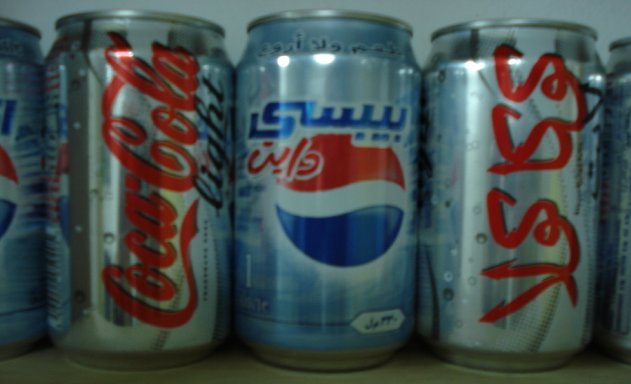
It is hard to overestimate the value of precise, current information and the understanding of local conditions when talking about almost anything, but especially concerned with persuasion and public affairs. Remember that when hearing from experts who purport to know a lot about really big and widely dispersed cultures or countries.  Even Coca-Cola tastes different in different places. There is no such thing as a global brand.

I was reminded of that during an unpleasant conversation I had with a woman who implied that she spoke for or at least understood Muslims.  She didn’t really specify, but she left the strong impression that she was talking about ALL the Muslims. Last I heard, there were about a billion and a third of them. I don’t doubt that she had important insights, but it is clearly not possible for anybody to be an expert on that many people, living as they do in such diverse circumstances.   Nor is it possible to craft any message or campaign that will appeal to all of them. It is just stupid to lump a billion people together. Yet stupid is rampant. 

I goggled that transparently stupid phrase, “what do a billion Muslims really think” and to my chagrin found lots of people who claimed they could tell me the answer.  There is a whole book with that in the title, hundreds of articles, scores of opinion polls and lots of activity by think tanks. I guess I should not have been surprised.  It has long been a profitable racket for experts to set themselves up as spokespeople for large unknowable masses. I have met those who “speak for” the workers, the business owners, the blacks, the whites, the poor, the rich, the famous, the unknown … I even met people who claim to speak for the animals, trees, rocks and for the earth itself.   I have even met people I did not know who claimed to speak for people like me. You just have to call them on this. 

One of the most important roles for a non-expert who is assigned to do something with experts is to keep them in their places.  This is hard, since they do indeed know more than you do in their area of expertise.  They can make you look silly for questioning them and most experts think their own field of endeavors is the most important or at least the indispensable link in the chain of effectiveness.   

But they do not know everything.  Developing real expertise is necessarily a narrowing process.   It is attractive to be THE expert and that means digging deep into something nobody knows, or maybe nobody cares, much about.  These kinds of experts may not have much grasp of the bigger picture, re how their part fits into the bigger whole.  They are so accustomed to intensifying the parts of their expertise that they forget to ask what their expertise is part of. The tricky tasks of the expert master is  to develop enough specific knowledge to ask the right questions,  enough humility to let the experts operate autonomously when appropriate and enough confidence and courage to stand up to them when necessary. Actually, a true subject matter expert rarely is a big problem for an experienced leader. They are like craftsmen, who do their job according to specifications. If you keep in mind that to a man with a hammer, every job looks like a nail, and you are sure that hammering is what you need, the main challenge is choosing the right people for the job in the first place.    

The problem people are the uber-experts, who extrapolate from what they legitimately know to claim all sorts of Gnostic knowledge that they claim to know but cannot explain to you because you can just never know it.  They tend to slither into places they don’t belong and develop a type of exclusive pseudo-expertise power that cows the timid, impresses the credulous and generally creates a pain in the rear for everybody else.  Anybody who claims to be an expert on Muslims w/o narrowing the category to something more specific is such an expert.   This goes for anybody who claims to represent any large group or have mastered any broad and complicated subject.  Little good can come from associating with them, apart from some passing entertainment value.  But the costs can be high in lost opportunities and misallocated resources.

Socrates warned us about people like that almost 2500 years ago. It is not a new predicament and it will not go away because it is too profitable for those doing it.  They struggle hard to protect their phony-baloney jobs and they are usually smart enough to put up a good fight.  The key to nullifying their power  is just to identify it for what it is and expose it to the light. Of course, that is easier said than done and sometimes even harder to explain to others.

Revenge of the Geezers

I am getting to that age where I get annoyed when I think we spend too much time thinking about the youth.   Don’t get me wrong.   My children are young and I used to be young myself.  I would be younger if I could. Youth has definite advantages.   But society is changing in ways that are leading us away from the youth domination of the recent past, which – BTW – may well have been a historic anomaly. 

Let me focus on the one area (other than physical prowess) where youth is supposed to enjoy the greatest advantage: technology.  A funny thing has happened on the way to complicated technology. As technology becomes more complicated inside, its use becomes more transparent and as it gets easier to use, more people easily use it.  You see this in the evolution of connectedness.  Early adapters were young, cutting edge and tech savvy.  Today the fastest growing user segment of Facebook is retired or close to it, those with the least familiarity with the newest technologies find them no more complicated than using a telephone. That’s progress.  If I asked you to picture an avid user of the new technology, I bet you would come up with someone young, maybe looking like that actor who plays the Mac on the PC v Mac commercial. But as I mentioned above, this is less and less true.   In fact, the most revolutionary aspect of the new media will be how it engages older people and brings or keeps them in the mainstream of society.   Older people have long excelled at sitting at home.  What does a guy with a computer do most of the time?  

Ironically, old people tend to resemble young people in a couple of important respects: many don’t have full time jobs and they have time on their hands.   Increasingly, that idle time is being invested online in both groups.

Labor force participation by ageI am not the first to say this, let me be among the most energetic in repeating that this age wave, supported by new technology is already happening.   You will see a continued diminution in the relative influence of the young.  IMO, marketers and politicians are insufficiently aware of this, despite obvious signals, and it is already biting them.  Take a look at this Pew Study from a couple days ago.  Let me hit the key quote, “According to one government estimate, 93% of the growth in the U.S. labor force from 2006 to 2016 will be among workers ages 55 and older.”

Watch the news reports of those town hall meetings.   Almost everybody who attends – pro and con – is either a senior citizen or soon will be.   And if you dig a little deeper, you find that they were often energized, informed and brought there by new media techniques, such as Facebook and Twitter.  The same technologies that keep you in touch with your grandchildren and fishing buddies can be turned to political or business goals w/o significant modification.  Those with their eyes on the youth didn’t see this coming.

The new media has already spread widely and it will continue to do so.  Nobody can ever keep up with all the permutations of technology. You may not have to as use becomes simpler. The day of the geek is coming to the close as we greet the bright dawn geezer.      

The Downside of Gray Power

I am not entirely happy about the new geezer power, even though I am more closely aligned with the geezer than the geek segments of society.   The biggest challenge our country will face is the exponential growth of entitlements, including Medicare and Social Security.  Entitlements already take up 2/3 of the Federal budget, up from 1/3 a generation ago.  That means that all the military, roads, foreign aid, post office, science, national parks etc spend only take up half as much of the budget as entitlements.   At current trends, in around twenty-five entitlements will take up ALL of what we now spend in Federal dollars (and we already spend too much).

FDR was very clever when he set up Social Security.    He made the retirement age 65, when life expectancy in 1933 was only 63 and he sold it as a fund, when it actually is a giant pyramid scheme.   The system worked well when giant generation of baby-boomers was working to support the smaller generations of their parents.   But now the baby boom is hitting the old folks’ home like that lump in the snake.  My generation will have to accept relatively less from these sorts of government funds than our parents did.   Politically, this is going to be the hardest thing ever.

I hope my baby boom generation – the biggest, richest and most assertive generation in American history – uses its new media leveraged gray power wisely. We cannot take all we are “entitled” to; we have to leave something on the table for the next generation.  They are OUR children, after all.  They need to keep more of their money.  The trends look good for us to stay active.  We are healthier, sharper, more able and many are willing to work longer, as the figures I mentioned above indicate.  Maybe it is better if we work and save just a little bit more for ourselves, work a little longer and let the kids off the hook a bit.  Continuing to be productive is (or should be) the price of staying influential. 

Social Security has been a fantastic success and there has been a lot of progress in America.  Back when FDR created the program, most people worked at jobs requiring hard physical labor.  They were literally worn out after a life at work.  Most retired when they couldn’t work anymore and shuffled off this mortal coil soon after.  Life has improved and so has liveliness of old age.  Yes, things have changed since the 1930s.

BTW – there is an interesting article about what might happen to assets as the baby boom retires at this link.   

BTW2 – people asked me about the cat in the picture above.  I just needed a picture and that is just a strange looking cat Alex and I saw in Rome.  We thought he looked a little like Hitler. 

Presidents/Politicians CANNOT Fix the Economy

Render onto Caesar … but don’t expect government to perform miracles.  You can’t always get what you want, even if everybody votes for it.  No government has been able to repeal the principles of physics, the march of time or the law of supply and demand.

It doesn’t matter if it is President Obama, Bush, Carter or Reagan.   I am sick of hearing the question on the Sunday morning news programs, “How is President ___ going to fix the economy.”   It just doesn’t make sense to think that any political decisions can fine tune or even quickly move something as massive and diverse as the economy.   What politics can do is create conditions that ALLOW the people to create and maintain prosperity and this is always a very long term proposition, and when we are talking about long term, it might mean decades or even generations. 

Beyond the obvious fact that presidents simply lack the power to command most of the factors in the economy, and it is a good thing, BTW, think about the time it takes to do almost anything.  To make it simple, let’s just go with an example of something government actually does control.   The roads we drive on and over which our commerce flows were laid out decades or centuries ago.  The decisions on whether to expand or maintain them, or not, were made by thousands of local jurisdictions over many years.  Quick changes are just not possible.  If you need a road in a particular place where you don’t currently have one, the president’s decision makes no difference.  If President Obama had the power to order a road built and he gave that order today, how long before you could drive on it.  Besides buying the land, laying out the plans, bringing the resources, you would have to contend with the NIMBY opposition and scores of lawyers. At best, there can be a road in five or ten years. So why do you think he can “fix” the economy with things not even in government’s legitimate control?

Yesterday I wrote a post mentioning a new process for hardening wood.   This small process could create new markets for sustainably grown softwoods and maybe go a great distance in curbing deforestation in tropical forests.   This small technology improvement might have a bigger positive effect on environmental protection, specifically CO2,  than all the government rules and posturing of the past year, which still have accomplished nothing. But most people have not heard of it.  If/when it starts to work, many people will falsely associate the improvements with that climate bill that disappointingly has so far gone nowhere in the Congress.  How many other things like this are running the economy? It reminds me of that old saying in medicine, “God cures; the doctor collects the fee.” 

America is much more than its government and no government can keep up with the innovations and imaginations of the people.  I am not a no-government guy.  I work for government.  I love government.  Government has an indispensable role in creating conditions for prosperity. There can be no free market w/o the rule of law.  Government creates infrastructure and sets the tone for society.  Government’s must have a monopoly over the legitimate use of violence and right to wage war.  Governments can produce fine monuments.  But everything belongs in its place and there are lots of things government cannot do.

What government cannot do is manage the particulars of economics or business.  Unfortunately, it is much more fun and politically profitable for politicians to wade into management and take credit for what is happening around them largely beyond their control, than it is to do the hard work needed to create the conditions for prosperity that will only pay off years in the future.   The incentive system is just all wrong.  

I think we have a profound pro-government bias built into our study of history and into our very understanding of how things work.  It is hard to get out of the intellectual trap of thinking that political leaders actually lead in all aspects of life because it is such an ancient formula.   A leader in a small tribe makes decisions that truly do affect the daily lives of their people.  The kings in the fairy tales do too.   In the old days political leaders were also economic leaders to a much greater extent than they are today.   The state was usually the big investor that handed out patents and monopolies necessary for anybody to do business.    This changed as economies got more and more complicated and the free market made it possible for most people to do business without day to day permission from the authorities, but our thinking is way behind the times. 

Today there are so many people making so many decisions that leaders can no longer understand, let alone command, the economy, but we are remain comfortable thinking that someone is responsible, both for good and bad effects. We like heroes and villains, and we imagine them if we cannot find them in real life.

IMO, we should take inspiration from the Biblical verse – we should render onto Caesar (the government) that which is Caesar’s; render unto God that which is God and let the people themselves sand the free market take care of everything else.   Everything has its proper role.

Presidents cannot fix the economy.  We wisely have not given them this power, which they clearly cannot handle and would lead to tyranny if they seriously tried. They can only create conditions that allow the people to make prosperity.  But they do have the power to mess things up if they over reach.  It is easier to wreck than to build, easier to promise than to deliver and easier to create the appearance of success in the short term that to create a sustainable prosperity. That is why we should be very careful what we ask of politicians, since they might try to give it to us or at least might try to make it look like they have.

Sustainable is Better than Natural

We make a lot of distinctions w/o even thinking about it.  One of the most prevalent and potentially pernicious is the idea that some things are natural – almost sacred and untouchable – while others are profaned by human contact.  

I think the goal should be sustainable, not “natural.”  Natural is a slippery, arbitrary and often arrogantly used term.   It is a chimera that assumes also that an environment that results from random chance and the interactions of non-human animals and plants is somehow qualitatively different than one with human influences.  This is just not true.   Some of the most productive, beautiful and sublime environments are the resulst of long term human interference and management.   They are not “natural” if that term implies human free.   But they are sustainable  

That is why I quibble with words like “recovery,” “damage” or “natural” used too freely when talking about human interactions with the environment. They can sometimes be appropriate, but they too often imply that something is broken and that we have identified a problem that we need to fix.   Some radical misanthropes who call themselves environmentalist actually believe that somehow the earth would be better off w/o humans.  Of course, this is a very short-sighted and ironically very human-based point of view.  

In fact, we would not want most human-influenced, human created, environments to revert to their pre-human state, even if that was possible and even if we could determine what non-human influence means, since there has not been such an environment in most of the world since the end of the last ice age or before.  The wonderful “natural” environments of pre-Columbian America were by no means natural, BTW.   They were created by Native American activities, especially fire, for example.  Humans have changed the environment ever since there have been humans.  Other animals have done so too, BTW.  It is the nature of all life.

Sustainable is clearly the better concept.  It provides a wide variety of choices and modulations of human influence. We will always have human influence as long as we are here, who cares after that, so why even talk about anything else?  So let’s go with sustainable, which is achievable and good, rather than some hypothetical “natural” state, which is – BTW –itself an artificial human philosophical creation.

(I have long contributed to the Nature Conservancy and I recommend everyone do it. What I like about the Nature Conservancy is its do something good perspective.   I like it that my money helps conserve and restore places to sustainable nature.   Read some of what they are doing for sustainable grasslands at this link.) 

I read a three articles today that touch on these concepts.  The first talks about how quickly ecosystems will revert to a sustainable “natural” state when humans move away.   The truth is that it takes a lot of human effort to PREVENT nature from obliterating the works of humans.  Some would argue that the new state is not “natural” and it is not pristine or natural in the purist or religious sense, but it is sustainable, which is what we should really care about.  

The next article talked about new environmentally friendly processes that can make softwoods as hard and resistant to the elements as tropical hardwoods.   This is important because we and do grow softwoods (such as pines) sustainably.  Tropical hardwoods tend to be essentially mined from rainforests, often illegally.   Replacing tropical hardwoods with sustainably grown temperate wood would go a long way to slow or even stop deforestation.   It seems almost too good to be true, but many really big changes pivot on small improvements in technologies and techniques.

The last article is about an unsustainable, well intentioned hubris. Spain has been subsidizing solar power, but it has proven unsustainable, i.e. it is not viable w/o subsidies; it doesn’t look like it soon will be viable w/o subsides and Spain can no longer afford to provide subsidies.  The whole worldwide market for solar is affected.

This is a good example of why governments should not try to favor specific technologies.  Solar does work, but not as well everywhere. The kinds of decisions must be made on local levels to allow the greater variety and localization.  The Spanish debacle might well have a desired effect, just not in Spain.  Prices are dropping because of the Spanish withdrawal. The lower prices will encourage adoption, maybe in places and applications where solar actually makes more sense.  

We should take the lesson for our own environmental legislation. The best regulation is one that gives people and firms incentives to use their intelligence and imagination to create innovations appropriate to their needs. General directions are better than detailed instructions. 

We humans are going to be on this earth for a long time to come. We are part of nature. We should not pretend we can separate ourselves.  Our task is to live sustainably on this planet. Trying to establish a pre or non-human perspective is just plain stupid. Human interventions can be good or they can be bad.  Sometimes plants and animals do better around human “footprints.”

Found in Translation

Meaning often lost is translation but you can sometimes find even greater significance in different interpretations if you look hard enough. I have long been interested in Taoism (the philosophy not the religion) and have been fascinated by the great variety of translations of the words of Lao Tzu.  Some of them directly contradict the others, so I have given up on the “true meaning” and rather go with the meaning useful for me. In other words, I take inspiration rather than direction.

I was talking to a Chinese translator who told me that Lao Tzu was not nearly so mystical in Chinese.  The translations had enhanced the mystic feel and may have created some where none was implied.  Lao Tzu, he said, was actually a lot like “Poor Richard’s Almanack.”  Consider the old saying, “Early to bed, early to rise, makes a man healthy, wealthy and wise.” Here is my reformulation, “He who is present at the dawn will come to know the robustness of fortune on the path of ancient wisdom.” 

I still go with the ancient wisdom, but I understand that a lot might be what the translator put there and what I am reading into it. This is really a good thing.  We improve it and make it more applicable to our circumstances. That is why it is impossible for something written just a few years ago to be a “classic”.  

To be a classic, a work has to have been interpreted and reinterpreted by at least a couple of generations, each accreting its own perspective and wisdom.   In other words, the wisdom of Socrates or Lao Tzu wasn’t as potent when it was first bottled as it became after being properly aged and filtered by subsequent generations.

Philosophy & literature, like fine wine, good cheese or even decent beer, require time to ripen.

Writing good literature in translation takes a good writer in the target language, since it is much more than just substituting words. Nobel-Prize winning poet Seamus Heaney’s translation of “Beowulf” is probably better than the original in many ways and we cannot say how much of its beauty is from the original and how much from the poet’s skill.   We have our pick of translations of the Iliad, the Odyssey and the great philosophers of the world.

I don’t remember much of the classical Greek I once knew, but I do recall the many possible interpretations of even simple texts and that some things couldn’t be rendered elegantly into English.  The most common challenge was a kind of framing (µεν …. δε), which we translated as “on the one hand … on the other hand” but it didn’t really mean that in most cases.  It was just a kind of notice that a comparison was on the way.  Sometimes it was used ironically, i.e. in the sense of saying no comparison was possible.   If you translated it faithfully, you might create the false impression that a comparison was made when none was implied.   If you were merely inspired by the meaning, i.e. did not try to be too literal, you could be accused of putting too much of your own personality into the translation.   If you read Plato or Aristotle, the translations are full of decisions and compromises made by translators, so never tether yourself too closely to any particular turn of phrase. 

My job has often involved foreign languages, supervising translators and/or using translations.   I am not sure that most people are aware of the types of considerations I mention above.    More and more I am going with the inspirational rather than the literal idea.  I know the pitfalls.  Whenever you lard anything with your own judgment, you change it.  But every choice is a judgment.  Should we leave a literal translation that we think be interpreted incorrectly by the listeners or do we go with something that might change the meaning? 

I recall hearing about a Russian who complained that the translator got it wrong.   He asked the rhetorical question, “Can a hunchback change his hump?” which was translated as, “Can a leopard change his spots?” There is clearly a difference.   A hunchback, in spite of the nobility of the hunchback of Notre Dame and the lovable subsequent Disney character, is vaguely creepy and menacing and the condition is usually the result of an accident.   A leopard is sleek and wild and his spots are a natural condition.  We don’t have that hunchback metaphor is English but the translator should have stuck with the clumsier literal translation.

The best translated speech I ever heard was when President Clinton announced support for Polish NATO membership in Warsaw in 1997.   But Clinton’s speech was not really very good.  The Polish translation was much better and delivered better (with sequential translation) by Victor Lipinski, who had a knack for the dramatic perfectly tuned to Polish sentiments, which Clinton lacked as an outsider.   Even though English is my language and I understood all the words (something I cannot always do in Polish) I could appreciate that the Polish was better.  But then it had the advantage of being enhanced by the emotion and the symbolic lifting of generations of oppression by Czars, Nazis and Communists.  That meaning was FOUND in translation floating on the aspirations of millions of people.

BTW – If I may digress on a spectacular memory involving a beautiful translation, I still remember that day in Warsaw in July 1997.  It had been rainy and overcast with black clouds all day.  The sun came out as if on schedule when Presidents Clinton and Kwasniewski came out in front of the Royal Palace to make speeches.  As President Clinton (and Victor) reached the crescendo, promising that Poland would never again be conquered, they released thousands of red and white (Polish national flag colors) into the sky.  They rose into sunlight and danced against the ominous dark clouds now receding into eastern sky.  No special effects artist could have planned it better.

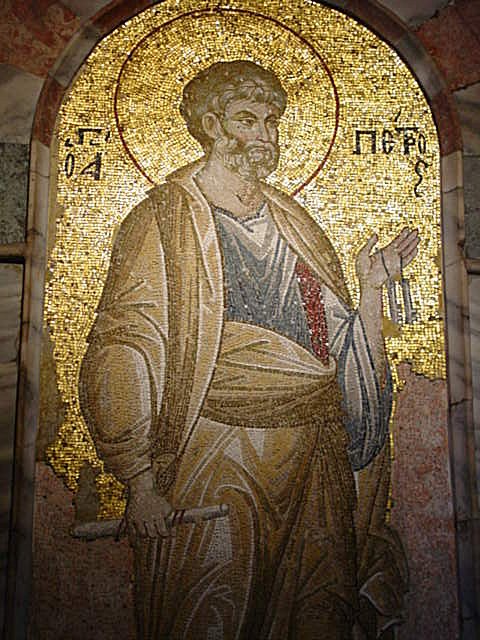
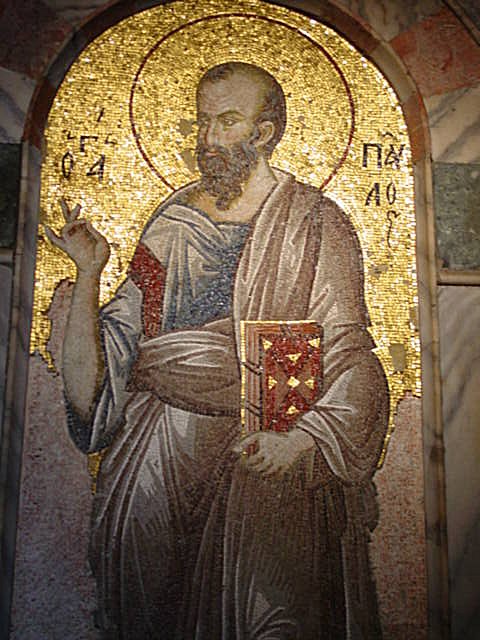
BTW 2 – The pictures above are St. Peter and St. Paul from the Church at Chora in Istanbul.  They actually require significant translation & explanation.  Although I am not expert enough to give the whole story, let me do the basics of what I remember the guide telling us.   The images of these two saints were more or less set in the first centuries AD and these two representations are typical.  Paul is balding and intellectual; Peter a big burly guy.  Since there are no contemporary pictures of the two men, the representations developed and scholars study how they changed over time as artists learned from each other.  They also draw on older, even pre-Christian models and the depictions are also dependent on the technology, i.e. mosaic used to create them. 

Notice the symbolism.  Peter is holding the keys to the kingdom of heaven.  The Popes in Rome made a big deal about being the successors of Peter and so the holders of the keys.  The Greek Church was less interested in that particular, but kept the same symbolism. From these mosaics and others around town, you can also see how the ethnic mix changed.  Presumably, the artist made portrayed people as he knew them around him. All of what is now Turkey was part of Greco-Roman-Christian world ethnically, linguistically and culturally.  To the extent that the native people living in Istanbul (then Constantinople) looked like Peter as depicted before the Turkish conquest, they were significantly different from the people living there today.  A guy looking like Peter might be mistaken for a German tourist in today’s Istanbul, although Paul could probably pass unnoticed on the streets.  So in these mosaics, we see tracks of the changing religion, culure, ethnicity and interpretations of history.  There is a lot of meaning beyond the pretty pictures.

Anyway, these mosaics are true classics, since they incorporate ideas and personality of generations long past.  They need explanation.  We may never get the meaning “right” but we can find the meaning nevertheless.
New Media’s Reach Exceeds Its Grasp

Measuring success in public affairs is hard because we don’t control all, or even most of the key factors. Beyond that, we are essentially trying to measure a cascading set of conditional probabilities, each more fuzzy than the one before.  First we are trying to measure attitudes that nobody really understands.   Then we are asking where those attitudes come from.  After that we want to know the strength of the conviction and how attitude make practical differences.   Do they change behaviors or outcomes?    Complicating analysis is that effects may be significantly separated from the causes in both time and space and you have to account for the effects of temporary circumstances and random chance. 

You begin to see the problem?  All we really need to care about is what people do, but to explain that adequately, we have to consider all the things mentioned above.    

Does the Rooster Make the Sun Rise?

It only gets worse. Public affairs can be a little like peeing in the Pacific Ocean saying it caused the rising tide and practitioners, me included, can sometimes strut like roosters taking credit for the sunrise.  In other words, we are not sure how the attitudes affected behavior, nor are we sure where those attitudes came from or the strength of conviction.  On top of that we are trying to figure out how our small input created a big output.  

Not that we are always merely mendacious when taking credit, BTW.  Public affairs is indeed all about leverage.   Very small input can often create monumental outputs using leverage of the public affairs environment as it pulls in outside resources.   Even this good thing, however, is just another problem for measurement.  The equation would look like this. 

Our input + lots of other resources we don’t control + luck + time = output, which MAY grow into a useful outgrowth.   We cannot control most of the factors in this equation and often cannot even know what they are, so instead we measure the reach (not the effectiveness) of OUR own inputs. Let me illustrate with one of my usual examples, not surprisingly an oak tree 

Mighty Oaks From Tiny Acorns Grow – But a Bushel of Acorns is Not an Oak Forest

If I plant an acorn, it may grow into a mighty oak.  How much credit do I deserve?  Maybe a squirrel would have planted an acorn if I didn’t.  Maybe one would just grow by itself.  Besides that,  I didn’t make the acorn.  I didn’t create the soil.   I cannot control the rain nor can I anticipate every destructive storm nor control all the bugs.  The oak tree will grow according to its form and DNA.   I cannot demand that it become a pine tree. In fact there is little I can do expect remove obstacles to it becoming the best it can be.   But if you come back 100 years later, maybe some kid will say, “My grandfather planted that tree.” 

In public affairs we are not dealing with acorns.  Our analogous measure is reach.   We can get a reasonably good measure of the number of people who COULD have received our message.   It doesn’t mean they DID receive our message or that they paid any attention.   So reach is a problematic measure. 

Don’t Count the Same Guys too Many Times

A look at Facebook shows examples of opportunity, challenge & problems associated with this kind of measurement. You might have a thousand friends or a big rock star might have a million fans.  But how much are they getting the messages?  We also habitually overestimate the connections.  If you have 100 Facebook friends and each of them has 100 friends, you do not have 100 x 100 or 10,000 friends because the sets overlap.  If your friends are also each other’s friends you may have only 100 in total. Overlap is usually not 100% and the real number is probably more than just 100, but it is far less than 10,000.   

Reach is not a very useful measure, but we like it because it is a relatively easy number to find or estimate AND it tends to be the largest number we are can get, especially if we engage in some willful ignorance about human attention spans and math 101 concepts of overlapping sets, as above.    

Reach Exceeds Grasp

And reach is relatively easy to astro-turf, especially in the new media.  There is an interesting article talking about how you can BUY Facebook friends and fans for as little as $.076 and $.085 respectively.  What reach!  If you have big bucks you can reach the all the world in theory.  Who can you blame if your reach exceeds your grasp, if you have a million fans who cannot remember your name or hear your message? 

Hey, the numbers are good, even if they probably overlap and may represent meaningless relationships.  We might become a little suspicious if our extrapolated fan bases (i.e. our estimate of our own fans to the exponent of their fans & friends) exceeded the total population of the earth, but achieving that might take a couple of months anyway.   

I am not saying we should not rejoice at successful numbers, but let’s not try to fool others and let’s not fool ourselves.  Reach provides ONLY the opportunity to engage and engagement provides only the opportunity to communicate and communication provides only to opportunity to make a difference.  You need to start with the acorns, but that doesn’t mean you automatically have a grove of big oak trees.

Continuous Improvement Makes Everything Look Bad Looking Back

Here we are again in the spasms of self-flagellation about how we treat (or mistreat) people who have planned and sometimes carried out the murder of many of our citizens. We worry that revelations about harsh tactics used to get information from some of them may have damaged our international reputation and there are calls for a full scale investigation to uncover and reveal additional details. As long as we do such things – the argument goes – we cannot hold the moral high ground nor expect cooperation from others.  The ends don’t justify the means.  Actions speak louder than words. 

But actions must be framed and interpreted, and that requires words and analysis. Sometimes the reason something is done does make a difference and the some ends can justify some means. I believe we make a big error in framing our actions by demanding, and letting others demand, a measure of perfection not attainable among humans.   In those terrible times after 9/11, I think the U.S. showed amazing restraint, even after we captured some of those who planned the attacks that killed thousands of Americans.  Under passionate circumstances, and even under normal ones, mistakes are made.   Humans overreact, over respond and overreach, and things done in the passion of one situation may seem stupid or even evil after those circumstances have passed.  We go over and over our mistakes, often very publicly, and say that it is a sign of strength to do so.  We allow a successful program to be “ruined” by one mistake or even one insensitive action or even one remark that could be interpreted as insensitive. We may be acting honorably or we may be overlooking the fundamental nature of error and improvement. Maybe we are doing both.  

You have to refine and re-refine what you do to minimize the scope of errors and also – of you really want improvement – you have to minimize the finding of blame.  Even a very rigorous system cannot eliminate all error.  And we have an additional caveat. While this total quality approach is great for physical processes and assembly operations, it still doesn’t work as well in emotion or politically sodden human affairs and it especially doesn’t work when you have adversaries.  Focus on your errors gets to be like trying to understand a contact sport from only from one perspective.  Every contestant is going to make mistakes, get hurt and inflict pain.  If you fail to look at the whole picture, even the champion will look like the loser by those criteria taken in isolation.

We justifiably complain that we don’t live up to our own high standards.   But that is in the nature of complicated systems, especially human systems.  An after-action analysis will always find flaws.    Mistakes should be identified and corrected and then we need to move on, avoiding the twin errors of glossing over mistakes or being blinded by them.  Learning and improving only takes place in that middle ground between treating errors as terrible sins and ignoring them as inconsequential.

I want to be very careful to underscore that I am not advocating lowering our standards.   America should and does hold to the highest standards and we can only improve setting the bar higher than we can presently achieve.  But I think we open the door too far for criticism when we allow some of the nastiest despots and terrorist to assume the high ground of victimhood.  It is the old problem of moral equivalence.  A man who takes a pencil from his office and the one who embezzles a million dollars are both stealing from their employers. But they are not really the same.

Every judgment needs to include the “compared to what?” question. If we allow the frame to be a comparison to some theoretical perfection, we will always come up short. We can always imagine something better than we can achieve.  And ironically the more we work to improve – i.e. the higher the standards we set – the worse we look in relation to our own every rising goals.  The more positive achievement you make, the worse everything else looks.