Public Diplomacy Persuasion

Another FSI lecture is below.   I am doing this one on Monday.   The PowerPoint is available below. It has a lot of the same themes as the last one, but is significantly different.

Everything is always becoming something else

Πάντα ῥεῖ  – everything flows. That is what the ancient Greek philosopher Heraclitus said more than two and half millennia ago and he was right. But the fact that he said it around 500 BC indicates that the concept has been around and talked about for a long time. Yet it seems to be a concept that each generation discovers for itself and then thinks that it is the most afflicted – ever – by change.

We always have and always will live in a dynamic environment.  What is more, our attempts to understand and act within it alter it, so that we never really face the same challenges twice.  (Heraclitus also said that you can never step twice into the same river – and he was right about that too.)  There is no finish line; there is no stable end goal.  Success means sustainable change.
So I don’t think my reference to Heraclitus is as obscure as it might seem in the context of something as dynamic as public diplomacy and the media. Our job as public affairs professions is to understand the ebbs and flows of events, to take advantage when things are flowing in the right direction, help direct them when we can and know when to get out of the way of the big waves.

Portfolio or Toolbox Strategy (for an uncertain world)

No technique or media tool will work in all situations.  That is why we need to deploy the whole panoply of tools and techniques and know which combinations are best.  This is more an art than a science.  The key is flexibility. Don’t get too enamored with anything in particular or develop strategies around one platform. You don’t want a Twitter strategy.  You want a strategy that may use Twitter as one of the tools. Carpenters don’t have “hammer strategies.”   They have building strategies that may involve hammers as one of the many tools in the box.

There is no such thing as a global brand or a one-size fits all

Even a ubiquitous & simple product like Coca-Cola tastes different and is marketed differently around the world.  The reason they teach us all these things and all these languages at FSI and the reason you make the big-bucks as public diplomacy professionals around the world is that you are supposed to understand the local cultures and environments and apply a nuanced and appropriate persuasion strategy.  I would add that almost all the effective public diplomacy (as opposed to public affairs, which happens mostly in Washington, BTW) work occurs at posts overseas.  Washington programs should be in business to support the field in this respect.   This is something we sometimes forget.
We are not allowed to change our “product,” i.e. the United States and its policies, but we can choose which aspect to emphasize, what analogies to make, what frames to deploy, what relationships to cultivate and when and where to do these things.

The human equation: bridging the last three feet

Edward R. Murrow, the greatest director of USIA or public diplomacy, observed that our communication technologies could span the world, but the real persuasion took place in the last three feet – human contact. He lived in the days before Internet. IMO, internet can (although less easily than people think) create or at least sustain the kinds of engaged relationships Murrow was talking about, but we still have to build those relationships. There is a cognitive limit to human engagement. You can only keep in real contact with a couple hundred people, although new technologies may expand that number, it does not reach into the millions or even the tens of thousands.  That is why you have to set priorities.  You just cannot love everyone equally and any strategy designed to reach everybody will satisfy nobody.

There is no garden w/o a gardener.   

You cannot outsource or compartmentalize your brains or your engagement.  The person doing the public diplomacy must be involved with the public diplomacy decisions.  There just is no way around this.  If we don’t get involved, we cannot make good decisions.  Too often, we just try to shunt off the PD function.  We hire consultants.   Many consultants are good, but a consultant is often like the guy who borrows your watch and then charges to tell you what time it is. If we outsource our decisions, we essentially outsource our intelligence. Then THEY know what we need to know.  It is a lot like hiring a guy to look after your spouse.  Even if it seems to make her happier, maybe that is your role. BTW – be very wary of pseudo-experts who claim to “speak for” large groups of people or have some kind of inside knowledge that cannot be replicated or properly explained.   If they cannot explain it to you even in broad strokes, they probably don’t understand it themselves and often they are just hucksters protecting their phony baloney jobs.   We have too many such people hanging around us not to trip over them occasionally.

So let me sum up before I move to the next part.  Technologies are new; human relations are old.  Our “new” methods return to an earlier age when communication was engaged, individualized, personal, two-way and interactive.  And for public diplomacy the lessons of anthropology (people) trump technology (machines.) How does public diplomacy really work?

Forget about mass marketing & advertising analogies. We are not selling something as simple as a can of soda and we do not have the resources to engage mass markets. We are not trying to build awareness (who is not aware of the U.S.?) and content DOES matter.Public diplomacy is a mass networking proposition, where we build key relationships with opinion leaders and use leverage to allow/encourage others to reach out, who in turn reach out …  We cannot reach THE common man (because he doesn’t exist) and we should be careful not to mistake A common man for THE common man.

There are thousands of books and experts who will point to the example of the obscure person who did something great.  They are right; but it is really easy to pick Bill Gates out of the crowd AFTER he has been wildly successful.   Then it is easy to explain why he succeeded.  Of course millions of others did similar things and did not become the richest man in the world.   They call this survivor bias.  In many ways it is like a lottery.  We can be sure that SOMEBODY will win, but we cannot tell who before the drawing.  So we have to play the odds and we cannot treat everybody who buys a lottery ticket like a potential millionaire. 

Humans are social creatures who make decisions in contexts of their culture & relationships We make a big mistake if we treat people as members of undifferentiated masses.  Human societies are lumpy. There are relationships that matter more and some that matter less.  And (as per Heraclitus) they are in a constant state of flux. People make most of their important decisions in context or in consultation with people they trust.  Later they might go the some media sources for confirmation or details. Probably the biggest decision you have ever made was buying a home.  Did you just read some literature and make an offer? Or did you ask around and talk to people you trusted?  How about the car you own?   We like to explain our behavior rationally, but relationally will provide more reliable assessments.

Information is almost free and a wealth of information creates a poverty of attention

We now must find or create social context for our message to get attention.   I always laugh (at least to myself) when I hear someone say that “we got the message out” or “We reached a million people”.  I am going to start calling this the barking dog strategy, because like the dogs, we just shout “I’m here; I’m here; I’m here.  It doesn’t matter what you say; it is what they hear that counts.   If your message does not say the right things, if it doesn’t fit into their cultural and socials contexts and if it is not delivered in an appropriate way, it doesn’t get through.   I will reiterate that the reason you get those big-bucks is to understand the right time, place and context of the communication.   The new technologies have not made this easier.

Understand – Everything has rules and patterns

I mentioned Heraclitus.  Let’s go a bit farther east and think of Lao Tzu.   He talked about the need to understand the “Tao”, the patterns and logic in all things.  Understanding these things could make the most difficult tasks fluid and easy.   There is usually easier and harder ways to do things.  Sometimes you CREATE more resistance and make less progress by pushing too hard.   So try to understand before you try to persuade.  If people have been doing things for a long time, there is a reason.  Figure out what that is and persuasion becomes much easier.   And always look for the links and relationships.  People may not be aware of what drives their own behavior, but it is often linked to social acceptance. And a person’s outlook often changes more based on the perceived future than on the present reality. 

Let me digress with a fish story from my time in Iraq.   During the late unpleasantness, Coalition forces had to ban fishing on the Euphrates River for a time, to prevent insurgents from using it as a highway.   But fishermen didn’t return after the ban was lifted, even though the fish were plentiful and bigger given the no-fishing respite.   We thought of helping them buy new boats, nets, sonar etc. But the reason that they weren’t fishing was much simpler – no ice.  The ice factory had shut down and in this hot climate if you cannot put the fish on ice, you cannot move them very far or sell them. We helped the ice house back into operation and the fishing started again.  

ENGAGE – influencing your community but also being part of it and willing to be influenced 

This story shows the importance of engagement.  You also have to get out – physically – and meet people where they are.

Inform & Interpret – turn information into useful knowledge

Engaging is fun and essential, but if we are not giving the taxpayer value for their money if we don’t inform and persuade.   Since information is almost free, what do I mean by inform?  This means turning raw information into useful knowledge and narratives.   Even simple facts must be put into contexts.  What if you didn’t have any dresser drawers or hangers in your closet?  What if you didn’t have any bookshelves or cabinets and all you stuff was just lying on the floor.  It would be hard to find things and many things would not be useful.  Turning information into knowledge is like putting things in some order.  In the public diplomacy realm, that usually means framing and narratives.   People understand stories and until they have a story that makes sense, information just sits there, useless as the shirt you cannot find under the pile of dirty clothes.  Analytical history, BTW, as opposed to antiquarianism or chronicles is depends almost entirely on framing. The historian must choose what to put in and what to leave out and that makes the story.

So if we are talking about actual persuasion, it probably won’t help just to make information available. Providing information was a key to our success in the Cold War because accurate information was in very short supply. Today in all but the dwindling coterie dictatorships in the world’s most benighted places, information is already available.  It is how that information is put together – the contexts, relationships and the narratives – that counts.

As persuaders we need to acknowledge what we know, what salesmen and marketers have long understood and what even science is beginning to explain. We are not in the information business. Information and facts are part of our raw material, but our business involves persuasion that is less like a library and more like a negotiation paradigm and rational decision making is not enough to achieve success. I mentioned framing, but I should say a little more.  The frame is how you characterize information or events.   If you want to be pejorative, you can sometimes call it spin, but there is no way you can understand complex reality w/o some kind of frame. Most of our frames are unconscious, but that doesn’t mean they are not powerful or pervasive.  Think of the ubiquitous sports frame.   Describing something like American football, (i.e. centrally planned, stop and start with specialized plays and players) versus football other places (i.e. fluid, fast breaking with the players less specialized) makes a big difference to how it will be perceived. Or think of how we try to frame our presidents.  We want our candidate to be in the frame with Lincoln and Washington, Warren G. Harding and Rutherford B Hayes, not so much.

Build a community & be part of a community

 Figure out what you can contribute and do it.  Remember people make decisions in the contexts of their relationships.  Also make sure that you get something back. 

The basis of almost all human relationships is reciprocity. All human societies believe in reciprocity. It has survival value. You want to be able to give to your fellow man and expect that he will do the same when you are in need. When that breaks down, so does civil society. It is probably a good idea to be SEEN to get something in return anyway, since if you don’t others will impute an ulterior motive anyway.

I know that this sounds crassly materialistic, but the reciprocity need not be material. You might help a person in the “pay it forward” mode, assuming that when he gets the opportunity he will help somebody else. The reciprocity might just be gratitude. But when a recipient is left w/o some way to reciprocate, a good person feels disrespected.  At first they are happy to get something for nothings, but they soon learn to despise their benefactor.  And maybe they should, since his “generosity” is taking their human dignity.

A simple rule in persuasion is that it is often better to receive than to give.  Let the other parties feel that they have discharged their social obligations, maybe even that THEY are the generous ones. You notice that the most popular individuals are rarely those who need or want nothing from others, even if they are very generous. And one of the most valuable gifts you can receive is advice and knowledge.  Let others share their culture and experience.

Just a few more short points …

Inclusive & Exclusive 

Communities are inclusive for members and exclusive for others. You attract nobody if you appeal to everybody. You have to earn membership in any community worth joining. 

Personal – or at least personalized  

Editors and marketers have tried for years to homogenize for the mass market. That’s how we got soft white Wonder bread and Budweiser beer.  Niche markets – and social media is a series of niche markets – require personality.  We do a poor job of segmenting our market in public diplomacy.  This is something I will work on when I get to Brazil and I suggest you think about when you get to your posts.

Reiterate

Success is continuous learning – an iterative   process- not a plan – and a never ending journey.  As I wrote up top, we never get to the end. We have to learn from our failures and our successes and move on. The best we can do is make our own ending worth of the start.   

Notes on Social Media & Public Diplomacy

A more mature understanding of the social media

It is no surprise that our early forays into the media felt a bit like returning to high school.   Much of the social media was for and by teenagers and catered to their motivations and predilections.   We followed through that door, looking for that ever elusive youth market and we were about as successful as adults always are when they try to “hang around” with teenagers and young adults.

This is one of the impressions I got from participating in an open discussion about how we (State) use social media in Washington and at posts at the tail end of the FSI course on using the social media.  In addition to teaching techniques this course was also designed to assimilate experience from those who actually work with the social media on a regular basis in real world public diplomacy, making, as course organizer Bruce Kleiner characterizes it, a “why-to” as well as a “how-to” course. 

Bruce ran what amounted to an informal expert practitioner focus group and since Bruce and I had worked together to design this module, I got to be there to take part and take notes.
The good news is that everybody is now using a wide variety of social media methods and platforms in public diplomacy.  We no longer have to do the sales job.  And we are maturing.  You can see the changes month-by-month.  Not much more than a year ago, it was enough to be on the media. 

At first we looked to the social media for numbers.  In many ways adopting the teenage paradigm of popularity, we measured our own worth and that of our programs by how many people put their names on lists, called themselves our friends or said they approved of our comments. We learned how to build audiences and found that it was easy.   But we don’t have the audiences we want and we don’t really have the audiences that want what we provide.

Several people complained that they were pressured to create and populate Facebook or Twitter realms w/o specification about the kinds of audiences they were supposed to get.   The result was massive, unsegmented groups of fans or friends, with little commonalities of interests.  We indiscriminately push our messages to these groups and call it a success if we reach a million people. But  we are now exiting this stage of development.

The dogs bark, but the caravan moves on

It seemed fairly unanimous that audiences and content count.   The social media can get people’s attention, but we have to hold it once we got it.  This is harder.  I compared some of the social media to barking dogs.  The bark says “I’m here; I’m here; I’m here.”  Our audiences are acknowledging our presence and now asking what is it we want to say?   If the content that follows is insufficient or not well targeted, we will be about as effective and maybe as annoying as a barking dog.

This transition will not be easy.  We have developed general social media audiences but we want to pass messages about specific topics.  It is unlikely that any particular people will be interested in all or even most of our topics and few people will sift through all of what we send to find the nuggets of gold. 

Segment the audience and sell to the segments

Skilled marketers know that marketing is not selling.  It requires understanding your customers, your products and your potential products and putting these things together.  It is easy to take marketing analogies too far, but this one fits public diplomacy well.

The first imperative is to segment our audiences.   This may mean trimming them to smaller and more interested proportions.   A community that allows everybody in quickly becomes a mob, where important ideas and messages are lost in a sea of inanity. This actually fairly describes much of the social media.  If we want to make this medium useful, we have to tend to our audience segments.

Of course addressing a market segment implies that you have some product particularly appropriate for that audience.   This means content and often very specific content.   An individual interested in climate change, for example, will not long remain satisfied with simple information aimed at a general audience.   This will apply to any subject we can think of and it will happen even if we are trying to talk to experts.  An informed layman will quickly move beyond the general information and demand more.   If they don’t find it with us, they will move elsewhere.   Information is easy to find on the web.

Social media exacerbates a classic sales temptation.  An aggressive salesman can sell products his organization cannot reasonably produce or deliver.   A good salesman ensures that customers get what they want and his organization can produce and deliver what he promises.   This is often the difference between short and long term success.  

Another temptation is to use the social media as a conduit to unload our products into the market.   I asked how many people would actually read the various speeches or watch the videos we send out.  The response was not overwhelming.   If we, who are more interested in such things than a most people, will not be interested in these things, why do we think others will want them?   We have an important role to play for sources or archiving.    Most people will not read through a whole speech by the Secretary of State or the President, but many people want to have it available as reference.   They essentially mine out the nuggets of information they want.   Filling this need is a web 1.0 function or even just an archiving task.   We might use social media to remind audiences that these things are available, but regularly sending out texts is probably a waste of time and may even morph into the barking dog mode of annoyance.

Culture matters

It was clear from the discussion that people at our posts have many similar problems and successes with social media.  It was equally clear that there are substantial differences in what is possible or desirable based on local cultures, environments and priorities.   There is no such thing as a global product and we need our people on the ground to tailor and modulate our messages.   BTW – it is also very important to have up-to-date information from people on the ground.  Conditions change rapidly and what worked last year may be a disastrous failure this year.   There is no substitute for local expertise.  Social media can leap borders, but it still has to appeal to local people when it arrives.

Answering criticism

Another audience question concerned responding to criticism.   Sometimes we just have to repeat the same answers over and over because there is nothing else to say. This may not be satisfying to us or others but it is the way it has to be.  We agreed that we should welcome legitimate criticism and answer it truthfully and forthrightly.   There is a danger, however, of getting too deeply involved.  We don’t know how many people are really involved in an online discussion and/or if it may reach a wider audience.   We also don’t know the level of commitment.    For example, there might be only a couple individuals criticizing us.  Maybe they have thousands of friends “involved” but these people don’t really care.  Remember the difference between involvement and commitment can be seen in a ham and eggs breakfast.  The chicken is involved; the pig is committed.

We can never be as efficient or nimble as a private firm

We talked a little about the differences between what we (USG) can do versus what private firms, or even smaller governments can do.  Much private effort in the social media is to simply build awareness or name recognition.  Unlike most private firms, the USG has no need to build awareness of itself.  Everybody knows who we are.   We also must recognize that people may see even our innocent effort as menacing.   I told the story about my recent experience with Amazon.com.  I checked out a few books on ancient Greek literature a few days ago. Now Amazon.com is sending me updates on books in ancient Greek.  Their machine has noticed and categorized me. I don’t find this offensive and it may help me find things I might want.   Now imagine that you are a citizen of a country where America is not universally liked.  You learn that we have the kind of information on you that Amazon.com has on me.  Are you happy about that?   What if you find out that the U.S. Government wants to “help” educate your kid?  We have to recognize that we are not a normal organization and that our embrace is not always welcome.   That means that we can almost never just copy what others are doing successfully and we will never be as efficient or nimble as private firms because we cannot let ourselves be so.

Somebody has to do it

There was mention of the problems of staffing.  Social media duties tend to get tacked onto the workload.  Since most posts are already working with reduced staffs and already “doing more with less,” this can be a strain.  There are no easy solutions to the staffing problem.   All of them involve priorities.  We agreed that posts need to identify who will be doing the new work and how much time it will take.  Then they have to ask and answer the question whether the new duties are important enough to displace old ones, and if so what.   Of course, social media will sometimes automatically displace older duties.   The need to copy, collate and distribute is vastly decreased because of the social media, for example.   As with most management decisions, it might be better to reengineer and/or eliminate whole sets of tasks rather than tinker around the edges.  

A flatter hierarchy might be very helpful, since a great deal of time is spent getting clearances and making fairly meaningless cosmetic changes to documents.   The old saying that you shouldn’t spend a dollar to make a dime decision goes for wasting time too. 

The medium is not the message

Finally, we have to recognize that the advent of social media may be less immediately revolutionary than we initially thought.   Most people still get their information through traditional media, especially television and radio.  When President Obama spoke in Cairo, for example, it was hailed as a social media success but almost everybody who saw the speech, saw it on television.   Even people who saw it later on Internet saw it essentially through the television lens, just delivered differently.  And following up on social media has not proven as successful as the original excitement would have implied.  You still have to have something to say and you still have to maintain relationships.   Social media will become increasingly important as components in the toolbox of public diplomacy, but it will never be a standalone technique.   Social media can support programs, but it never can be the program itself.  The medium is not the message.  

BTW – I gave the keynote to this course.  The PowerPoint is available below.

Brazilian Elections

Brazil was once derided as “the country of the future and always will be” but it seems to have become the country of today.   The economy is doing very well, even in these tough global times and this year Brazilians will vote in their sixth free presidential election. That was the topic of a seminar I attended today at the Wilson Center.

It was interesting even before I got into the room.  As I checked for my name on the guest list, I noticed that we were all listed by our first names. I had forgotten.  That is how they do it in Brazil.  You generally call people by their first names, even if you don’t know them well.

You can read about the panelist at the link above.  I am going to write in general just to put out the quick note.

Brazil faces the challenge of success. The currency is stable; economy doing well and Brazil is getting the international respect it has long sought. Much of this is the result of the “Plano Real” enacted in 1994. At that time, Brazil was in dire straits and its options were limited. They had to follow good macroeconomic policies and privatize or at least discipline state owned firms.  Today, options have expanded and so has temptation to slip back into the state capitalism or socialism that created so many problems in the past. The Economist featured and article about that last week, and comments of panelists echoed some of the same themes.

The middle class has grown. Brazilian sociologist divide their society into groups A,B, C, D, E.  A&B are fairly rich. C is middle class, i.e. people can afford some things like nice TVs, computers etc.   The C class has grown by thirty million in the last decade and has gone up from 34% to 49% of the population. These people are feeling good and Brazilian consumer confidence is at an all time high.  The issues are “middle class” priorities, such as crime, drugs and schools. Concerns about jobs, inflation and poverty have moved into the “givens” categories and do not motivate voters as much in this election.

The current President Luiz Inácio Lula da Silva, just called by “Lula,” comes from the workers’ party (PT) which was socialistic, but Lula has followed policies that have mostly made businesses and investors happy. He is very popular, and could almost certainly win a third term, but Brazilian presidents are limited to two terms (like ours). So he is trying to pass his popularity to Dilma Rousseff (just called Dilma) his former chief of staff, who will run on the PT ticker. Dilma has never run for office before, so nobody knows how well she will do. Lula is phenomenally charismatic, Dilma, not so much.  The question is whether Lula will be enough. Panel members pointed out that it is easier for Brazilian politicians to control the message  and that PT will protect Dilma.

The main opposition candidate is Sao Paulo governor Jose Serra.  Serra is ahead in the polls, but everybody agreed that it is much too soon to tell. Serra (they called him by his last name, maybe because Jose is such a common name) is known as a competent manager, but not charismatic as Lula. IN this election, where most people are content with the status quo, his strategy seems to be that his management competence will be better to maintain and enhance the good times that people are living today.  But it is always hard to sell change when times are good.

Some of the outlines of the election are already clear. Serra is strong in the richer parts of the country (the South and Southeast) and among the richer people. The panelist agreed that Dilma will carry the poorer parts of the population, but Serra will need to ensure that the loss is not a landslide.

The question and answer session added a few insights.  For example, the panelists agreed that race is not an issue in Brazil as it is in the U.S.   Brazil doesn’t treat race in the binary way we do. There has been a lot of racial mixing and it is possible for siblings to be in different racial categories.   Most Americans “blacks” would be thought of as mixed race in Brazil and many would even be classified as white.  There is some trouble now with the idea of quotas.  One person told a story about applicants at the University in Brasilia where twin brothers categorized themselves differently and the one got in based on race preference.  

Internet is still not important politically in Brazil.  Radio is still the big way to reach people.  This year, however, it will be possible for candidates to solicit money over the Internet and the parties have brought down U.S. consultants with experience raising Internet money here.  Nobody knows how that will work out.

The most interesting guy on the panels was Alberto Almeida, Director, Instituto Análise.  His talk was interesting and delivered with a great and amusing style.   I will have to make a point of looking him up when I get to Brazil.   He wrote a book called “A cabeça do brasileiro.”  I would like to read it.  Unfortunately, it doesn’t seem to be available on any of the online bookshops I can access.

There is some other references from the Wall Street Journal

Short Cuts

Being able to cut through Fort Meyer has greatly improved my biking to work experience. I had almost forgotten that I have this blog to thank for this. One of my colleagues at State Department send me an email telling me that Fort Meyer was open again after reading this post.

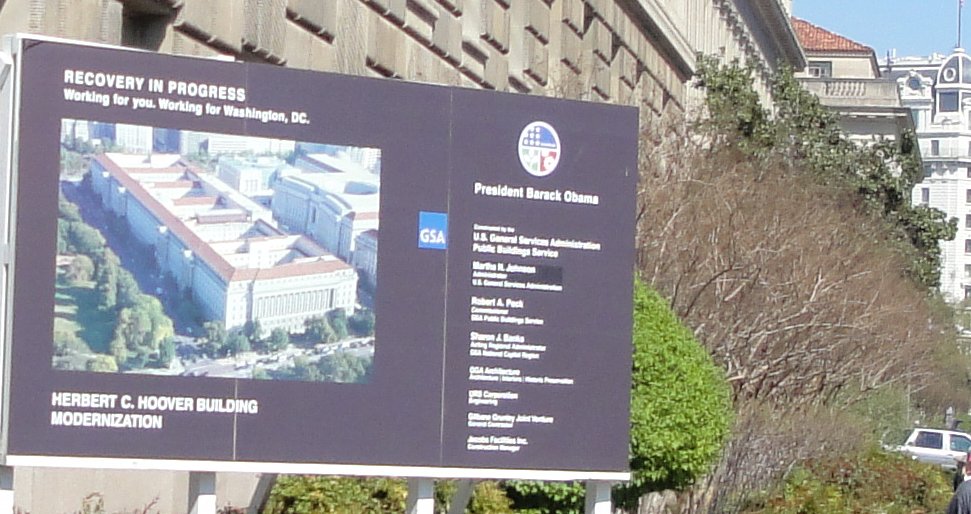
Above is an interesting sign of the stimulus. It struck me as funny for a few of reasons, first because it is the Hoover Building. Hoover’s reputation on economic recovery is not that good. Second this renovation started a long time ago. Chrissy used to work in that building and they were already renovating it when she was working there back in 2007/8. Third, this building was one of the first big government buildings in Washington. It was the biggest office building in the world when it was completed in 1932. 

Above is new bigger home that replaced a little ones. This kind of “tear down” or “in filling” is still happening, as you can see, but has slowed down a lot because of the recession. People buy the smaller houses, like the one at the right, tear them down and rebuilt bigger, newer ones, like the one on the left, on the lot. This one is not as big as some and it seems to fit in well with the neighborhood. Sometimes people build huge houses that essentially cover the entire lot, often literally shading out their neighbors. 

Imitation is the Sincerest Form of Flattery

If imitation is the sincerest form of flattery, its lack much be a sincere form of rebuke and our hypertensive desire not to be seen to be intolerant of “judging” makes it one of the few measures we can actually use to understand what people really think.  The capacity to copy traits you think are good or useful and let the negative ones die out is one of the primary benefits of diversity.   It is the essence of adaption and the lubricant of innovation.  It is how all successful people and groups have prospered in practice, but it has never been very popular in theory.

It seems a little mean, especially since it will tend to fall hardest on the least successful individuals and groups in society, since they are almost by definition doing the things that don’t work as well. Nobody wants to copy what losers are doing. And it gets entangled with ideas of cultural values and ethnicity.

What is culture?  Basically, a culture is a set of habits and traditions that were useful at least some times in the past.  Whether they remain useful is a question we have to ask constantly. There is nothing sacred about any particular cultural traits and while we should be very careful when changing long-established practices and relations – like ecology, they often have connections and purposes that are not immediately apparent – change them we must.

American culture is extraordinarily good at this. In the 1980s, we went through a revolution in business management, where we copied, adapted and developed many organizational principles from Japan.  Emphasize those words adapted & developed.  It was not just a copy; it was something better suited to our needs. Or consider the changes in the American diet, at least the one we know we are supposed to eat. My father would not recognize many of the things we commonly consume. We have imitated and developed.

Yet it is a common theme that Americans do not learn from others and try to force others to be more like them. One reason for this is that we adapt & develop with so much ease that it often goes unnoticed, even by us.  Another is a kind of bias against American ideas.  When we adopt something, it seems to become “American” and others might resist it for that reason, often while imitating it, BTW – the sincerest form of flattery – because it works. But I think a lot of it has to do with the other side of that flattery equation. The lack of imitation is a kind of rebuke and there are lots of things we don’t imitate and don’t want to imitate.

But too often we are too hypocritical, i.e. politically correct, to be open. Instead we praise, but don’t take any concrete steps to learn or adopt. 

In my observation, the more people effusively praise something, the less they actually respect it* and if you have to have a special sponsored celebration you can be pretty much sure that nobody will be imitating whatever/whoever you are celebrating (i.e. they don’t really want it).   Think about it from the point of view of what we really want. When we were trying to learn about Japanese quality control methods a couple decades ago, we didn’t have to sponsor special months for it. Everybody wanted it. People & firms paid their own money and spent their own time trying to learn about it because they really thought is was something they wanted.

The cynical saying that you should either be sincere or fake sincerity only works in the short term and only for transactions that involve mostly words. If you loudly praise the food I serve, but won’t eat it, I know you don’t really like it.  After a while, I will resent the insincere praise.

We should respect all humans because they are human, but there are some types of respect that cannot be given or demanded; they must be earned. You earn this kind of respect by what you do over a period of time.  It means doing something worthy of emulation or creating something worthy of imitation. Respect is a kind of mutual society. You can only get it and only give it if you are doing the right things. 

This is the harder part. There are some people whose respect you don’t want and some whose respect you can’t get. When you are not getting the respect you think you deserve, it usually is your own fault, but sometimes it really is their fault. 

* Here I am talking about traits, habits and culture. Of course, we may legitimately praise heroes or great events, but even that can go overboard.

BTW – the picture is a metal tree in the sculpture garden near the Capitol Mall. I hate it. Who needs an imitation tree when there are plenty of real trees. I wonder how much they paid for it.

Spring Forest Visit

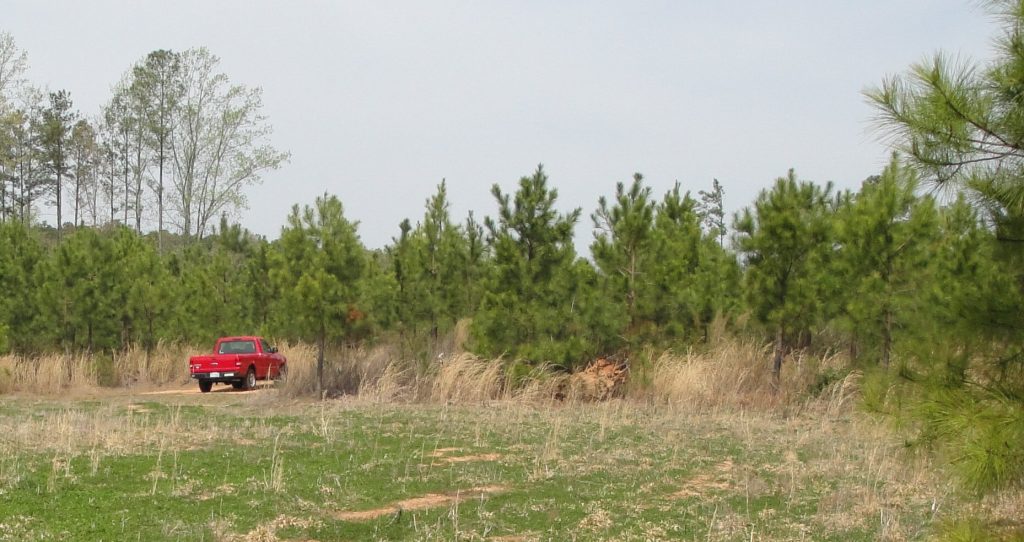
It was a little early to go down to the farms. The trees haven’t quite started to grow yet and the clover is still small and not flowering. I will be back in a few weeks. But I wanted to check on flood damage now. Above are the trees near the clover field at the top of the hill. The truck gives perspective. The land was clear cut in 2003, so you can see how much the trees have grown since then. The biosolids helped them grow faster last year. Below is another truck comparison. There is an interesting detail. Look at the two trees behind the truck. The round top one is a “volunteer” i.e. natural regeneration. It was probably a little tree when the place was cut. The one next to it is a planted genetically “super tree.” Because of their location at the crossroad, I have been paying attention to this place. The round top tree was twice as big as the ones around it when I first noticed. Today, you can see that the one next to it is a little bigger and I expect that after this growing season it will be significantly bigger. I will take another picture.

I saw clear evidence of heavy rain and lots of runoff, but no real damage. The places near the streams overflowed, but that doesn’t hurt the trees. The water is running UNDER one of the water pipes. I figure it will undercut the road, but I don’t think there is much to do about it. I will put in a load of rocks and turn it into a ford when/if it collapses. I think it will be better for the water to run over instead of under. 

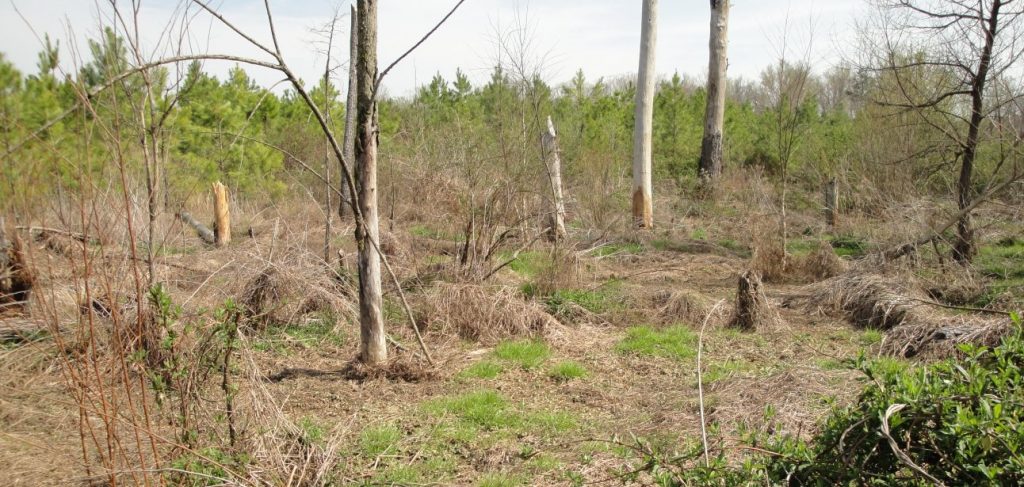
One of the little streams changed course last year. It went back to its older course. When I dig down, I find sand and gravel all over, indicating that the stream has changed course a lot. It creates wetlands until the mud piles up into natural levies, and then it moves again. You can see from the picture above that there have been times when the ground was dry for a long time.  The dead trees were alive when I got the place in 2005, when the stream shifted and evidently drown the roots in wetland. I suppose that now the stream has shifted again, it will be dryer, although the whole place is spongy.

I also think that runoff will decrease over time as the trees on the slopes get bigger and their roots absorb more of the water before it hits the streams. 

I want to get the trees on the Freeman tract thinned this year or next, before I get to Brazil.   Above you can see from the comparison with the truck that the trees are big enough and thick enough. They will be fourteen years old this year, which is a little early for thinning but within the range.  Below is the power line right-of-way. They replaced the wooden pylons with steel and kind of tore up the grass. I have eight acres under those things. I am looking into establishing quail habitat, since I cannot plant trees (or allow them to grow) that would interfere with the wires.  On the plus side, it provides a long area of forest edge and wildlife plot and the utility company maintains the road. 

Spring has Come to Washington

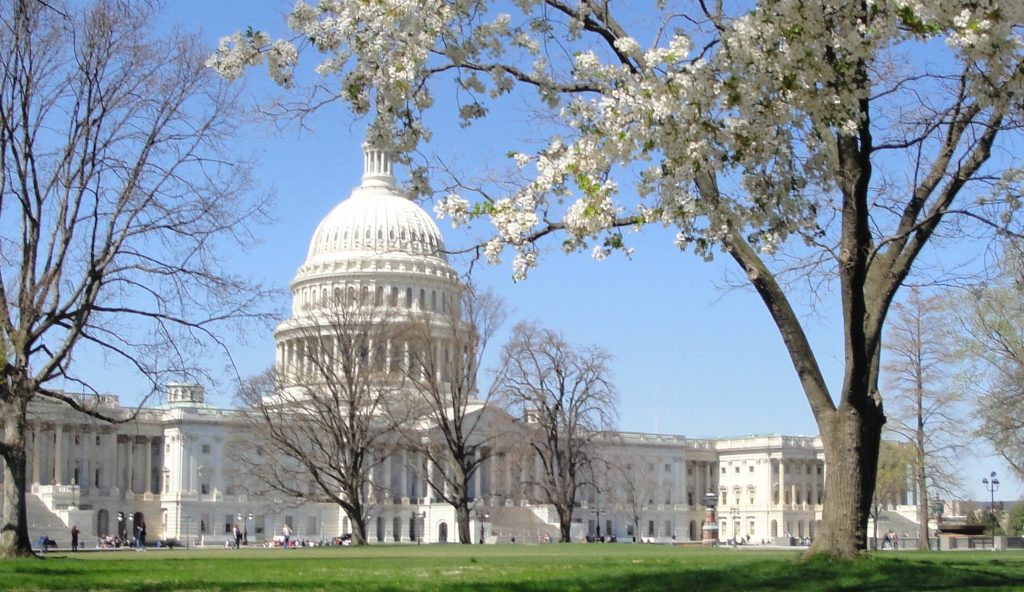
Spring has arrived in Washington.  Some pictures are included. Above is the Capitol seen from the NE corner.  Below is the Jefferson Memorial.

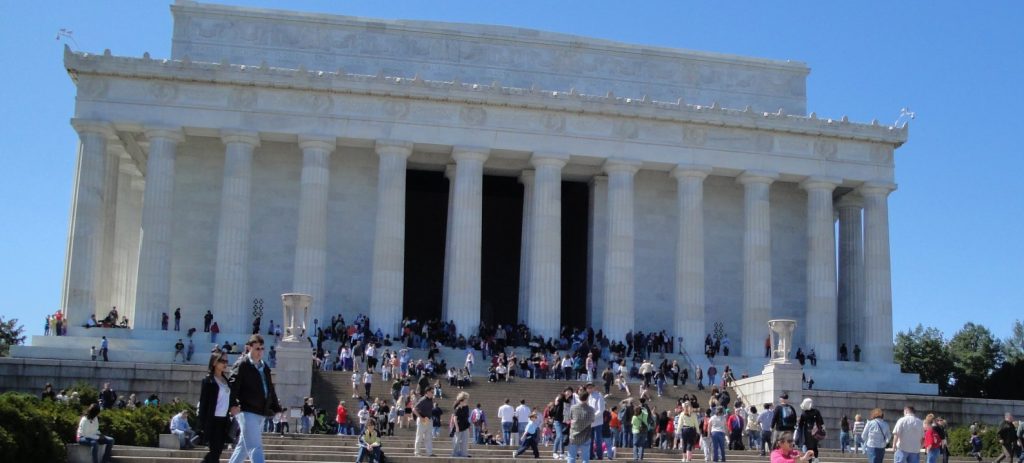
Below is the Lincoln Memorial. Lots of people have come to see old Abe. 

Below is the Washington Monument through the cherry trees.

Below is the path along the Tidal Basin.

Computer Revolution #4 (and counting)

I am doing my FSI talk again on Monday.   It is very similar to the one I did in February, but there are some additions and changes.   The new PowerPoint is below.  I was thinking through the slides and about the impact of new media this time.  Below are a few ideas.  I don’t know if I will use them in the very short presentation, but maybe if somebody asks.

This is the forth computer revolution that I have personally experienced

The first was when I was still too young to have much of an understanding.   This was the one where computers were going to take over the world.  Science fiction movies had computers just usurping the thinking of humans.   There were “evil” computers like Hal on “2001: a Space Odyssey” (funny, 2001 came and went w/o that Jupiter mission) but mostly they were just better than we mere humans.  The irony is that the actual computing power was so low in those days that we just laugh at the perceived threat.

I was part of the next revolution, proud and excited.  This was when young people (like me at the time) were going to use computers to change the world and displace all the accumulated wisdom of the ages with our raw young intelligence bolstered by computer power. The problem was that we really didn’t know how to do anything.  The computers just helped us do nothing much faster than before and leveraged our mistakes.  I recall a saying on the wall the University of Minnesota, where I got my MBA. It said,

“to err is human, but if you really want to mess up you need computer support.”

The other MBA epitaph was, “Often wrong but never in doubt.” Harness that to the power of computers and see what you come up with.   The third revolution was the dot.com boom of the late 1990s.  This is the one we have to pay close attention to because it has lessons for today.  The idea of the dot.com is that you didn’t really need any content or products. The race was for attention – eye balls.  People set up web sites supposedly selling all sorts of things, but all they really cared about was exposure.  Money poured in to investments in dot.com. It wasn’t until around March of 2000 that people noticed that the emperor had no clothes. The demise of the dot.com pulled the market down with it and also much of the economy.  The NASDAQ still hasn’t fully recovered. Some firms like Amazon.com came out winners. The difference was their organizational skills and the fact that they delivered real products.

We have our own special dot.com cautionary tale. We (the USG, State, USIA) messed up big-time in the 1990s in relation to public affairs, or at least the concept did.  Many were taken in by the promise of the Internet and there were those who thought we didn’t need a real presence on the ground in other countries. We could do it all from Washington.  During the 1990s, we closed posts, shut down most of our libraries (made them into Information Resource Centers), eliminated many of our centers overseas and generally let our public affairs capacity atrophy. A simple but telling statistic is that there were only about half as many public diplomacy officers in 2000 as there had been in 1990.  After the attacks of 9/11, we really didn’t have the people on the ground or the experience needed to communicate with world publics. The website “air war” was a bust. You can reach millions of people, but you are just wasting your time if they aren’t paying attention or your message doesn’t appeal.

BTW – Rebuilding American diplomatic capacity began soon after 9/11. Colin Powell spearheaded a diplomatic readiness initiative to help compensate for the damage done during the 1990s Results are starting to show but rebuilding networks will take a while longer. U.S. diplomacy has a very peculiar age structure because of the nineties neglect. There are many new employees (>10 years experience) and many old employees (20 > years experience), but not many in the middle.  This will be a challenge in the next five years, as much of the experience will go out the door through retirements. (Career diplomats can retire after 20 years.) It will be a good time to look for a job in the Foreign Service, but our government will be paying for mistakes of the 1990s for the next ten years. You cannot turn these things on and off like a light bulb. Think of public affairs like a forest. Things take time.  The trees you plant today determine the forest years from now and you cannot expect to walk in the shade of your trees that you didn’t plant 15 years ago. Some things just take time.

Now here we are in revolution #4. I don’t know how this story will end.   My earnest hope is that we will remember that we are always and everywhere talking to people.   People are funny.  They don’t always do what you think they will.   You still have to understand them before you can expect them to understand you.   In this latest age of new media, reaching out with the newest tools is necessary, but not sufficient to achieve our goals

A Cherry Flavored Fleeting Beauty

The cherry trees are in full bloom. It is hard to recall that snow was on the ground just a few weeks ago. Some pictures are included with the post.  The picture at the side shows the bread line from the FDR Memorial. I went down to the cherry trees and visited Roosevelt on the way back.

Cherry blossoms are precious because they are ephemeral.  We know that they will not be there for a long time and we have to enjoy them while we can. We revel in the passing and should not wish the moment to linger beyond its time. They are beautiful precisely because they will not last.

We try to preserve too much. A report this morning on NPR talked about people worried that the world of the Mario Brothers (Donkey Kong) was disappearing. They want to preserve and protect the classic world of games. Just let it go.  We should let a lot of things go. Let them become stuff of memory and then let them slip quietly into oblivion. Nothing lasts forever.

I was reading a book called “False Economy.” The author talked about dead-end strategies and how some things just don’t make it. The example he used was the panda bear.  Besides being cute, they don’t have much going for them. They eat only low nutrition bamboo, which they evidently cannot properly digest, so they have to eat a lot but don’t get much bang for the bite.  Mating is a chore they don’t enjoy and on those rare occasions when they do muster up energy and the urge, there is a good chance nothing will come of it. What is amazing is not that they are endangered but that there are any of them still around at all. A less cute animal would have gone the way of the dodo a century ago.  But pandas have a constituency.  People cried a few weeks ago at the National Zoo when the Chinese took their panda back.

I remember seeing them at the zoo. Well actually, I am not sure I saw them at the zoo. They don’t  move very much. You could just put a fur there and claim it was a panda and nobody would know the difference. They are an evolutionary dead end. People have perhaps hastened their demise, but didn’t change the direction. I tried to think of why it wasn’t true, but I couldn’t. 

BTW – The pictures are much bigger scale. If you want to see more detail, you can go to the source and look at the bigger versions. 

Decent Folks

 I don’t make a fetish of equality. In fact, I usually value diversity over equality and believe a good system is one that provides opportunities for most people to live meaningful lives in line with their aspirations and talents. This is along the lines enabling the pursuit of happiness, not actually providing happiness or even significantly facilitating it. One reason we cannot advocate ”providing” happiness is that we don’t know what happiness is. Nor can we know, since each person defines it somewhat differently. One thing we do know is that happiness comes from believing your life has some meaning and a meaningful life is often not an easy one. Meaning in life comes from making choices and living with the consequences of them. If you cannot or do not make choices, you are an object and most people don’t want that, no matter how comfortable they might be.

So a good government is one that enables most people to make meaningful choices and create meaningful places for themselves in society. A good society enables most people just to be decent folks. I think we are slipping up on this.

What I don’t like is an increasing tournament mentality, maybe even a lottery mentality. This is a specific type of completion, which is unusually pernicious since it not only features a winner take all (or almost all) finish, but also tolerates or even encourages sabotage and subterfuge.

Competition usually carries with it the notions of winners and losers, but in a broad society base with continuous diverse, you can have different sets of winners based on different skill sets, luck or time. If you find that your skills are not particularly suited to one field, you might go into another. It is possible to have whole different sets of criteria. In a balanced life you will win some and lose some and in a reasonably open opportunity society you can benefit from the innovation and techniques of the winners even when you don’t yourself win. The challenge and response are important. The “final” outcome is less crucial because there is not final outcome. (While competition underlies all human societies (and all animal and plant species as per Darwin) we have modified out some of the more destructive aspects.)

A tournament competition is not like that. In a tournament you go directly against other competitors. Your goal need not to be better in general, you just have to be better than the competition. This is great for games and game shows (like American Idol) but it is hell in real life. Most of us don’t like to be on our game all the time and few of us really like head to head competition. But society is becoming more like a tournament all the time. If I am right that most people don’t want to be involved in a constant tournament, why are we in them more often?

One reason is that some people really DO like the tournament model and they can sometimes force this kind of competition on others. But there have always been such people. Why do the dominate at some times and not others?

IMO they are enabled by several conditions. The first is technological. It is possible for a person to cast a much longer shadow. There is a program out now about life on earth. Oprah Winfield narrates. Why is she narrating this program? Because she can. Oprah does almost everything. She is an actress, a narrator, an editor, a commentator, a talk show host, and she also is just very-very rich. Oprah has beat out the competition in so many areas because technology allows her to be virtually in many places at the same time. She has displaced hundreds or thousands of other narrators, commentators etc in a way that would have not been possible a century ago, when such things usually required actual physical presence and time spent.

The “March King” John Phillip Sousa opposed the rapid spread of phonographs. He feared it would hurt live-performances and virtually kill the “production” of music in the home and he was right. In days past it was common for family members to perform musical programs for guests and each other. Probably most of them were “bad,” but if you rarely heard a “good” one, it was okay. Today your poor little sister has to compete with the world’s best musicians available on recordings that sound even better than the live show. It is no wonder we have all retreated becoming passive listeners, each of us equipped with our own I-Pods. Most of us have lost the tournament, AND we know it.

This goes for arts & performances. It goes for business too and it has gone way beyond mass production. Goods have become more ethereal and sometimes contain almost no physical component. Software is like that. It can be duplicated at almost no cost and sold for significant profits. Beyond that, it true tournament fashion, one software system will come to dominate. There is a “market” for pirated copies of successful software, but there really is no market for a myriad of alternatives. Many people dream of knocking off and replacing Google, but nobody thinks there will be thousands of little locally produced Googles. In the tag line from “Highlander”, there can be only one.

Another driver of this tournament is globalization. This is not the first time the world has seen his. The first globalization I know much about came at the end of the Greek dark ages, around 700BC. Of course, I am using the globalization term generically to say that beginning around that time the Greek world encompassed THE world as far as they cared. There problems were remarkably similar to ours.

One of the biggest problems was growing inequality. Great inequality is impossible as long as you live in a poor, localized environment. There just is not enough total wealth nor the means to accumulate or preserve it. In other words, even if the king owns everything, there is not that much available to own and his capacity to use it is limited. A human can only physically consume so much and it is not possible for the richest guy to eat or drink much more than the poorest ones (presuming they eat enough to stay alive) and besides fat, you really cannot accumulate eating. Globalization brought in luxury goods and changed the equation. Suddenly eating goat meat and drinking goat milk was no longer enough.

What globalization provides is scale. The big fish can grow bigger in a bigger pond. You can see this in the modern world in languages. English the most widespread language in the world, so an author who writes in English can access hundreds of millions of readers with not much variable cost. (More than half the world’s technical and scientific publications are in English, not because they are all written by native English speakers, but because it is the international language. If a Japanese scientist wants to communicate with a German scientist, he does it in English.) An author writing in a language like Norwegian is just out of luck. Even if he becomes “world famous” in Norway, he probably cannot sell more than a half a million copies of his book. The market is just too small. It is just not possible for a writer in Norwegian to become a mega-best seller. But if he taps into the global market, it is possible. That is one reason why so many people write in English. There is a significant network effect. But globalization also leads to the tournament effect.

I don’t think there is much we can do about those things I mentioned above. The ancient Greeks wrested with the problem. There was the example of the Spartans, who successfully localized themselves and kept the changes at bay for a couple of centuries, but while we can admire Spartan martial spirit and vigor, I don’t think we want to pay the price they did. We have to live with a world where Oprah can take the place of thousands of us. But there are things that are within our control.

Most of us are never going to do anything great and almost none of us will be famous for being great because greatness is a zero sum game. Technology and science can give us more stuff, but it cannot give us more greatness in the famous sense. There can be only a limited number of famous people. It is the nature of being famous that the club is very exclusive.

We can go back to the concept of “decent folks.” Being decent doesn’t imply anything extraordinary. It is possible for almost everybody to achieve “decent” status. And you don’t have to be famous, but you do have to have some standards and that requires some “judging.”

I think we have abandoned or even tried to destroy the idea of decency because we have been loath to judge those who didn’t live up to it and we have fallen into the perfection trap. A decent person is not a perfect person. I consider myself a decent person, yet I know I have done or sometimes failed to do some of the decent things. When I realized my error, I sometimes tried to make up for them, but I didn’t always succeed. Nevertheless, on balance I am decent.

Am I hypocritical? Sometimes I am. But I like it that we have hypocrisy. Hypocrisy is the tribute that vice plays to virtue and being hypocritical implies that we do indeed have a standard that many of us do not attain, but believe is valuable.

If you apply a standard of decency to fallible humans, you will indeed have some hypocrisy. But consider the alternatives. Do we want the kind of world where a man can cheat on his wife while she is fighting cancer, lie about fathering a child, treat everybody he knows poorly AND not feel he should be ashamed to let people find out about all of this?

BTW – there is a hilarious South Park episode that addresses this kind of thing.

Most people can do the decent thing most of the time. AND most people know what that is most of the time, although there will be some variation among individuals and groups.

I think that happiness comes from self respect – not this self esteem thing we try to “build” among people who might not otherwise have earned it – and self respect comes from having choices and making the decent choices most of the time. Many of those star athletes and wacky celebrities we so often see on their way to detox or apologizing for their latest escapade are rich in self esteem, but lacking totally in self respect. The decent choice is the one you feel good about, even if other people don’t praise you for it. It often means doing the right thing that is hard, rather than the pleasurable thing that you can excuse later.

Unearned success is spiritually corrupting. Who among us would want to be Paris Hilton if you had to BE Paris Hilton in all her goofy glory? When people look back on the good times in their lives, they almost never reminisce about the fat times when somebody gave them something for nothing. It is rather the challenges met and mastered that make us happy. The actual rewards of the accomplishments are often secondary to the choices made. Happiness is earned, not given.

Few of us can be famous and most of us cannot be rich, but all of us have the choice to be decent folks … or not. All of us can pursue happiness and lots of us can catch it. But nobody else can do it for us.