Brazilian Days of Future Past

I have been reading clips from Brazilian newspapers. The Embassy put me on their electronic distribution network and gave me SharePoint access. I get daily PDF files of articles about environment, energy, politics, culture and security. My Portuguese is coming back very nicely, at least reading. I can read most of the articles fairly rapidly and I can do it well enough that I actually enjoy it, i.e. I can get the news and views from the article rather than just treat it as a language lesson. It is a lot easier to read contemporary articles and easy if you can follow the news narrative.  Since I know what to expect, I can often understand unfamiliar words and phrases from the context.   I am learning a lot about cotton subsidies, foreign military sales in Brazil, renewable energy and the Brazilian government’s attitude about Iran.

Naturally, it is easier to relearn a language than to start from scratch.  I used to reach the Brazilian newspapers every day when I was assigned there. The funny thing is that I think I am actually better now than I was back then.  It doesn’t seem possible. The intervening quarter century should have wiped out much of my Portuguese and it had, but the reading came back very fast.  I don’t remember being able to sight read articles as I can now.  Maybe my standards are lower, but I think my general ability to comprehend and figure out written foreign languages just go better with practice, even if the practice was in Polish or Norwegian and not Portuguese. I will see how good I really am when they give me the test before I start formal study.

My comprehension of spoken Portuguese is not good at all. I got several Brazilian movies.  I couldn’t tell what was going on w/o the subtitles, although I am not entirely sure it is only the language because even with the subtitles I sometimes cannot follow every plot line.  There is a lot of cultural context in film.  Sometimes I cannot follow British television shows, even though I understand most of the language.  I never understood the attraction of Benny Hill, for example.  

I used to watch the Brazilian news every night when I was working there and I recall understanding it well-enough.   But news is familiar.  Maybe that is why I can understand the newspaper articles so well.  I wouldn’t want to tackle a Brazilian novel. 

New technologies are making it easier to study language. I can get the Brazilian news on the same day.  I remember when I first learned Portuguese.  I had to page through copies of very old magazines and newspapers on that ultra thin airmail paper.

I am really motivated to get the language right. I want to be precise. My Portuguese used to be fluent, but I don’t think it was really good. This time I will do better. 

Brazil was my first post. I learned a lot and made a lot of mistakes.  I learned some lessons so that I won’t make the same mistakes again. I suppose I will come up with a whole new set of them.

Brazil is a very interesting country and I can’t think of a better place for me at this time.

The Irrational World of Persuasion

I am making a presentation about public affairs at FSI in a few weeks.  It is a short presentation to mid-level officers. Below is some of the raw material thinking I have been doing about irrationality and reciprocity in persuasion. I figure that all of the stuff below will distill into one or two short paragraphs, but thinking it through is useful and I think better when I can write and ramble.  Since I have it written out, I figured I would post it.   

We like to think the truth will always come out, but isn’t necessarily so. Similarly, people are often not persuaded by facts or even their own experience. Persuasion just is not logical in the way we want. 

If people do not always (or even usually) respond rationally to arguments and persuasion, they do tend to respond in recognizable patterns. Marketers and salesmen have known this intuitively – and used it effectively – for many years. Only recently has science or at least academics, recognized and tried to explain the phenomenon. Here are some of the books that talk about that. There is some overlap with a list I made earlier about decision making that you can see at this link

I won’t try to convey all the information in all those books on the lists above. Suffice to say that people respond differently to identical sets of propositions or incentives depending on how they are stated, framed or presented and that people’s preexisting predilections, prejudices and perceptions determine not only which arguments are most persuasive but also which facts are considered salient or even heard at all. That is why attempts to “set the record straight” usually only work with those already inclined to believe you. If the bad news is that people do not make decisions rationally, the good news is that they make their irrational* decisions in patterns that can be understood if not perfectly predicted. The bad news that comes after the good news is that these patterns can also be manipulated by those whose motives and goals we abhor, so the lesson is that we are playing this game, whether we like it or not. 

So if we are talking about actual persuasion, it probably won’t help just to make information available. Providing information was a key to our success in the Cold War because accurate information was in very short supply. Today in all but the dwindling coterie dictatorships in the world’s most benighted places, information is already available.  It is how that information is put together – the contexts, relationships and the narratives – that counts. As persuaders we need to acknowledge what we know, what salesmen and marketers have long understood and what even science is beginning to explain. We are not in the information business. Information and facts are part of our raw material, but our business involves persuasion that is less like a library and more like a negotiation paradigm and rational decision making is not enough to achieve success. 

The first persuasion decision you have to make is whether or not to engage at all. No matter how urgent a problem, you should not engage unless you have a reasonable chance of success.   There are times for aggressive action, times for more passive approaches and times when you just have to hunker down until conditions improve. It is hard to know when the times or right and even harder to manage the transitions among them, which is why people who are good at knowing make the big bucks and are sought after or reviled (depending on which side they are on). 

There are some folks who say that you should be out there always and they are right that you should never fold entirely if it is something you care about and you have the capacity to stay.  But standing in front of an irresistible wave not only depletes your resources but also makes you less able to fight again another day. It is much better to let the wave expend its energy and then come back in.

Once you are engaged, think of it in a negotiation paradigm, not usually a negotiation between you and an adversary, but more of the win-win with you among a large number of participants.  Most people involved are not direct participants, but they are often the ones you want to persuade.   The committed radicals are not the targets of your persuasion.  There is no argument you can use and no concession you can make that will persuade them.  Your job is to talk over, around or through them.  Luckily, few people are really committed radicals and you can find some common ground with almost anybody.

Let’s talk about common ground. What if you have some monumental disagreement with somebody?  You might think that you cannot make any progress until the big thing is solved and then lament that the big thing is unsolvable. This is the wrong way of looking at it. In negotiations, it might be possible to set aside the big thing and work on a series of mutually beneficial smaller one.   Sometimes the momentum from successfully addressing the little issues makes solving the big one possible.  Just as often, it makes the big issue less relevant.  Most big problems are never “solved” in the context in which they were created. They are just overtaken by events. The situation might change so that it just doesn’t matter.    

Some families have a rule that you cannot discuss religion or politics. They know that agreement on these issues is nearly impossible, that a dialogue will just create more tension and that they can be safely avoided at family gatherings. 

Denial and avoidance are perfectly good tactics. Many things really do not need to be talked through and resolved and much diplomacy involved making sure sleeping dogs are not disturbed.  Not everybody likes this strategy and there will be persistent calls to “get it out in the open”.   There may be a time for this kind of frontal assault, but if dialogue will merely sharpen differences without resolving them and entrench individuals in their positions it is pernicious.  In the case of any contentious issue, there are also always a fair number of people who are professionally aggrieved.  Their goal is to keep the dialogue alive and fresh as long as possible.  In a rational world, dialogue would almost always produce better outcomes, but we don’t live in a perfectly rational world (see above).

If we are wise to avoid the frontal assault, what do we do about hard issues? When possible go around them, avoid the grievance professionals when possible and deny them a forum when you can. In public affairs, as in negotiation, you never want to be stuck on one issue where you cannot divert or make tradeoffs. One of the strengths of diversity is that it waters down grievances. If you have two opposing groups with one intransigent issue, you have a problem. But you have an interesting community if you have a dozen such groups.   

So in addition to denial, add dilution to your public affairs tool box.

Some people think it is naive to talk about win-win negotiation.  They say that somebody has got to come out on top. Avoid such people if possible because working with them will often lead to such an unhappy result. For most other things, however, we can all get more of what we want.  That is the whole basis of free exchange and cooperation in general. People all do not want the same things most things you get from a free exchange will be worth more to you than what you gave up.  The same goes for the guys on the other side and the same goes in persuasion as in negotiation.

The problem comes with the natural and good human desire to be generous. Win-win doesn’t mean giving away more than you should.  It doesn’t mean sacrifice. Those things are lose-win. It means that you get what you want AND I get what I want. Nobody should go into an engagement unless he/she believes that. But we do.

One of the dumbest things you can do is to make needless concessions.  It is not generous to give away your important positions. It is just dumb and it makes nobody really happy. Everybody will think that you are insincere. Either you didn’t really believe in your own position in the first place or you are lying about your concession, or –even worse – you are patronizing. There are to be a mutuality, a reciprocity.

The basis of almost all human relationships is reciprocity. All human societies believe in reciprocity. It has survival value. You want to be able to give to your fellow man and expect that he will do the same when you are in need. When that breaks down, so does civil society. It is probably a good idea to be SEEN to get something in return anyway, since if you don’t others will impute an ulterior motive anyway.

I know that this sounds crassly materialistic, but the reciprocity need not be material. You might help a person in the “pay it forward” mode, assuming that when he gets the opportunity he will help somebody else. The reciprocity might just be gratitude. But when a recipient is left w/o some way to reciprocate, a good person feels disrespected.  At first they are happy to get something for nothings, but they soon learn to despise their benefactor.  And maybe they should, since his “generosity” is taking their human dignity.

A simple rule in persuasion is that it is often better to receive than to give.  Let the other parties feel that they have discharged their social obligations, maybe even that THEY are the generous ones. You notice that the most popular individuals are rarely those who need or want nothing from others, even if they are very generous. And one of the most valuable gifts you can receive is advice and knowledge.  Let others share their culture and experience.

I have had my biggest successes in public affairs when I genuinely wanted to learn something. My first assignment when I got to Poland a few years back was to write a report on the Polish media. I interviewed dozens of reporters, editors and academics and they became my best contacts, often sending me updates or referring to my questions even months and years later. The most influential thing you can often do with an individual is listen carefully to what they tell you and come back a while later being honestly able to say, “I was thinking about what you said and you were right.” This interest cannot be easily faked.  I have been “played” by people who have taken the course and try to feign interest in my esoteric pursuits or ask my advice. When they praise the insights, but repeatedly fail to act on them, trust disappears. Of course, maybe I have run into people who are just so good at it that I couldn’t tell.  I suppose that would be successful persuasion.

——————-

*   I use the term “irrational” cautiously. “Rational” decision making is overrated and under examined. We make decisions based on a variety of preferences and emotional factors, some of which we cannot state. When they are reduced to their “rational” components, they may no longer make sense. There are things that really cannot be reduced to rational parts. The lyrics to “Some Enchanted Evening” actually sum it up well, “Who can explain it, who can tell you why? Fools give you reasons, wise men never try.” Or we can quote GK Chesterton “The madman is not the man who has lost his reason. He is the man who has lost everything except his reason.” If we seek only rational decisions, a computer can do it for us much better than we can.
Various Facts About Foresty around the Shenandoah and Blue Ridge

I drove with Frank Sherwood to the Virginia tree farm of the year and got a chance to talk to him as we walked around on the ground. Frank has been doing forestry in Virginia for thirty-five years and I got some good information on drive down from Winchester. 

This area of Virginia features a lot of mixed hardwoods and white pines. I was very familiar with white pines form Wisconsin, but I really had a lot to learn about them. For example, white pine wood is light and not as hard or strong as loblolly.  It is good for fence rails (it doesn’t twist) and it is used in log cabins, but it is not as much use as structural timber.  Frank lamented that there is not much of a market for white pine saw timber in the immediate area, besides in those two limited uses. A lot of the local white pine had not grown straight and un-branched.   The newer plantations are doing better.

White pines have not been developed genetically as well as loblolly and it is less likely to be planted, since natural regeneration works very well.   A white pine rotation is around fifty years (15-18 years longer than loblolly) with two possible thinning. 

Pulp prices have remained steady over the years, Frank told me.   Some people are a little concerned about biofuels, which would compete with pulp and drive the prices up (good for landowners), but there currently is not a biofuels market in the Winchester region.  You can make ethanol from cellulous, but it is not worth it with today’s technologies.   That means that effective biofuels for wood is to burn it directly and for that you need local facilities that burn it.   The alternative is to make wood pellets, but that industry is also not present locally.

Landowners have a couple options for timber selling.  The one you get the most money for is saw timber.  Saw timber will yield $150-400 per 1000 board feet.  Pulp is the cheapest, maybe biofuels in the near future.  Pulp yields $5-7 a ton for pine and $2-3 for hardwood.  In between is scragwood.  These are small diameter but straight trees that can be sawed into rough boards used in crates and pallets.

Frank feeds the mill in Luke, Maryland.  He says that the mill’s catchment area is getting bigger because it is harder to find wood in local areas.  Development and forest fragmentation are the causes.  You can do forestry on small tracts, but at some point it gets to be economically unviable.  You probably need around forty acres to do decent management. Development has been taking forestry out of business. Although the recent economic downturn has stopped much of it, development will resume when the good times roll again. Too bad.

Frank doesn’t know of anybody using biosolids or animal manure on forest lands in this part of the Shenandoah valley or around.  There are several chicken operations (we drove past a Perdue operation) that produce a fair amount of chickenshit, but Frank didn’t know what they did with it.  Chickenshit is a powerful fertilizer, high in potassium, but as I understand it, chickenshit has to be left to decompose a little otherwise it can burn out the crops.  IMO forest lands would be a good place to dispose of some of these farm wastes.  There is a lot of forest and they could absorb and use the nitrogen and phosphate w/o letting it slip into the Chesapeake Bay. Of course, the problem is transportation. Manure is bulky, heavy and stinky.

The problem is concentration.  These large animal operations concentrate the crap. That changes it from a valuable fertilizer into a potential pollution problem. The difference between a life-giving medicine and a deadly poison is often the dosage.

Anyway, those are some of the things I learned from Frank.  The biggest benefit of writing the tree farm of the year article is getting to talk to people like him while actually setting foot on the forests.

2010 Virginia Tree Farm of the Year Visit

Noble Laesch, the father of the current owner Judith Gontis, bought this acreage in the late 1960s and it has been a certified tree farm for the last twenty-eight years. Laesch and Gontis did not live on the land and so for the last twenty-eight years it has been forester Frank Sherwood’s business and pleasure to look after these 927 acres of hilly mixed forest just inside the Rockingham County line.

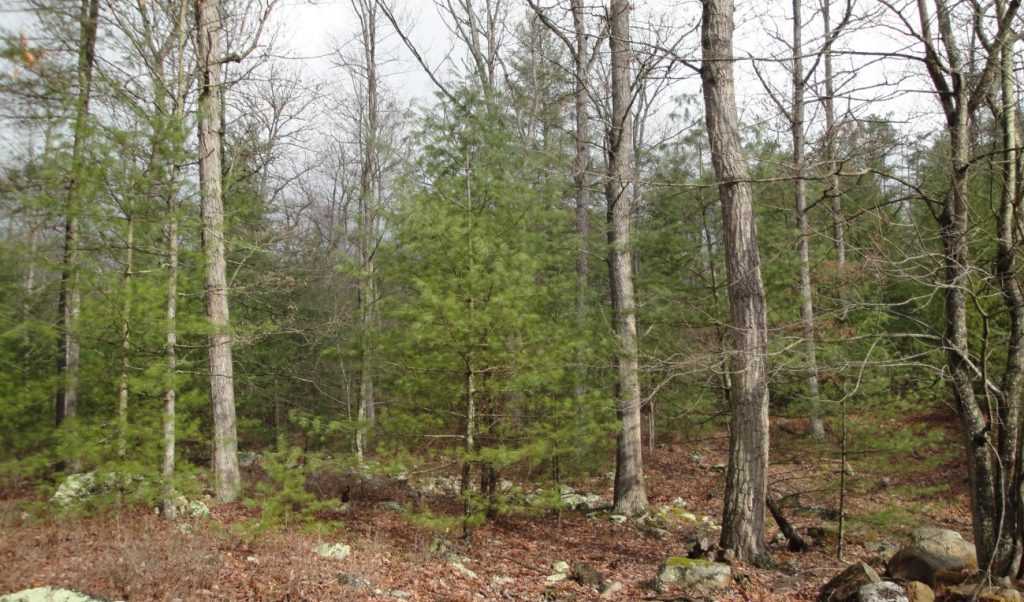
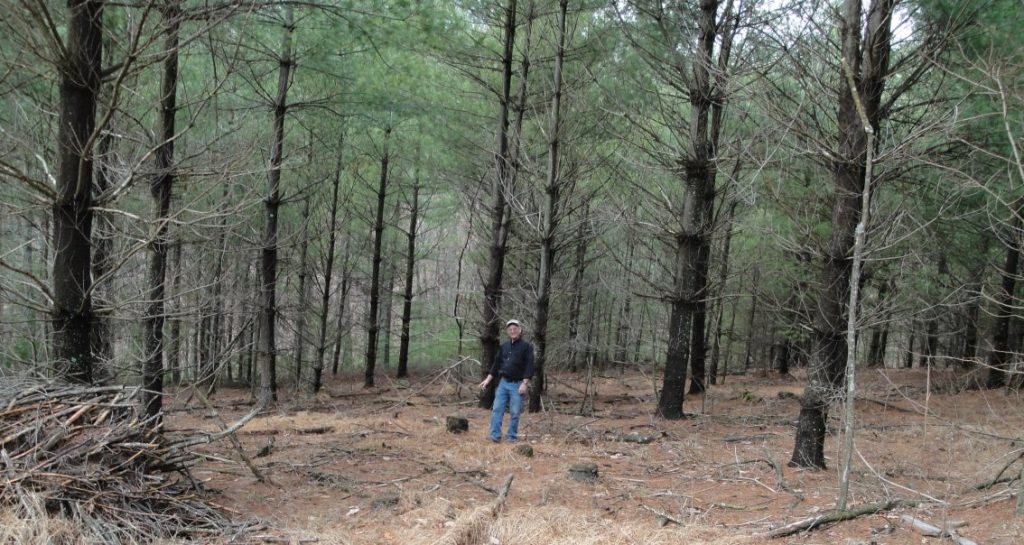
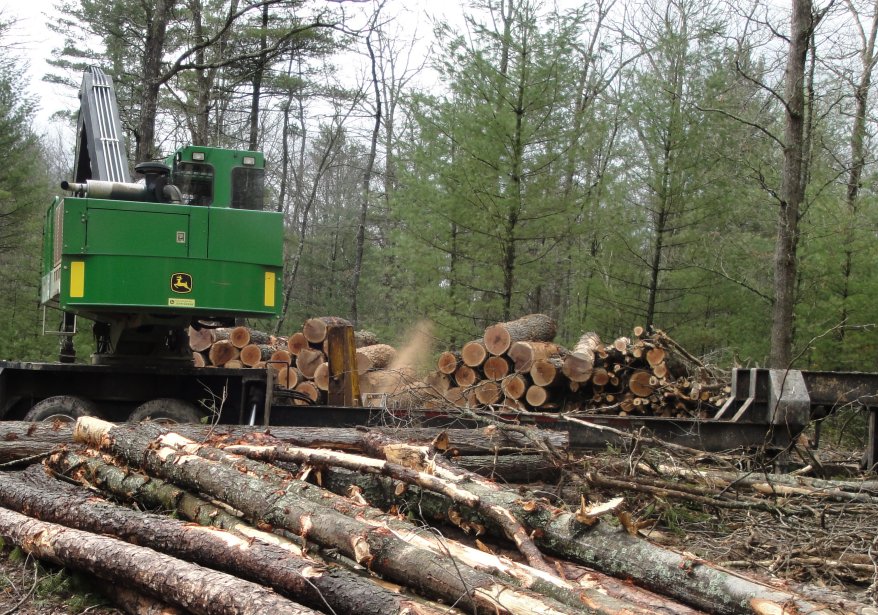
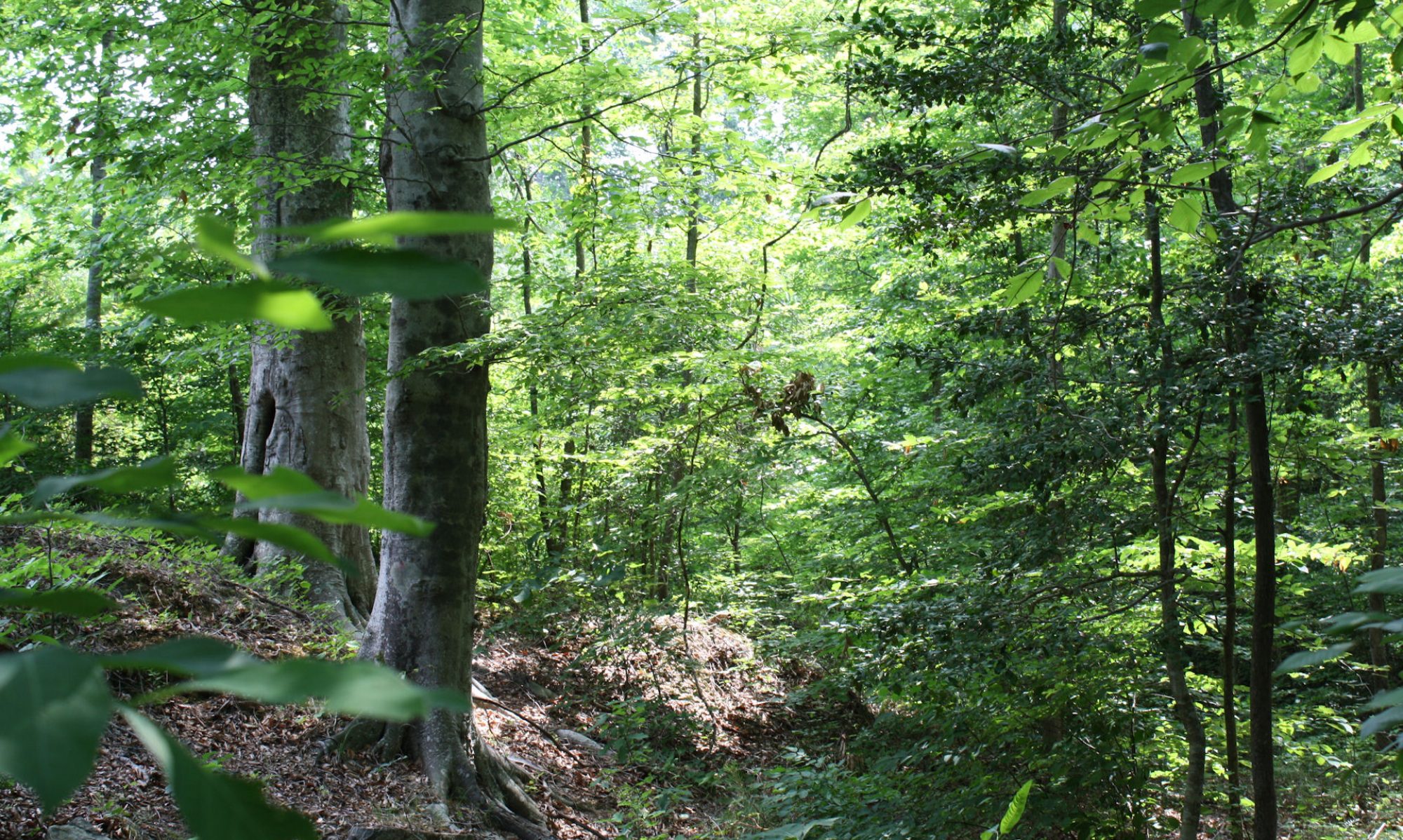
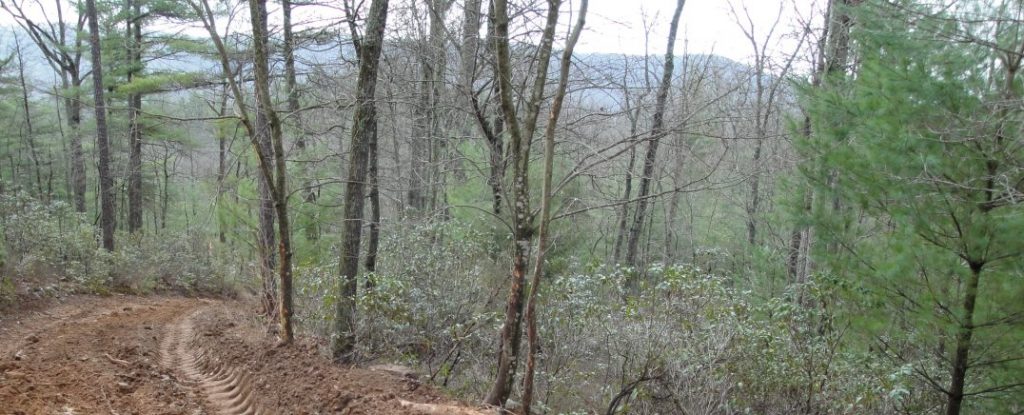
It is a tree farm with great diversity in terms of species composition, topography, soils and microclimates. The ridges are still dominated by mixed hardwoods, although gradually white pines are taking over, both through natural processes and forestry practices. We looked at a logging operations and examined some of the recently cut stumps during a recent visit. The partially shade tolerant white pines had seeded in naturally under an older stand of mixed hardwood, mostly scarlet oak, but were suppressed until released by the forestry operation. 

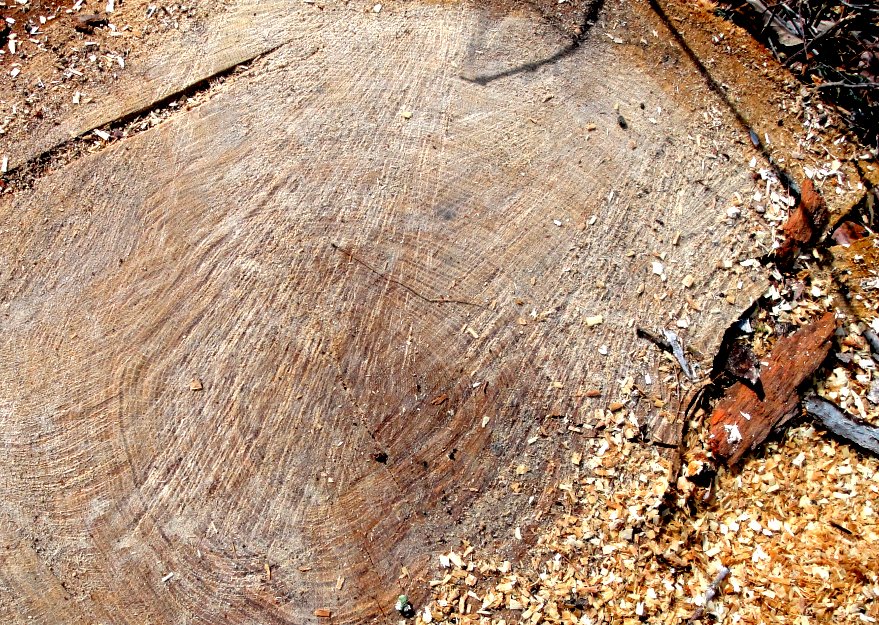
 We counted 130 rings on a scarlet oak stump. For the first sixty years of life, the tree grew slowly and crookedly. It is clear that there were too many trees here competing for sun, nutrients and water. We have no record of how the neighboring trees were thinned, but the tree started to grow much faster at around sixty until it slowed in older age. Unfortunately, although very big, this scarlet oak, like most of the others in the stand, had begun to rot in the middle. It was past time to remove them and give the white pines their time in the sun. Within a few years this will be an almost pure stand of white pine.

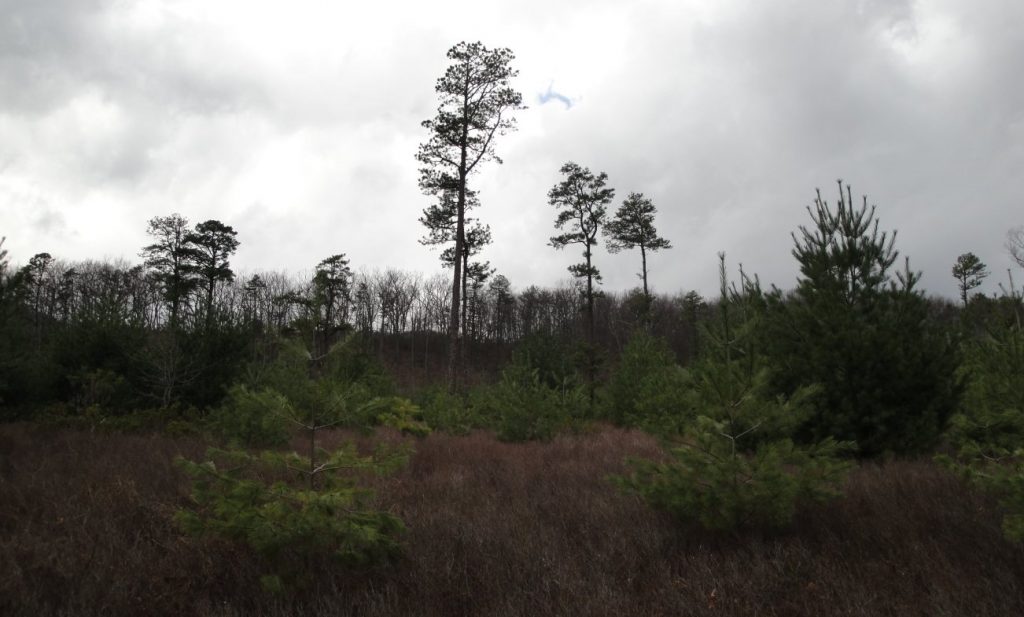
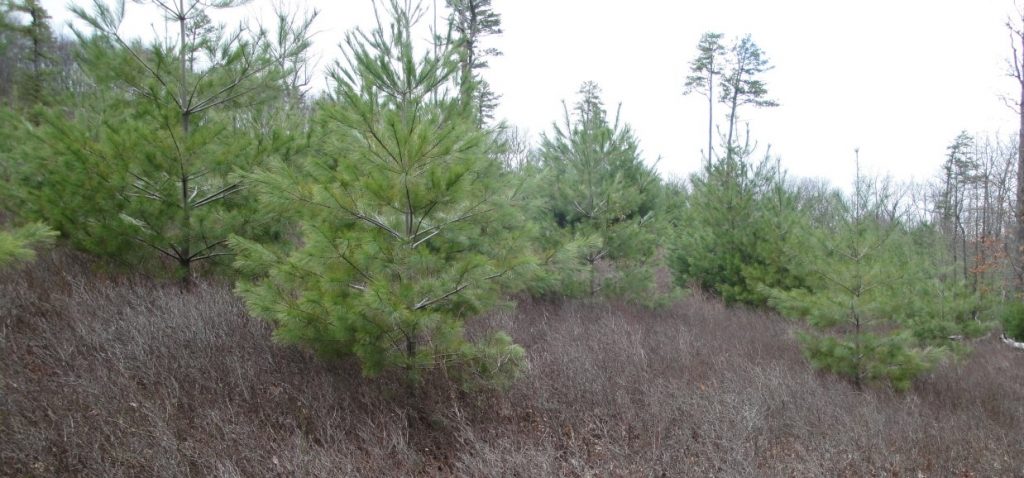
Farther down the hill was a recently thinned plantation, a total of 126 acres of twenty-year-old white pine and a clear cut left to regenerate naturally in white pine. The trees were vigorous but widely spaced. The blueberries had come in very thickly and perhaps they just outran the pine seedlings.   The plantation was clearly better for timber production, but the naturally regenerated area had cost nothing to plant and the widely spaced trees were providing excellent openings for wildlife.   As with any management plan, it depends on what the landowner wants and it was interesting to see the side-by-side comparison of different choices.

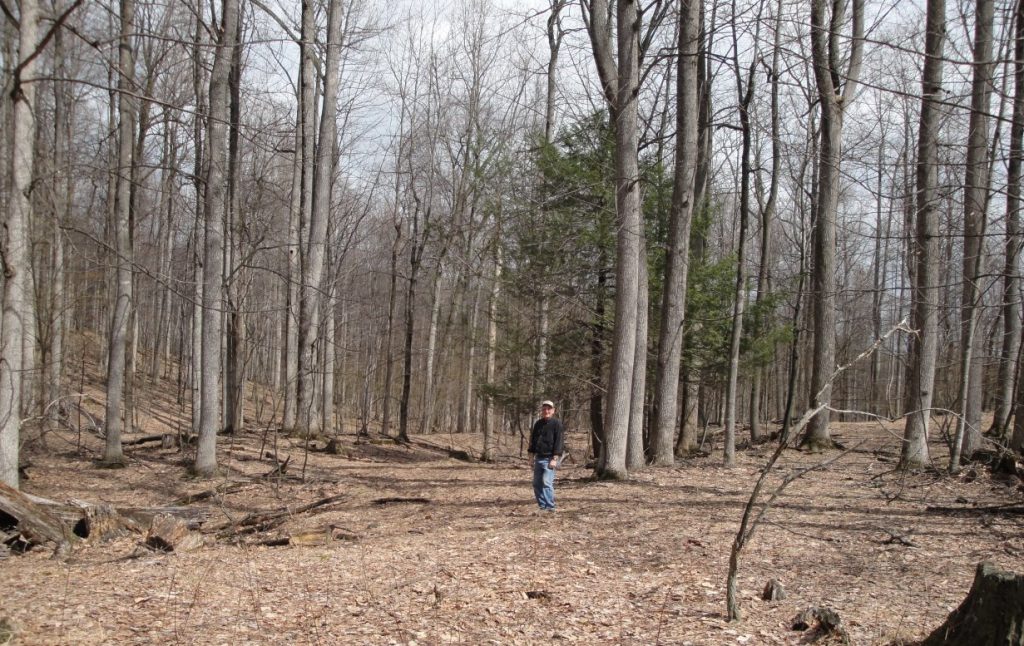
The tulip-poplars that grow so profusely on the eastern slopes of the Blue Ridge do well here too, but only in coves or bowls that have deeper soil than the rocky and sometimes sandy slopes.   In these places you find towering tulip poplars that can be harvested at regular intervals and regenerated naturally.

The rest of the tree farm is mixed hardwoods, especially white and red oak, plus some maples, as well as white pine.  This is white pine country. Although loblolly can be grown here too, the white pines do it naturally. With Frank Sherwood’s advice, Mrs. Gontis, as her father before her, manages for pulp and saw timber mostly through selective cuttings.  

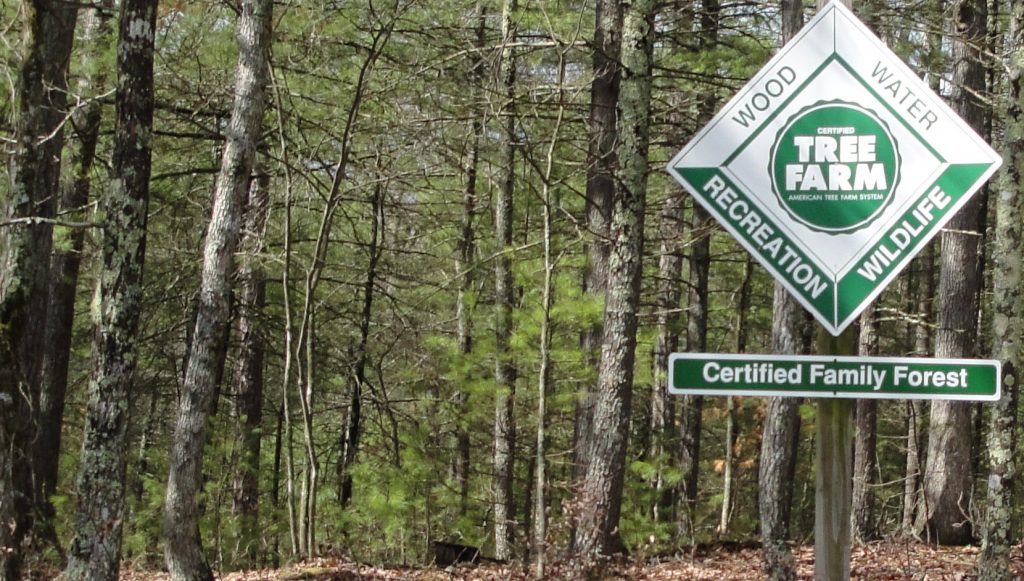
Like all well-managed tree farms, this one provides a home for wildlife, a place for recreation and protection for water resources. The farm is drained by Runion Creek, whose waters find their way into the Shenandoah and the Potomac and eventually into the Chesapeake Bay. Although there is some development in the region, it looks like this tree farm and its 927 acres will continue to provide these kinds of ecological services for years to come. 

130 +/- Years

The stump is from a scarlet oak that started life sometime around 1870 up the hills just over the northern boundary of Rockingham County, where I was visiting this year’s tree farm of the year. I didn’t count all the rings, but it is close. I sharpened a little on the picture so you can see the pattern. It tells a little about Virginia history.

You can see that it grew hardly at all for the first sixty years. This is probably because it was severely overcrowded. This area was almost completely cut over in the decades before the Civil War. Some of the wood was used for building, mining supports & staves, but mostly for charcoal for little foundries and lime kilns in the region. The trees grew back after the industries moved along and they came back thick and for about sixty years, roughly from 1870-1930 there wasn’t enough sun or water to go around. (In those days there weren’t as many deer and other varmints around. These days, they would browse down some of the trees.) Our tree was also leaning a little. You can see that it grew as a reaction more on one side.

But something happened around 1930. Somebody probably cut down some of the trees.  Or it could have been a fire or insect infestation, but that seems less likely, since whatever it was didn’t harm our tree here. In fact, it started to grow a lot faster, until it slowed again down because of its age.

Scarlet oaks are part of the red oak family, but they are among the worst members. They wood is not as good northern or southern red oaks and scarlet oaks tend to rot in the heart or have other irregularities. The logger said that the logs in the pile shown in the picture were probably not up to saw timber standards because of this.

All members of the red oaks family have open pores, which is why they cannot be used for barrels and generally do not do well when exposed to water. Even as seasoned firewood, they can hiss when burned, since they absorb water easily and a little rain will soak in. The oak whiskey barrels used for Bourbon whiskey are always white oak. White oak also makes better firewood. 

There were mostly scarlet oaks on this ridge, mixed with white pines. White pines are partially shade tolerant when they are young, so they will come in under the oaks. The loggers cut out the scarlet oaks and the forest will come back as mostly pine. The scarlet oaks were almost done anyway. Many were already rotting in the centers and they were well past prime as timber trees.

This part of Virginia is white pine country, at least on the hillsides. In the coves, where the soil is deeper, the yellow-poplars do very well. The picture above shows some of them. They grow very fast. This stand has been harvested twice since the late 1970s and it is ready for a third cut, as you can see.

Yellow-poplar is good for furniture inside drawers and cabinets with veneer of oak or other high quality wood on the outside. Yellow-poplar doesn’t shrink or swell very much, so it is good for that purpose. 

I will write more about this subject tomorrow. 

Alex & Mariza

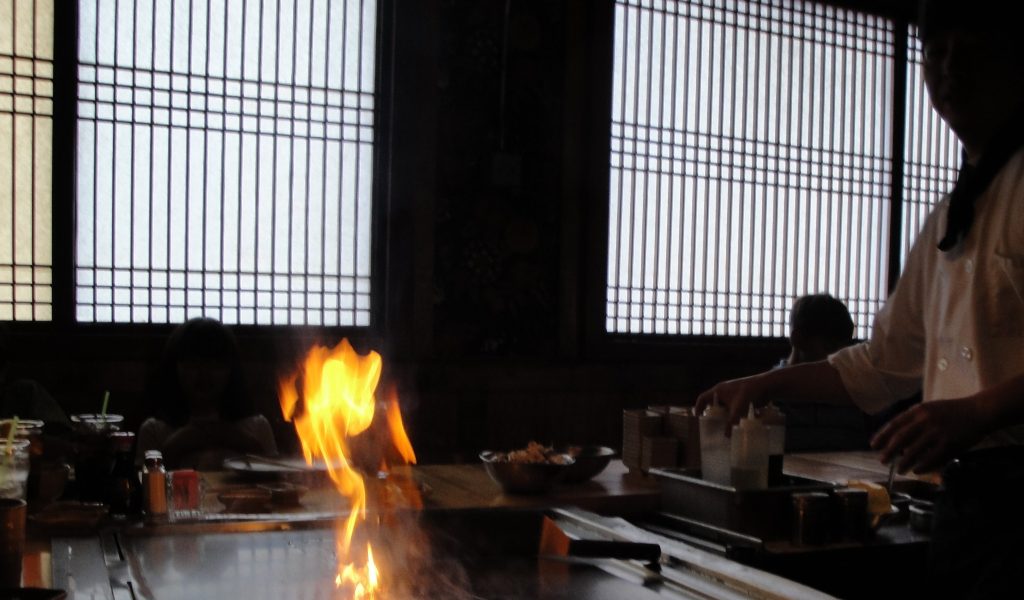
I drove up to Harrisonburg for Alex’s birthday.  He is doing okay, but is still having some loneliness problems. We didn’t do anything extraordinary, mostly talked. We did go to lunch and supper together and went got a few necessities at Walmart. Lunch was at Kyoto, one of those Japanese steak houses where they do the grill show with the food. 

Mariza’s birthday was a couple days ago. She came down from Baltimore for it.  We had some cake, but we aren’t very big on the party things.

I wrote the birthday stuff last year and nobody feels comfortable about too much recent information being divulged. There is a kind of declassification period that must be respected.   

Suffice to say that I am proud of the adults they have become and I enjoy their company, but I miss the children they were. These are the times that I feel that most acutely.

Thoughts on Cars and Trucks

I was part of a new car design survey today. I think that they chose me as part of the control group that knew nothing about cars. I filled out a survey about the kinds of criteria I would use in buying a new car. 

Then I went in and saw about a dozen new car designs.   Evidently they were Volkswagens, Hondas, Toyotas and Chryslers.   We were asked to evaluate each car in terms of looks, interiors etc.   Most of the cars were too small inside, IMO.  I like the feeling of my Honda Civic.  Although the car is small, it has a lot of room in the driver’s seat.  A lot of the bigger cars don’t really have that feel.

I don’t really care much about cars.  I want one that is reasonably safe and comfortable and one that gets good mileage.   Other than that, I cannot tell much about them.   As part of the survey I had to guess what kind of car we were looking at.  I don’t think I did very well. 

I watched an old movie “Convoy” with Kris Kristofferson. It was made in 1978 when the price of gas had gone up and the 55 MPH speed limits were imposed.  There were a few movies like this that portrayed the anger associated with the perceived loss of the freedom of the open road.  “Smokey and the Bandit” was another one like this, a lot of law breaking and destruction of property. 

I wanted to be a long-distance truck driver once. I was an indifferent student when I started college and didn’t see much future in that.  When I worked a Medusa Cement, the truck drivers seemed to have it best.  They got out on the road, while we just loaded the bags of cement on their trucks. I would not have been a good truck driver. It is a subset of the general driving thing and my lack of love of cars (mentioned above) is probably an indicator that it is not one of my strengths.  

The 1970s were the tail end of the trucker golden age anyway.  Traffic was getting worse.  Speed limits were coming down and generally the open road was disappearing.  Everything is a lot more organized now and much less of an adventure.

The 1970s was also the time when containerized cargo changed shipping in general.  It put a lot of truckers and longshoremen out of jobs.   That really revolutionized commerce. 

Arlington Cemetery

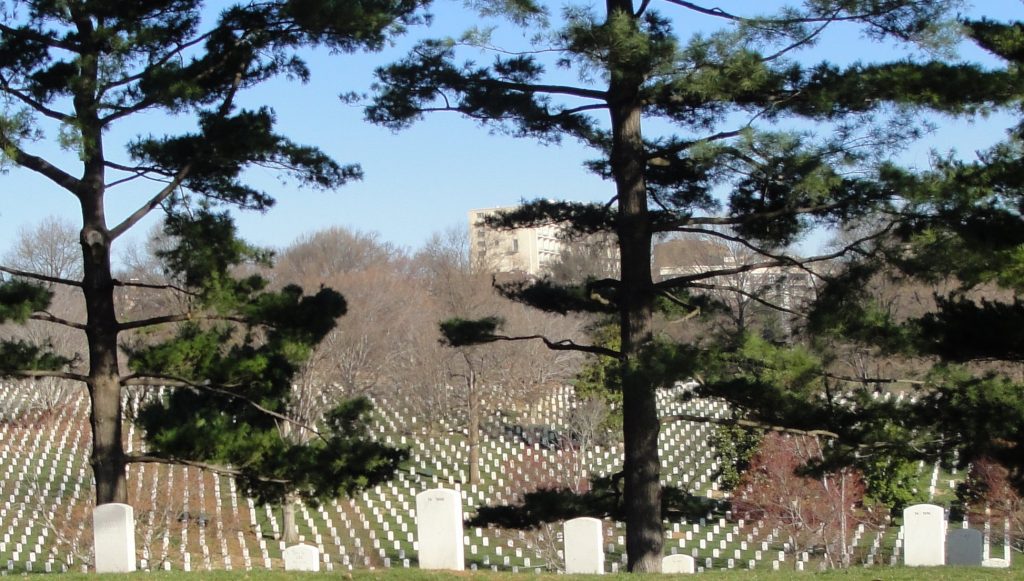
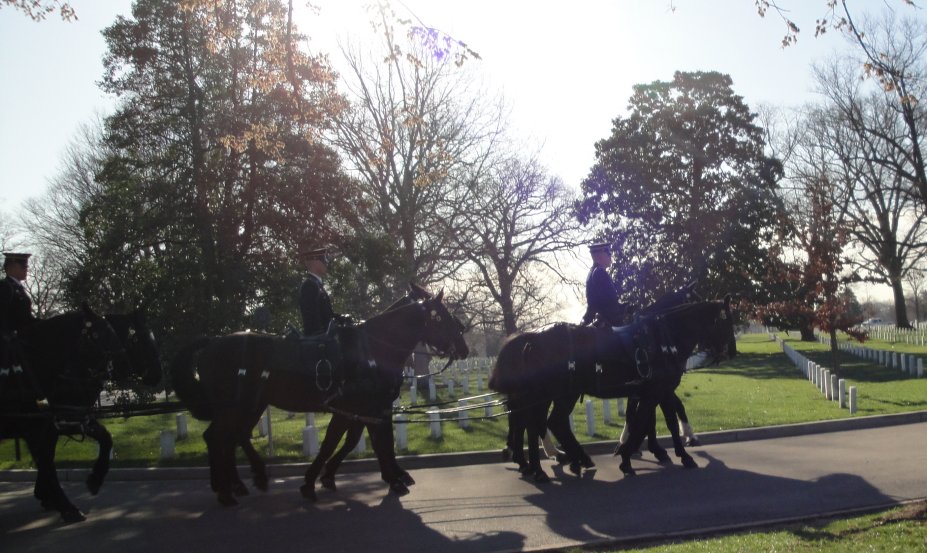
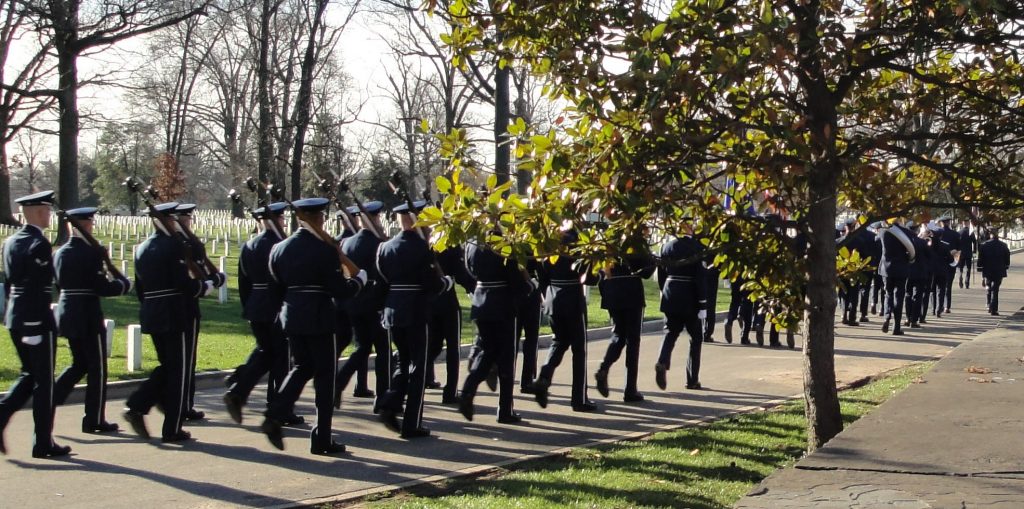
I have been riding my bike to work again through Arlington Cemetery, as I wrote in yesterday’s post. Daily exposure to something can desensitize you to its details, but it can also help you see and appreciate it more. I am not sure which side I fall on most of the time. Maybe I see it new again each season. Anyway, I took a couple of pictures.  

Like Riding a Bike

Today I got all the way to work w/o getting a flat tire or crashing into anything.   It was a great first (well second) day for my bike-to-work season.  It is true that you never forget how to ride a bike.  The old muscle memories jump back into line – just not as efficiently as the end of last season.  I expect to be a little stiff tomorrow because I am already a little stiff today.

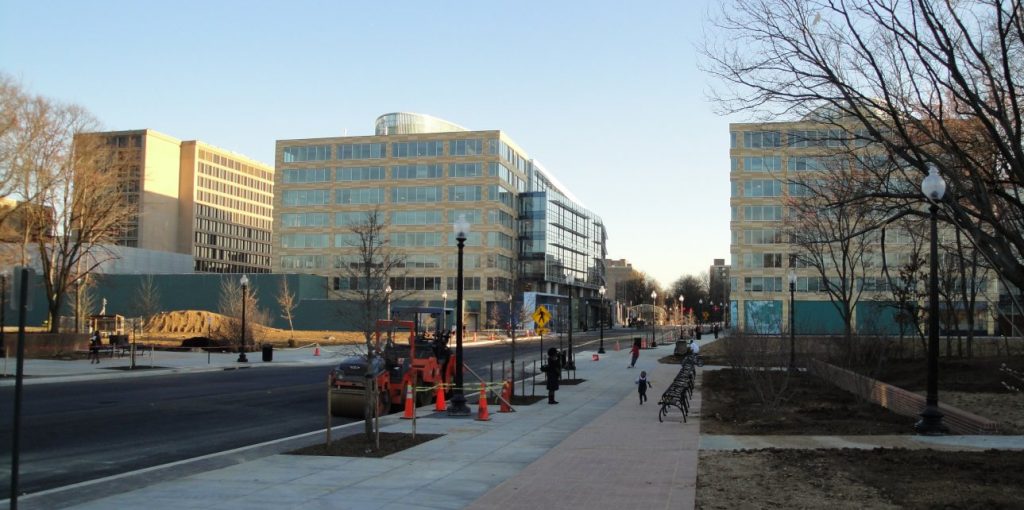
Below is the almost done building at Waterfront Mall.

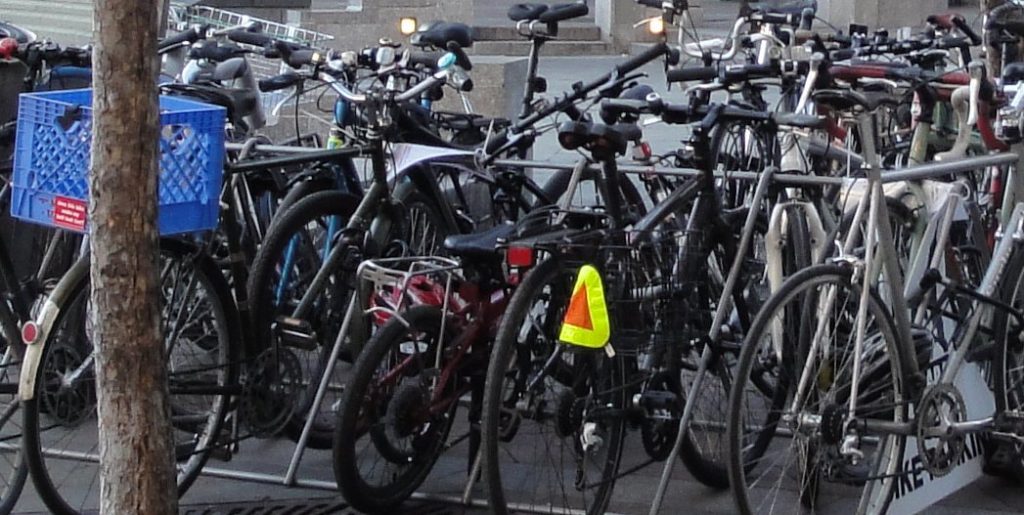
There have been suggestions at State Department that we should subsidize bike riding.  It is a silly idea. Frankly, I don’t want to share my bike path with anybody who has to be paid to be there.  It is a joy to bike.  You just need bike friendly facilities.  My building is very good.  We have a locker room with showers.   You really don’t want to sit all day at work after riding an hour on a bike w/o a shower, nor do you want to sit next to anybody else who has done it.  Modern technology has made looking neat easy.  I bring along a wrinkle free shirt.  These things are great.  100% cotton, comfortable and always pressed.  Even if you stuff it into a bag, and I literally stuff it into a Ziploc freezer bag, all you need do to make them look a pressed as the best iron could made them is to put them on while you are still damp. 

I cut through Fort Meyer and Arlington Cemetery. I also ride past the Lincoln Memorial, in sight of the Washington Memorial and the Capitol.  It is a very patriotic bike ride.

Our operation at work is in stand down mode.  President Obama has postponed his trip to Indonesia, originally scheduled for March 19, then March 21 and now sometime in June. (He has to stick around for the heath care final act.) There were lots of plans and preparations and people had cleared their calendars for the visit. Now, for a brief time, there will be … nothing. It is like the scene in the movie “Cool Hand Luke” where everybody works at top speed and then they get to the end of the road and there is nothing left to do.  I wasn’t much involved with it, actually, but my colleagues were working full-out. They deserve the rest.

Our business is like that.  We spend a lot of our time in frenetic activity that is overtaken by later events. I guess life is like that sometimes in general, a tale, told by an idiot, fully of sound and fury, signifying nothing. But who cares if you can bike to work in the pleasant warm air and sunshine, preferably with a little tail wind. This is going to be a glorious spring. Spring is always nice around there, but usually we get a few flowers at a time. They kind of ration their beauty.  But atypical cold and snowy winter has held back the flowers, which will now burst forth at once in a rare display of unity.

Stuck in a Dead End

I tried to start my bike season today and ended up with a flat tire. It was my own fault.  After many years of riding my bike, I still cannot properly change a tire. I “fixed” my bike yesterday and I think I just got the inner tube caught on the rim. It just needed a little pressure to blow out. I wasn’t too far from home, so I could walk back in around a half hour. It was not a complete loss. The walk was really nice and I had a chance to think about a few things.

What I thought about was Nash equilibrium. I can’t say I am an expert on the details, but as I understand the simple version, Nash proved mathematically what we perceive intuitively but imperfectly. It is possible to have stability at a situation that is bad and everyone agrees is bad.  However, each person makes perfectly logical choices that lead to this outcome.    

The way that it works is that if almost everybody makes the “good” choice (call it choice A), they are all better off.   But if not enough people make that choice (they choose choice B), those that choose A suffer more than those who make the bad choice (B).  So everybody tries to figure out what the majority will do, while complaining about the stupidity of the herd. These sorts of equilibria have tipping points.  If enough people come to think others will choose outcome A, they all will pile on. The same goes for the other option.

Nash, BTW, is the guy played by Russell Crowe in the movie “A Beautiful Mind.” The real Nash won the Noble Prize for his work in mathematical economics. If you study game theory, you have to study Nash.

The example of a Nash equilibrium I thought about on my morning walk was traffic and blocked roads.  Northern Virginia has horrible traffic problems. Many of them result from the stupid way streets are laid out.  Unlike a logical grid layout you find in many cities, Northern Virginia’s road system looks more like a river drainage basin, with dead end tributaries flowing into larger and larger streets. There might be only one – usually winding – road that you can use to get where you want to go. Parallel streets, if they exist at all, are blocked or dead ended.

I think that the original road system was based on cow paths and Indian trails. We have Braddock Road, which is the course that General Braddock took to Pennsylvania during the French and Indian wars. Since he insisted on building a road, the French and Indians saw him coming and wiped him out.  George Washington saved some of the troops and it was the start of his good reputation.

Onto the cow path system was appended a system of cul-de-sacs and dead end streets.  This is where the Nash equilibrium starts to play. People prefer to live on quiet streets and the best way to ensure a quiet street it to make sure that it doesn’t go anywhere. So builders and planners create neighborhoods with no-through streets. This means that you might have to drive ten miles to travel one mile if you could go straight. It also throws all the traffic onto a few overcrowded roads.  

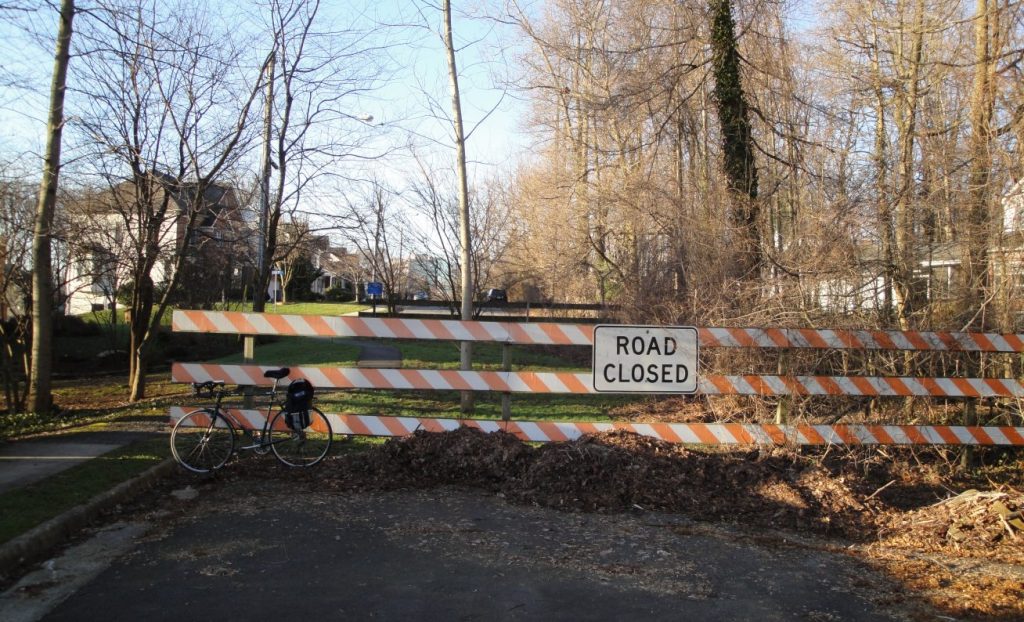
I walked home along Sandburg Street. It parallels Gallows Road, which is gridlocked at the time I was walking.But there were no cars on Sandburg. That is because you cannot get there from here in a car.  Sandburg has a dead end right in the middle. This is what you see on the picture. The wide and well paved road comes to an end in a patch of grass around five yards wide. It has been this way a long time, because some trees have grown in. Then it starts again. I am sure this was originally a real dead end.  Now they cannot make it grow through because the local residents will complain. There are lots of place like this in Northern Virginia.  Everybody agrees that we would all be better off if we could spread the traffic and drive the shorter distances. But nobody wants to give up his own quiet street.

BTW – Did you hear the story about the guy asking for directions? He asked an old man, “Does this road go to Chicago?” They old man replied, “No. I have lived here all my life and I have never seen it go anywhere.”

So the State keeps on widening the roads. The irony is that they widen the empty roads too.  As you can see in the picture, Sandburg is a fairly wide road, considering it doesn’t really go anyplace.  At least this road has a place where pedestrians and bikes can get through. Most don’t even do that because everybody wants privacy.

There is no way out of this equilibrium. You might say that we have reached a dead end.