Green Bay Packers

I am a perfidious sports fan. The only time I watched regularly was when I was kid. I broke my leg when I was eleven-years-old at the start of the 1966 season. I was in the hospital in traction for six weeks, so it was enforced watching. My father and sometimes my uncles would come to visit me every Sunday and we would watch the game. They must have allowed them to bring in beer.  

I became a very dedicated Packer Fan that season and the next. It kind of spoiled me. It is a colossal understatement to say the Packers were good in 1966-7, with Vince Lombardi, Bart Star & my personal favorite Ray Nitschke (he seemed like an ordinary good guy). At eleven years old, I really couldn’t remember a time when the Packers were not a great team. In my kid sort of way, I just assumed that it was an order in the universe that the Packers would win most of the time. After the 1967 season, the universe was out of order.

As I said, I am not a great sports fan, but the Packers always remained my favorite for nostalgic and emotional reasons as well as a few others.  The Packers are the only team in the league that is not located in some big city. Green Bay only has around 100, 000 people and it is not near any large commercial or population center.  This is because of the unique ownership. The Packers are a non-profit, community-owned franchise, the only one in Americans sports.  There are 112,015 shareholders. Nobody is allowed to own a large percentage of shares. The shares pay no dividends and it is stipulated that if the franchise is ever sold, all the profits go to charity. This removes the financial incentive for moving the team. It also means that the Packers are essentially owned by the Fans & the people of Wisconsin. I like that. 

I am watching the Super bowl today and writing this during the halftime show. The Packers are ahead and I have confidence that they will win.  If the Steelers come back, I will have had the pleasure of celebrating an interim victory.  Chrissy & I have been watching the playoff games and it is great to see the green & gold in the Super Bowl.  It brings back lots of memories and feeling that I had forgotten.

I bought the cake at Safeway today. I couldn’t say for sure if it was supposed to be a Packer cake or a Steelers cake, but the chocolate football kind of looked like a cow pie sitting on a green pasture, so I figured it must be Wisconsin.

Peripatetic Observations

I wrote yesterday about the usefulness of walking around. I walk around an hour and twenty minutes a day, including my walk from the Metro etc. I cannot say that I spend all that time thinking, but I do have a kind of “commuter radio.”  I get “NPR Marketplace” and some Brazilian podcasts, as well as my usual audiobooks.  I don’t think I could just sit still and listen to these things. 

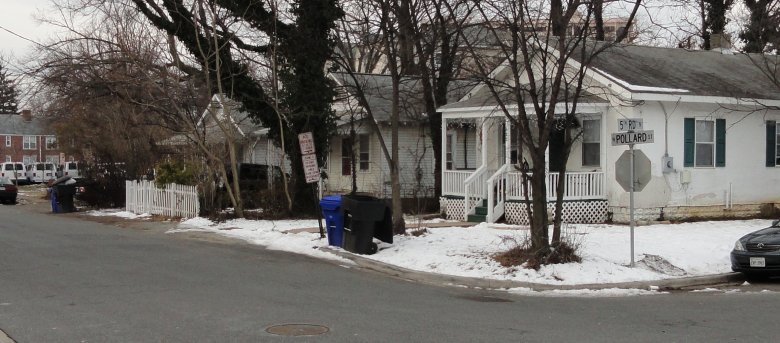
One of the good things about the walk is being able to look around and feel all the daily changes. Up top and just above show the changing neighborhood. On top are modified “shotgun shacks”.  You can see that they are simple.They call them shotgun shacks because a shotgun fired at the front door would go right through the whole house. These places won’t be here much longer. Immediately above is new construction. The new condominiums will almost literally cast a shadow on the shotgun shacks. How long until somebody builds something here?  Below – We recently had some thawing and I enjoyed watching the melt-water flow. The picture isn’t so pretty but those who like flowing water in all its forms will understand.

Sound Mind & Sound Body

The ancient Greeks & Romans were fairly unanimous in understanding that body health & mental health were inseparable. The idea slipped during the middle ages, when some believed in the “mortification of the flesh.”  Our ideas in modern America are mixed. Popular culture features the fictional conflicts between nerds/geeks and jocks. According to the formula, the geeks are uncoordinated and physically weak, but hard working and smart. The jocks are the opposite. Like lots of high school concepts, this one is based on a simplified version of brains v brawn and narrow definitions of health and intelligence. 
The Greeks were right.  Healthy bodies and healthy minds go together, at least in a statistical sense, i.e. in general but not always.  I know that somebody will throw up the example of Stephen Hawkins, but he is an exception in almost every way.  The brain is part of the body. When the body functions poorly, the brain is affected.   You just cannot think as clearly if your body is giving you trouble. Think about the last time you had a bad toothache. Did you think about lots of other things when it was acting up?

It is hard to determine the causality in mind-body health. Healthy people can devote more energy to keeping their mind alert and intelligent people understand better the need and methods for staying healthy. We find a correlation between health and success, with obesity and poor health more common among the poor. It some ways it violates our sense of fairness. We like to think there is some kind of compensation, so the guy with the weak body gets the compensation of being smarter.  It just doesn’t seem to work like that.

I go to Gold’s Gym three times a week and I am under no illusions that all those guys built like gorillas are rocket scientists. On the other hand, the people who work out during their lunch hours, before or after work seem a cut above the ones who don’t.  

Talk of the Nation – Science Friday” reported studies that show that moderate exercise, like walking 40 minutes three times a week actually increase the size of your brain. They also discussed “brain exercises” like doing crossword puzzles. These things make you better at crossword puzzles, but don’t do much in general.  Physical exercise, on the other hand, improves the raw material of brain health and so provides across the board benefits.

I know this is not the same thing, but I find that I think more clearly when I am walking. I don’t know why that is. Maybe it is just better to be in motion. I can think about things when I am walking. I suppose if I was just to sit still and try the same thing my mind would wander or I might just fall asleep.  

Another thing the ancient Greeks used to say was “nothing too much” or “everything in moderation.”  You don’t have to be a triathlete to have a healthy mind and body, but it would be a good idea to be able to walk around the block w/o your body complaining. It helps keep the mind clear.

The picture up top shows the dumbing down of our society. How dumb do you have to be to require a warning on your computer keyboard? IMO, one of the big challenges to our society is that we allow fewer and fewer responsible decisions.

The Great Ronald Reagan & Me

Ronald Reagan would have been 100 years old on February 6. As the partisan passions fade, everybody is starting to recognize the greatness of the man. President Obama recently read a Reagan biography for inspiration and wrote an article in USA Today praising him.  

Any president who leads a big change will provoke dislike on the part of his opponents and I recall the rabid hatred among some of them in the 1980s. They can be forgiven some of their faults. Reagan was a very insightful & intelligent man and a hard worker. We know that now from reading his journals and from other sources coming out about him. But he evidently liked to hide these things. Maybe he was modest or maybe it was a strategy.  

Ronald Reagan used to say that you can accomplish almost anything as long as you don’t care who gets the credit. The easygoing persona that he projected allowed lots of people to feel they deserved credit. It also allowed people to give him things he wanted w/o appearing to give in. Reagan didn’t score points off the failures of others, but his affable personality also led opponents to underestimate him. They thought many of his accomplishments were just dumb luck. In my experience, someone who is consistently “lucky” has something special going on. Only a man truly confident in himself can behave as Reagan did. That is one reason he was such a unique leader.

I voted for Reagan in 1980 & 1984. It was a little hard for me to do in 1980. I had voted for Carter in my first election in 1976 and I was living in Madison, Wisconsin, in one of the nation’s most liberal enclaves. When I would say anything good about Reagan, or even when I didn’t join in the criticism of him, my colleagues would make fun of me. There is considerable social pressure in a liberal university setting to “rebel” within acceptable margins. I was finishing my MA in history and looking forward to going on to my PhD. As I recall, most of my colleagues considered Jimmy Carter too conservative and Reagan was clean off the map. The popular candidate around my part of town was a guy called Barry Commoner. Commoner was a bit of a nut, but he said the right things about the environment and was sufficiently obscure to get the “intelligent” student vote. 

Anyway, it came as a surprise to me too that Reagan made sense to me. Up until that time, I just assumed that I was a type of liberal, which was the local default option. I think that my vote for Reagan actually had significant effect on my life. Of course, not the vote itself, but the cognitive dissonance it provoked.  I have never been good at keeping secrets and so I talked about it with my friends. They treated me like someone who had been in the sun too long and tried to explain why I was just being foolish.

As I listened to their arguments and defended myself, I came to understand that I really did not hold the same sorts of views as they did. I started to read more widely and came to lots of different conclusions. One of the very practical changes I made was in my course of study. I began to perceive myself as a bit of an outsider in my history-sociology circles. I still loved history, but I became more interested in practical things like business (IMO a kind of applied history) and decided to get an MBA. This was greeted with some distress by my friends. One well-meaning guy carefully explained to me that an MBA was a kind of “trade school” degree and it was not the kind of thing somebody like me should do. For me, at least, the MBA was a lot more of an intellectual challenge than my MA, but maybe that was just me.

You follow well-worn paths for maybe 95% of your life. This is something you have to do, since nobody could abide the chaos of constant uncertain change. There are a small number of inflection points, however. These are usually little things. You may be almost unaware of them at the time, but over time they take you off the old path and put you on a new one. The little half turn doesn’t seem like much, but there can be substantial divergence a few miles down the path as the one change leads to another. 

Somebody once told me that there are only around 5-7 inflection points in any life and if you think about it, you can probably identify them. They are rarely the big, shocking events we think of. The road to Damascus type conversions are the ones we mark, but they may actually be the culmination of a long process of change, not the beginning.  By the time you make the public announcement, or even know it yourself, it may have been stewing for a long time.

Looking back, my decision in 1980 to vote for Ronald Reagan was one of those little decisions that changed the way I thought of myself and ended up changing lots of other things too. So like all Americans, I can thank Ronald Reagan for what he did for the country, but I also have a personal reason to be happy that he came along.

Charismatic Religions

My area studies today featured religion in Brazil. These are some notes and impressions.  

Max Weber, one of the fathers of sociology, thought that religion would disappear and that Protestants would lead the way, since they embraced rationalism that would come to make religion redundant and expendable. Students of sociology and political science still study his ideas those they spawned & there are lots of good ideas. But embedded in the classic sociological system is the assumption, common in intellectual circles in at the turn of the last century, that religion was old-fashioned and in the future would atrophy. Max Weber died in 1920 from complications from the Spanish flu. Religion has shown no signs of dying out and among most dynamic and expanding types of religion are the charismatic protestant denominations.  Maybe the reports of the death of religion have been exaggerated. 

One of the most interesting places to watch the religious dynamic is Brazil.  Brazil remains the world’s most populous Catholic country.  This doesn’t surprise most people for a mostly Catholic country with a population of 190+ million.  More surprising, perhaps, is that Brazil is also home to the world’s largest community of Pentecostal Christians.  The numbers of protestants in Brazil is has been growing rapidly. A couple generations ago, there were almost no Protestants outside immigrant communities in the south. Today some surveys indicate that Protestants make up as much as 30% of the population and their numbers are growing rapidly.

The Protestants are also among the most active.  As I mentioned above, Brazil has the world’s largest population of Pentecostals.  They currently make up between 15-21% of the population, but they are very much involved in their religion. They attend church services in very large numbers and account for around 40% of all contributions to churches in Brazil.

Many of the new Protestants come from the poorer parts of society. The church gives them not only spiritual guidance, but also social benefits. The church provides social networks and encourages members to stop drinking, gambling and cheating on their spouses.  All these things translate into generally better life outcomes on earth as, presumably, in heaven. Compared with others in similar social-economic circumstances, Brazilian evangelicals have higher incomes. Americans would recognize some of the methods Brazilian evangelicals use to reach potential converts and keep in touch with the flock. There are what we would recognize as mega-churches, but more often the secret of success is to be local and close to the customers, as illustrated above.  The new churches know their communities and satisfy both their spiritual and social needs.  Brazilian evangelicals were among the first to take advantage of television.  One of the biggest denominations,  the Universal Church of the Kingdom of God (Igreja Universal do Reino de Deus)  owns a television network, Rede Record. Brazilian evangelicals are having significant effects overseas, especially in Africa.

What marketers might call closeness to the customers is a big advantage that evangelicals have over the Catholic Church, which tends to be a little more distant. Catholic priests are also thin on the ground.  There is only one priest for every 8600 Brazilians. With that kind of ratio, it is hard to get close and personal.  This is exacerbated by the fact that many priests in Brazil are foreign born. Brazil doesn’t produce enough of its own.  The Catholic Church is trying to counter the loss to the charismatic Protestant churches with its own version. The leader of this movement is a priest called Marcelo Rossi. Despite these efforts, the Protestant numbers continue to grow.

For now, it is the Protestant charismatics who are reaching the poor. They preach a personalized salvation, as opposed to the “liberation theology,” which was the largely unsuccessful attempt to reach the poor a generation ago.  That does not mean that the Protestants stay out of politics, however.  Leaders have learned to deploy their numbers as swing voters.  In recent elections, they have supported the left leaning PT (Lula’s party) but not reliably (hence the swing vote status).

Those of us who graduated from secular-based programs in secular universities have a little trouble understanding the power of religion in motivating people. Our world view just doesn’t include the power of faith. We tend to look beyond the religion and seek secular explanation based in sociology or psychology. These factors probably have some validity, but maybe religion is a big part of some people’s lives because they really believe it is true.  IMO, we need to respect that a little more than we do and treat beliefs as a goal in themselves, not merely a means to achieve some material goal. 

BTW – I have sometimes used the term evangelicals. This does not mean exactly the same thing to Brazilians as it does to us. In its Portuguese version, it is more inclusive of all Protestants, but it is true that the fastest growing portions are those that might fit in well with our connotations.

You can find more about Brazilian statistics at www.datafolha.com.br.

A Couple Days in January

Pictures from some ordinary days.  The winter has been colder than usual for Virginia. We have managed to avoid most of the snow, but what we have is hanging around.

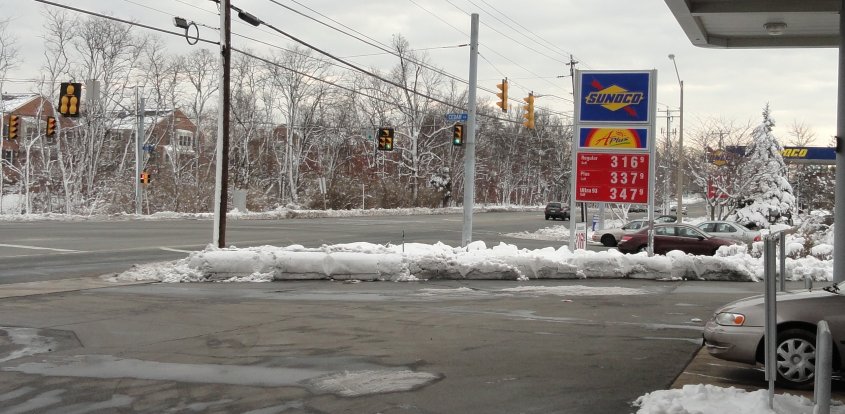
Above – gas prices are going up again. Given the events in Egypt, maybe these prices will look low after a little while.  Below – not a good time for the Red Cross disaster truck.

Below is a welder at a construction site near Balston. 

Below is the top of the building.

Food TOO

They seemed to be going in opposite directions. The report I watched on “Globo Rural” talked about transgenetic crops. Much of the soy produced in Brazil (in the U.S. too, BTY) is genetically modified. The reasons are clear. It is easier to grow. One farmer in the State of Parana explained why he went completely over to genetically modified soy. He could use a lot less fertilizer, almost no herbicides or pesticides and he did not have to run his machines in his fields nearly as much.   

Transgenetic foods are labeled with a “T” in a triangle, so that consumers can recognize them. Evidently some people don’t like them as much and so are willing to pay more for non-T-modified products. Non-T foods are also sold to the EU. People there, no doubt egged on by strong domestic interest groups, want non-T products and are rich enough to pay the higher prices. I am not really sure about that term non-modified, since all the field crops we grow are significantly modified by plant breeding. I chose to use that instead of “natural” since they are also very far from whatever ancestor they had in nature. This leads me to the second article.

The second report on “Jornal Nacional” talked about organically grown food and labels proving that the food on the shelves is organic. 

To some people this means natural, but all that it really means is that the farmer did not use synthetic fertilizers, herbicides or pesticides.AND for the time being “organic” does not include foods genetically modified by specific biotechnological means. This distinction is also important, since almost all the foods we eat are genetically modified.All the apples you eat, for example are from clones.Apples do not breed predictably.The only way to guarantee a red delicious apple is to clone it.Every one of the red delicious apples (or other varieties as well) are the identical tree, genetically). But people who care about labels consider plant breeding a different category.

People favor organics for a variety of reason. Some people think the organic products are better for them.  Others say the organic products taste better. (This could be true, although probably more because organics often are grown by smaller, local operators who can cater to tastes.)  But a big part of the choice is that organics are perceived to be better for the environment. This last is not true. 

Organic farmers tend to be less productive (per unit of labor and land) than those who use a wider variety of techniques. I don’t want to make too big a distinction between organic and non-organic. Much of “non-organic” production, BTW, is very organic.  Dairy farmers, for example, produce and use tons of organic manure and most farmers follow rotations, planting nitrogen fixing legumes, for example, which add nutrients and organic materials to the soils. No farmer uses only synthetic methods. The difference is the organic farmer will not use any synthetic products in addition to organic ones. This makes them less productive, which is why organic products cost more.  But the environmental cost is harder to understand.  Less productivity means that more labor and land must be used to produce the same amounts of food, which means more land must be cultivated, leaving less land in a “wild” state. 

It seems to me that one of the best ways around this dilemma would be transgenetic crops.  As the farmer in Parana said, he chose to plant transgenetic soya because he could use less fertilizer, less herbicide, less pesticide and he needed to use his machines less in the field, i.e. burned less fossil fuel in the cultivation of his crops.   It seems like a win-win to me. 

Transgenetic crops can be very good for the environment since they require less of all the inputs that currently cause concern. Properly deployed, transgenetic crops could solve, or at least address the problem of lower yields for so-called organic crops. Something that produces more, on less land, with fewer inputs of fertilizer, herbicides & pesticides and lets farmers use less fossil fuel should be welcomed, don’t you think? Maybe we should come up with a new category that is environmentally friendly. It could include organic products and transgenetic ones that use fewer of those inputs above.

We can call it trans-genetically- organic. How about this? We call it a Transgenetic- Organic-Operation for food production. The label can be “Food TOO.”

Making it Right

Mudslides in Brazil have killed around 900 people in the last few months. These are not natural disasters. Although the proximate cause is heavy rain, it is the deforestation and the uncontrolled building on steep hillsides that turned weather events into deadly disasters.  Brazilians understand this and have been looking around to other countries that have done better.  The most current example is Australia, which suffered the worst floods in decades with significantly less loss of life.  But Brazilian TV has also gone to New Orleans to assess the successful American response to Hurricane Katrina.

One of the hopeful aspects of the recent Brazilian disasters was the response of Brazilian society.  There were more volunteers to NGOs than could be used and people were lined up to donate blood for the victims. This may seem unremarkable from the American point of view, but this is an evolution in Brazil.
Until recently, Brazilian civil society was relatively weak with a centralizing government taking the predominant lead in most situations. The fact that the government by itself was often not up to the job did not discourage the belief that it should do it all. Like most developing countries, Brazil was thick with laws and rules, but there was often little enthusiasm for following or enforcing many of them.  There was the tacit agreement that the network of rules could not work and finding a way around them (Jeitinho Brasileiro) became a fine art. This had the beneficial effect of keeping things working, but also contributed to lots of trouble.  The uncontrolled building and deforestation that caused the recent disasters, for example, was almost all illegal, but laws could not be enforced.  In some ways, the laws were “too good.”  Their provisions were not executable by actual people in real situations.

What impressed the Brazilian television reporters about New Orleans was not the government’s response, which remains inadequate in many ways. The success in New Orleans is Make it Right, a non-governmental organization spearheaded by actor Brad Pitt.  Make it Right is doing innovative things quicker than any government bureaucracy could manage. Rather than building cookie cutter projects or maybe not really building much of anything at all, as is often the government response, Make it Right is constructing homes that different and unique. They are adapted to the environment, so that when the next flood comes, these homes will survive.   

The lower 9th Ward of New Orleans is becoming a place where homeowners can experiment in new ways of building environmentally sustainable communities, not just individual homes, but whole communities with local vegetable production, rain gardens and open space. The unique thing about all this is that it is not top-down, nor really bottom up. Rather it is a partnership with ideas moving both ways. This is a development to watch.It might seem that I am critical of government because government has “failed” to do what Make it Right is doing. On the contrary, the beauty of the system is a government that allows, enhances and encourages  the efforts of private individuals and groups. The government cannot do these sorts of things and a wise government recognizes that it does not have to. The total society response is what counts; government is only one part of total, sometimes the most important part, often not.

Government contributes in a particularly American way based the choices of the people and on our tax code. For example, I decided to contribute money to Make it Right, and because of the nature of our tax system – i.e. the tax exempt status – government essentially matched part of my contribution. After granting tax-exempt status, no bureaucrat needs decide which charity is worthy. The individual Americans decide with their preference, knowledge and with their own money. This distributed decision-making is a total society response with a role for business, government and individual Americans. Balance is important.

Government doesn’t have to and should not try to do it all. We fallible human beings don’t know what a perfect society would look like, so we can’t empower government to create one. We can create a government that contributes to conditions that help citizens prosper. A good society doesn’t solve all problems; it enables citizens to do the right things & make their own choices. 

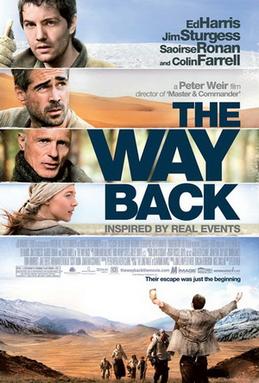
I thought “the Way Back” would be just an adventure movie. It was interesting from the adventure point of view, but I thought it was even more interesting from the point of view of politics & heroism.

The main character is a Polish officer captured by the Soviets after they and the Nazis divided the country between them in 1939. The Soviets massacred many Polish officers at place like Katyn forest, so that he escaped alive was an achievement. It was a terrible time in Poland and not very good in the world in general. It sometimes seemed that the world would be divided between totalitarian communist or totalitarian Nazis, with lots of petty tyrants mixed in but not much space left for freedom. In the movie, the communists throw the guy into a Gulag on the usual communist style charges. There are scenes of the brutality. The main character and some others escape and walk all the way across Asia from Siberia to India.

It has been more than twenty years since communist collapsed in Europe and Poland led the way to freedom. The horrors of communism have faded from popular memory. It is almost impossible to believe it really happened at all. Whole populations exterminated, people thrown into camps because of their associations, class origins or just for no real reason at all. The wars of the 20th Century were bloody with industrial strength, which makes it even more astonishing that more people died from the murderous internal oppression of revolutionary socialism, like communism and its cousin Nazism,  than in all the battle associated deaths.  When the world started to wake up from that long nightmare, when the Berlin Wall fell and freedom returned to large parts of the world, our joy at the events allowed us to put aside some of the horrible memory. Few Americans have ever experienced anything even remotely like the horrors of the Soviet Union, but it is important sometimes to recall the carnage and suffering committed in the name of progress toward totalitarian utopias.

We like to think that the human race has grown past this kind of thing. People living in just societies in peaceful times can feel that way. History gets sanitized. But the study of history informs us that it good times represent just pushing back the wilderness, in limited times and geography. The demons still lurk out there and even within. World War I opened the door for lots of them and in many ways Lenin, Hitler, Stalin & Mao were made possible by the monumental disruption in the world order. With the passage of time, some of these events and personalities seem less pernicious; they become stereotypical characters, and their murderous henchmen, like Leon Trotsky or Che Guevara can even acquire a kind of radical chic.  

No matter the other merits of the movie, it helped me remember both the horror and the heroism of those who resisted tyranny and ultimately brought it down and also the dangers of revolutionary change. The mostly peaceful general collapse of communism in Eastern Europe may have made us too optimistic. In a place like Poland, it happened smoothly as power moved to a well-prepared and civilized opposition. Despite the past, there were no significant reprisals. As I write this, we are witnessing potential revolutions in the Middle East. I don’t know the details and I certainly cannot predict the future. But I am afraid that behind the revolutions there, there is no Geremek, Onyszkiewicz, Mazowiecki or Wałęsa. I am not sure what the historical analogy will be. When the Iranians knocked down the Shah, worse and more persistent tyranny followed. Just knocking down tyranny is not enough. Some will be there to pick up the pieces. Good does not always get there first with the most. The good people are not always the best organized and the violence, exhilaration and power associated with revolution can corrupt even the best people.

There is no solution to this or a formula that will work all the time. In the times of wrenching change, a lot depends on personalities and luck. Would our post-revolution been so successful w/o men like George Washington?  If the Germans had not “imported” Lenin back into Russia, might their revolution been more moderate and less horrible?  The farther we get from events, the more they seem to have been destined to unfold as they did, but nothing is determined.

Returning to the prosaic, “the Way Back” is a good movie, worth going to see. You can enjoy it as an adventure film and a tale of adversity & triumph and if it makes you think, so much the better.  Colin Ferrell does a great job of playing a murderously dangerous and dumb but somehow likable man.  Ed Harris always does a good job. And Jim Stugess, who plays the Polish officer in the main role, portrays an honorable and determined man in an almost impossibly challenging position. See the movie.

Shoes on the Other Feet

I remember going up to the Vale dos Sinos with George Lannon, the Consul in Porto Alegre.  Our mission was to talk to Brazilian shoe makers there.  There was a trade dispute back then. Brazilian shoe makers, many located in the Vale dos Sinos near Porto Alegre in Rio Grande do Sul, were producing inexpensive, good quality shoes that were beating the domestic producers in the American market. This was more than twenty-five years ago.
I recall hearing the competition talking about the various “unfair” advantages the Brazilian shoemakers enjoyed.  They were close to inexpensive sources of quality leather, because of all the cattle raised in the region; they had the advantages of cheap labor and a low exchange rate; some people complained that labor conditions were oppressive.  (At the factories, BTW, we found working conditions were good.  It reminded me of Germany in many ways, since many of the people there were of German descent and they seem to run their businesses on that model.)  On top of all that, they made good shoes  because the firms were well managed and the workers skilled.  They studied and brought back skills from the premier leather processors in northern Italy.  I really had to respect their initiative and follow through.

Times change. I understand that. Nevertheless, I was surprised to learn that many of those thriving factories were closed or suffering mightily, not only Rio Grande do Sul, but all over the Brazilian leather industry. They could not compete with the cheap imports from China.  Brazil tried to protect its leather industry, but the Chinese figured out ways around the barriers and their price advantage was just too overwhelming.  Nobody has a permanent advantage and the apparently monumental Brazilian advantages evaporated in the last quarter century.  The Brazilian shoe makers complain that the Chinese have unfair advantages. They have access to cheap leather, a low exchange rate and labor that works under oppressive conditions. They might be right about some of these things, especially about the exchange rate, which the Chinese keep artificially low, but it doesn’t change the outcomes.

When American firms were faced with competition from cheaper products, one of the responses was to move to higher value added products.  Some of the Brazilian firms are doing that too. A report on Brazilian TV explains how Brazilian firms are making very high quality, customized products.  

Ironically, many of their most expensive shoes are aimed at the Chinese market. They evidently found a niche there among rich Chinese, who are willing to pay high prices and are impressed by the outward signs of quality as well as the snob appeal of having something expensive and custom made. 

People who study these things call them “positional goods” and refer to things that are valued less for their qualities than for their exclusivity. A rich person can only eat so much, drink so much or wear so many sets of clothes. In our modern world, even relatively poor people can partake in the luxuries once the exclusive domain of the rich. It makes it harder for the rich to express their status. The availability of tangible goods can expand. Everybody, or almost everybody, can have a refrigerator, good shoes or clothes of decent quality, but relative status is limited.  Status seeking rich guys look for things that are limited.   Returning to the example above, everybody can have good shoes these days, but the exclusive, handmade shoes are rare and so status enhancing for those who care about those things.   Thorstein Veblen wrote about this a century ago when he coined the term conspicuous consumption in his “Theory of the Leisure Class.”

For the time being, this redounds to the benefit of the Brazilian shoe makers.  The Chinese keep their currency artificially low against the Brazilian Real (against the dollar too, but that is another story), which makes Brazilian goods more expensive in China than they would otherwise be. But in the case of conspicuous consumption goods, price doesn’t matter.  In fact, the higher price, which keeps poorer people from owning the goods of desire, may actually heighten their attractiveness.  So the shoemakers get benefits from the high price they can charge enhanced by their overvalued currency, when they collect even more money from the Chinese fat-cats. 

Nevertheless, they should not rely on this situation lasting forever.

I have been following business stories for more than twenty-five years. I read about the decline and fall, and sometimes about the rebound and success.  Today’s hero may turn into tomorrow’s dog, as good times are followed by bad ones. But wait, you might make a comeback. Continued success depends on continuous adaption. The game is never over; there is no finish line. This is bad news when you are on top, but encouraging if you are not.  Veblen has an insight about this too. He talked about the advantage of borrowing and the penalty of taking the lead.  When you develop something that works, others can copy what works, leave behind the mistakes & then innovate some more. The Brazilian leather workers did this a quarter of a century ago, when they learned the best techniques from places like Italy & the U.S.  The Chinese did it after that. Everybody can do it, but we need to pay attention and be open to change.