Thinning pine forests is an important management tool for healthy forests. Look at the two pictures. The stands are opposite each other and planted in 1996. The difference is that the first one was thinned in 2011. We removed 2/3 of the trees. We left the other stand as a comparison. Already you can see it is less robust.
The trees thinned went to Kapstone in Roanoke Rapids, NC, where they were turned into cardboard. You do NOT save trees when you save paper. They just grow too thickly and in the end you are left with less paper and fewer trees.


A long and hard day

It is the end of a long day. I chose yesterday to go to the farms because the day was predicted to be the nicest day of the year, low humidity, sunny high about 80 degrees. And it was the best day – weather-wise. Otherwise, not so much.

Started off great. Got up early and headed south. Got to the first place at around 9 am and worked on my longleaf pine. But then I wanted to load up a couple rocks to take home. The big one you see in the picture hurt my back. I am getting too old for this crap. But that was not the end.

I went the other farm. My task was to cut some of the vines growing into my loblolly pines. The vines are a nuisance for several reasons. We have invasive Japanese honeysuckle and wisteria. Very beautiful flowers, but they just climb to the top of the trees and the wisteria wraps around the trunks and chokes them. My other concern is fire. Fire would not destroy my pines if it stayed on the ground. Southern pines are fire adapted, as I have explained on many occasions. BUT the vines form a kind of net that catches the needles and dead branches. It provides a ladder to the crowns. The chances of fire are slim, but not zero.

Anyway, I did not get to much work. First, I got a blowout on the way up, as you can see from my picture. It took me a long time to change the tire, since my back hurt. I did a little vine cutting after, but – not to get monotonous – my back hurt. And then I had to get back to town to get a new tire.
I went to Rick’s garage in Brodnax. They did a quick job and I got a new tire. My old one was ripped up and could not be plugged. While there, I started to feel sick to my stomach.
I drove the short distance to the Brodnax farm to check into my new plantation. We planted forty-six acres: fifteen acres of longleaf and the rest loblolly. I was worried about them because of the dry April, but from what I could see the wet May has redeemed them. You can see in my picture that a lot of brush has grown to cover the land. I will have to deal with that in September. I saw healthy trees in the areas I examined but did not examine much because I started to throw up and feel really tired. This is uncommon for me and I do not know the cause. It was unpleasant and made walking around difficult. So I went back to the truck and rested for a while in anticipation of the three-hour drive back.
The drive was too much, however. My back hurt and I still felt sick and very tired. I made it only as far as Petersburg. I didn’t think it was safe to keep driving and decided that discretion was the better part of valor, so I checked into the local Holiday Inn Express. I showered off the ticks and then went right to sleep. It was a fitful sleep, but I got some rest. I woke up about 230 am. The choice, as I saw it, was to get a few more hours of that fitful sleep or take off toward home. The advantage of leaving sooner was to avoid the gridlock traffic. So I went. It was an easy drive. There is not much traffic in the early morning, although I did still hit some traffic when I got to Washington about 430 am.
It was a long day because it kind of feels like today is still part of yesterday. My back still hurts but feels better. The stomach problem was evidently only a short-term deal.
I will have to go after those vines another time.
A place to sit

A problem at the farms is that I have no place to sit. It just is not comfortable to sit on rocks or on the ground, not to mention that when you sit on the ground you get closer to the ticks. So I brought an old bench, where I can sit, eat lunch, listen to the water flow. It is a nice shady place to be. Of course, I suppose it will discourage actual work.
Prickly plants on the farms


 Lots of things are prickly or troublesome on my land. Some are useful but annoying.
A good example are the blackberries. They proliferate anyplace there is a disturbance and sometimes seem to have a malevolent intelligence. As you push through them, the branches whip backwards, hitting you in the back of the head and sometimes knocking off your hat. But blackberries are good in that they provide significant food for wildlife and habitat. You can eat them yourself. They taste good but they are small and you have to take a lot of thorns for your meager meal.
The next picture is a devil’s walking stick (Aralia spinosa). It is mostly harmless but it does hurt to run into it. They are very common on our land in Freeman but completely absent on the Brodnax farms a few miles away. I had to cut a couple dozen of them out of my longleaf patch. You have to be very careful. You grab them with you gloved left hand an whack them with a downward stroke from your machete. You need to hold tight, however, because if you hit it loosely, it hits back.
My last picture is a tree of heaven (Ailanthus altissima). This is nothing but trouble with no redeeming characteristics in a rural setting. There are some uses in degraded urban environments, since they grow fast and can grow almost anywhere. They are nearly impossible to eradicate. If you chop them down, they grow back more vigorously. There is no effective method I have ever heard about that does not require chemicals and even with this you cannot win a final victory. I have been spraying these things for years and go after them whenever I see them.
I was indolent with the one in the picture. I noticed the clump in the middle of the wildlife plot last year, but I didn’t have my sprayer with me so I left it. I went back last week. It had growing bigger and thicker and about a dozen little ones had sprouted as far as 100 yards away. I think I got most of them, but I am sure they will be back.
My last picture is a tree of heaven (Ailanthus altissima). This is nothing but trouble with no redeeming characteristics in a rural setting. There are some uses in degraded urban environments, since they grow fast and can grow almost anywhere. They are nearly impossible to eradicate. If you chop them down, they grow back more vigorously. There is no effective method I have ever heard about that does not require chemicals and even with this you cannot win a final victory. I have been spraying these things for years and go after them whenever I see them.
I was indolent with the one in the picture. I noticed the clump in the middle of the wildlife plot last year, but I didn’t have my sprayer with me so I left it. I went back last week. It had growing bigger and thicker and about a dozen little ones had sprouted as far as 100 yards away. I think I got most of them, but I am sure they will be back.
Simple soil solutions


 Went down U.S. 29 to see Simple Soil Solutions, a farm near Gladstone, VA where they are rebuilding soils through progressive grazing and then stopped at Madison, VA for a meeting with local tree farmers.
I always enjoy the drive down U.S. 29. It is very pretty with the Blue Ridge on one side and rolling hills on the other. There is usually not too much traffic. I used to drive that way regularly when Mariza Matel went to UVA (I am very proud that she graduated from Thomas Jefferson’s university) but now I have less cause to do it.
There are lots of charming little towns, wineries, apple orchards, as well as historical places like Thomas Jefferson’s Monticello and James Madison’s Montpelier. It is very green and the temperature is a little cooler than in Washington.
My first picture shows Madison, Virginia. It has the usual Civil War monument in front of the public red-brick public buildings.
Next is a road sign I noticed describing the destruction caused by the remains of Hurricane Camile in 1969. They got more than 25 inches of rain in a few hours. 125 people were killed in Virginia when those rains flooded mountain streams and rivers. Note the the Hurricane hit Louisiana and Mississippi with the highest hurricane winds ever recorded to hit American land and was still powerful enough to cause havoc in Virginia.
The other two pictures are from the Simple Soil Solutions farm.
My first picture shows Madison, Virginia. It has the usual Civil War monument in front of the public red-brick public buildings.
Next is a road sign I noticed describing the destruction caused by the remains of Hurricane Camile in 1969. They got more than 25 inches of rain in a few hours. 125 people were killed in Virginia when those rains flooded mountain streams and rivers. Note the the Hurricane hit Louisiana and Mississippi with the highest hurricane winds ever recorded to hit American land and was still powerful enough to cause havoc in Virginia.
The other two pictures are from the Simple Soil Solutions farm.
John Matel Information about the Simple Soil Solutions farm. http://simplesoilsolutions.com/

simplesoilsolutions.com
simplesoilsolutions.com
Tree farming on acreage big & small

You cannot be a true tree farmer on an acreage small enough that you can just take care of it yourself using hand tools. On the other hand, it is profoundly gratifying to work with your trees on small acreages, where your efforts make a difference. I have developed a compromise. Most of my trees are out of my hands. I will manage the land, but do little in the way of personal work. But I have a few areas special to me. They are small enough that my muscles and primitive tools and diminishing muscle can be effective, but big enough to be significant.

My pictures show one of my areas of special interest. This about five acres. It is mostly longleaf pine but there is some loblolly. I want to make this an open woodland of the sort once common in the south. The longleaf pine ecosystem is one of the most diverse in the world, since it includes an over-story of widely spaced trees and a ground level that is essentially a type of prairie. Mine will not be that way for a while. In fact, it will happen only after I am myself compost or too old to know I am not. But I am present at the creation and working toward a goal.

The first picture show the longleaf. They were planted in 2012 after the land was burned. It is a nice plantation. My work consists currently of whacking down hardwood and loblolly competition. It is a little sad for me. Anywhere else, even very close, I would welcome these volunteers. I have personally knocked down scores, maybe hundreds, and still they come. Notice the woods in back. Those are loblolly and they do proliferate.

The next picture shows the longleaf and the loblolly we planted. They are the same age, but notice how much taller the loblolly of the left. Loblolly grows faster for the first 20 years. At around 20, the longleaf and loblolly are about the same size. After that, the longleaf are bigger. But the longleaf cannot compete well in the first few years and would be eliminated absent fire or somebody like me wielding a machete. We will burn underneath the trees probably next year.
Next is the grass and wildflowers. The red flower is a butterfly weed, important to pollinators.
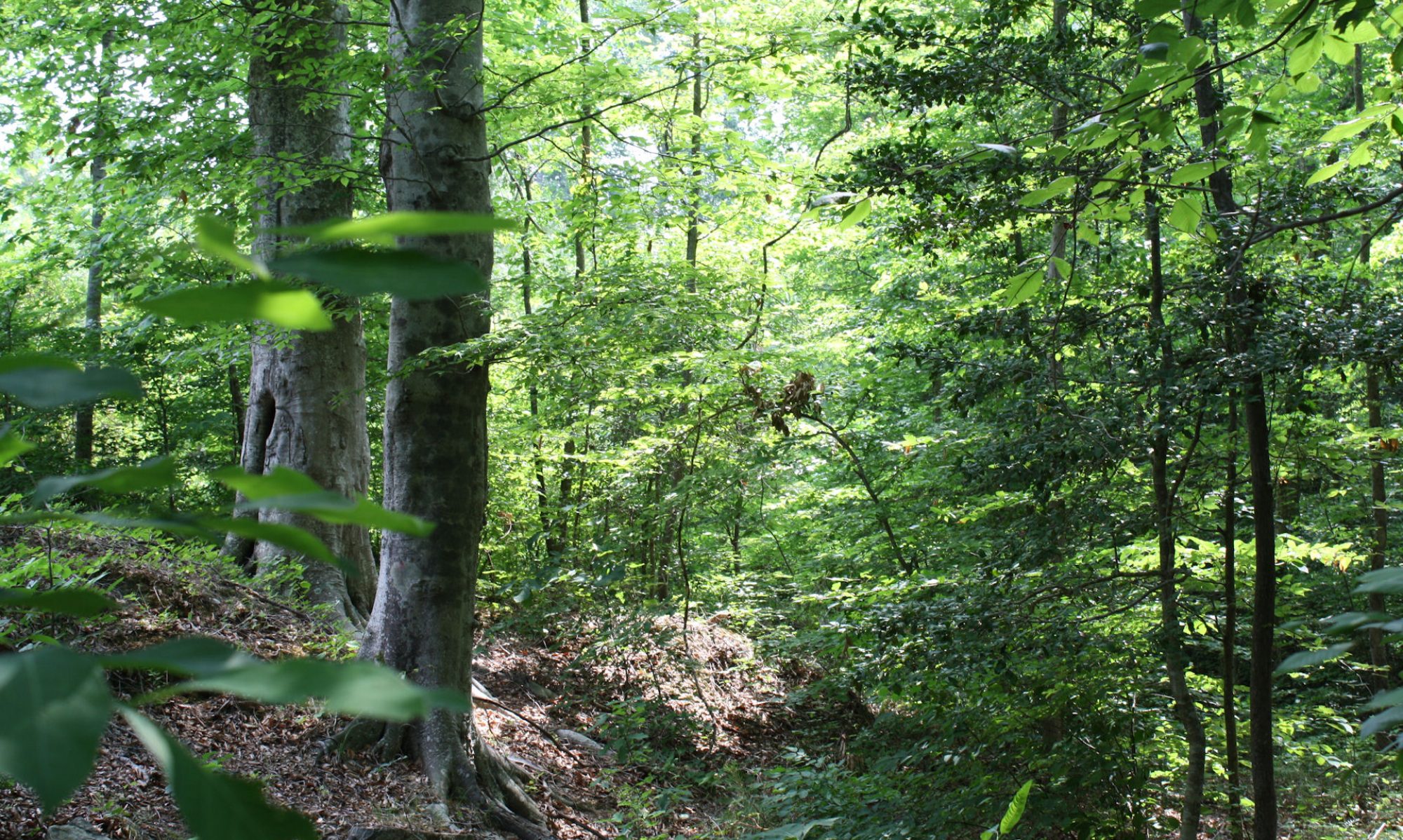
The last picture is inside the forest you see in the background. This is a stream management zone. We want to protect the water and so we do not cut. It is a well-evolved ecosystem. Notice the large tree near the right of the picture. That is a loblolly pine probably around fifty years old. It grew when this was open. Since then, the forest floor has become shaded (notice the shade-loving ferns) and pines will not grow there anymore. That tree may live another 100 years, but unless there is some natural or man-made disaster, none of its offspring will grow anywhere nearby. The new trees are mostly maple. Maple seed fly in the wind and can reach far. I did not see any beech. They will establish only later.
The first picture show the longleaf. They were planted in 2012 after the land was burned. It is a nice plantation. My work consists currently of whacking down hardwood and loblolly competition. It is a little sad for me. Anywhere else, even very close, I would welcome these volunteers. I have personally knocked down scores, maybe hundreds, and still they come. Notice the woods in back. Those are loblolly and they do proliferate.
The next picture shows the longleaf and the loblolly we planted. They are the same age, but notice how much taller the loblolly of the left. Loblolly grows faster for the first 20 years. At around 20, the longleaf and loblolly are about the same size. After that, the longleaf are bigger. But the longleaf cannot compete well in the first few years and would be eliminated absent fire or somebody like me wielding a machete. We will burn underneath the trees probably next year.
Next is the grass and wildflowers. The red flower is a butterfly weed, important to pollinators.
The last picture is inside the forest you see in the background. This is a stream management zone. We want to protect the water and so we do not cut. It is a well-evolved ecosystem. Notice the large tree near the right of the picture. That is a loblolly pine probably around fifty years old. It grew when this was open. Since then, the forest floor has become shaded (notice the shade-loving ferns) and pines will not grow there anymore. That tree may live another 100 years, but unless there is some natural or man-made disaster, none of its offspring will grow anywhere nearby. The new trees are mostly maple. Maple seed fly in the wind and can reach far. I did not see any beech. They will establish only later.
Don’t blame global warming
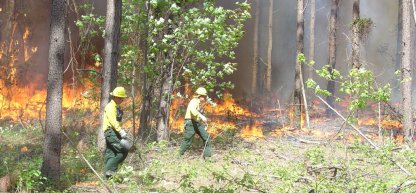
The problem with blaming global warming for everything is that it discourages better management practices that could be done, should be done to make our forests healthier. A good example are pine beetles. They are a problem and have been for years. They have become worse in recent times, and the facile explanation is global warming.
This article tells about how better management techniques slow the beetles. “As Dr Hood reports in Ecological Applications, the death toll was 50% in the control zone, 39% in the area intentionally burned, 14% in the one both thinned and burned, and nearly zero where it was merely thinned.”
Pine beetles are a threat in our Southern forests too. We know that the beetles are slow and stupid. When the tree are far enough apart, the beetles have trouble preying on trees and birds have an easier time preying on the beetles. That is a big reason we thin. Western forests are more often managed by the Forest Service and they more often are victims of misguided activists “protectors” who object to thinning or burning. As a result of the activists the forests are destroyed by insect and burned disastrously instead of in a better planned way.
So much of the destruction of Western forests is causes not in spite of the best efforts of activists, but because of them. Don’t blame global warming.
Reference
Other blog posts
Fire in Texas oak openings
Burning Questions
Setting the woods on fire
Burn the brush but save the soil
SITES a LEED for landscape
It is not the destination; it is the journey. That makes sense in the figurative way and today literally when I rode my bike down to the SITES event in Alexandria. We went to Alexandria a lot when I first came into the FS, but I go there rarely today and I have never gone all the way on the bike trail.
The bike trail journey was cool. You take the W& OD until it merge with the Four-Mile Run trail, which then turns into the Mount Vernon Trail. You have to leave the bike trails a little in the town of Alexandria.
The first part was very familiar, following my quotidian commute at least as far as FSI. The next part was familiar. I had been down many times, but not regularly. That part went as far as where Four Mile Creek enters the Potomac. The last part was new to me but not strange. I had been near driving, but not on the bike. The one-way distance was about sixteen miles. This was our first summer-like day, so it was sort of hot, but it was nice to sweat.
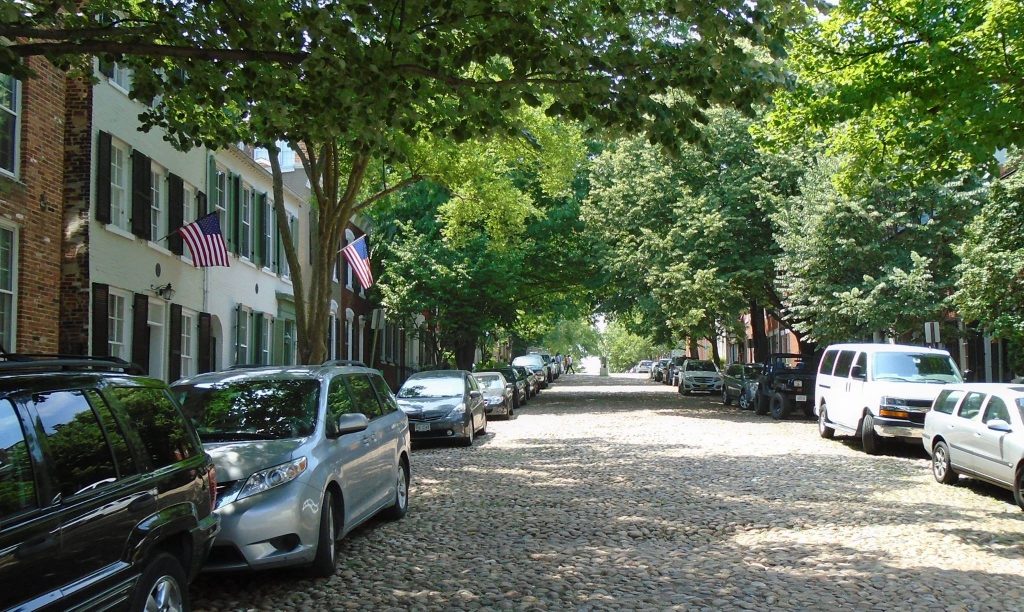
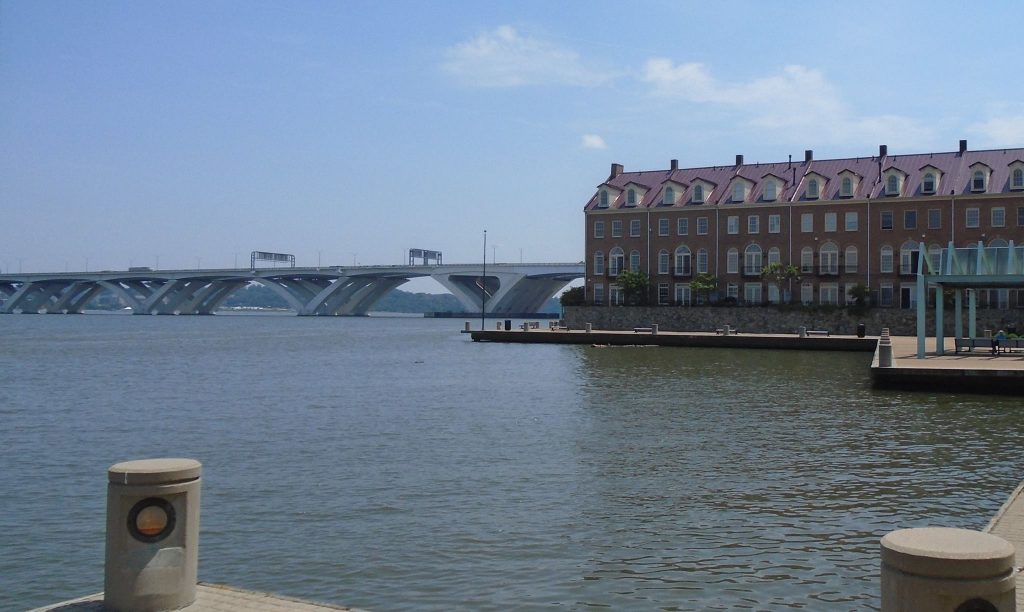
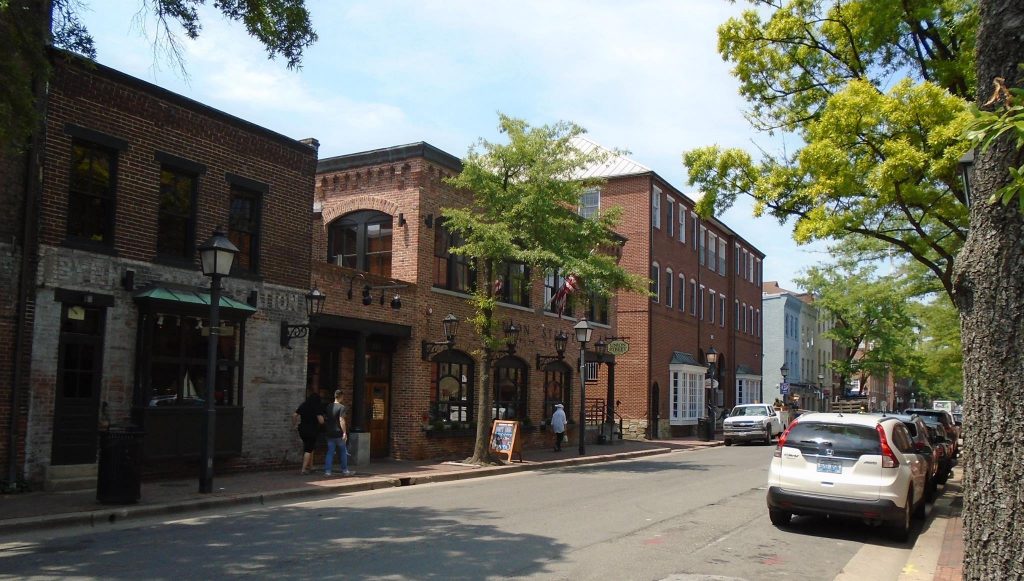
My first picture shows a cobble stone street in Alexandria. Very picturesque but hard on cars and impossible with bikes. I took a picture but avoided it. Next shows the Woodrow Wilson Bridge and the southern terminus of the trail I had to cut west to get to the meeting site for the SITES. Alexandria has gentrified and the old factories are now bars, restaurants and lofts.
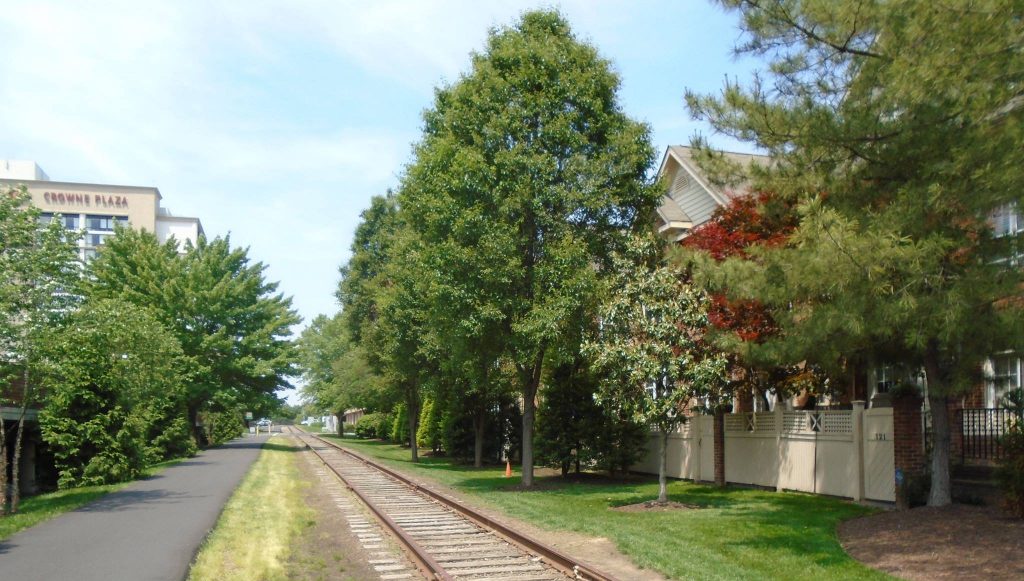
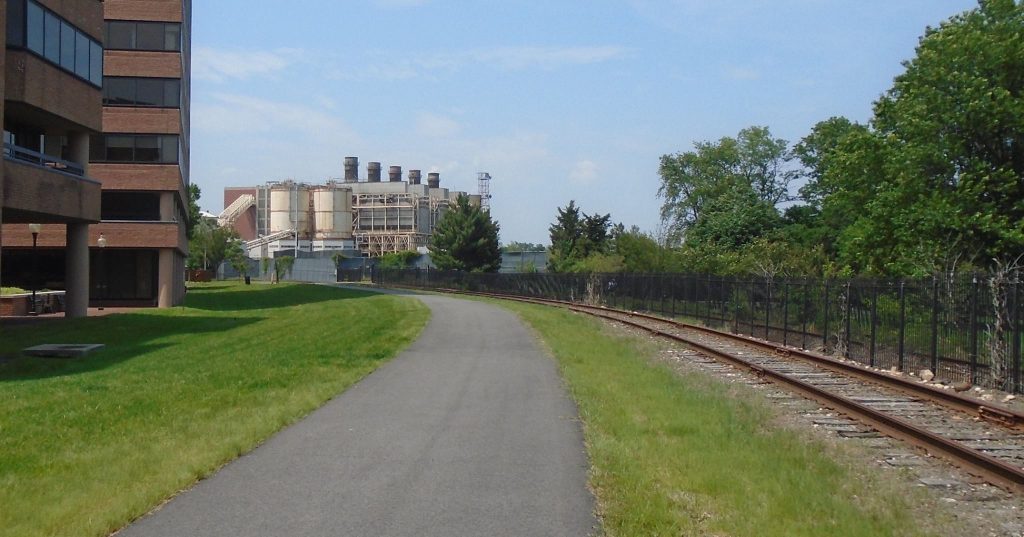
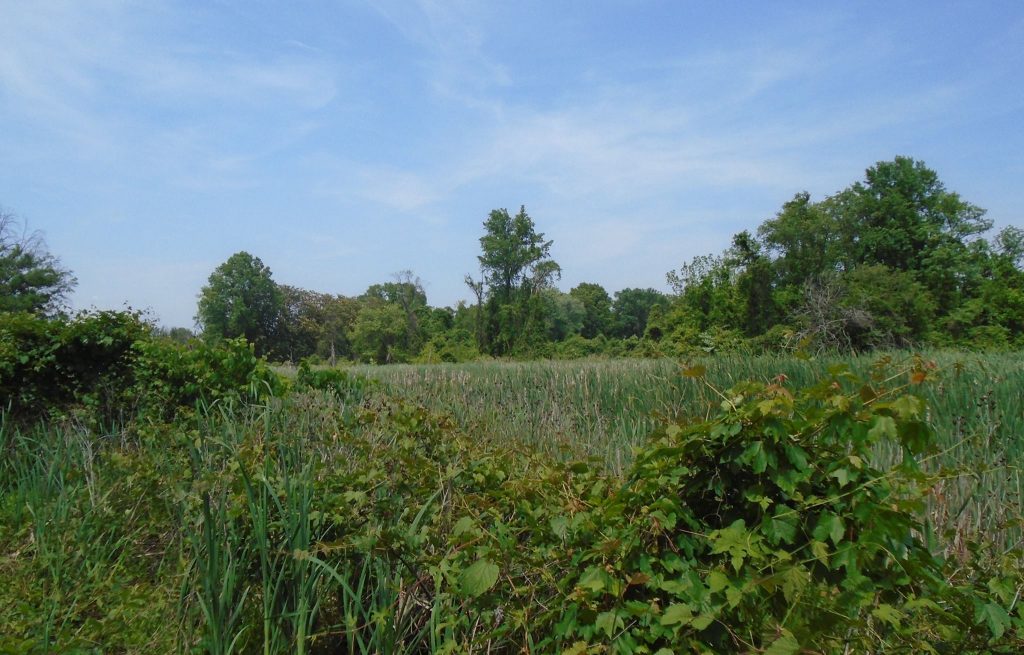
You see that in picture #3. The forth picture is the bike train going up to the old Potomac River Power Plant. It was a coal burning station that polluted the nations capital. It shut down in 2012. Now that it is closed, we see it more fondly. Picture # 5 shows the bike trail tracks and condos. The tracks used to carry trains loaded with coal for the power plant. They run no more and now the tracks are just interesting and quiet enough that you can have a high-priced apartment on the “wrong side of the tracks.” The penultimate picture shows a cattail marsh near the Potomac and finally is the bike trail in a typical section.
Why some people are not poor
The big question is not why some people are still poor but why today most are not. The world before 1750 was uniformly poor and miserable, a long dark age punctuated by a ephemeral points of light, enough to give humanity hope and a taste of truth and beauty, but never enough to sustain prosperity.
What happened around the middle of the 18th century to change this monotonously grim calculus?
As the author writes, “What enriched the modern world wasn’t capital stolen from workers or capital virtuously saved, nor was it institutions for routinely accumulating it…
“…The capital became productive because of ideas for betterment—ideas enacted by a country carpenter or a boy telegrapher or a teenage Seattle computer whiz…”
What happened was that a system developed that decentralized decision-making and spread incentives to a larger number of people. This greatly increased the total intelligence and innovation available.
““When people ask, ‘Will our children be better off than we are?’ I reply, ‘Yes, but it’s not going to be due to the politicians, but the engineers.’
“I would supplement his remark. It will also come from the businessperson who buys low to sell high, the hairdresser who spots an opportunity for a new shop, the oil roughneck who moves to and from North Dakota with alacrity and all the other commoners who agree to the basic bourgeois deal: Let me seize an opportunity for economic betterment, tested in trade, and I’ll make us all rich.”
Anyway, I saw this woman speak on two occasions now, and it is worth reading what she wrote here. A while back George Clack covered some of what she wrote in his quotations section.
Additional reference
High grading
High-grading involves harvesting the biggest and the best trees. This is attractive because it is most profitable, but it is also attractive because it is easy to confuse it with selective cutting. Over time, high-grading is usually significantly more disruptive than a clear cut. The biggest trees are not always the most mature. On the contrary, the may well be the healthiest and best trees. By removing them, you are taking away the best and leaving the worst.
But you will rarely be criticized for high grading, since you will leave a forest intact. In fact, you might garner praise from urban environmentalists unfamiliar with high-grading.
High-grading is unethical or ignorant, i.e. if you understand what you are doing you are behaving unethically, but not everyone understands. Some woodlands have been high-graded for years. You can imagine the well-intention landowner explaining that he cuts only the ones “ready to be harvested.” That is why we have to make a big deal about this. Most landowners want to do the right thing on their land. Not everyone knows what that means.
See this link for reference.
See this link for reference.