CO2 & Forests

Carbon dioxide makes plants grow faster and stronger, so presumably higher levels of CO2 in the air as a result of burning fossil fuels would make forests grow faster.   I was particularly interested in an experiment done at Duke University where they dosed a loblolly pine plantation with elevated levels of CO2.     Duke is not far from my forests and they were experimenting with the same species as I have on similar soils in a similar environment. 

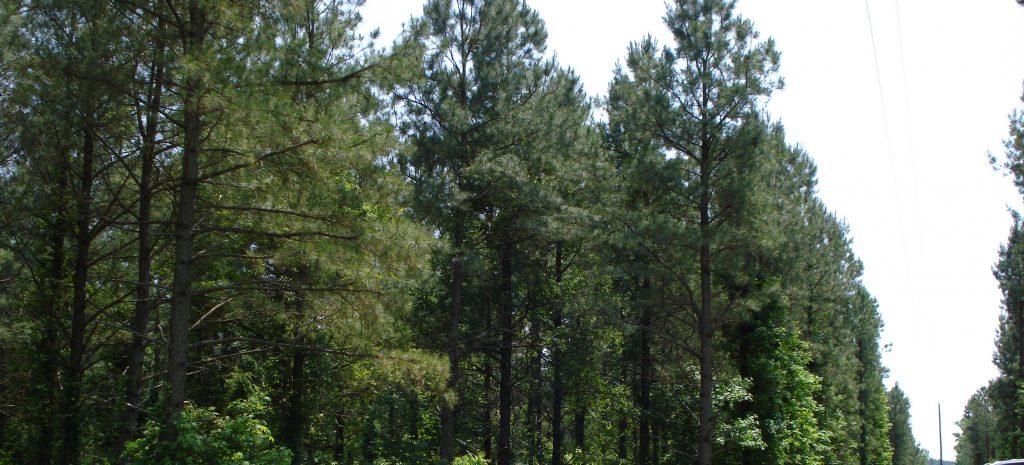
Below are pines at a Virginia Tech experimental plot testing biosolids at the Peidmont station near Blackstone, VA.  The trees were not actively managed before the biosolid experiments.
The studies showed that the pines did indeed grow faster and stronger.  They were also less prone to damage during ice storms, which is a factor that limits loblolly growth farther north.  The forest did relatively better during dry years.   The hypothesis is that the limiting factors in the growth of the pines are nutrients such as nitrogen, which is in deficit on much of the pine land in the Southeast.   In dry years, however, the trees don’t bump up against those factors since they are growing more slowly because water is the limiting factor.  When rain is plentiful they are reach the limits of the site’s nutrients and the extra CO2 isn’t much of a benefit.

Everybody knows that forest soils in region are deficient in N and P as well as trace minerals.   Pine forests often sit on land that was used for cotton, corn or tobacco.  These crops depleted the soils, which were old soils anyway.  Building the soils is one of our tasks. 

It seems to me that we have a solution to this problem if we just fertilize better.   This is something we might want to do anyway.   I think this is a place for biosolids.    I really don’t understand why we cannot balance these things better.   I read about the problems of disposing bulk wastes and sewage from municipalities and commercial farms.   In Virginia and NC, we have a lot of chicken and hog operations.   They produce too much crap; our soils could use it and the trees would grow better and faster.  I am going to try to figure out why this is not being done more widely.  I suspect it is misguided regulation coupled with plain inertia.

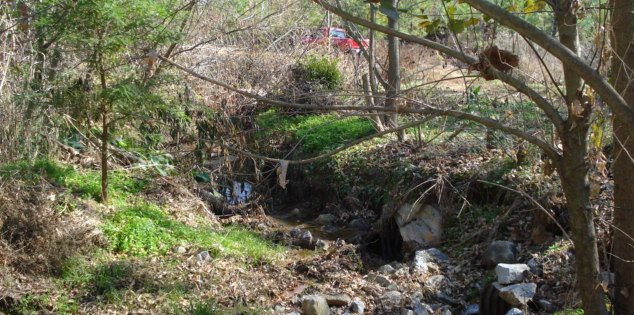
Below is one of my failures, or maybe a single success.  I planted twenty bald cypress.  As far as I can tell, only one survived.  I want to get back into the swamp when the ground freezes this winter to check on the overall progress.  I was in Iraq last winter, so I missed that opportunity then.  The tree you can see in the picture is thriving.   The others not.  I don’t know what I did wrong.   My guess is that there was too much competition.  There are a lot of box elders that overgrew them.  This one is near the road, so I can get at the brush regularly.  BTW – the bald cypress is the green one on the left. 
Anyway, the Dept of Energy, which was funding the Duke studies, is pulling the plug on them.   You can find information re at links here, here & here.    It was that news that made me think about this subject.   I am a little unhappy about this outcome, although I am not sure how much more could be gained anyway.    There are too many variables.  You would have to try to fertilize some, make sure others had lots of water etc. and by the time you figured it out the results would probably be OBE’D.  Good forestry practices and superior genetics will make the forests grow a lot faster anyway.    Experiments are difficult in forestry because of the variable conditions and the very long times involved.   It is usually easier to compare and contrast different places and practices over larger areas and work with landowners.

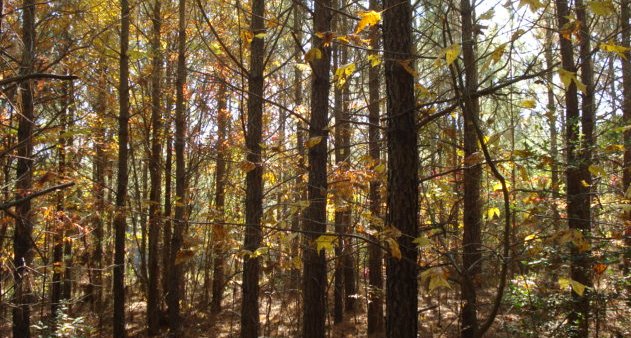
Below are 13-year-old loblolly pines on my new land.  They are planted close together, which shaded out other trees.  You can see there are only a few stray hardwoods.  But these trees are too close.  I want to thin them out maybe in 2010.  That is a little early, but the stand is growing well and I think the opening will help.
Virginia Tech does a good job of outreach to forest owners, which helps them understand the forests of Virginia in a very practical way.    For example, they are studying biosolids application on a tree farm near Blackstone and they invite landowners and anybody else interested to look at the results.  It was a biosolids demonstration in 2007 that directly led me to apply biosolids on my land.    They also send around student teams to check on forest pests etc.   All this outreach makes the whole Commonwealth of Virginia their laboratory.

I know this is a bit of a subject change, but I have to add that any CO2 solution requires higher prices for carbon-based fuels.  The bad news is that oil prices are coming down.  We need to tax them back up.  I have been writing about this for years now.  Please follow this link and let me know what you think.  

Of course, maybe all this will go for nought.  It has been darn cold around here for the past weeks and I read in the paper today that not only was this October one of the colder on record, but there has been no global warming for the last ten years.   Statistics are like that, however.  There is the story re the man whose head is in the freezer and feet in the fire but on average he is comfortable.
Traditions, Quantico and NGOs on the Battlefield

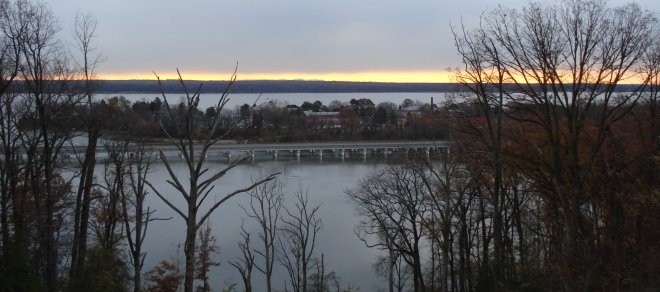
Military bases and battlefields are often located on beautiful natural locations.  It makes sense when you think about it.  They were looking for high ground that commanded some natural features.   Such places have nice views.   Below is the view of the Potomac from the Marine base at Quantico where I went to participate on a panel on civil military affairs at the Expeditionary Warfare School. 

We had an interesting discussion about NGOs in battle spaces.   The students were generally unsympathetic to the neutrality of NGOs and their arguments were cogent.   What happens when an NGO learns about an imminent attack?  On the other hand, it is important that we have NGOs maintain the ability to work with both sides, at least nominally.   This is especially important for an organization like the Red Cross, which has real responsibility to minister to the victims of armed conflict on all sides.   There will always be a dynamic tension.    It takes physical courage to be on a battlefield and it takes moral courage to maintain neutrality in these tough conditions.   The expedient thing to do in the short run is often not the right thing for the long run.  I defended the NGOs, although I admitted that the actions of many also annoy me much of the time.   We cannot always defend only those things we like.  

Beyond that, NGOs are a key part of civil society.   They usually help us with stability operations, whether or not they want to work toward “our” goals.  They provide services that make life better for the local people.   The bad guys tend to hate them for that.   Their goal is to make life horrible for the average person in order to break down support for legitimate authority, create chaos and drum up recruits for their nefarious purposes.   Of course, that does not include the politically motivated NGOs, and there are a few of them.

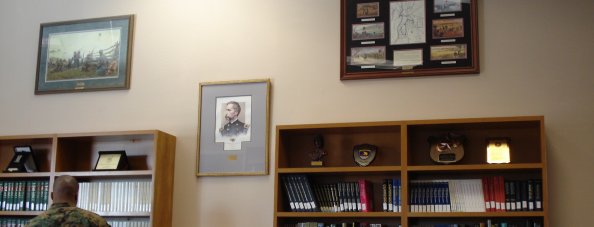
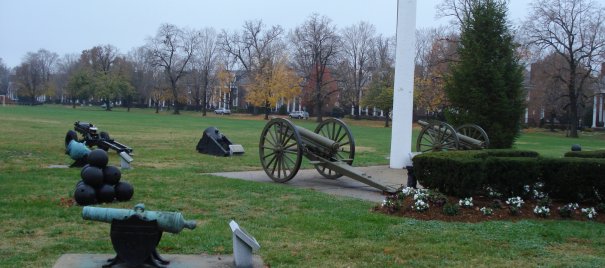
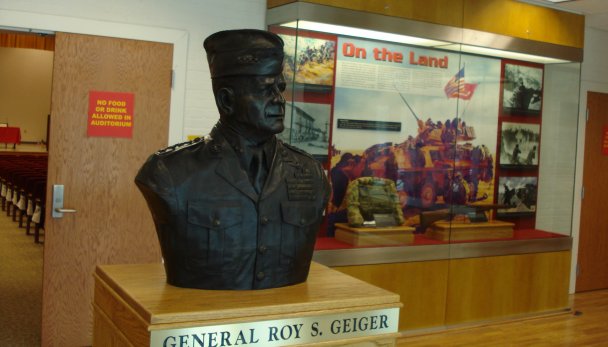
The military does tradition well.  The building where we met was called Geiger Hall.  Many buildings are named after famous people, or people who gave piles of money to whatever institution is naming the place.  This is different.  General Geiger earned the honor AND the building owners explained why.   The constant exposure to the reminders of his successful and heroic life gives instruction and inspiration.  These are things we need more in our lives.  Below is the story of Joshua Lawrence Chamberlain, a truly remarkable man.  If you don’t know the story, I suggest you google him.

I had to rush back from Quantico to do a presentation on strategic communications for the JSAT at NDU.   Our part of the task force is studying that and I will write more insights re public diplomacy when I have more of them.   I will have to go to Doha to work on this in early December.   Back to the Middle Eastern desert.   Actually that area is pleasant in the winter, it is only for a couple weeks and I won’t be in the war zone, so I don’t mind.  

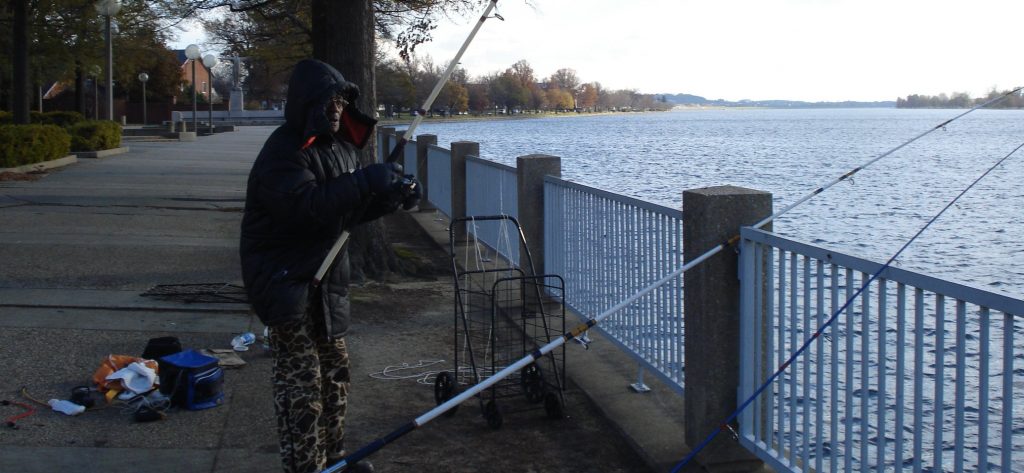
I walked along the Potomac on the way from the Metro to NDU, where I met this guy.   He told me that he was fishing for catfish and rockfish and catching some catfish.   As a senior citizen, he says he doesn’t need a license to fish in the Potomac.   He has been fishing there for more than a half century, back when this part of Washington was a poor semi-rural town.

Above – with all the oak trees, we have alot of squirrels, agile and graceful creatures. Three of them were burying acorns, but by the time I got my camera out, only one remained. This one reared up.

Pictures

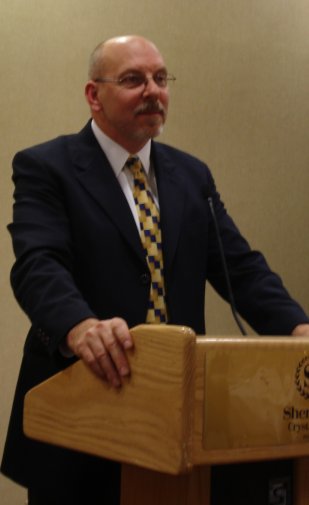
The post below is the core of my talk that I gave yesterday to a group of young engineers re infrastructure in Iraq.    Chrissy came along and took the picture you see on the side.   I think the talk went okay.    I did not have too much to write today but I wanted to put up the picture of me at work.  I enjoy public speaking as long as I don’t have to stick too closely to the text.   I like the give-and-take, not the formal talking at the crowd.

I cannot decide what I like best.  Speaking is one of my natural environments.  I like to talk to groups of people, but then I really like to be in my woods by myself. I am lucky to have the lifestyle that lets me indulge many of my peculiar preferences.  Forestry is not a common hobby among FSOs. 

Espen and I were watching TV and on came a commercial for Bosley hair restoration.   He asked me why I didn’t call. I told him that i not only don’t mind being bald, but I actually prefer it.  It is much easier to take care of and I pity those hairy fools who have to waste their money and grooming products and throw away their time using them. 

I also am happy with the beard.  I can groom that once a week and otherwise not think about it.  No more shampoo and shaving.   Mornings are easy.  

I figure this is probably my most inane post, but sometimes you have to be inane.

As I walked around tonight, I noticed the Capitol.  It is pretty at night and – to my surprise – my camera got a decent picture.  It is amazing what a cheap digital camera can do.  Of course, I had to take five to get this one w/o too much shaking to make it blurry.

Infrastructure in Iraq

As the introduction says, I am a career Foreign Service Officer who recently returned from a year in Iraq leading a provincial reconstruction team (PRT) embedded with the Marine Regimental Combat Team in Western Iraq. 

PRTs are an old idea made new.   My assignment was to help rebuild Western Iraq, a task much bigger than me.  I had a team of seventeen (17) experts to help.   I also had the cooperation of the Marines and other U.S. military stationed in Iraq and most importantly I could ride on the energy, talent and hard work of the Iraqi people in Anbar.   I think we were successful.   I feel a little like the rooster taking credit for the sunrise, however.   I arrived in Anbar at the inflection point when the war-fighting stage was largely over and the rebuilding was beginning.  The people of Anbar, with the help of the Marines and my team members, made great strides during that year and I was privileged and proud to work among them.

Let me tell you a little about how I would like to handle this talk.  I propose to lay out general principles and then fill in some examples. This won’t take very long.  After that, I would like to address your specific questions and concerns.  A disclaimer.  I am not an engineer.  Leading a team called a provincial reconstruction team implies building and engineering.  This is not the case.  I cannot talk re specifications, materials or building methods. 

What I can tell you is what I saw in Iraq with my own eyes.  What I have seen may indeed make more sense to you when I describe it than it does to me.  Your training gives you insights I don’t have. My eyes and your expertise may create synergy.

Our PRT was tasked with helping rebuild – or in many case just build – infrastructure in Iraq.  Infrastructure is broader than roads and buildings.  You know that.  Infrastructure includes all those things that make a prosperous modern society possible.   

Roads, Bridges etc.

We start with the obvious things like roads, bridges and railroads.   W/o these things prosperity is not possible.  Then we move to factories mines and office buildings.  In Iraq, they had significant agricultural infrastructure in the form of irrigation and water projects.  All these things are clearly classified as infrastructure and can be built almost anywhere.  But there is more. 

Institutions

One of the hardest tasks in any developing country is the infrastructure of institutions.  We Americans often forget this because we have had a functioning country with rule of law, more or less predictable political system and functioning government bureaucracies for hundreds of years.  Iraq was lacking all those things.  W/o institutions, you can build all the physical infrastructure you want and still not create a modern prosperous society.

Societal Strength

Which comes first, a strong civil society or civil society institutions?   I don’t think you can really determine cause and effect.  They strengthen and support each other or pull each other down.   A key ingredient is trust.  Most of our transitions are based on trust, even those we think of as determined by law.   A prosaic example is when you go into a restaurant.   Your waiter trusts you pay for your meal and leave an appropriate tip.  You trust him not to tack on unreasonable charges and supply decent service and food.  Imagine if each transaction required you to check references and proactively defend your interests.  Trust in Iraq had been sorely tested and ripped apart by Saddam Hussein, his capriciousness and his wars.   The level of trust is still low and a society with a low level of trust is a weak society.   You cannot build a strong society directly.  It takes time.

Below – Iraq geography is like the moon with more gravity.

Environment

We often take environmental services for granted.  It is like good health.  You don’t miss it until it is gone.   In the U.S. we suffered through the dust bowl years when we abused our environment beyond its capacity.   There are other examples, but the dust bowl is appropriate because that is what Iraq suffers.  Dust storms are part of the natural arid environment, but the fantastic dust storms I saw are the result of long term human degradation.  We started to help rebuild this infrastructure.   

Human Capital

The most important part of infrastructure is human capital.   These are the technical skills, work habits, managerial capacity, entrepreneurial dexterity and even the good health of the people themselves. 

Human capital is harder to build and more important than physical capital.   My father was in the Army Air Corps during World War II.  They bombed German cities to rubble. When I went to Germany as a student, he asked me if they had rebuilt.  It seemed to me like a silly question, but it wasn’t.   Many countries that were underdeveloped twenty years ago are still underdeveloped today. Germany was completely devastated in 1945, yet ten years later the western half at least was among the world’s most prosperous countries.  People build and run things.  That simple fact is often overlooked by those who think they can just buy or give prosperity.

Or think of the more pop example. In the old television show MacGyver, the lead character would go into a situation with almost no tools.  He would make what he needed out of simple kitchen ingredients or thing he found lying around.   This is the power of human intelligence in real (Germany) and fictional examples. 

Iraq suffered mightily from the destruction of its human capital.  Millions of its best and brightest citizens fled the country during the decades of Saddam’s tyranny.  Many more never acquired the skills of a modern society because of the mismanagement and underinvestment in the education system and lack of opportunities.  Iraq during the dictatorship went from being one of the most skilled and literate countries in the region to being one of the worst.   Finally, the recent war and unstable conditions made refugees of millions, many have still not returned.   This is the longest term and most difficult problem that must be addressed.  Money can buy the beginning of a solution, but only time can bring it to fruition.

Let me give you some specific examples of each of the categories.   I want this part to be conversational.  Please feel free to ask questions as I talk.  

An Ordinary Day at Work & Play

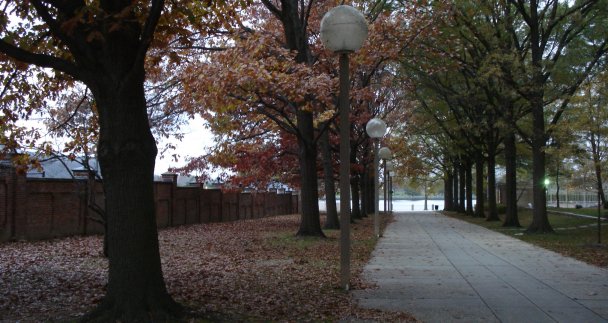
Below – Path to Potomac from NDU. Notice the red oaks on one side and the laurel oaks on the other.

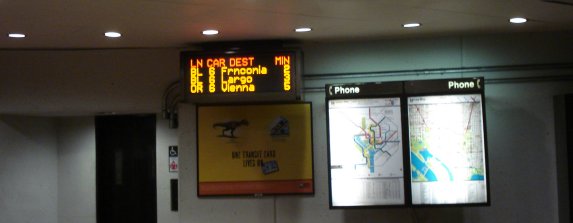
I have to leave before 0700 to get to the task force by 0800.  NDU is about a fifteen minute walk from the Waterside Mall stop or around a half hour from Federal Center.  I prefer to walk to Federal Center.  That way I don’t have to change trains.   I like the walk, although according to the Washington Post the area near Waterside Mall is not a safe area. I don’t intend to change anyway, so I don’t suppose I need to look into it any further.

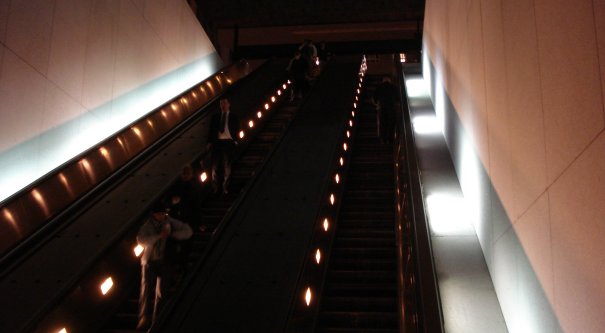
Below is the escalator to my Metro stop.  The etiquette is that people stand to the left and walk to the right.  I like to guess who will stand and who will walk.   I believe my record is good. I admit that I might have confirmation bias, but you can often predict by body type.  Tourists also tend not to walk, but I think they just don’t know the local custom. 

Below is my Gold’s Gym.  I used to go there three times a week, but I still have not renewed my membership.   Tomorrow.  Gold’s Gym is simpler and cheaper than some others.  My kind of place.

The walk along the Potomac from the Metro to NDU is a little out of the way, but it is nice.  

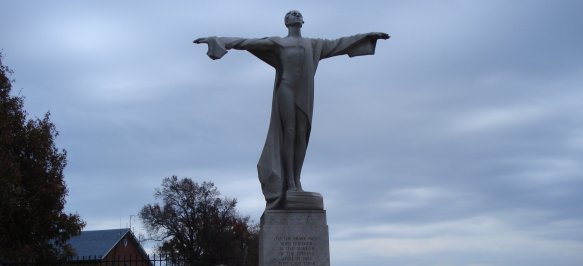
I came across this monument to the victims of the Titanic.  It says it was commissioned by American women to thank the men of the Titanic for letting the women and children go first.   This sounds crazy to people in our more cynical age, but that is evidently how it happened.   The movie “Titanic” had to go against the historical record and show a more cynical picture.   In a similar situation, when the Lusitania sunk Alfred Vanderbilt gave his life preserver to a young woman even though he couldn’t swim.  His body was never recovered. 

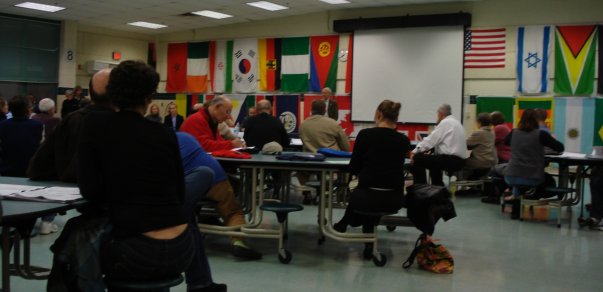
In the evening, Chrissy and I went to a zoning meeting.   They are talking about raising the density of the lots on both sides of our townhouse complex.  Some of the buildings could be as high as 115 feet.  We will be like a canyon between all these buildings.    But density makes sense near the Metro.    It is good to see all the citizens involved in their communities.   Although some of the same people make the same comments and complaints.

Backgrounder on My ePRT

This blog entry goes with my talk this week re building Iraqi infrastructure, what we did on the ePRT, and how civil-military cooperation worked in my experience.   I have included relevant links to other places on the blog that I believe illustrate various aspects of the work.   If you are reading this before the talk, I look forward to your questions.   If you are reading this after the talk, I hope this fills in some of the blank spaces and/or questions raised.   In either case, please feel free to post questions of comments.

Why I volunteered to go to Iraq

Getting used to being at Al Asad

Notes on our ePRT

·         Evolution of the Western Anbar ePRT

·         Our team 1

·         Our team 2

Infrastructure in Western Iraq

Embracing local culture (goat grab)

Prospering in spite of the politicians

Achieving success in Iraq

Western Anbar progress report

Sanctions, mismanagement & lost opportunities

We did what they said couldn’t be done (can we use the V-word yet?)

Come safely home

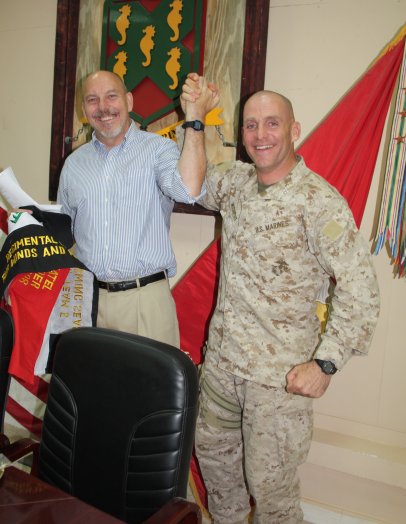
The Marines and me

Transitions

Below are grounds at NDU.

If you want to effectively be action oriented, you have to spend most of your time trying to figure things out.    You have to be reasonably certain that you are doing the right things and that you are doing the important things and not merely responding to the urgent ones.    If you don’t think about things in advance, you will get stuck responding to events and/or be captured by the passions or fears  of others.   All this makes perfect sense, but it is harder to do than to talk about.   It is hard to not get excited when things are moving fast and it is easy to get blamed for doing nothing or waiting even when those are the proper responses.   

I expect life will get interesting soon when the new political appointees come to take over.  IIP has been w/o political appointees for a couple of years, ever since Alex Feldman left.  This is very uncommon.  In times past, we had all sorts of political guys around and I am sure we will have them again in the new administration.  The new people always have lots of ideas and they often believe that they are the first to have thought of them.   This is my forth big transition.   When all the sound and fury is finished & the dust has settled the trajectories are fairly predictable.  Career people like me have to remember that the political leaders set policy and we have the duty to help those policies succeed for the good of the country.  The hard part is to give advice in a credible way w/o being either arrogant or sycophantic.  The best way to do prepare for this is to know the portfolio and have thought through the various scenarios.   In other words, to be action oriented you have to have spent the time figuring things out.

The thing I worry about in the transition is security policy.  (I am happy that I am not directly involved with too much of this, BTW, but I still think about it.  Transitions are seams and enemies can exploit seams.   The U.S. did a good job preventing new terror attacks after 9/11.  We also managed to turn around the situation in Iraq and achieve tentative success there.    I am afraid that there is a growing public perception that these outcomes were natural or resulted from luck.   As the memory of dangerous and uncertain events fades, complacency grows.   We were indeed lucky in that the bad guys did some really stupid things – they overreached – and we were lucky that in the last couple of years many things broke our way more often than not, but our success depended on a lot of things we did right.   I am personally familiar with only a small part, but I know enough to be sure of that.   We should be sure not to lose through apathy & unawareness what we have worked so hard to win with effort, bravery and blood.    

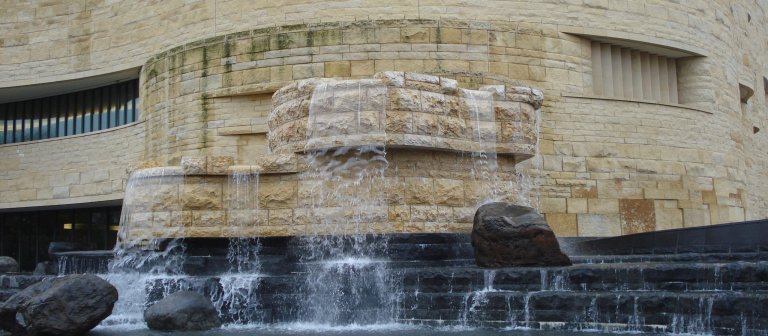
Below – waterfall at American Indian Museum in Washington

It seems so long ago now.  In the years since 9/11/2001 many people have been trying to understand the motivations of terrorists and working to make profiles of the sorts of people who become violent extremists.    Not many people really have the mental profile of the violent extremist.   It takes a prodigious amount of hate, intolerance and determination to make a person want to be a terrorist.    Fortunately it also takes something else – opportunity, as well as a impetus. Beyond that, the link between attitude and behavior is tenuous.   

Links – Links are the keys.   There is a long chain between the conception of a terrorist desire and the successful completion of destruction & mass murder.   A chain is as strong only as its weakest link and each of the links in the chain can be attacked.   You attack the whole chain by identifying and attacking each of the links as well as the environments that help forge the chain.  That is what I hope and believe our information activities are helping and will help to do.    That is what we have to keep on working to do.

We have to be not like a chain, but like a cable, where each strand goes from start to finish, twined together seamlessly.   I hope this transition will be smooth and clean.

Earth Day Park & L’Enfant Promenade

I usually get off the Metro at Smithsonian.   That is two stops before the one closest to my job at State Annex 44.  The walk takes around fifteen minutes and it is through some nice places around the Smithsonian. 

You probably would not make a special trip to see Earth Day Park, on Independence Avenue.   As the old saying goes, it is worth seeing but maybe not worth going to see.  It is one of those things  you notice and enjoy when you it becomes an ordinary part of life.   You enjoy it more when you know a little about it. 

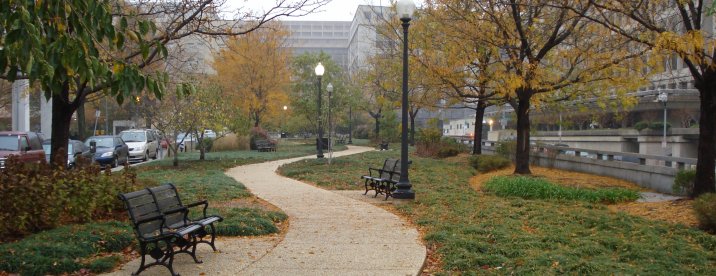
Earth Day Park was dedicated on Earth Day in 1996.  It covers the top of Interstate 395 as it passes below the Mall.   This makes it remarkable.  This kind of thing is not usually attractive and I understand that this was no exception until the park was made. 

Everything in the park is low maintenance.     The lily turf requires no regular cutting.  It is enough to do it once a year and it survives even if you don’t.    The trees and bushes can live on the semi-rooftop environment, with its frequent lack of normal soil moisture. 

BTW – the path looks very inviting, but if you follow it you don’t get anywhere.  When I first saw it, I thought it might be a nice sideways to get to work.  Not. 

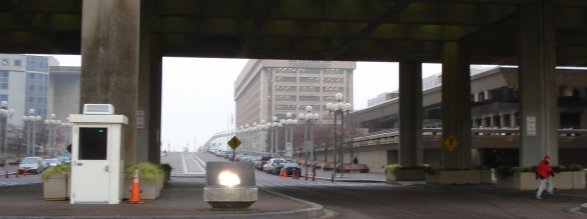
Above is L’Enfant Promenade.   I mentioned it in an earlier post.  I don’t like it.  It is ugly, almost Stalinist.  That boulevard goes nowhere.   You can kind of get down to the riverfront from there, but it is not easy.    The road ends at Benjamin Banneker Memorial, about a quarter mile from where the picture was taken, just over the rise at the horizon.    In typical 1960s style, L’Enfant Promenade manages to almost get it right, but ends up combining two things in a way that emphasizes the disadvantages of each.   You can see from the picture that the promenade looks like a boulevard for cars.  It is.   But since it goes nowhere there is not much point to drive along it.   It has become a long parking lot.   There was great potential as a walking street, as the name promenade implies.   The end of the street has a nice view of the river.  But there is enough traffic to make walking (or running) unpleasant.    The design exacerbates the problem, as the few cars that do use the road come around a circle at Bannecker Memorial in a way that keeps pedestrians looking over their shoulders.

So, to sum up:  Earth Day Park Good; L’Enfant Promenade bad.  Perhaps they should restructure L’Enfant to make it more pedestrian friendly and more like Earth Day Park. 

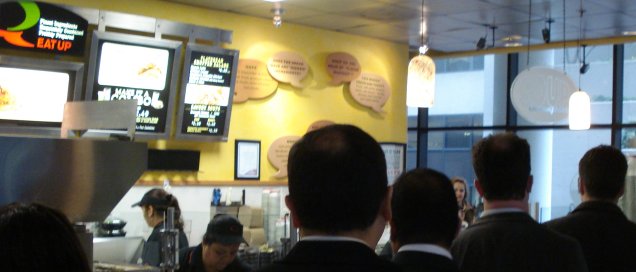
Above is one of the local attractions – Quiznos.  You can see all us bureaucrats lining up for the feed.  I get the small classic Italian on wheat bread.  When you get the combo (i.e. coke and chips) it costs $7.02 with taxes included.  Quiznos is my favorite sub, excepting Cousins from Milwuakee, which is unfortunately unavailable in Washington.

Good Life in Washington

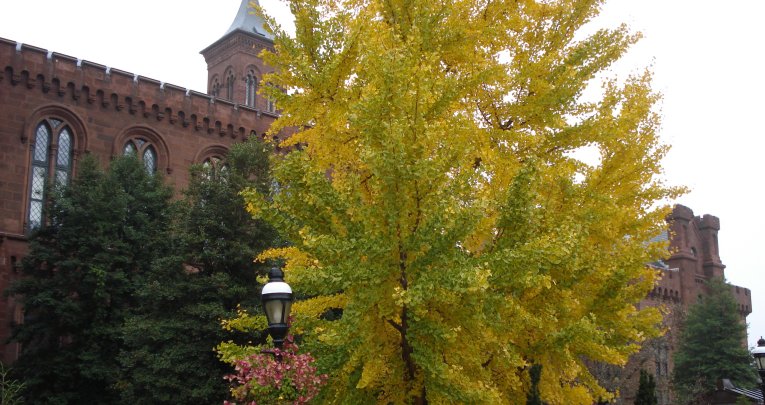
Above – ginko tree outside Smithsonian

The best things in life are free … especially if you live in Washington DC,  where you can go to all the museums and enjoy all the public space, think tanks and events at no or little cost.  Europeans justifiably boast of their cultural achievements, but everything costs money there.   You have to buy tickets to the museums in Rome, Paris or London and much of the public space is not really open to the public. 

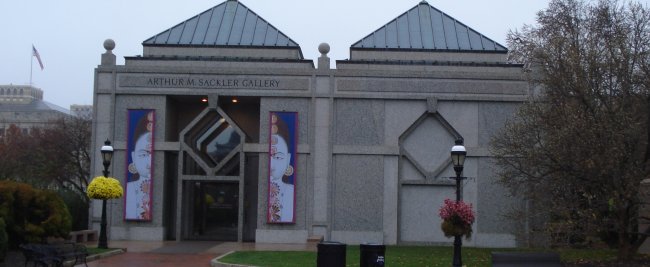
Above is Sackler Gallery.  There are vast underground facilities.  The Mall gets to look untrampled.

The irony – and this goes for lots of things besides museums – is that in America we have access to things in practice but not in theory, while in most other places you have access to things in theory but not in practice.  People are often beguiled by the promises.  They want to be granted the right to something in principle.   They forget what Otto von Bismarck, who originated the first social security program said, “When a man says he approves of something in principle, it means he hasn’t the slightest intention of carrying it out in practice.

We get a lot in practice, even if we are not doing so well in theory.  Way back in 1827, Johann Wolfgang von Goethe, the great German man of letters, wrote it in a poem. “Amerika, Du hast es besser” (America, you have it better), he said –  and he was right. Life is good. 

The National Gallery of Art & Pompeii

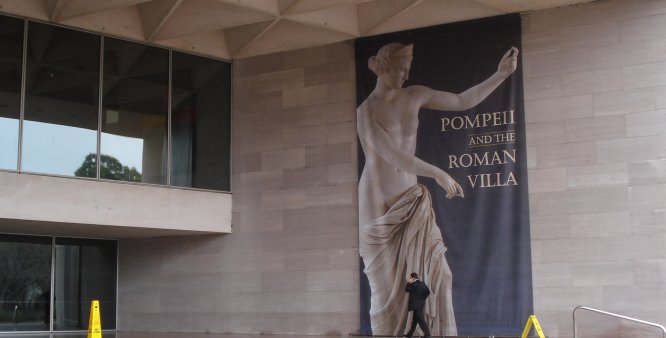
I enjoy being in Washington.  It offers so much.   On my lunch break today I walked over the National Gallery of Art to see “Pompeii and the Roman Villa.”  I couldn’t take pictures inside, but you can see what it looks like at this link.    It is great just to drop in.  Because there is so much and it is freely available, you don’t feel like you have the chore of staying all day and making an ordeal out of the appreciation of art.  I stayed only around a half hour.  I did not “see everything” but I can come back.   IMO that is how culture should be, a part of life integrated into daily activities.  

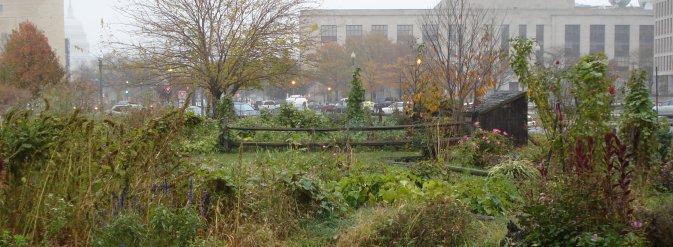
Below – community garden near Capitol.  I think this is left over from the 1960s. 

I heard about the exhibit before, but I was motivated to go today by my Roman history lecture on my I-Pod.  They were talking about the Roman cities and used Pompeii as an example.   Pompeii was not the greatest of Roman cities, it was not even very important, but we have the unique frozen in time aspect.  Tragic as it was to the people at the time, the eruption of Vesuvius has made them the messengers of their culture to future generations.

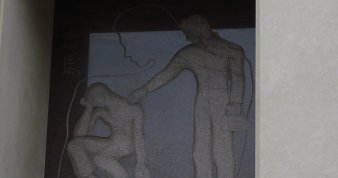
Below is depression era artwork on a government building near the National Gallery.

The area around Naples for the Romans was something like the California coast is to us.  Life was pleasant and easy.  The rich and famous went there to live and vacation.   They build expensive houses and lived large.  According to what I learned at the exhibit, the very rich people lived in coastal villas.  Pompeii was sort of middle rich.  The district was called Campania.  It had a good climate and great soil, provided in part by the volcanic activity that buried Pompeii and Herculaneum in AD 79.  Volcanic soil is very productive.   It is sort of a bargain.  You get live the good life on the volcanic minerals, but it is unpleasant to be there when the volcano spreads a little more ash.

Starting the New Job(s)

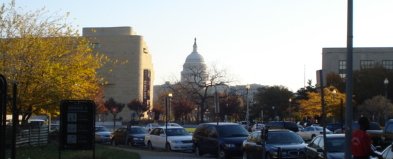
Below is the Capitol & the Indian Museum on my way to work.

It is always confusing in the first days back on the job.  This time the feeling is exacerbated because I am trying to do several things at once.  I am assigned to work on a strategy group at NDU.  While I am sure it will be very rewarding, it created a whole new set of challenges I had not thought about.  This is nothing earthshaking.  They are things like getting my clearances passed so that I can get the proper ID, finding my role in the groups and just finding rooms and offices in a place I have never worked before.  This comes at the same time that I am checking into my new job and checking out of the old one.   I have to file travel vouchers, get the logon, get the Blackberry set up, do check in etc.  Again, this is nothing earth shaking, but it takes more time than it seems it should and generally throws sand in gears.  

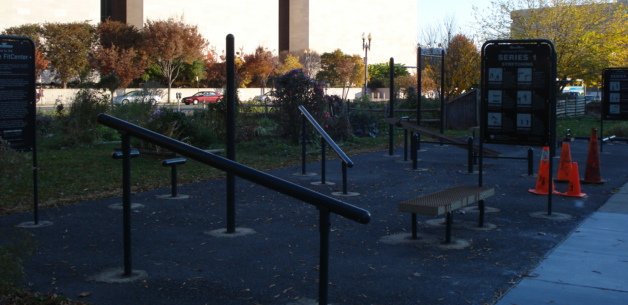
Below – chin up bars etc near Air & Space Museum

I have to be careful with the adjustment.  I had thought through my first weeks at the new job and had a good idea of what to do.  I don’t “hit the ground running”.  Rather I try to learn the new organization, the people and my place among them.  This requires time and patience, since it has the element of relationship building and not mere knowledge acquisition.  First impressions are not sufficient and I don’t want to move before I know where I am going.   It is especially challenging at IIP because I was here before, doing a nearby job, and I think I know things. 

It is easy to be overconfident when you think you know something.  I learned my lesson in Warsaw.  I had been in nearby Krakow so I knew most of the Warsaw staff.  I had even served as acting press attaché up there for a couple months, so I thought I knew everything I needed to know.   When I got to post, I just started to do things and make decisions and waves.  A few months into the job, I realized that I would have been better doing some things differently.   I like to take quick action, but I have come to understand the advantages of patience and doing not much at first.  Better to seem a little dull at first than start climbing the wrong mountain.  I am not talking a long time, just enough to start out on the right foot.

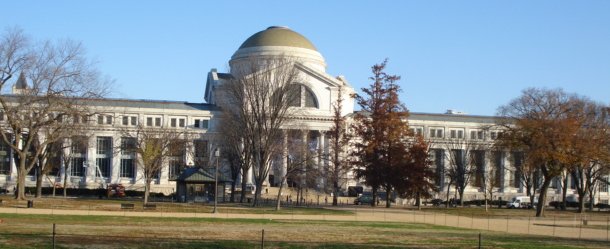
Below – Natural History Museum.  Notice the Roman style.  The Romans invented the kind of cement that allowed them to make domes like that.  Egyptians, Babylonians & Classical Greeks didn’t use domes because they couldn’t make them w/o what we today call concrete.  Alex & I visited the Pantheon in Rome.  The dome is still standing 1800 years later.  Even more impressive is Hagia Sophia in Istanbul built by Justinian the Great from 532-7.

I am reminded that my plans never work anyway.  I find myself doing something completely different, which will make my entry on duty seem more tentative and ragged.   It is like making the grand entrance just as you notice that you forgot to put on your shoes.   I am not sure how to handle this.   On the one hand, I can do both jobs.  This is not as crazy as it sounds.   There is a lot in my IIP/P job that is directly applicable to my NDU job.  Both responsibilities are involved with strategy, information gathering & public affairs, sometimes about the very same things.  What my IIP colleagues have done and what I can share with my NDU colleagues will add value to both.   There is a real possibility for synergy that I hate to lose.   On the other hand, we have the problem of being half there.  I guess the choices are limited.  I already have made the half there entrance and may as well make the most of it.

I attended my first staff meeting at my new IIP/P job and got the run down of ongoing activities. We are doing some interesting things.  We are going to do focus groups in Tunisia and Jordan re the impact of our outreach programs.  Another colleague is working on a conference and publication on the problems of extremism.  This is a very intellectually satisfying venture, since it will involve lots of scholars and get to play with ideas.  Other colleagues edit and post issue briefs and run the information distribution that gives our public affairs professionals information they can use to help them do their jobs.   We also run the public affairs toolkit, a kind of best practices wiki.   The media hubs in London, Brussels and Dubai also have a place on our pages as do the research people, who post their public opinion assessments.   There are a lot of interesting things going on and a lot of things I want to get involved with doing.