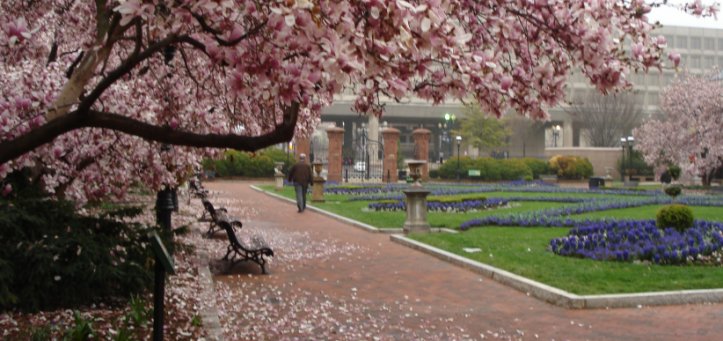
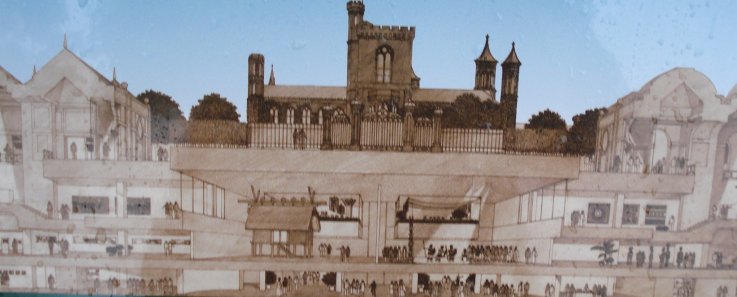
I am beguiled by springtime in Washington. Today it was warm, with a little drizzle. I did my morning telephone call in the garden in front of the Smithsonian. I never really thought about it before, but this is a roof garden. There is a significant museum complex below the ground.
Since it is on ground level, it doesn’t look like rooftop garden, but it has the characteristics. The heated rooms below make the dirt in the gardens above significantly warmer, so plants from further south can thrive and they can come out earlier in the season.
I can include pictures, but they can’t convey the smell of the air heavy with the fragrance of flowers and earth and I can only mention the sounds of the birds. A few minutes in the garden put the whole day in the proper perspective.
Our Foreign Service evaluation period ends this month and it is time again for all of us to list our myriad achievements in a couple pages of dense prose. I hate that. Coming from my conservative Midwestern background where bragging was discouraged and ridiculed, I am at a significant disadvantage vis-à-vis those who consider pushing oneself forward a pleasure. I have always hated hustlers and hustling. But there is the time for those things.
I have gotten better at it and developed methods and rationalizations that help me through. My best method is to imagine I am writing about someone else. In my job, I often have to “sell” ideas. I make the self-promotion exercise just another job like that. I have never lied or even exaggerated in any of my assessments, but it is amazing how different achievements can seem when put in context or surrounded by the right words and phrases. And I guess I have done all right in the promotion game, despite all the gnashing of teeth.
If you stayed in the Foreign Service for 200 years, things would even out and you would probably end up more-or-less where you deserve, but in the course of a 20 year career there can be lots of random events that affect your success. I know very capable colleagues who suffered some kind of career downdraft through little or no fault of their own and forever stalled at mid-level and there are a happy few who have risen to very high ranks on the strength of some random occurrence or lucky break. Of course, some people can’t get ahead no matter what breaks they get, but chance matters too.
Good or bad luck can affect whole generations, so you have to compare people to their peers. During the middle 1990s, it was very hard even for good people to get promoted because they were cutting the FS. It is easier now when we are expanding hiring. I read in a biography of Eisenhower that he despaired of ever getting another promotion back in the late 1930s. But it worked out for him. His became “the class the stars fell on” (the class of 1915 produced 59 generals out of 164 graduates, not bad) when WWII expanded the army. Eisenhower, Bradley, Marshall, Nimitz, Halsey etc were able men and they were successful, but had the war come five years later we would have had a whole different set of five-star leaders. Colonel Eisenhower might have found himself called out of retirement to run a training program, but the crusade in Europe would have had a different champion. “There is a tide in the affairs of men …”
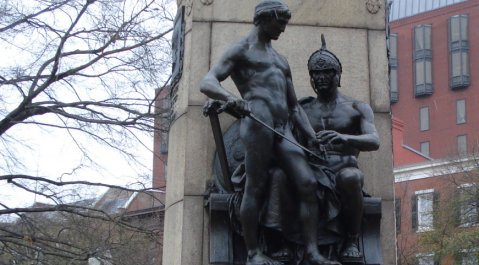
Below is a statue of Gen John Pershing, General of the Armies, the only man to attain that rank during his own lifetime. Later Congress passed a law stipulating that no American ever had or could outrank George Washington.
Losers blame their circumstances, and they are right just enough to keep the idea plausible. With the caveat of comparison mentioned above, promotions are correlated to actual merit, but certainly not perfectly correlated. There is a statistical quality to them, which is not always fair or right, but in the long term and for the most part you can understand what happened.
Some people have opportunities dropped in their laps; others have to work hard to find them. You do need opportunity to shine, but what you do with it makes all the difference. The FS is a very good laboratory for achievement because we have such a variety of jobs and we move among them. Even though we are all similar in background, and the FS test ensures that we are all smart in the academic sense, you can really see the difference people can make in positions. Posts and positions may suddenly become important and effective just because a new person has come in. The reverse is also true.
In my observation, chronic underperformers are those that avoid responsibility and refuse to make consequent decisions. It has to do with that opportunity thing I mentioned above. In choosing mediocrity, they cannot be blamed for failure, but they also never have the opportunity to succeed. In a knowledge organization like the FS, the preferred method to avoid responsibly is to over analyize every situation and then spread risk by involving lots of marginal participants in your decision making. I don’t think that most of those doing this really understand the implicit choices they are making. They think they are being prudent and honestly don’t understand why their list of achievements pales next to those of their “crazier” and “less hard working” colleagues.
I have real trouble understanding how I achieved the success that I have enjoyed and I cannot believe that I deserve it. This doubt is not a malady I suffer alone. I find that most successful people who are honest and self-aware fear that they are frauds whose mistakes and faults will someday be embarrassingly revealed. This is a useful attitude. It keeps us more humble and stimulates a desire for continuous correction and improvement. I pity the fools who believe they have no serious faults left to correct. But self-doubt can result in the risk-avoiding mediocrity I mention above and you have to be careful not to be overly influenced humility and self-doubt at evaluation time. Evaluations are comparisons. In this universe of imperfect people, where do you stand in relation to others? Nobody is perfect and the ostensible quest for perfection is another way people avoid responsibly to make choices. If we disqualify ourselves based on the faults & fears we know we suffer, all we do is allow the more dishonest or self-deceiving people among us to prosper and rule … and those are not the kinds of people you want running the show.
It is not only your right, but your proactive duty to ensure that you can make a contribution commensurate with your capacity. That means we have to engage in what I would call bragging at evaluation time. Unfortunately, evaluations are like a race run in the fog, where you might have to judge the winners by who is bragging the loudest because the actual finish was unclear.
The arguments we make for ourselves should be honest, but well crafted. We can share credit and take credit for common efforts at the same time. It is not a virtue to allow your achievements to be hidden or ignored, since that means that your ability to do more will be curtailed and it is likely that a less competent but more confined guy will take your place. In my circumstances, getting promoted really doesn’t mean making much more money, since our pay is capped. It does mean having the opportunity to do more useful and interesting things before they kick me out (we have an up-or-out system).
Anyway, those are the things I am telling myself as I embark on my creative writing exercise.
We get to write our own first page on our evaluation forms and tell the promotion boards why we are worthy. I will imagine that I am writing for somebody else and give that guy the benefit of all doubts. I have some interesting narratives this year and I suppose I can spin some gold out of that common straw.
It has been a cooler than average spring, but we are getting there. Today I met Chrissy for lunch up near the U.S. Naval Memorial. It is around a ten minute walk from my office and it was very nice today. I don’t have much text, just some pictures from a warm spring day.
Above are kids flying kites on the Mall
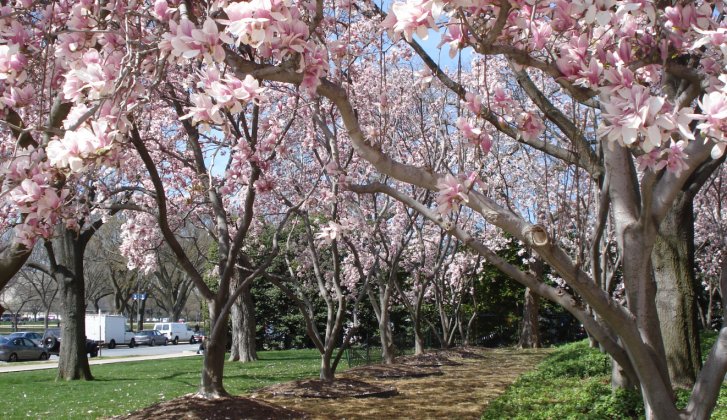
Magnolia grove near National Gallery of Art
Springtime in Washington in John Marshall Park
John Marshall, longest serving Chief Justice of the Supreme Court. His rulings shaped the Constitution. Among the key opinions: Marbury v. Madison, 5 U.S. (1 Cranch) 137 (1803); Fletcher v. Peck, 10 U.S. 87 (1810); McCulloch v. Maryland, 17 U.S. 316 (1819); Dartmouth College v. Woodward, 17 U.S. 518 (1819); Cohens v. Virginia, 19 U.S. 264 (1821); Gibbons v. Ogden, 22 U.S. 1 (1824); Worcester v. Georgia, 31 U.S. 515 (1832); Barron v. Baltimore, 32 U.S. 243 (1833)
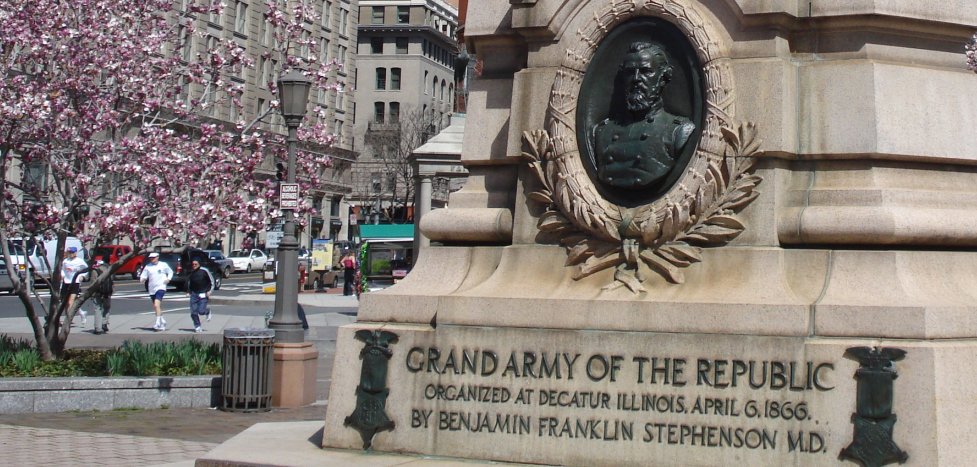
Monument to the Grand Army of the Republic
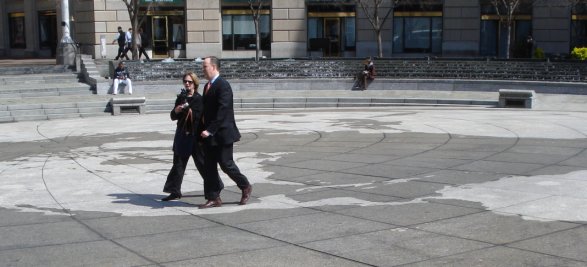
US Navy Memorial. Look closely. The patio is a map of the world. Those guys are walking across Texas and Mexico.
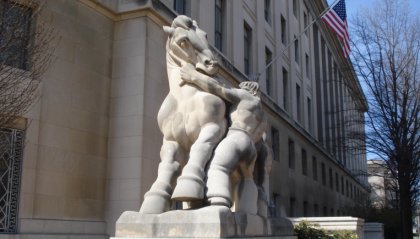
Horse Tamer near world commerce center
Fountain at Navy Memorial. In background is the Archives Building
I rode my bike into work for the first time in the season. There was a very brisk wind from the NW, which was great, since I travel SW and the tailwind pushed me along. If only it could be that easy every day. I lost a couple of week because of early daylight savings time. I don’t like to ride when it is still dark. Only now is it getting light when I have to ride.
It is 17 miles from my house to work by the routes I take. I usually enjoy the ride. It is like a mini-journey with several distinct segments. First I leave to complex and cross the freeway. Then I climb a hill along narrow Shreve Road. It is a typical suburban street. About two miles from home, I catch the W&OD bike trail. It follows the old railroad right of way, so it is not very hilly. There is a big bridge across Leesburg Pike, but then you go down a segment punctuated each block by city streets. This is not so good, because you really cannot safely get up speed. After crossing Lee Highway, you come to the next segment.
This is the part you can fly. It is gently downhill, well-paved bike trail next to Route 66. It goes under the streets, so you don’t have to stop for a couple miles. It is a pretty ride with Four-Mile Run on the right side. Beavers dammed the creek a few years ago until local authorities persuaded them to leave. There are lots of flowering trees, especially crape myrtle and oak and poplar forests. The trail goes through some crowded neighborhoods, but you cannot tell.
Bike/running/walking trails on old railroads are good. They form long narrow parks that provide passages and a lot of accessible green space. It is a matter of geometry. A square park is compact with little surface area to intersect with neighborhoods. In some places, the W&OD park is only about 100 yards wide, but the green impacts lots of space and the acreage goes a lot farther.
You pass under Wilson Boulevard along the creek. It doesn’t take much rain to make the creek rise and flood because there is so much hard pavement and rooftops in the watershed. One time I was riding home during a thunderstorm and almost got swept away by the creek. I saw that the path was flooded, but I figured it was shallow enough to muscle through. I got a head of speed and hit water higher than my waste. I had to get off the bike and pull it out. After that, I was a little more circumspect around the creek. It is very unstable.
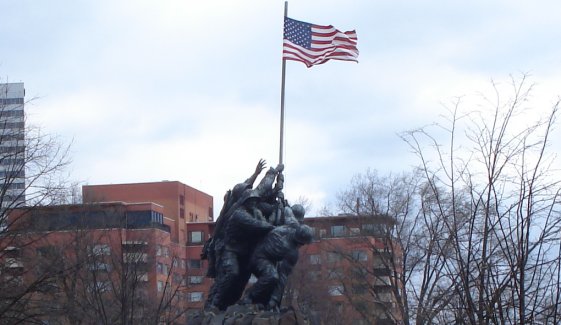
Right after Wilson Boulevard you come up a little hill and go down some city streets to Carlin Spring Road, then down some more little streets past Glebe Road into Arlington neighborhoods. They are very pleasant. I have to track north, a little out of the way to catch Clarendon Boulevard. I used to be able to go down Pershing and through Fort Meyer, but since 9/11 you can’t pass through the fort. Clarendon has a bike trial on the street. You feel a little safer, but not much, since you still share the road with cars and trucks, many of which consider bikes a nuisance that don’t belong on the roads. I cut across Hwy 50 at Rhodes Av and head toward the Iwo Jima memorial, then downhill along Arlington Cemetery and across Memorial Bridge into Washington.
Usually I then go past the Lincoln Memorial, along the reflecting pond to the Washington Memorial and then along the Smithsonian Mall to work. Today, however, I cut south along the Potomac to the Jefferson Memorial to see the cherry blossoms. They are a little behind this year. Its been cooler than usual, but a couple of warm days will get them back on track.
Anyway, it is a nice ride with good variety. I know I have provided too many details, but I feel very much attached to my bike trails. I have been riding variations of this trail on this bike (I have put thousands of miles on this bike) since 1997 and some of the closer in sections since 1985, when I lived in Clarendon. One of the things I like best about living in Washington is that an ordinary ride to work can be such an adventure.
Most people are uncomfortable with the exercise of authority and they usually resent those who do. Lord Acton’s observation about the corrupting nature of power still applies. (“Power tends to corrupt, and absolute power corrupts absolutely. Great men are almost always bad men.”
Nevertheless, establishing order requires authority and w/o basic order, nothing much gets done. Power need not be overly coercive and the most effective leaders are those who welcome the participation of other. I have written on this subject on many occasions. But sometimes you come to a bottom line where a decision must be made. In those times, a leader who refuses to make the hard decisions is shirking his duty.
Leaders who refuse to lead are the leading cause of unhappiness in the workplace, IMO. Worst of all are the guys who won’t lead, but like to boss. Next worse are the ones who hide among the rules. Rules apply to most situations and all routine decisions. You need leadership for those times when they don’t. Leadership requires the exercise of judgment, which will always seem arbitrary to those who disagree.
I learned an interesting lesson from an exercise in my leadership seminar last year. Reference this link for details. I don’t think it was the one intended. I was chosen as a group leader by a more or less random and unfair procedure. In the exercise, points were distributed based on rank but were also earned by individual and group effort. I determined that our group could score lots more points if we cooperated and with my two leadership colleagues, we created a system that distributed the points fairly. The facilitators were surprised and (I think) a little chagrined that we were scoring so many points w/o dissention. We soon got dissention, when another group used the rules to seize power, despite the fact that it cost us all points. The lesson I took was that the essential task of power is to maintain it. Nasty and Machiavellian as it might seem, the simple fact is that you cannot accomplish your goals (even if your goal is to pass along power to someone else) if you are deposed. Weak leadership does nobody any good.
I am reading a book Alex gave me for Christmas called Rubicon. It is about the fall of the Roman Republic. The author is very talented, but he evidently doesn’t like the Romans. His description characterizes them almost as an infestation that infected and ultimately destroyed the ancient cultures of the Mediterranean. Their virtues of perseverance, bravery and patriotism are seen as merely enablers of their cruelty. A couple months ago I finished a book called Empires of Trust, which left almost the opposite impression. I have been reading Roman history for a long time. They are both right. The Romans established the greatest Empire in history and brought order, a degree of justice & prosperity to the lands of Europe, Africa and Asia that surrounded the Mediterranean and now are thirty-six separate nations. They were brave, resolute, consequent and practical. They were also cruel, mendacious, superstitious and capricious. In other words, they displayed all the usual attributes of power.
I admire the Romans, with all their faults. Our world is very much based on theirs. Our American constitution embodies many of the lessons of Rome, only better. I believe in progress and that sometimes we can learn from history. We learned from the Romans and we can be better than they were because we stand on their shoulders. The fatal flaw of the Roman organization was their messy succession procedure. Augustus established the principate (became emperor) through stealth and maintained it with the fiction that he was merely the first among equals. He is recognized as a political genius and a great man for his achievement and it was probably the only way to pull it off. But it avoided some of the responsibly of power and made each transition an unpredictable adventure which often involved murder and the exercise of military muscle.
The Romans were hated and justifiably feared because of their power. They deprived the people of the Mediterranean of political freedom, what we would today call national self-determination. If you annoyed the Romans, you paid a high price. But the Roman Empire provided a great deal of liberty, tolerance and personal autonomy. (Of course all ancient societies were horrible and oppressive by modern standards. Remember that progress thing. But compared with the available alternatives, you were probably better off living in the Roman Empire than anyplace else in the world at the time.)
Above – Romans perfected the dome and pioneered the use of concrete in buildings. Most of my ancestors were among the barbarians who destroyed the Empire and I imagine my grandfather many generations removed scratching himself in the Forum trying w/o success to figure out how all that water got to the fountains. The Empire fell in 476 in the West (although it hung on until 1453 in Constantinople) but the idea of Rome persisted and the whole world is heir to their achievement. You can see it in architecture from Shanghai to Seattle. Washington looks a lot like a Roman city. The Romans were not very original, but they were experts at assimilating and developing ideas from a diversity of sources. They developed what became our concepts of rule of law, citizenship, the concept of a republic and separation of powers, so we Americans are especially indebted to them. Our Founding Fathers knew what we sometimes forget.
People are breaking down the doors trying to get jobs for the Federal government. In these inconsistent economic times, the promise of steady work and a good pension trump dreams of riches.
My original plan when I joined the FS was to stay in for about seven years and then start a different career. It didn’t work out that way. When my seventh anniversary came, I was in Norway in a great job. Then I was in Krakow. Who would ever want to leave a job in Krakow? Then Warsaw, Fletcher School, it was always something good. The only time I was really unhappy with the job was brief time when I was doing shift work in the Operations Center 1997-8, but I was only there for nine months and they sent me to Poland for three of those months to work on NATO expansion issues, so I never got around to sending my resume around.
You have to look at the totality of life that goes with a career, not just the job alone. As an FSO, I get to travel, meet interesting people, work with a variety of ideas and serve my country. I am not being facetious when I say that I had the opportunity to go to Iraq and the privilege to live with Marines. Few jobs offer that sort of adventure to a man north of fifty years old.
State Department has long been a popular place to work and the FS never has any trouble recruiting good people. BTW – it is a good time to be looking for a job as an FSO. They are hiring a lot this year. This year, however, people government jobs are popular across the board. I have mixed feelings about that. It depends on why you want to work for the USG. There is a special responsibly when you work for your Uncle Sam. Government jobs should be callings, not refuges.
I am glad that we have so many good people who want to work in the USG. I welcome them in the FS – follow this link. But we don’t want too much of a good thing. America has been an exceptional country ever since our revolution and even before. There are other models. France has followed a different, more directed, strategy since its revolution, for example. France is a great and beautiful country, but I prefer America.
In France, the best students dream of getting secure jobs in the government. Young Americans have always had visions of being entrepreneurs or running businesses. I am delighted to have enthusiastic and smart young people eager to work with us and they are coming at just the right time. We will face a wave of retirements in the next five years. We will need them in the FS to accomplish our mission. But I hope they are doing it for the right reasons (because they want to do good service not just for security) and I hope that soon young Americans will recover their confidence in the economy and themselves. I hope that some of them will still want to work with us, but maybe not so many.
I have been reading a book called Survival of the Sickest, about how seemingly deadly genetic factors can be explained. For example, genes for a potentially deadly genetic condition called hemochromatosis helped protect people from the Black Death in the middle ages.
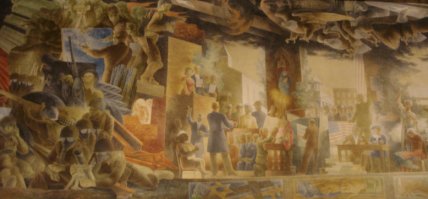
Below is a mural at the 21st Street entrance at State Department,
A that really matters for the genes is whether or not you can reproduce, so adaptations that help you do that will be maintained even if they have downsides. This is especially true of traits that appear in later life. Throughout most of human history, people rarely lived beyond around thirty-five years old, so anything that happened after that age just didn’t matter. Usually you just had to make it into your early teens in those days to send your genes into the next generation. That explains why a lot of deadly conditions are manifest in later life. (BTW – It is not survival of the fittest with regard to being strong and good. Evolutionary fitness just means you succeed in reproducing. In this respect, the Octomom has us all beat.)
The book also goes into the interaction between genes and environment and choices. In that respect, I read a very interesting article today in NYT called “Mugged by our Genes.” It seems a lot of genetic factors are manifest more in later life. This doesn’t make much sense at first, since your body and brain are finished developing by the time you are twenty-one. What is important here is choice. Many personality traits are genetically influenced and we make choices based on these traits. A person with a risk taking personality may have chosen a lifestyle that exposes him to more dangers, so is more likely to be injured etc.
Science sure has changed since I was in school. Back then if you talked about genetics having a role in society you were shut down by your professor and labeled a racist, sexist etc. It was a generally accepted idea that people were influenced only by their environments. As I recall, when the famous and now honored geneticist Edward O Wilson came to speak at my university in the 1970s, somebody tossed a sandwich in his general direction (who knows what that meant, but it wasn’t a sign of acceptance.)
Wilson, BTW, studies insects and he observed that Marx was right that socialism works; he just has the wrong species (good for ants, not humans).
Today we understand that both genes and environment play roles and it is the combination of influences that makes us human. They influence each other to an extent that it is often impossible to separate the causality. Another interesting book I read called Nature via Nurture explained how some genes are activated by particular environments. The author talked about a particular gene the produce a propensity for violence that is activated by the experience of violence in childhood. If the kid doesn’t have the gene, violence in his youth doesn’t doom him to be a violent adult. And if he has the propensity but doesn’t experience violence as a child he will not turn violent. But in the case when the gene and violence are present, the problems come. (I read the book three year ago so I didn’t explain this perfectly. Look at the book if you are interested in the longer version. Here is an article re.)
Anyway, we have a significant ethical dilemma and it gets worse the more we can understand and predict behavior. A person may be violent through no fault of his own, but he still IS violent. It is unethical to restrict someone for crimes they have not yet committed. It is also unethical to allow someone to be hurt or killed when we have a moral certainty that it will happen.
An unforeseen outcome of my sojourn in the Iraqi desert was that I lost control of the television remote. Now I get to see American Idol, Hell’s Kitchen and others, but you do get a different perspective when you don’t choose all your own programs. If left alone, I would watch the variations of History Channel, Discovery and the News, along with reruns of “Bonanza” & “Star Trek”. I suppose some variety is okay and I can see what others are watching.
I really hate “Family Guy” and the boys know it, so they make a special point of coming up and turning it on. When I object, they claim that they are only seeking a family experience and something we can watch together. “Family Guy” is clever, but very hateful. It is an old comedy tradition to poke fun at society, but the writers of this show seem to hate everything about the way most people live. Still, it provides a type of entertainment. When the lead character, called Peter, does or says something particularly egregious, the boys look at me and wait for my ranting. I don’t disappoint them. It is a family social event.
“South Park” is a show I started off disliking, but now generally enjoy. It is very uneven. Parts are horrible, but it there is some legitimate social satire. The writers of this show don’t display the disgust I perceive in “Family Guy’s” treatment of our society. The one today parodied the economic mess. If you get a chance, watch it.
Chrissy likes the tournament style shows like “American Idol,” “Top Chef” and “Hell’s kitchen.” We also get to watch “House” and “Grey’s Anatomy.” I really cannot stand “Grey’s Anatomy.” The doctors are all ostensibly skilled, but rotten and selfish. They usually redeem themselves with an ostentatious show of some politically correct compassion or outrage. It actually drives me out of the room. I clean up the kitchen, which might indeed be its purpose. Chrissy likes “Ax Men,” which I also like and we watched DVDs of “The Wire,” which was a great show. We have now reached the end of it, however. I used to like “The Office” but that is also starting to get on my nerves.
I guess you have to have an English accent to be truthful. On “American Idol” only Simon Cowell tells the truth about the sometimes horrible performances. The audience boos him for it, but I think most people respect his integrity. Otherwise you just get that vapid praise. Paula Abdul praises everybody, but doesn’t seem to be sure where she is or who she is watching, so it is not much value. The terrible truth is that half of all people are below average and always will be, but that seems to be an unwelcome surprise. The other truthful guy is Chef Ramsey on “Hell’s Kitchen.” Actually, I am not sure if he is truthful or just plain mean. He is constantly out of control. Of course, they seem to pick a bunch of idiot savants as contestants. They seem to be able to cook, but lack all social skills and common sense.
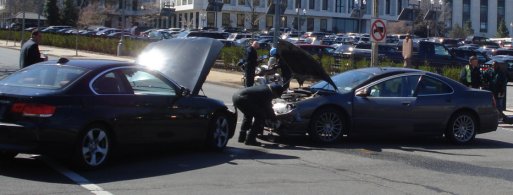
Below – This happened near the Capitol. I don’t think anybody got hurt. You don’t have to hit a car very hard to do a lot of damage.
We now have TViO, which means we can record shows for later viewing. This is less useful that it might seem. We have lots of shows recorded but not enough time or inclination to watch them. The only show that I record and actually consistently watch is “Modern Marvels.” Recently they had episodes re how cheese and sausage were made, a history of pigs, oil refining, plastics and – my favorite – forestry technology. I like it because you get the story with all its parts but w/o the social commentary crap that seems to have accreted to most things today. For example, they talk about how pigs are raised and eventually turned into bacon and ham. That’s it. We don’t get the sad music or the criticism of modern eating habits. I just want to know how things work. I don’t need the help re how I should feel about it.
For all the criticism of TV, it really has improved and it is a great learning tool – if used properly. You could get a decent general education from watching things like “Modern Marvels.” “Nova,” or the various History Channel Shows. It also democratizes and fosters search for knowledge. There are now a lot of people trying things out. For example, there are whole cottage industries involved in figuring out how people in the past lived and built things by actually building them with the tools and techniques of the times.
Of course, you could just spend your time watching reality shows. They are popular, IMO, because all the losers watching can feel better than the even bigger losers on TV.
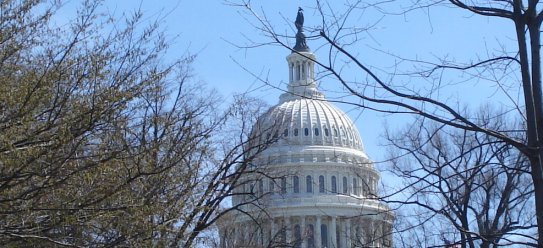
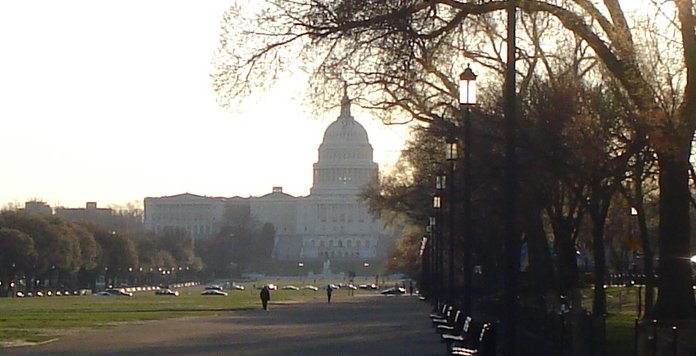
It is still a cool spring, but some of the trees are starting to bud out & flower. Below is the Capitol on March 22 at about 8am in the morning calm and the soft morning mist. You can see some of the trees are getting leaves.
Below are a few interesting links.
This one from the Economist talks about new dams. Many countries need to develop more water storage. Follow this link.
This one talks about the ancient Greeks & Romans. The Greeks & Romans are a little out of style in the modern academia. Many people now prefer to emphasize the contributions of the less well known or the less western civilizations. The problem is that the reason we have revered the Greeks and Romans for so long is that they contributed so much to civilization. The Greeks and Romans also had a viable literature. This article tells more about it.
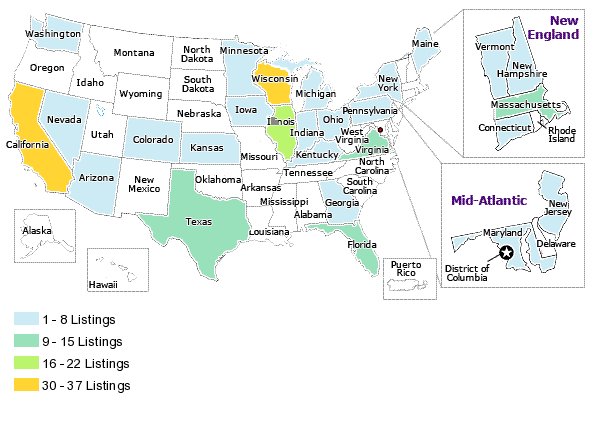
Finally, I happened on this name popularity page. The most popular first name in the U.S. is still John. And the most popular last name is still Smith. You can put in any name and find out where it ranks along with a map showing the distribution. I typed in “Matel,” which is not a common name. Matels are relatively most common in Wisconsin. I suppose most of those are some relation of mine. There are also some in California, I don’t know if any of those are my cousins. There is a Matel in Colorado. I know at least one person there, Larry Matel is my relation. He contacted me via email a while back. I noticed that there is a John Matel in Duluth. According to the Whitepages, he is ninety-five years old. My father was born in Duluth and his family lived there. Maybe this is one of his cousins.
You can play with the names in various ways. For example, you can choose names from various ethnic groups and see the distributions. Wisconsin is the home of many German names. Minnesota has lots of Scandinavians. I didn’t find anything unexpected, but I wasn’t looking hard.
It is probably a genetic maladaption. My mother had all that kind of stuff – vegomatics, cap snafflers – all those labor saving devices that make more work while ostensibly being labor saving. I saw the “Slap Chop” on television and called in for one. I got the Slap Chop and the bonus Graty for the one low price of $19.95. Great.
It does what it is advertised to do. It easily chops onion, potatoes, mushrooms and other vegetables with one slap. It just isn’t worth the trouble. In this respect, it is a lot like the “Fry Baby.” It does what it is supposed to do, but you have to go out of your way to put it to good use.
The one good labor saving device I have is the “Pizzaz Pizza Oven.” I actually cannot take credit for this thing. Chrissy bought it. It cooks frozen pizzas to perfection. If you put a few fresh mushrooms (I suppose I could use the Slap Chop) on a Tombstone Pizza, it is as good as the average take out. I have learned to put it first only on lower to crisp the crust and then do dual to finish the job. The kids eat a lot of pizza, so this thing make sense for us. It is more useful than a toaster.
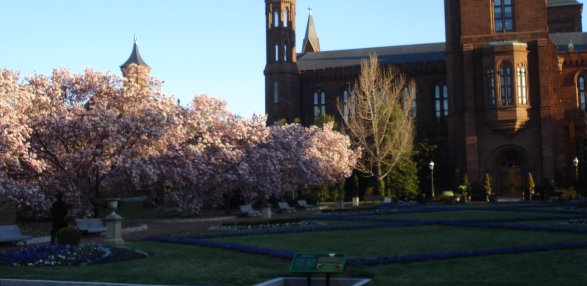
Below – magnolias are flowering near the Smithsonian.
I am still glad that I bought my hybrid car back in 2005 but on TV today, they reported that hybrid sales are down. Last year they couldn’t keep them on the lots. Consumers are fickle, but logical. They respond very rapidly to one thing – the price of gasoline. Everybody I talk to claims to be interested in saving the environment and concerned about our addiction to Middle Eastern oil, but their behavior tells a different story.