Survivor Bias & the Teleology Trap

I have been reading an annoying book called Tribes: We Need You to Lead US.  It is typical of many such books about change, new technologies etc. in that it has that insufferable air of superiority and fawning homage to coolness.   There are some good ideas; enough to fill an article or maybe a blog post, but not a book.   But it wasn’t a waste.   I thought about some of the reasons these books sell so well and how the faculties they employ sound so convincing … and why I probably cannot use much of the advice.

This book and others like them (some very good such as the Tipping Point) suffer from survivor bias.   They talk about how little movements turn into big things.  You get examples, like Google or Facebook, that seemed to come from nowhere to dominance.  The examples are real, but the game is rigged.   It is “survivor bias” & the teleology trap.    It is when you assume that conditions you observe today were a natural or even an inevitable outcome. You infer a pattern or purpose where none is implied.  It comes from a faulty perspective.   A lottery winner asks, “What are the chances that I would win?”   But the correct question is “What are the chances somebody will win?”  Of course, the chances of that are 100%.   If you bet on that, you are always right.

A simple illustration of survival bias is a game of Russian roulette.   Survival is a random event, but at the end of the game, somebody will have survived.    If a large enough group starts out, somebody will survive even repeated plays.   You just don’t know who it will be.   No doubt the “winner” will come to believe that he knows some secret of success.   He may write books about it.   But there is nothing to it.

Of course there is more involved in technology companies, celebrities or investing, but sometimes less than you would think.    Let’s take the example of celebrities.   All celebrities have talent.  They are all attractive in some way.   They are generally smart (or at least smarter than they seem).  A celebrity needs these things.  They are threshold requirements, the minimum you need them just to get through the gate, but they are not enough to provide success. Beyond that, the winning combination will not be known in advance.   It looks very different depending on when you look.    

If I know that a person is a celebrity, it is fairly easy to go back and explain why her ascent was inevitable.   But if I substituted a non-celebrity, I might find much the same biography.   When you listen to the winning Super Bowl team, they always say that they knew they were going to win and confidence is important, but the losers also knew they were going to win.   They were just wrong.

Books like Tribes play on this bias.  It is like naming the winner of the lottery AFTER the drawing.  It is easy to be prescient about the past.   The other thing I don’t like about this book is the appeal to coolness.    They talk about the latest styles and sing paeans to change.    People today demand the latest, they say.   Once again, they are right, but so what.   A lot of change is just froth.  I have been reading these sorts of books for more than twenty years.   They are always talking about the changes and the changes are always happening.   But most of them don’t stick.   In fact, the authors are usually self-contradictory.   They seem to think radical change will happen and then it will be the change they want, but things keep on moving.

Another thing that annoys me about the cool change folks is that they don’t seem to understand cycles.  The author of Tribes triumphantly states that smaller organizations are often growing faster than bigger ones.   What a surprise!   A young tree grows faster than an old one, but trends often do not continue.  Beyond that , when praising the growth of the small, it is useful to do some simple math.  Which would you rather have,  50% of $1 or 5% of $1000? 

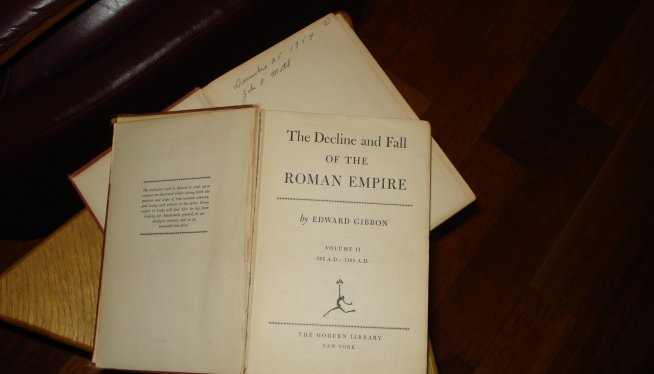
I have a special perspective on cool fads.  As an FSO, I am away from America sometimes for years.   Sometimes I miss entire fads.   They come and go while I am away and there was no point in even thinking about them.   Ephemera.   Meanwhile, my bookshelf still has lots of classics that are never wildly popular but endure.   The book that has been longest in my possession is a copy of Gibbon’s Decline & Fall of the Roman Empire that my mother gave to my father the Christmas of 1954, the year before I was born.   It was first published in 1776.   I first read it in 1966 and it is still a joy today.  Who could have predicted that the yet unborn baby would still be reading that book fifty-five years after my mother bought it?   

Change is good & and so is continuity.   A balanced person treasures both but is beguiled by neither.

BTW – Survivor bias is why we think stuff was better in the past.  All the junk has long since gone in the garbage.  What is left is better or at least by definition the longer lasting. 

Life is Endlessly Interesting

You have to look for changes & there are so many things going on the time.

Below are a couple of guys advertising for Gold’s Gym.   I couldn’t capture their skill and speed on the still picture.   They twirled the signs and threw them up in the air.   I don’t know if many people were persuaded to join Gold’s Gym, but they certainly got a lot of attention.

Let the Games Begin

Continuing my thoughts on games in public affairs, interactive games will soon become the leading method of persuasion and a key advertising medium.   I know that is a sweeping statement.   Those familiar only with the “Space Invaders” game generation will think I am nuts.  The “Myst” people will see the merit in the statement, and those playing World of Warcraft would heartily endorse it, if they could divert their attention long enough from their games.   Games are already a primary way that young people interact with data, each-other and the world in general.   Even the EU now thinks that gaming might be good for young minds, so we better get used to the idea that games.  For a funnier approach, take a look at this video.

Games’ pervasive persuasive ability is part of a continuum of imagined worlds so let’s digress a little to the more familiar previous persuasion champion – the play (or in the modern versions the movie or TV show).  Sophocles and Shakespeare, Ibsen, Shaw, O’Neil and George Lucas & Steven Spielberg were/are masters of persuasion and they all knew what they were doing.   Think of a play as a very long commercial message that you volunteer to watch.  And remember that if a thirty-second commercial can sell you a product, don’t you think an hour and thirty minute play or a thirty minute TV show can sell you an idea or a lifestyle.

The writers, producers, directors and actors work together to sell you an idea.  Sometimes it is  innocuous; sometimes not.  Shakespeare sold us all the Tudor version of English history and we bought that Richard III was nothing but a sneaky rat and Henry V was a great and brave hero.  There is some truth to some of these characterizations, but they are fictional caricatures, not history.  It was a conscious effort at propaganda, but it was so skillfully done that it is still part of the fabric of our society four centuries later.   A skillful current propagandist is Oliver Stone.   Many people draw their knowledge of JFK or Nixon from his movies and the images are strong.  Even when you know the real history of the events, it is hard to get the image out of your mind.   The living, moving image often trumps the truth of history.   That is the power of the play/movie/TV Show.    

The writers/producers/directors control ALL the characters.   They can make the ones they don’t like unlikable or stupid.  It is all a set up.  They can structure events so that faults are revealed AND they can give characters the faults to be revealed.    It is analogous to your own dream, where all the characters are you but they seem to be others and that is how you react.   In every play, for persuasion purposes, the bad guys and the good guys are on the same side.  They are all working for the guy who wrote the play.  But the illusion remains.    Directors sometimes disingenuously talk about characters as independent or they ridicule critics by pointing out that it is only fiction.   Think of how you view familiar historical people or events.  Now consider whether your image came from reading actual history or just watching it on TV.   

BTW – the power of the producer has increased in Orwellian fashion.  Now many directors go back to their movies and change them to fit the current situation and sensibilities.   The “Star Wars” you saw in 1979 is not the same one you will see today.  “He who controls the past controls the future and he who controls the present controls the past,” is the philosophy of Ingsoc and Big Brother in George Orwell’s “1984.”

But the power of the play/movie/TV show pales in comparison to a modern game.  Viewer might get involved in a drama, but not matter how involved the couch potato gets, he is still a passive participant.   None of his intelligence or perception will change the course of the investigation on “Law & Order”  and none of his passionate tears will prevent one death on “House” or “ER” and the rerun will unfold exactly as it did the first time.

Not so in a game.   The game provides some choices and the illusion of free will.   What you do makes a difference to the outcome.   That is why games are so addictive.   You get to be a player in all the senses of that word.    The irony is that BECAUSE you are making choices and seeming to go your own way, the power of persuasion is multiplied.  

The game maker sets all the parameters.   He can suspend the universal laws of physics.  He can dictate the nature of human interactions.   He can dictate the nature of human nature itself.  Animals can become wise; inanimate object can be animated.   The game maker can determine heroes and villains, but now they are also YOUR friends and enemies.    Humans have a wonderful capacity to personify animals and objects.   It is much easier when these things have elements of a real personality.    Games create that.

I don’t think most game makers have an explicit social or political agenda, but they do have perceptions and prejudices that color their view of reality and so come to color the reality of many others. 

I no longer play many video games and I date myself when I say that used to play Sid Meyer’s Civilization, a game from the 1990s.   It is the only game that I really know well and it is familiar enough to many people, so let me use one example from that game.  You can find examples from other games at this link.

Civilization requires you to develop from a society of Stone Age wanders into a future with space travel.  As you develop various technologies, you get more options, both in civil and military matters.   The game makers have determined the relative merits of particular advances and you get them as givens. You compete with other civilizations and you have to spend a lot of time defending yourself and there was some criticism that the game was too warlike, but so was human history.

The first rendition of the game the other civilizations had characteristics broadly correlated to their historical activities.    For example, Hammurabi and the Babylonians were builders who spent relatively more time developing irrigation and road.  Lincoln and the Americans were technologically savvy and likely to develop democracy.   Shaka and the Zulus were less interested in technology and were more aggressive in attacking others.   The most aggressive and dangerous people on the board were Genghis Khan and the Mongols.   This was very un-pc and it disappeared from subsequent versions of the game.   

So the message of the later versions was that the unpopular idea of national character or any sort of cultural determinism was completely useless.   This is a very important point, BTW.   IF applied to the real world, it would mean that over time you would expect the Swiss and the North Koreans to behave in the same ways and that their national character would have no predictive value.   This, BTW, is the message of cultural relativism that you get in many universities.    If you get it directly, you can counter with the Swiss-North Korean argument.   If you imbibe it unconsciously as a teenager, it just becomes part of your world view.

But there is even a deeper message implicit in the game.  You, as the leader of your civilization, have nearly complete knowledge.  You make choices based on calculation or preference, but you can be logical.   Real world leaders never have this option.   There is always fog and uncertainty.   So if players take a lesson from the game, they have way too much confidence in the ability of leaders to run the economy or engage in foreign policy.   Conversely, if the leader does not deliver as promised, they are less likely to understand the constraints, unavoidable ignorance or mitigating circumstances.

Anyway, more and more we will use games to persuade and train.   Games are artificial models, created by humans, bundled with their unconscious preconceptions and prejudices and often peppered with deliberate manipulation.  As with any model, they represent one reality.  They are not THE reality.  But they sure seem like it to the players and I wonder what sorts of mind-sets the games are creating.   Games can create an entirely artificial world, whose characteristics players may carry over to the real world they (sometimes) live in.

Tell it Plain

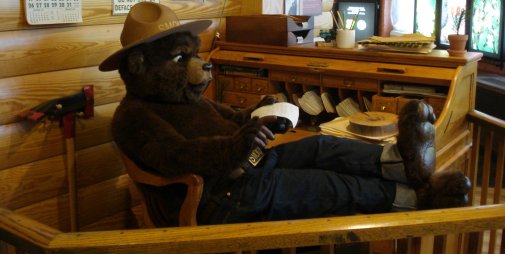
Below is Smokey the Bear, no doubt reading plainly written government regulations.

The Congress in its wisdom has mandated that Federal employees should write in plain language. This is a great idea, but what does it mean?

I write in a simple way.  I don’t use the passive voice very much.  Most of my sentences are simple noun, verb & object.   I don’t use circumlocutions, but I do use the most appropriate word, for example, “circumlocutions”.   Using that one word avoids having to write two or more sentences.  

Plain writing requires a wide vocabulary. You have to use the words appropriate to the ideas you are trying to express.  Speaking of writing plainly does not mean making it so easy that a fifth-grader can understand.  Some concepts are beyond the understanding of a fifth-grader.     We have education to improve people so that they can indeed understand more.

Lord knows that government writing can be convoluted and confusing.  (Note the use of the word “convoluted”.  That is the best word for this thought.  An easier synonym for convoluted is difficult, but that does not adequately convey my meaning.)  I guess I am afraid that this great idea will be misused by some in the government to dumb-down our writing.    Some overzealous official might strip out words like “circumlocutions”, “convoluted” and … “overzealous”.   That would make my writing more simple-minded, but not simpler and not easier to understand.

There is no small irony in assigning a bureaucratic process to the art of writing.  Bureaucracy is the biggest reason our writing is difficult to understand (note that I did not use the word “opaque”, which was my first thought.  Instead I had to use three words (“difficult to understand”) that do not exactly convey the meaning I had in mind.    Much is lost when writing becomes a lowest common denominator group exercise.  The first goal of bureaucratic language is not to offend anybody, BTW. Conveying meaning is always a subordinated goal.

When I was in Poland, one of my Polish staff wrote a note asking for office supplies.   It was very clear, but also very clearly written by someone whose native language was not English.  The person receiving the request sent it back to me with a snarky comment “Didn’t you edit this.”   I wrote back much more politely, “No, I did not edit it.   I understood what she wanted and so do you.  Just send us the requested supplies and don’t bother me again.”  This was very clear and it caused some consternation among the admin folks.  My boss even called me to caution me about hostility, but they never bothered us again and it was worth it.   Had I knuckled under, I would have empowered the pedants and all of us would have spent many hours rewriting great prose like “Please send five boxes of pencils.” 

Government employees spend an inordinate amount of time on these sorts of things. Life is a lot easier if you just say no.  

And, BTW, the legislation specifically does NOT apply to regulations.  They can remain as opaque as ever, so that ordinary educated people cannot figure them out with any certainty.  I think we call that the “lawyer and bureaucrat full employment act.”

Just a Lane Change

Above is my morning commute on the W&OD bike trail in Arlington, VA.  Notice that they are doing utility work in one of those big cherry pickers.  The rain was coming in behind me.  You can see it in the clouds, but I got to work before the rain did. 

———————————————————————————————— 

Robust.  That is what we want and that is what are getting with the new media.  A robust solution provides lots of options and achieves desired outcomes by whatever means work best and whatever path is easiest. 

During a program supporting President Obama’s discussion with Turkish students, CO.NX provided a great example of how a robust system works in practice. 

CO.NX had an audience of hundreds of Turkish young people interacting over the internet while watching President Obama live on streaming video.   Unfortunately, the video pod on the CO.NX software broke down.   Disaster?  It would have been in an earlier technological age, but CO.NX is robust.  

The Adobe software gives users the ability to stream in video from other sources.   CO.NX staff just opened another link and viewers in Turkey seamlessly switched to watching video from the Whitehouse sources, or some preferred CNN Turk, which provided a local angle.  

What would have been an embarrassing program-killing crash is now as uneventful as changing lanes to pass a slow truck on the highway or pushing a button on your remote to get a different perspective. 

There is a greater lesson from this event about robustness. In order to achieve success, we relied on systems outside our own and that gave us several good options.  In the past, we would have needed to produce costly backups, which would have come with their own risk of failure and would never be as elegant as what we can get free.

I think an old saying fits well in this case:  why own a cow when you can just go to the dairy? The new media gives us choices.  Updating the old saying, why own a cow and get only milk, when you can just go to the supermarket and get yogurt, ice cream, Swiss cheese …?

Robust.  I am making that my word of the day.

————————————————————————————————

Below is the front of our townhouse complex.  I planted those pine trees.   The one in front is an Austrian pine.  Behind is a white pine.

International Generosity

A lot depends on how your draw the graph and the measures you use.  Statistics are often used in ways that bring the U.S. down.  For example, when we talk about CO2 emissions or military spending, the measure is usually the straight big number.   On the other hand, when we talk about things like foreign aid or investment, we usually find a measure as a % of GDP.   In the apples-to-apples comparison, the U.S. is the world’s #1 foreign aid donor and the #2 producer of CO2.  Per unit of GDP, we are a medium producer of CO2 and a low donor of official foreign aid, although we do significantly better when the total aid (private plus public) is included.

Consider this graph from the Economist.  The graph gives you one impression and the numbers tell another story.   As $26 billion, the U.S. accounted for almost 22% of the entire official foreign aid given world wide.   In fact the increase of U.S. aid from 2007 to 2008 was bigger than the total foreign aid given by some countries.  Sometimes size matters.

If you made a graph of actual outlays, the U.S. would be almost twice as big as the second place donor (Germany).

So I guess it depends on what sort of point you want to make.  If you are trying to make a moral point – that U.S. official aid is stingy because the U.S. could afford more, the graph in the illustration works.  If you are actually wondering how much poor people are receiving, you might want to look also at the raw numbers too, because if you had the choice between getting 90% of my salary or 1% of Bill Gates’, you should go with Bill.

The irony is that declining economic fortunes may improve the outlays as a % of GDP.   If you manage to lose half your money, you become twice as generous by this reckoning, perhaps another reason to reconsider the measurement.  

Beyond the measuring problems, there are questions about the overall effectiveness of official foreign aid.  If official foreign aid was the key to development, Tanzania would be really rich and Singapore would still be a basket case.  The WSJ ran an article today re how aid helps keep Latin America poor.  You sometimes get perverse effects from generosity.

You have to consider behavior.  Unconditionally pouring money into corrupt societies just sustains klepocracies.  U.S. foreign aid has become more effective in recent years when we started to demand reforms in return for the cash.  The Millennium Challenge Program was the best thing that ever happened to foreign aid, IMO.   But overall, the best thing the rich world can do for the poor world is to make trade easier and more transparent.   It has something to do with the old saying about giving a man a fish.

The Last Three Feet

Those of us who got our jobs in the old USIA grew up professionally with the example of Edward R. Murrow. Murrow was a great newsman when newsmen were great. He was  director of USIA & we remember him for the “last three feet”.  Murrow observed that communications spanned the world, but real persuasion happened when people made personal connections, in the last three feet.  Of course, we cannot talk personally to millions or billions of people and the challenge remains how to bridge those last three feet on a massive scale.  It is a paradox, like mass customization.  But mass customization is demonstrably possible with computer aided design and manufacture.  Maybe technology can help us too.  New communications technologies give us lots of opportunities to reach out in more personalized and interactive ways.  We can talk and listen in real time and engage and in ways that were not possible only a short time ago. And my colleagues are trying to figure out how to use new technologies and old techniques in new ways to adapt and engage in a mutually respectful communication. 

I don’t think they get noticed enough.  It is the usual problem.  People doing good things are too busy doing to have time to talk about them.  So I am making it my business to find success.  Let me start with CO.NX. CO.NX is the fastest growing IIP program in recent months.  It is the multimedia descendent of the simple webchats we started to do regularly a few years ago, but the character has totally changed in the course of its evolution.  We knew we were in a different league when we got 45,000+ questions during an election night program.  Much of this change was facilitated by technological improvements and changes in organizational culture. 

CO.NX use Adobe Connect, which is a very simple but effective interface.  It requires the recipients to download no software and a reasonably adept participant can be using the program within minutes.   Participant do not have to register, which is a big deal in many places.  It takes up little bandwidth, which is crucial given the vast diversity of technologies used by our audiences worldwide.  Important for the same reason is its scalability.   Anything from interactive video to simple text is possible, so countries and individual audience members can participate at the level and to the extent they prefer or their equipment allows. Programs are only useful in the context of the communities they create.  The creation of communities, both entirely online and online facilitated face-to-face communities, is the key to CO.NX’s recent meteoric rise.   The key to the communities has been Facebook and Twitter to a lesser extent.  (Although we work across platforms, these are the ones currently producing the best results).   The original webchats relied on list serves.   This method is a clumsy way to reach an audience and does not easily facilitate discovery of new members or the viral spread of information.  

Facebook provides an excellent framework to connect the various parts of CO.NX.   It allows a simple way for people to become part of an online community as well as a place where information can be disseminated.  In addition, Facebook engagement is phenomenally well targeted and inexpensive.   First, you can simply engage through friends already in the community, but you can also search out interested new people with targeted advertising.  A recent outreach to build an audience in Pakistan among people interested in the new U.S. strategy in the region produced 203 participants for the program in about twenty four hours at the cost of just a little more than $35.00.   IIP research indicates that each of these participants has an average of 183 friends, which means that we touched an audience in the thousands, even accounting for overlap among friends networks.   Beyond that, the program made its way into the Pakistani blogosphere where the new U.S. policies were explained and discussed by opinion leaders.   A program like this would have been impossible to arrange a few years ago, no matter the price we were willing to pay.  

CO.NX can engage with audiences sorted by age, gender, location, university affiliation and even by major at the university, among other categories.  It is an amazingly effective tool and it means that we no longer have to put our product out there and wait for a reaction.  We can proactively shape the public affairs terrain where we participate.   Another free technology CO.NX is using is YouTube.    As I mentioned above, CO.NX can have a video component and most programs do.   Parts of these videos have been put onto YouTube, sometimes by the CO.NX people directly and sometimes by others, which show the interest our programs are generating.   If imitation is the sincerest form of flattery, how much better is a direct copy?   In addition, in the Internet world,  having someone other than ourselves post adds to the credibility.    Secretary of State Hillary Clinton and President Obama himself are among  those whose images and statements have made it into cyberspace with the facilitation of CO.NX. 

Of course, the IIP CO.NX staff is very small.  There is no way that a couple of full time employees and a few interns can effectively reach the whole world, no matter the technological leverage they enjoy.  Fortunately, IIP enjoys the support of a human network worldwide – our posts and IRCs overseas.  A network solution is emerging, with IIP providing the initial information, training and platforms, and people from posts overseas becoming more autonomous and helping each other.  This is especially crucial in time zones far removed from Washington. 

Posts such as Afghanistan, China, Thailand and Mexico have been avid pioneers in independently using the CO.NX system.   Secretary of State Clinton did a live town hall CO.NX program from Belgium.   A member of the IIP CO.NX staff was dispatched to advise, but the posts did all the heavy lifting for this immensely successful outreach.   This is as it should be and as it will become more commonly.   Note: CO.NX was a useful tool in building realationships with Turks around President Obama’s talk to students in Istanbul.  Follow this link to read about how the robust system worked.

Our overseas posts understand the local environments, can speak the languages and have the opportunity to build robust relationships, bridging the last three feet that Edward R. Murrow talked about.   That is what we need for persuasion and there is no substitute, but IIP CO.NX is helping us get in range and maintain relationships across space and time zones.  It is something simple that works.

Games: Monopoly

At work we are experimenting with using games in public affairs, so I have been thinking about them and reading about them.   I just got a book called Changing the Game, re how video games change ways we do business.   We are very much influenced by games because games create reality.   I plan to write a couple posts on this general subject, but to get my thoughts rolling I considered Monopoly.

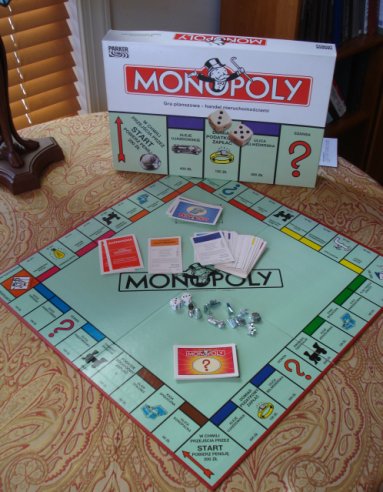
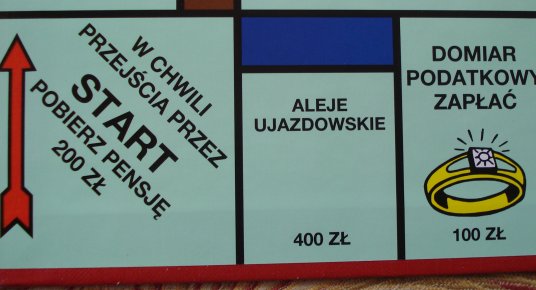
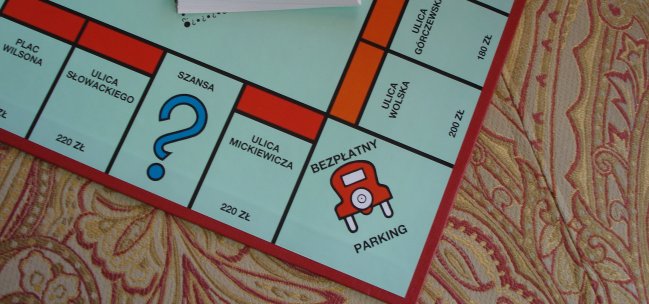
Left is the Polish version of Monopoly.  I didn’t have the original American version, but I used the familiar names of properties in my post.  The proliferation of Monopoly around the world shows its general appeal.

Monopoly was the game we played when I was a kid.  I played it with my sister and with my friends.   I didn’t realize what it was teaching me and the subtle persuasion that was going on.   Learning and persuasion are closely related, of course.   When we learn a system, we are simultaneously persuaded that it is good and/or useful.   So what does Monopoly teach/persuade? 

You learn a lot about statistics.   Dice produce random results within a pattern.   There are thirty-six possible combinations of two dice that produce the twelve numbers we might throw.  Seven is the most common number, since you can get seven with six different combinations of the two dice.   Least common are two and twelve, since there is only one combination that can produce each of these.

The Monopoly board accounts for this.    You cannot buy a property that is seven steps from “GO” and the most common landing spaces are occupied by “Chance,” or “Community Chest.”  The probabilities created by the dice would become less important as the game progressed, except various events of the game tend to bring you back to certain places.  You often are told to “advance to GO”, which resets the probabilities.  Seven spaces from “GO” is “Chance,“ BTW.   You are also frequently told to “Advance to the nearest RR” or sent to jail.   Seven spaces from Jail is “Community Chest” and there are no monopoly property possible seven paces from a RR except the green property North Carolina.  

Given all the permutations, it is generally the lower cost-lower rent properties that get most of the business.   Mediterranean and Baltic are the most visited properties, but it is hardly worth having them, even with a hotel.   Boardwalk is the killer property, but people tend not to land there and it costs a lot to build houses and hotels.   IMO the best combination of affordability, frequency and income are the Red group of Illinois, Kentucky and Indiana.   The next best are the Orange New York group.    I am sure that somebody has figured out exact probabilities. 

The winning strategy is to get the best property you can and build as soon as possible.    There is a big advantage to being first since you will get the resources to expand (and deprive your opponents of same). 

Fortune favors the bold and a person who is timid and refused to deploy his current money to produce future income cannot win.  Of course, the reverse is not necessarily true.  You can know all the things you should know and play superbly and still lose.  If you could just do something with a certain guarentee of success, it wouldn’t be a game anybody would play.  There is no uncertainty in dice, but there is probability and risk. In Monopoly, you can assess risk.  Over the long term you will win if you do the right thing.  Over the short term, such as a particular game or even lifetime there is no such guarantee.  That is the nature of risk.

These are really good life lessons.  I learned probability from Monopoly before I knew about it in school.   We practiced simple math.  Got a good short course in negotiations and a chance to observe human nature in wealth and poverty.  

The world view we got from Monopoly was that this is the way life was.   We had early free enterprise, followed by consolidation and then Monopoly and bankruptcy for all but one big winner.   Although that last part was never achieved in our games, which was another lesson.   We always made deals (not permitted by the official rules) to help each other save face.   We also noticed that the bankers tended to have more ready cash than their property holdings seemed to justify.

The games usually ended when it became clear enough who was winning and everybody got bored, or else somebody got mad enough to upset the board or end the game abruptly.   We had several sets of brothers who played with us.  Inevitably one or more would resort to petty violence in response setbacks in the market, thereby ending the game.    I guess it was like real life.

Clearly, the game persuades us that some behaviors are useful and others not.   I don’t think Parker Brothers had support for Capitalism in mind when they started to sell the game in the 1930s.  In fact, I read that the precursor to Monopoly was invented by a socialist who wanted to show the pernicious nature of private ownership.   It just goes to show the law of unintended consequences that it taught generation of American kids about the virtues, if risky ones, of the free market. The mistake that Monopoly teaches is that the free market is a zero sum game, with winners in proportion to losers.  In fact, the free exchanges in a market economy increases general wealth, although not in equal measure.  I don’t think we can blame Monopoly, but this zero sum mentality is the leading cause of misunderstanding of the market.  Of course, games need winners and losers.  They are only games after all.  And one reason we like games is that, unlike life, they provide definitive results, but we would not like those kinds of results in real life.

Anyway, kids don’t play Monopoly like we did.  They have other options.   

Loose Ends from March

Sometimes I come across interesting things, but there is just not enough to write a whole post re.  Here are some of them.

Self-driving Monster Tractors

Below is a giant tractor I saw on a farm on the Northern Neck.    It can drive itself.    It is equipped with a GPS, so once it learns the field it doesn’t require a driver to drive.  GPS is a fantastic technology that has gone from unbelievable science fiction to practical commonplace within a few years.   Soon I wonder if trucks and trains couldn’t drive themselves.   They would just need some kind of collision sensing systems and some of those are already available.


Green Buildings

Below is a LEED building.  It is theoretically built to good environmental standards, a “green building,” but  LEED is the elitists brand for “greenness.”     I think in the long run Green Globes will be the way to go.  I admit that I am a little annoyed with LEED.  They don’t recognize tree farm wood as ecologically sustainable and if they don’t like my forest I don’t like them.   They also tend to favor European sourced wood over North Americans supplies.  I think we should be more interested in actual environmental achievement than in the political correctness.  The narrow definition of sustainable timber also raises the cost of building.   Read more about the comparison here.  American Tree Farm System tend to be smaller land owners.  We are not so politically savvy, but we do a good job with our trees.


Pulaski

Polish glassmakers were among the first settlers at Jamestown and Polish heroes like Pulaski and Kosciusko participated in our war of independence.   KazimierzPulaski wrote to George Washington, “I came here, where freedom is being defended, to serve it, and to live or die for it.”  At the recommendation of Ben Franklin, Washington took him on.   Pulaski is called the father of the American cavalry.   He died of wounds he got at the battle of Savannah in 1779.  Below is his statue on Freedom Plaza near the Whitehouse.


Willard Hotel

The Willard used to be the classiest hotel in Washington.  Lincoln stayed here.   When Grant came east, he checked into the hotel.  Grant was an unassuming man and nobody really noticed when he came in, until the clerk read the name on the register. 


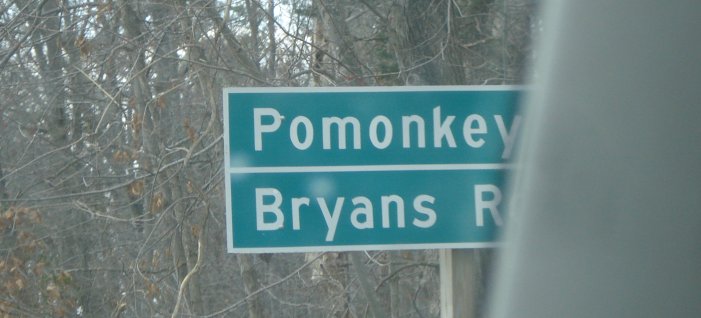
Pomonkey

This is a local small town in Maryland.  I don’t know how it is actually pronounced.  I just think it is a very funny name.


Erodible Soils

Soils in tidewater Virginia are a mixed bag because they have often washed down from other places.   They are also not very stable and erosion is a constant challenge.    This picture shows some of the soil stratification.   It picture is not an example of erosion per se.    The farmer who owns the land uses this soil to make berms to protect other soils.

You Never Thank Me

One of the greatest virtues is the ability to feel genuine gratitude and the reverse is one of the most pernicious faults.   Of course, gratitude and generosity are complicated human emotions, intimately tied up with status, responsibility, guilt … in short almost everything.  

There are valid reasons not be grateful.  Generosity is often a status seeking activity.   The giver is asserting his dominance over the receiver and often trying to influence his behavior.    That is why generosity on a large scale is tricky.   Those too often on the recipient side, may come to resent and even hate their benefactors.    I read that this is even true for other primates; lower status group members are alternatively obsequious and demanding. 

Constantly being the one-way object of generosity is shameful if not put into the proper context of reciprocity.  In order not to be shamed, the recipient needs to believe that he will be returning some form of compensation now or in the future or that he is entitled to the largess through a legitimate social relationship.   Good families are like that and so are good friends.    Parent/child relationships are very uneven, but there is significant reciprocity and expectations of continued relationships.  

Friendships can break up when one becomes unwilling or unable to reciprocate. For example, drinking buddies usually do not keep careful score about who buys the beer, but they will notice if one of the group always keeps his hands in his pockets when his turn comes.  In long-established relationships, friends will cut each other considerable slack, but eventually the non-buyer will begin to be the object of some ridicule and will probably drift away.  Of course, if he owns a pickup truck and helps everybody move it might be a different story. Reciprocity need not be exact and it need not be immediate, but the expectation is there.  It goes the way too.  Everybody loves the big spender – at first.  But soon real friends drop away, replaced by free-loaders. 

This generosity thing is harder than it seems.

Generosity in the expectation of behavior is one of the hardest to understand, since both sides are often confused by the expectations.   Let’s leave aside the obvious mating rituals and take an example where the donor thinks he is being altruistic.  If I give money to a drunk, I might expect that he will try to become sober.   If I give to a mother, I expect she will help her kids and generally when I help anybody out, I expect that they will show their gratitude by helping someone else in the future, a kind of pay it forward scenario.   In all those cases, I feel perfectly justified in my expectations, but my experience in all those situations tells me that I may be the only one in the transaction who feels that way.  The recipients think you are trying to run their lives and that you think you are better than they are … and they are right.  You are implicitly telling them that you know better.   

In these cases, the recipients bear a bigger share of the blame.  They should feel grateful and at least attempt to live up to the good expectations.  But the donors need to be flexible too.  The fact that the recipients have not yet taken the needed action up till now says something.

The best “charity” is the kind that makes the recipient a valued member of society and allows him to pull his own weight.   That is the charity of mutual respect.   But it is hard to do.  In the short run, it seems insensitive and even in the long run you may not get credit for your generosity, which is what many people really want.  But it works.

I admit that I don’t always do this. There are a few bums around some places I go who I just kind of like. I don’t expect them ever to improve.  I give them money. I suppose there is a bit of reciprocity, since we sometimes talk a few minutes and they tell me their stories. I don’t usually believe most of the details, but we share the face-saving myth and we are all happier.   But this sort of generosity is not really very generous. You need reciprocity.

I had that experience on a larger scale in Iraq.    We were shoveling money out the door in terms of projects and generosity.  There was some justification for that at first, but the first thing I did when I got to the job was to make us stingier.   Projects w/o local commitment were misused and not sustainable and people are not committed to anything unless they have put something of their own into it.   What about the poor?  If they don’t have money, they have time.  They can give something.  There has to be a contribution.  At first we got complaints when we demanded reciprocity; some thought we were not being generous, but shortly after that we got respect.  We also got better quality projects and happier people working on those projects, so that we were able to respect the recipients, i.e. they earned respect.  It became much more a shared enterprise.    

Shared enterprise is a characteristic of reciprocity relationships that is usually lacking with straight up charity.  It means that we have taken enough interest in each other’s aspirations to do the due diligence required to engage in a mutually beneficial relationship and that we trust each other to honor committments. This is a whole lot better than just cutting a check.

I think these things are true. Nobody really values anything that comes w/o significant effort; nobody can really respect anybody else until he respects himself and only a person who respects himself can feel grateful to others.  Thoughlessly giving money is morally lazy and thoughtlessly taking it is a moral hazard.  A fair business relationship may well be more generous than freely giving away money.

It is sometimes better to receive than to give if doing that helps build the bonds of reciprocity and respect.  Then everybody can feel genuine gratitude for what they receive and what they give.