Alex back to JMU

I took Alex back up to school at James Madison.  He is in a new dorm right in the center of the campus.  I think he will be better.  He can more easily walk to the places he needs to go and will have more contact with other students.  The room is smaller than the one he had before & has no air conditioning.  This will be okay most of the school year, but it still can get hot in September.  His room is part of a suite with six guys, who share a kind of living space in the middle.  Above is his building and below is his room as it looked when he moved in. The tree is a river birch, the southern cousin in the birch family. In Wisconsin we can grow the paper birch or the white birch. They are pretties than this kind of brownish one, but you have to adapt to local conditions.  I wanted to get a picture of Alex too, but he refused and kept on moving in and out of the shot.

The campus was full of new freshmen, you can see the gaggle of them below. They are much better groomed than back in the 1970s when I started, but otherwise look similar. Speaking of gaggles, the geese just stroll across the road and most cars stop.  I didn’t.  I went slow enough that they could move out of the way, but I am not going to yield to geese.  They squawked a little but they cleared a path.  Up at the farm, a turkey stood in front of my car and stared at me.  I actually had to get out and shoo it away. Turkeys are dumb enough to be run over by a car going 3MPH; geese are not.

A Cool Bike Ride

It was cool and overcast for my morning bike ride, but an easy trip because of the west wind.  I am glad that I don’t have to drive. Below you can see the cars backed up on Memorial Bridge.

Above is the stop light to cross near the Lincoln Memorial.  You have to push the button to get the walk light, at least you HAD to.  Somebody glued button down so that it just goes through the cycle continuously.  I think that is good.  I hate that idea that you have to push the button and always wait.  Of course, sometimes you can just nip through between the traffic.

Above & below are elm trees looking not good on Independence Avenue.  I have noticed that many of the elms around town are not looking good.  Some elm trees are resistant to Dutch elm disease, but none are completely immune.  I worry that something is going on with the trees.  It would be a shame if these big trees died.  I have been watching the media for reports re the elms.  So far I have found nothing.  I hope that my fears are unfounded.  It was a hot year. Maybe they are just stressed.

Fells Point in Baltimore

Chrissy and I went to visit Mariza in Baltimore. It really is a nice city, at least the parts we visit.  Espen and I once turned into a less nice area. It looked like the set for a cop drama; lots of people just hanging around, but these places are being renewed and redeveloped pretty well.

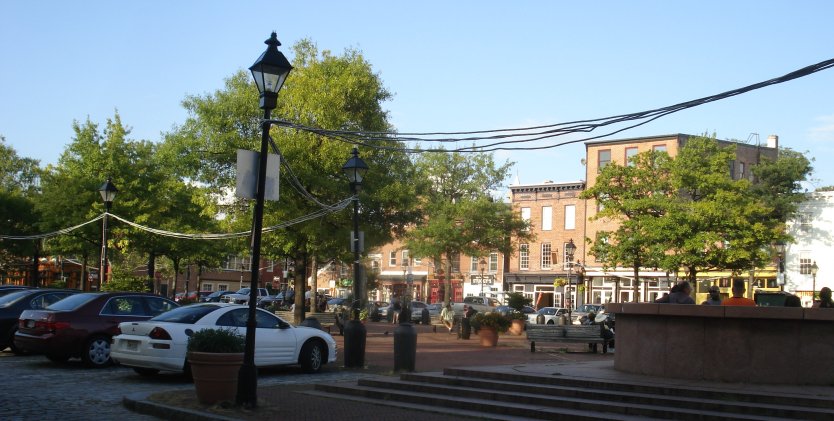
The pictures are from Fells Point, where we went to eat at a place called Kali’s Corner, a seafood restaurant. They had a special menu for restaurant week. I had sea bass; Chrissy got skate, evidently a sting ray & Mariza got the salmon. The Atmosphere was very good; food was okay.

Mariza is doing fine.  Business is picking up a little at Travelers.  Evidently they are at least hiring some new people this year. Above & below are pictures from the windows of Mariza’s new apartment.

Wind Bags

I found this about wind power. All the swells love wind power until it comes anywhere near them. They can often even get the local Indian tribes to claim it violates some sacred something or other to make the opposition more PC. Evidently it spoils the view from some burial grounds. I am not making this up. Who knew the dead were so sensitive?

Where to put it is a serious problem for any type of alternative energy. Oil and gas, for all their problems, have small & shrinking footprints on the land per unit of energy produced and it is less important for them to be near places where they are consumed. Wind, solar and biomass production are very land hungry AND because of transport & transmission challenges they are better situated near where they will be used, i.e. near people. And since some of these people will be rich & powerful, as with the Kennedys and the Cape Wind Farm, they can effectively kill many projects.

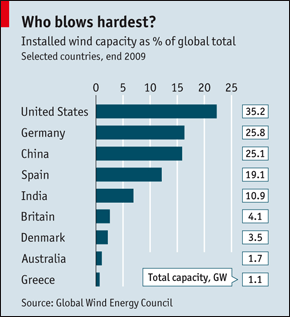
BTW – You can see from the chart nearby that the U.S. is now the world’s leader in wind energy, with more than 1/3 of the total world production. You might not guess that from all the caterwauling you hear about the U.S. falling behind in these things. Any guesses about which state is the leader?

Love of Sports

U.S. runners were much less competitive than they used to be.  This bothers the author of the linked article.  Paradoxically, more Americans are running.  In fact, the author thinks this might be contributing to the slowing down of America’s elite runners. Races are dumbed down to cater to the masses. So what if we don’t produce world class elite runners?

I don’t care. Beyond the health benefits, which you can get at a relatively low level or competitiveness, it matters not at all if athletes improve over time. Competitive sports are the epitome of the zero sum game.  I bet they thought up that term to describe sports.  

If we improve the general level of production in business, everybody gets more, at least potentially. If we raise the general level of yield in farming, we can grow more with fewer inputs.  But if the general level of athletic excellent increases, it does nothing to improve anything but the record books. There will always be only one gold, one silver and one bronze.  It doesn’t matter that a decent HS athlete can run/swim/jump/throw better than the guys who won Olympic gold in the 1920s.

Even an average NFL teams today could probably beat the Champion 1967 Green Bay Packers. Players and training methods have improved that much.  Big deal.  In fact, we were better off in the old days before all this scientific training. The game between the Green Bay Packers and the Dallas Cowboys in the “ice bowl”  was as good as any game will ever be.  No progress is possible, no matter how much more bigger, stronger and technically proficient athletes become.  

It is always hard to know when enough is enough.  I was on the swim team in HS. I thought I was pretty good because I won most of the time. Technically, however, I was not very good compared with the really excellent athletes.  Did it matter?  It was against the rules for us to have practices before the season officially started in November. So before we had swim team, we had swim club. We all got together twice a week and worked out. When the season was over in March, we all did other things. There was no continuation of training until we showed up again in the fall.  We were good swimmers; we were never excellent swimmers.  But we were good enough.  It was better that the competition for swimming didn’t dominate our lives even more.

I don’t swim much anymore. It is hard for me to just have fun. Like Pavlov’s dog, I am conditioned. When I jump in the pool, I feel the need to swim back and forth as fast as I can. I still like to run and I make a special point of not competing nor even knowing exactly how fast I go.

Anyway, if America never again produces a native-born champion marathoner, it really doesn’t matter. If the average level of football, basketball or baseball languishes or even declines, it doesn’t change anything, nor does it matter if it improves.  It doesn’t create more winners.  It is much better if lots of Americans exercise even if none of them gets to be very good.   

Working on the Railroad

Which country has the  world’s best freight rail system,according to experts?   It is the United States, by a wide margin.  And it has gotten a lot better since 1981.  

Those of us who have traveled the comfortable and reliable passenger rail in Europe are surprised by this information.  But the key to our confusion is the word “passenger.”  American passenger rail doesn’t work as well.   And freight tends to be out of sight, so most people just don’t pay attention or even suspect what is going on in the vastness of our country and in those lonely places literally on the wrong side of the tracks.

If you look at the nearby chart, you see that rail productivity exploded and prices came down after 1980.  The Staggers Act was one of the few sustained successes that came out of the Administration of Jimmy Carter.  It rationalized regulation and eliminated some of the pricing schemes that had previously crippled the railroads.  It still working.  Some people thought that railroads were creatures of the past that couldn’t compete with trucks, but they were wrong.  

In fact, the fastest-growing part of rail freight is “intermodal” traffic: containers or truck trailers loaded on to flat railcars. The number of such shipments rose from 3m in 1980 to 12.3m in 2006.  This is something that affects all of us who drive on the highways, since one freight train can carry as much as 280 trucks. Now maybe we all appreciate freight rail a little more. Of course, success creates its own dangers.   Bigger container cargoes and an expected doubling of the capacity of the Panama Canal by 2014 will create need for capital improvements.   Government may pony up some of the cash, but government money comes with government management.  It would be horrible if we returned to the bad old days before 1980. 

(BTW – I  worked on railroad cars in the 1970s.  I remember that each train had to have a “fireman”.  What did the fireman do?  Nothing.   A generation before, the fireman’s job  had been to shove coal in the old steam engines.  When diesel replaced steam, union rules and regulations protected this now redundant and phony baloney job.  Some of the firemen would actually do a little useful work, but others would tell us, “I ain’t gotta help you f*ers and I ain’t gonna.”   And they were right.)The other threat to freight rail is passenger rail.   High speed passenger rail has its own tracks in a few places, but most of the time they share the tracks with freight.  Passenger trains pay only a fraction of the costs, but they tend to get right of way over freight.  Passengers complain a lot more than does a load of coal or timber, so when push comes to shove, freight is shoved aside.  This saps efficiency and greatly adds to costs. 

We have to be careful when we rush to copy Europe’s trains not to copy the downside with the good.  Freight rail is the most efficient form of terrestrial transportation and there is a good reason it so rapidly replaced canals and wagons.  It can continue to compete well in the age of trucks, as long as we don’t mess it up.

Bad Solutions to Water and Shade Problems

There is talk about building a drain again in back of the houses. This drain would cost around $8000 and would not solve any problems. I am probably the only one who will actually stand out in the rain and watch the drainage and soak away characteristics and I see how it really works.

The problem is that the decks, board fences, houses and vegetation creates shade, enough shade that grass won’t grow.  In a heavy rain the water running off the rooftops can cause erosion.  The culprit is the lack of vegetation, not the water. 

Although grass won’t grow, lots of other things will. A couple years ago I planted some lily turf.   It cost me nothing, since I took the shoots from the front of the house. The only improvement that I had to make was to put in some timbers to stop the water in the short term.  I also knocked down the board fence at the end of our house, letting in more light.

Look at the pictures.  I took them from my deck today after a few hours of rain.  Notice how the mud starts exactly where the planting stops. If the problem was water or sunlight, it would not be like that. My plantation not only greened up my space; it also slows erosion up and downstream by slowing or stopping the water flow. Things will grow back there, just not grass.

The drains would not work because they address the wrong problem.  Beyond that, it would make everything worse by quickening runoff.  It is exactly what we don’t want to do to our local streams and Chesapeake Bay. So we would be spending $8000 to help break down stream beds downstream and ultimately dump more silt and pollution into Chesapeake Bay.

I am afraid such backward activities are common when we make collective decisions.

Industrial Policy

Big issues are perennial. Just details and names change. I recall debating industrial policy back when I was studying for my MBA more than twenty-five years ago. Conventional wisdom back then held that Japan, with its mastery of industrial planning, would overtake the U.S. as the world’s leading capitalist economy. Meanwhile, the Soviet Union, with its capacity to focus and centrally command resources, would catch up in the security arena. Our only hope, some argued, was to adapt their methods to our own ponderous, unorganized and chaotic economy through industrial planning.

Things didn’t turn out the way experts predicted/feared. Within a decade, Japan had plunged into an unpleasant and persistent recession that called into question the prowess of the planners. The Soviet Union went out of business entirely, collapsing under the weight of its own centralizing bureaucracy and structural inefficiencies. Gorbachev’s perestroika (restructuring) failed to change the facts on the ground or in the factory; his glasnost (publicity) served only to show the people the previously hidden hideousness of the decaying communist system. But these things that are so blindingly obvious with hindsight eluded the analysts at the time. *

The U.S. did not adopt a coherent industrial policy, but over the next quarter century grew much faster and created millions more jobs than those places, such as France or Japan, that had something approximating one.

Last time we talked seriously about an industrial policy was in the early-mid 1980s, when we were just coming out of a hard recession and people were uncertain about the future. It is no coincidence that in the conditions of today we are talking about it again. It is a hardy, perennial weed that thrives when things get bad and pessimism dominates. But I think the debate has improved, since it is informed by a generation of real experience. Beyond that, researchers have finally begun to explain in theory what people understood in practice for long time – how distributed but aggregated (i.e. market mechanisms) work. The “hidden had” is not as indecipherable as it once was.

I am a simple person and I like the “Economist” magazine because it explains things in simple ways. I suggest you look at these links if you want more background. here & here.

We can all recognize that every country in the world has something we could call an industrial policy but that none (even the most monotonously oppressed such as North Korea) has complete control of its economy. We spent a lot of time arguing a kind of yes or no industrial policy when I was back in school in 1983, but we were just stupid kids scoring rhetorical points on each other. Like most things in life, the question of industrial policy is one of gradations and implementation. In that regard, a little industrial policy is good, but at some point it becomes poisonous and some applications are better than others.

The best policies take advantage of preexisting advantages or propensities. Identifying exactly what those are is easier said than done, but let me give an obvious example. The State of South Dakota probably doesn’t want to invest a lot in becoming a low cost exporter of bananas. You CAN grow bananas there, in greenhouses. And there are some wise guys (sorry wise men) who will correctly tell you that there is plenty of naturally occurring hot water underground in parts of the state to heat them. But how stupid would you have to be to follow that advice? Politicians often don’t want to hear this, since much of the business of politics is to reward followings. Ironically, the reward is much sweeter when it is for something silly. If the recipient can do it w/o the help of the politician, he is likely to feel less grateful.

Another characteristic of successful industrial policy is NOT to pick winners and losers. The government does best when it creates general conditions for prosperity and then allows the people to make choices & investments that make the most sense to them. In other words, there is a good place for planning but not for the planner. More correctly, the planning is done by the people in that effective distributed but aggregated fashion I mentioned above. Remember how much trouble centralization caused the Japanese and the Soviets. Don’t do it. Once again, this is not something that comes easily to politicians. Picking winners and losers is a big part of political power. That power is the reason lobbyists line up to kiss the politicians asses and contribute big money to political campaigns. How is it that big firms are willing to cut big checks to “charities” recommended by politicians? They expect it to pay off if/when the guy they are backing wins.  

The pressure to politicize decision making – for good as well as bad motivations – is the second biggest hazard of industrial planning. The first biggest hazard is lack of timely, useful and accurate information in sufficient detail to allow decision making by the experts. That is precisely why we should not give them much decision making power. Like the watch making god of the Deists, they should set up the system, with its incentives and attributes, enforce the rule of law but otherwise let it grow by the decisions of the participants, intervening only to address true emergencies. This is essentially how it worked with the Internet, one of the most successful U.S. forays into “industrial policy.

The idea that you COULD have an industrial policy that was centrally run, comprehensive and innovated – all at the same times – is a supreme example hubris. Even stipulating that they are smart and honest, what are the chances that politicians or bureaucrats have the information or vision needed to choose tomorrow’s technologies and technology leaders? The record is not encouraging.

And the record goes way back. The Roman Emperor Diocletian did what we would call comprehensive industrial planning. It helped lead to bankrupting the empire and hastened the development of what we would later call serfdom. In more modern times, industrial policy has been associated with mercantilism. A lot of that originated in France in the early 1700s, when France was Europe’s predominant economic power. Suffice to say, it didn’t work out and France didn’t stay on top.

The free market requires government for some infrastructure projects, rule of law and provide for the common security. There are some things that have to be decide politically. But for everything else, we are better off deciding for ourselves the things that we care about the most and have the most information about and having faith that our fellow Americans will do the same for the things they know about.


—————————-


* My professor for business policy, a guy called Bruce Erickson, is one of the only serious people I know who openly and unequivocally predicted the imminent demise of Soviet tyranny. I still remember his simple structural proposition. He understood there were other factors, but this was the new part. Again, today this looks obvious, but in 1983 it was fairly new. He explained that the mainframe computer had been the salvation of communist central planning. They could control access to information and still do the needful computations. But the personal computers, which were just becoming common at the time, would be the death of central control because they decentralized information and decision making.

The communists had two options. They could give up a lot of control and then it wouldn’t really be communism anymore. Or they could resist the new technologies and make their system obsolete a little faster. In fact, the Soviets tried first restrictions and then let loose, so that both things hasted their system collapse. The Chinese saw this and refused to liberalize their political system, repressing dissent in a bloody crackdown of which Tiananmen Square was only the part we saw on TV. But they continued to liberalize their economy, essentially conceding many aspects of economic control (defacto abandoning communism) in return for continued political power. The Chinese experiment continues.

Focus on What You Do & Tell us How you Did it

More from my promotion boards experience.

It is very important to describe positions well.  Generics just don’t do it. Never accept the same description as your predecessor or the same one that “like” officers have.  For example, saying that your PRT is one of 31 PRTs in Iraq w/o saying much (or anything) about the particulars is unhelpful and, IMO, indicates a certain intellectual flabbiness.  Also be very clear about who you manage, how many and what they do. Recognize that quality and diversity count.  Managing 100 low level employees who all do well established and similar things may not take as much leadership as running an operation with ten colleagues doing a variety of changing duties.

Experience counts in similar ways. It is possible – and I have seen – people get twenty years worth of experience in five years. It is also possible to get five (or less) years of experience in twenty years. Some people just repeat the same sorts of things. I suppose they are getting better at doing them, but it doesn’t add much to experience. It reminds me of watching CNN and hearing them claim that they have 24 hours of news each day. No.  What they often have is a half hour of news 48 times a day. Watching an endlessly repeating loop of the same event doesn’t add much to understanding. Experience can be that way too.

Of course, there is a caveat. There is always a caveat. You need to develop expertise and some specialties. Beyond that, simple variety also does not produce useful experience.  Focus is important. Ideally, experience should build on previous experience creating a capacity to do and understand more. Change for the sake of change makes no more sense that the opposite. 

Experience teaches, but learning is not automatic. If things just happen to you and you don’t think about them it may be useless energy spent. I was impressed when I could see how people learned from experience and applied it in analogous situations. This demonstrated not only that the experience was good, but also that the individual had the ability to reason by analogy and make reasonable distinctions among situations.

Finally, I am reminded of what Mark Twain said about not learning more lessons from an experience than it has to teach. The cat that sits on a hot stove will never sit on a hot stove again; of course he will not sit on a cool one either. 

Getting Good from the Group while Avoiding Groupthink

The panel works a lot like a jury is supposed to work; it aggregates the experience of a reasonably well informed group, sometimes tapping into expertise that single individuals could not use.  Our group had five senior FSOs from various cones and with various career paths, alone with one member of the public for proper leavening. We made special efforts NOT to fall into either groupthink, where we have too much early consensus, or chaos, where we don’t achieve consensus at all. This meant initially ranking files w/o deliberation and then voting on those we thought were high, low or middle. 

I was surprised how often we came independently to similar conclusions. There were often overwhelming majorities on one side or the other. We discussed some of them briefly as a form of quality control. Perhaps more interesting than the near unanimity of the results was the fact that often the reasons for the decisions were very different. This made me more confident of the decision, since each person bringing his/her experience to bear on the aspect of the decision they knew the best had led to this aggregated decision. 

Of course, there were some close votes and those required more deliberation. Nobody tried to dominate the group, but each member came to be recognized as having particular expertise in some things.  I, for example, had more experience in public diplomacy and in running PRTs and that experience helped me understand if particular claims or achievements were really significant or just things that would have happened anyway. I could also point to instances where officers had tried very hard to achieve a very difficult goal and even in failure had demonstrated the characteristics we are looking for in our senior leadership. We tried not to penalize innovators, even if their reach sometimes exceeded their grasp, but of course you have to draw distinctions between innovation and recklessness. This is not always as clearly evident as we might like. I was glad to contribute my own expertise and grateful that my fellow board members also brought a lot to the table.

I believe we made good decisions and that our group decision was better than any one of us could have done alone.