Big curiosity

I was a better diplomat in Portuguese than in English because I had to listen harder and was a little more reluctant to talk. This is hard for a compulsive talker like me. And I did my very best work when I was really interested in learning about what others had to tell me and let them tell me.

That is why this book made so much sense to me. It imparts simple advice – a version of trying first to understand before trying to communicate – and like most simple advice it is easy to think you do it already, but when you think harder you see you don’t. I would especially recommend this book to two groups: junior officers just starting their careers and old guys like me on the way out. Both are in phase transitions and in special need of broad wisdom from others.

We never can know for sure what will come from any of these “curiosity encounters.” It is an exploration. I am making changes already next week. When I came to Smithsonian last year, I immediately & proactively started to meet people and try to learn as much as I could about … everything. When I looked at my more recent calendars, I noticed that there is much less. Fatigue? Actually, I just got lazy. It is easy to make the excuse that you know enough or meeting any particular person will not add much. You can probably argue that any missing any particular encounter is not big deal. But it is a big deal in total. Next week I am back to a more active meeting schedule.

I read an inspiring quote from William Mulholland, in a book I read last week and also talked about on Facebook. He said about the Los Angeles aqueduct project that it was …”a big one. But it is a simple one. The man who has made one brick can make two bricks. That is the bigness of this engineering project. It is big, but it is simply big.” This applies to many things besides engineering projects.

Reference – http://www.amazon.com/Curious-Mind-Secret-Bigger-Life/dp/147673075X/ref=sr_1_1?s=books&ie=UTF8&qid=1428843443&sr=1-1&keywords=the+curious+mind

Water: the big thirst in California

I watched Governor Jerry Brown on “This Week” this morning. He said some sensible things about water in California. One of the questions he answered referred to water to farmers. It was the usual comparison saying that agriculture uses too much water in comparison to it contribution to GDP. This misses a fundamental point about water. Actually, several fundamental points but let me address one.

Water is essentially a raw material for agriculture in a way it is not for other industries. Making a comparison in use is like complaining that the local McDonald’s uses beef than the gas station next door and then demanding both cut their beef consumption.
None of this is meant to imply that agriculture should waste less water. Since so much is being used in general, even small % of savings will make a big difference. But as governor Brown pointed out, irrigating a farm field is not the same as watering your lawn.

I read a really good book on water called “The Big Thirst.” I have reference it below. It is good for us laymen to understand the issue better. http://www.thebigthirst.com/the-book/

Do I contradict myself?

I recently wrote a post that included criticism of how AP classes study American history. I have been thinking about that since and noticed the persistent negativity. America became great by Americans doing great things. Every great thing, however, no matter the magnitude of benefit, will also create problems. The greater the total affected, the greater will be the total of negative effects, like a larger circle of light touches a larger area of darkness. We should certainly consider the negatives, but need to balance.
I was especially thinking about this as I am about halfway through “Water to the Angels,” a biography of William Mulholland and his bringing water to Los Angeles. I knew there was a lot of controversy about this water project, so I did a little general background research. Among the things I found was a PBS series and a lesson plan. The segment concerning this was called. “Water Use: Tragedy in the Owens River Valley.” That is kind of a loaded title, don’t you think? And it is a good example of the negativity I am talking about.
Most of the landowners in the Owen Valley lost water rights. This loss, BTW, was more potential than real. It could be called a tragedy, I suppose. But in compensation, the Los Angeles and the valleys around it got water they needed to grow. The Owens Valley was, and still is, remote. When the water project was built, there were only around 4000 people living there. It would not have supported many more. Most were able to sell the land or water rights for more than the market value. Although this was less than they would have/could have demanded had they known the magnitude of what was about to happen, but it is hardly a tragedy. In fact, IMO, it would have been a little unfair for them make all the money on the work others were contemplating.
Some people love to hate Southern California, but everyone has to admit that it is a miracle of engineering. The possibilities created by William Mulholland were truly remarkable. There were costs. There remains an alkaline dust problem in the Owens Valley. But if you compare that to all the innovation, industry and wealth created in Southern California over the past century, it is like holding a candle to the sun. If the water had not been “stolen,” growth in Los Angeles region would have essentially stopped. Of course, we could have irrigated land in the Owens Valley and produced more alfalfa.
Were I writing the lesson plan, I would title it something like, “The Miracle of Southern California” and put it in context of other projects, such as the one in New York about the same time that was supplying water to NYC, or later big projects such as Hoover Dam or Grand Coulee. W/o the energy and materials produced as a result of these projects, our country may not have prevailed in World War II. That would have been a tragedy of worldwide proportions.
Challenges overcome and costs paid say a lot about great people doing great things. We should taste both the sweet and the bitter but can choose which to emphasize. Lots of things are true at the same time.
“Do I contradict myself? Very well, then, I contradict myself; I am large — I contain multitudes.”
― Walt Whitman
Reference http://www.amazon.com/Water-Angels-Mulholland-Monumental-Aqueduct/dp/0062251422

Moynihan’s Mistake and the Left’s Shame

Interesting book review. Yesterday I posted a “Freakonomics” podcast talking about using data and experimentation to understands social problems. The empirical data often contradicts easy assumptions and may make it possible to make actual improvements. Too often in today’s debates about social issues opponents demonize and attach morality to what should be differences about what to do. For example, I have never met anybody who hates the poor or wants to maintain people in poverty. But there are legitimate differences in what to do. Sometimes, in a complex environment, things do wrong because of and not in spite of our best efforts.

Reference – http://www.city-journal.org/2015/bc0403fs.html

Regulatory humility in practice

It is easy, maybe even stylish, and certainly popular to dismiss our government officials as self-serving, incompetent or both, but it is not true. Sure, as in any human endeavor, there are those who are just in it for the prestige, power and/or promise of future gains.

However, most, in my experience, are good people trying to do a good job. I try to listen to what they say, beyond the sound bites, when they are trying to explain the basis for what they do. I was impressed, for example, with Interior Secretary Sally Jewell and her understanding of energy, especially fracking, and her commitment to managing our lands.
Yesterday I attended at talk by FTC Commissioner Maureen Ohlhausen with what seemed like an unlikely title: Regulatory humility in practice.   In fact, the title is what drew my interest.   The moderator joked that many thought it must be an April fool joke.   Since when is there humility among regulators? She gave a good talk. Starting with a classical allusion, which impresses me.

She talked about Procrustes. In Greek mythology, Procrustes was an innkeeper who liked things orderly. He had a bed that was exactly the right size. If guests were too short for the bed, he stretched them until they fit. If they were too tall, he cut off their feet. Regulators, she averred, were too often like Procrustes. They forget that the purpose of regulation is to improve conditions, not make people fit their preconceived notions of perfection.

Regulatory humility is simple to postulate but hard to practice. Regulators need to know their limitations, prioritize to protect against real, not hypothetical harm, and use the appropriate tools to correct the problem. As I wrote, simple to postulate, but making it work violates many of the laws of bureaucratic physics. Nobody gets rewarded for knowing their limitations and acting on that knowledge. I know from my own experience that more credit comes from “great ideas” and project beginnings than from successful conclusions. It takes real effort and significant self-abnegation not to play the game.

Ms. Ohlhausen pointed out some of the reason why you have to be careful with limitation.   One is that you cannot know all the factors involved.   Regulators do not have the time to collect and analyze all the information and even if you did you probably could not understand it. Furthermore, in a fast changing industry, information is quickly out of date. If you knew everything there was to know about Internet in 2010, you would be pretty much useless today.

Some knowledge is being created by those doing the stuff and much of it is “tacit knowledge,” i.e. the people doing things cannot explain exactly how they do it and nobody can learn it sufficiently in theory. I ride my bike all the time.   Yet I have no idea how to explain how I stay up.   I could look up a physical explanation, but that would be unhelpful and it is obviously unnecessary for a bike rider to know. A rule based on that physics that tried to tell me how to ride would be just as useless and unnecessary.

Even with all these caveat, however, regulators like to regulate. It is what they do. They need to identify places of real harm AND place where regulation can produce real good.  We can identify many bad problems that do not have workable solutions. It is tempting to take action, to do something, but that could be wrong. Regulators should work incrementally and transparently, correcting when things do not work as planned or when secondary consequences make the whole enterprise a net loser.   This is the hard part. People understandably want certainty, or at least the appearance of it. A system that adapts to conditions and allows learning usually works better than a rigid one, but it is by its very nature uncertain.   Regulation may create certainty by freezing in place the current situation. This may be okay, even desirable in some places, but certainly not in others.   It would not have been a good thing to freeze the Internet in place ten or even five years ago.   Innovation is unpredictable and usually messy, but we do need it.

BTW – these lectures feature a modest free lunch. I sat down in a good seat and introduced myself to the others around me.   One guy just mumbled and gave me a furtive look as he continued to eat.   Just before the start of the talk, he picked up his stuff and walked quickly away, never to return. I know that there are those who attend events mostly for the free lunch, but it is churlish to take the food and not listen to the talk, especially because the guy took a place at the table. Others, of course, could fill in, but it is somewhat awkward to get up and move in like that.
Empirical studies for social problems

Only recently have researchers been able to do something that approaches empirical studies. The data is showing some new things but also confirming some old wisdom. Most things are done by a very small percentage of the people. It applies to good things like innovation and bad things like crime or consumption of medical care. For example, 1% of the patients is 30% of the payments to the hospitals, and that 5% of the patients is about 50% of the payments to the hospital. You can address half your costs by targeting a very small part of the population.

Reference – http://freakonomics.com/2015/04/02/how-do-we-know-what-really-works-in-healthcare-a-new-freakonomics-radio-podcast/

Big bad wolves

Wolves and other animals do not attack people because they are afraid based on their experience with people. This is good. I prefer that animals be afraid of humans. The problem is (and will be worse in future) that we no longer threaten or harass these animals. As they learn not to be afraid of humans, they will become dangerous to humans. Therefore, it is beneficial to both man and beast that we humans occasionally assert our dominance, and, yes, harass them. So next time you see a coyote or a wolf, toss a rock in its general direction. You cannot tame them, but “kindness” may make them dangerous enough to harm humans and thus “need killing.”

Reference – http://www.wsj.com/articles/some-germans-really-are-afraid-of-the-big-bad-wolf-1428077944?mod=WSJ_article_EditorsPicks_3

Liberal arts

This is one of the reasons why many people distrust modern liberal arts educations. I have read arguments on both sides. Those in favor of leaving out the optimism and great leaders in American history often claim that students get that elsewhere. But they do not.
I thought the story below might be an exaggeration, so I got the test. It is indeed negative and it leaves out most of our triumphs. For example, innovation was a big part of U.S. success. Nothing. America was a magnet for immigrants because of the opportunity offered, i.e. the pull factor. The tests emphasizes the push factors. I will include a link to the test in the comments, so that everyone can come to his/her own conclusions.

I got my MA in history, but it was mostly Europeans and ancient history. I learned most of my American history as an FSO. I thought that I should know about my country if I wanted to represent it well, so I studied, visited historical places attended lectures and read a lot. I have doing this now for more than 30 years now. Maybe because my view is based on this, my view of America is optimistic. I have been drawn to accomplishments and innovations. That doesn’t mean that I ignore the dark periods, but they do not define our country; overall the pluses far outweigh the minuses. I do not think this is a patriotic view; it is a realistic one.
It takes an intelligent person to be cynical but a wise one not to be.
In that sample test, I do not find things that are wrong, but if you knew all those things you would have a very incomplete view of America. It emphasizes the negative. You would miss the heroic taming of a continent, the innovation that created great prosperity for lots of people, the achievements in science and technology and the successful struggles against totalitarian communism, fascism and Nazism.
I suppose I would not be happy not matter what. There is so much that needs to be there and so little space to hold it.
http://www.wsj.com/articles/lynne-cheney-the-end-of-history-part-ii-1427929675?mod=hp_opinion

Understanding great structures

I just finished this course. I generally prefer the audio to the video because I can listen while walking, but this one needs to be video so you can see the structures. I have been watching while using the climbing machine at Gold’s Gym. It is perfect, since I have no place else to go and have to give it my full attention. When I tried to watch these courses before, I always tried to “multitask.” I suppose running while watching is multitasking, but when you get in the rhythm the body goes auto-pilot. I recommend the course. Next time at the gym, I will start one on geology.

Reference – http://www.thegreatcourses.com/courses/science/understanding-the-world-s-greatest-structures-science-and-innovation-from-antiquity-to-modernity.html

Urban Waterways in Anacostia

I attended the Urban Waterways Symposium to better understand urban environmental issues. They are very different from the ones I am used to. A big difference is that the people involved do not own the land they are trying to conserve. There are lots of rules and lots of other stakeholder. If I notice some erosion that could use some rip-rap, my only concern is how much the rocks will cost and if I can get the kid to move them. It is not so easy in an urban environment.

Former DC Mayor Anthony Williams was the keynote speaker. He was very interesting and funny, but maybe more cerebral than lots of politicians. He joked that it was strange for him going from being a big wheel to an ordinary guy. He jokes that people used to come out to meet him; now he has to be careful not to get a ticket when he parks and walks in by himself. He talked about the need to plan for the 21st Century, pointing out that cities had often shunned their waterfronts in the past but now they embrace them. The Anacostia was still not very embraced. He also contrasted the type of conservation advocated by guys like Theodore Roosevelt (maybe my tradition) and the needs of an urban population. The Roosevelt model conserves nature. People are visitors or living from the natural resources. An urban model has people in but not of nature. They need to be integrated.


I also attended a panel discussion on gentrification. This is an interesting subject with lots of points of view. One of the concerns of people in Anacostia is that if they make it too nice they will be displaced by rich people. One of the speakers talked about gentrification the way I might talk about invasive species. It is a different point of view from mine. I suppose I would be the gentrifier if I moved in and Mariza is doing that with her house in Baltimore. I thought about how close Anacostia is to downtown DC and how the parks are really nice. I could become an invasive there.

I thought about my old neighborhood in Milwaukee. Growing up there, I thought it was the way it was always and would be. I still feel a little possessive about it, although I have not skin in that game anymore. It is only a landscape of memory. Neighborhoods are much more transient than we think. Few of the old neighbors are left. The new people think it has always been that way. Parts of Bay View are gentrifying. It is funny that relatively rich people move into the old worker housing and consider it a step up. I suppose the difference is that they have only a couple people in these houses that used to have families of five or ten kids.
It makes sense to reach out where you go. When I bought the tree farms in Brunswick County, I tried to get to know people so that I could fit in better. I found people were welcoming. They knew things I wanted to know and would share information. It must be as true in the urban environment, maybe more so because there are so many more people around. I want to learn more about this environment and will attend more of these conferences.
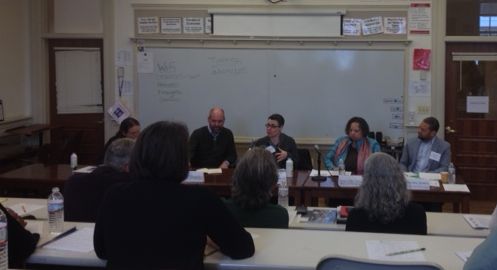
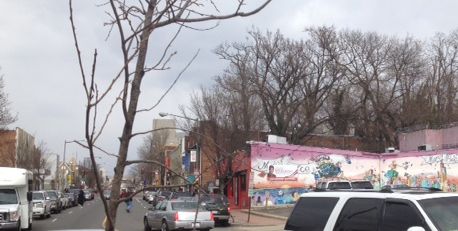
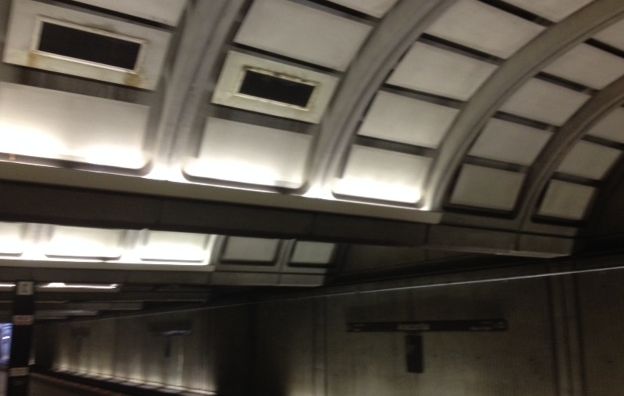
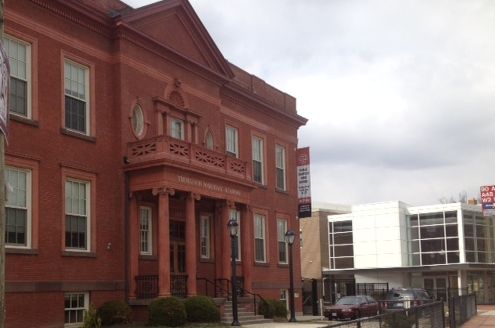
My picture up top shows the Thurgood Marshall Academy, a public charter school, where the conference was held.   It was a old building but very well maintained.   Next is the panel on gentrification.  Below that is MLK Avenue right outside the school and at the bottom is Anacostia Metro.  It is difference from all the other stations I have seen. It does not have the high, vaulted ceilings (although they tried to keep the general look with cross arches) and it barely underground.  Sunlight comes in from upstairs.