This is the first of the out of sequence posts from Frankfurt. I will dump them in, but please look back a few posts when you come on these.
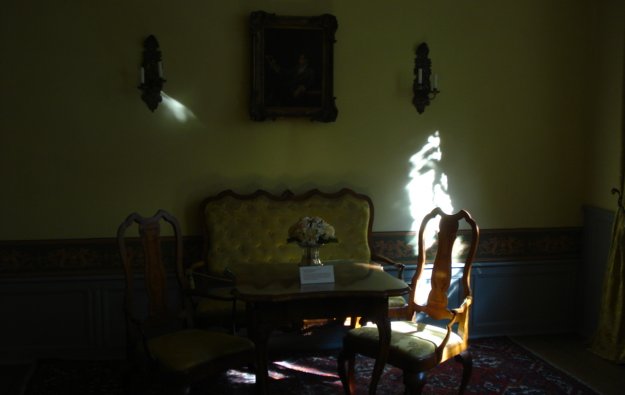
My sister believes in ghosts and she has what she purports to be a picture of one, so when I noticed the interesting – almost three dimensional – play of the light, I had to take a picture. Maybe I can sell it to “National Enquirer.”
The picture above is from Goethe’s house in Frankfurt. A believer in ghosts might well say that this was Goethe’s wife or maybe a serving girl. It seems a little small, but I suppose people were smaller in those days, or maybe you shrink when you turn into a ghost. You can easily imagine it as a woman in 18th century costume in profile. What do you think?
Frankfurt was the first city I visited outside the U.S. That was almost thirty years ago. Time flies. Things have changed in Frankfurt, but not that much. I use Euro instead of Deutsch Marks and the city seems more international than German. There are a lot of immigrants and Irish pubs.
I met three Irishmen in the youth hostel when I was here in 1979. They had checked into a hotel and went out to get drunk. That night, none of them could remember where their hotel was located and they still couldn’t – three days later. It didn’t bother them too much. They seemed to have money. During the day, they walked around the city trying to recognize their erstwhile lodging. At night, they went out and got drunk. Maybe they got stranded permanently and founded one of those Irish pubs.
The Irish wandered Europe and the world in those days looking for work. Germany was booming and they could find unskilled work. Today the Irish economy is one of the most vibrant in the world and the Germans envy their low unemployment rate. Ireland used to have high taxes and a government unfriendly too business. No more. It is now easy to set up shop in Ireland and the country has one of the lowest corporate tax rates in the world; it around 12% compared to the Germans’ (and ours) of around 35%. Some things change.
BTW – I heard that number on the debates today AFTER I wrote this. I guess I am topical.
But a picture is worth a thousand words. Below are some pictures with captions of less than a thousand words to explain them.
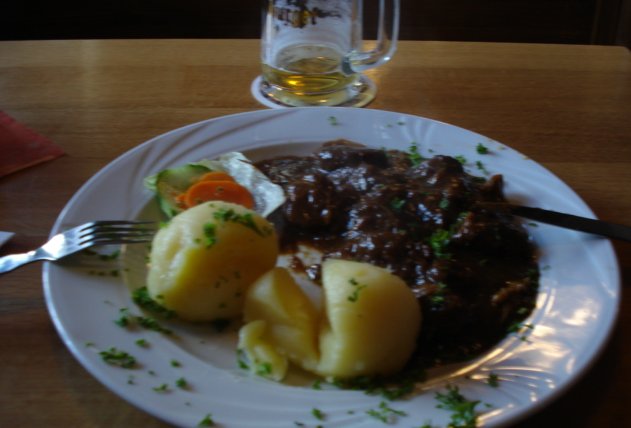
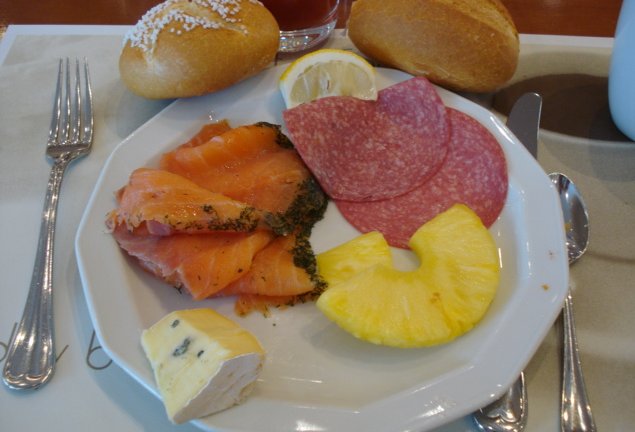
I was hungry most of the time when I visited Germany in 1979. I didn’t bring enough money, so I lost weight. One of my favorite dishes was goulash soup at Weinerwald. IT was cheap. I loved it. Hunger is the best cook and it doesn’t taste as good now as then, but I still eat it when I can, for old time’s sake. Below is what I like to eat now. This is breakfast at Courtyard. Much healthier food, but still enough fat to make it good. BTW – Courtyard Marriotts in Europe are great. They are usually in nice, wooded locations and they are not too expensive.
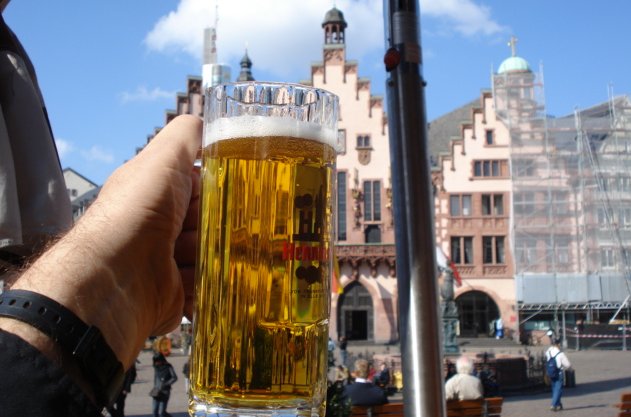
Even with my meager funds in 1979, I still could afford beer – liquid bread, cornflakes in a bottle. My favorite beer was Heniger, a local Frankfurt product. It still is good. The picture is from the old town square. It is great to sit in the sun on a cool day and drink a cool beer.
Es gibt kein schoneres leben
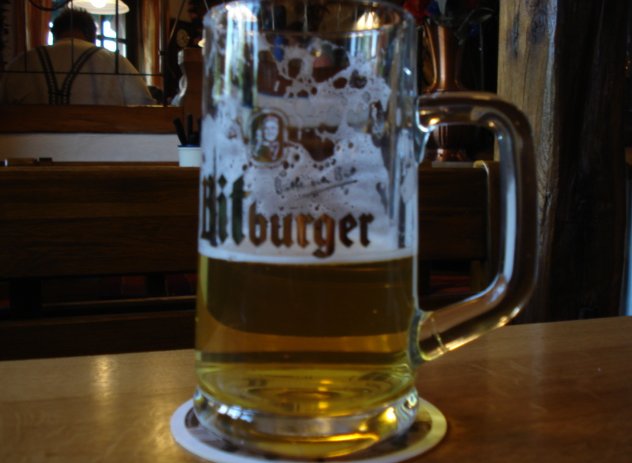
You can tell a good beer by the “cling”. Cling is the foam that adheres to the sides off the glass as you drink it down. It should look foamy, with small bubbles. If there is not much cling, the beer is too light. If the bubbles are too big, it probably means that the cup is a little dirty. Don’t order anything containing mayonnaise at that establishment. Below is good cling. The beer is Bitberger, with the slogan “bitte ein bit” – please a bit(berger). It doesn’t translate so well.
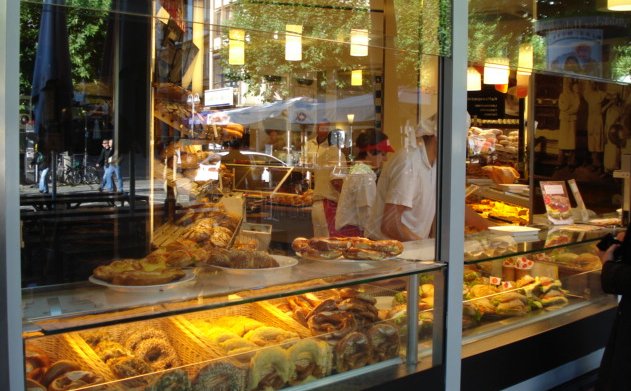
Germany has a good street culture, with lots of sidewalk cafes an food shops. This is typical of the bread and pastry shops. I couldn’t stay in Germany too long. The beer and chocolate would be too tempting.
This post is getting a little long. Let me continue in the next post.
P.S. It may seem like I drink a lot of beer. I don’t …usually. The Marines (and me) drink not a drop of it during deployment. I do like beer and during my time in dry and beer free Al Asad I developed an aching hunger for the liquid bread. As luck would have it, I spent a day in Germany on my way home. I saw my chances and I took ’em.
Im Himmel gibt’s kein Bier, Drum trinken wir es hier. Denn sind wir nicht mehr hier, Dann trinken die andern unser Bier.
CNN ran a report highlighting the failures in Iraq. It is not hard to find troubles and even easier to imagine various things that COULD go wrong. I suppose that is the job of journalists, but that is one reason why people are always anxious. Most of the bad things predicted don’t happen, but by then the journalists are on to the next big potential disaster.
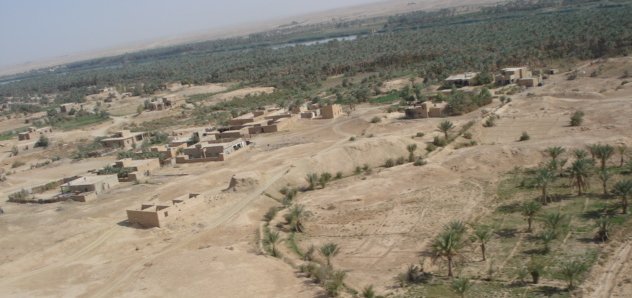
Below is an Iraq village from the air. Same scene as Hamurabi could have seen (if he could fly). Notice the electrical lines are not down. There never were any. Some things take time.
I am getting sick of hearing about electrical shortages in Iraq. Let me give you the ground truth that evidently escapes our intrepid CNN colleagues.
Iraq will NEVER be able to supply electricity 24/7 until it does something fundamental – charge money for it. Journalists never mention – maybe they don’t know or care – that electricity from the government grid is usually essentially free. Even when it is not free, there is rarely a variable price. No surprise then that electrical demand has skyrocketed. Saddam didn’t worry about demand. It was nearly impossible for people to buy new appliances or luxuries. Since the fall of Saddam, the Iraqi people have installed thousands of air conditioners. You see big screen TVs in the markets. People have computers with internet. All these things drain electricity.
The grid supplies a little more electricity than it did before the war and it will supply more soon when we and the Iraqis finish fixing all the maintenance problems Saddam left. It is like buying an old car that is ready to fall apart and then getting blamed for the breakdowns. But in addition to the grid, there has also been an proliferation of small generation. Our ePRT helped pay for some of them. With all these things, Iraq generates more electrical power than ever before. But demand bumps up 12% a year – one of the highest growth rates in the world. Much of that electricity is free and people feel free to waste it.
What do you think would happen in the U.S. if you paid $2 a month and there was no additional charge no matter how much you used? Would anybody turn down their air conditioning or flick off the lights when they left a room? Do you limit yourself to the least expensive items at the all-you-can-eat buffet?
When Iraqis and our intrepid CNN journalists (who I did not see during the entire year I spent in Western Anbar) talk about electricity, they usually mean the free stuff. If you drive through villages at night, you notice that Iraqis have electricity. Some if free or comes at a low flat-rate from the grid, but some of it they pay for – just like you and I do. This is what happens: a town might get six hours of grid electricity. Everybody plugs in everything he owns in anticipation of this happy time. Why not? It is free. When the free electricity is finished and they pay for it people are more careful with the electricity.
It is really the worst possible system. What do you expect when something is provided free for a limited time? Everybody uses as much as they possible can.
You cannot blame the Iraqis. We all would behave like this. If you don’t waste it somebody else will. If any individual saves power, he just gets less.
Only one place I know of – Anah – meters and charges for electricity the way we do in the U.S. and most of the world. Anah has no significant shortages. The leaders of nearby towns dislike Anah. It makes them look bad. It also proves the point.
So next time you hear about electricity shortages in Iraq, keep in mind that this is nearly completely an artificial problem caused by what started off as well-meaning and generous government policy. Well, maybe not that well meaning. Saddam used free electricity to bribe the people, knowing that the lack of electrical appliances would limit demand. No reasonable amount of investment will solve this problem because in its current form the problem is not solvable. It is easy to demand more of something you get free.
The electricity problem is a classic “hot potato”. We made the mistake of defining it as OUR problems and took the blame for a stupid system we inherited from the bad old days. We cannot solve the problem. Nobody can in its current form. We have to toss that hot potato back to those who can address the problem in the ways that will work. And somebody should explain this to CNN. I suspect somebody has tried. Not everybody is teachable. They prefer to look earnestly at the camera and list the failures rather than explain the solution is simple, although not easy.
I read a great article today about why the surge worked. Many of the opinions I read are from those who don’t know. This is different. Please follow the link to the original. It is based on an interview with General Jack Keane. Below is my block quote summary. It is mostly from the article. I put my own comments in italics.
Talking about the first phase of the war, just after the invasion.
Gen. Keane. “It didn’t work. And why didn’t it work? Because the enemy voted and they took advantage. The fact that we did not adjust to what the enemy was doing to us and the Iraqis were not capable of standing by themselves — that was our major failure. . . . It took us all a while to understand the war and [that] we had the wrong strategy to fight it. Where I parted from those leaders [at the Pentagon] is when we knew the facts — and the facts were pretty evident in 2005 and compelling in 2006 — and those facts were simply that we could not protect the population and the levels of violence were just out of control.”
President Bush chooses victory over popular politics.
In late 2006, after the midterm election debacle for Republicans, pressure rose for a quick if dishonorable exit from Iraq. Gen. Keane met Frederick Kagan, who was putting together a report on an alternative strategy for Iraq at the American Enterprise Institute. On Dec. 11, both men found themselves at the White House to push the plan. Congress, the Joint Chiefs, Iraq commander Gen. George Casey and the Iraq Study Group all wanted a fast drawdown. President Bush ignored their advice. Gen. Petraeus was sent out in February to oversee the new, risky and politically unpopular surge.
We did what they said couldn’t be done.
“It’s a stunning turnaround, and I think people will study it for years because it’s unparalleled in counterinsurgency practice,” he says. “All the gains we’ve achieved against al Qaeda, the Sunni insurgency, the Iranians in the south are sustainable” — a slight pause here — “if we’re smart about it and not let them regroup and get back into it.”
This is the part I really think is true:“I have a theory” about the unexpectedly fast turnaround, Gen Keane says. “Whether they be Sunni, Shia or Kurd, anyone who was being touched by that war after four years was fed up with it. And I think once a solution was being provided, once they saw the Americans were truly willing to take risks and die to protect their women and children and their way of life, they decided one, to protect the Americans, and two, to turn in the enemies that were around them who were intimidating and terrorizing them; that gave them the courage to do it.”
This is what I saw in Anbar. This is what I think was important for us. This is why w/o the surge, our friends would be dead and the terrorists would be getting ready to take the war to us someplace else. The U.S. came “within weeks or months” of defeat in Iraq in 2006, he says. The consequences of that were “unacceptable” for the region, “not to speak of an institution that I loved.” And what about the military chiefs who thought the extra battalions and extended service tours would be too much of a strain on American forces? “When people talk about stress and strain on a force, the stress and strain that would come from having to live with a humiliating defeat would be quite staggering.”
I am in Baghdad completing my check-out and getting ready to fly back to America. I don’t expect ever to be in Iraq again. I actually do have some fond memories of the place and I expect that they will improve over time, as the hardships fade and the good times are enhanced. The mind works that way. I made lots of friends in Iraq and I will miss them. Already I am thinking how fast the year went. I remember not thinking that at the time, but that is also the way the mind works.
It is quieter in Baghdad now, or maybe that is just my impression. It may be because whenever I have been here before it has been part of some kind of conference, so there were always other transients around. I have the luxury of a “wet” trailer (i.e. one with a bathroom) but I sort of miss Al Asad. With its Marines and its austerity, Al Asad is like Sparta. Baghdad is more like Babylon.
Frem og tilbake er like langt, but it really does make a difference which way you are going. Last year when I was going into Iraq, I was a little fearful and apprehensive but excited. Now that I am going out, I feel satisfied that my part of the job is done but still vaguely apprehensive.
For almost a year, my life has been ordered by the mission and the interesting conditions of being in Iraq. We worked every day. I often forgot the day of the week. I lived and worked with the same people. We shared a purpose and a duty. All that is finished.
I return to home to an America that has largely forgotten about Iraq. The economy is issue # 1 in the election. I don’t think it should be. The economy is a big deal, but the decisions of the president have limited impact on the economy.
If you look at a long term graph of economic factors, you see the waves are long and the incumbent president makes not much difference. (This chart is ADJUSTED for inflation, BTW, and it is the MEDIAN, so it doesn’t show that just the rich got richer.) An economic upturn began in 1982 and more or less continued until today. The terrible conditions of the 1970s are forgotten and we have not suffered anything like the turbulence of the decade following 1973. The economy went down a little in 1991 and recovered in 1992. GHW was president for both. It grew a lot in the 1990s and turned down in 2000. Bill Clinton was president for both. It recovered in 2002, grew a lot 2003-7 and then turned down last year. GW Bush was president for both. What did the presidents do to cause these things? Not much. They reflected worldwide trends. Presidents don’t manage the economy. They just get credit or blame. And the candidates mislead the American people about what they are going to do; like roosters promising to make the sun rise, if they crow long enough eventually they are right.
What happens in Iraq, on the other hand, depends on presidential decisions to a much greater extent. Foreign & security policy is where presidents have a dominant role. That is how our system works. Maybe it is better that people don’t think so much about Iraq. They usually get it wrong. They either think it is a terrible meat grinder or a place we can just leave at our choosing w/o consequences. Not many appreciate the work and sacrifice that brought us this far and the danger that all could be lost. They even think this result could have just happened by itself. People have their own affairs and I cannot really expect anything else. I will answer the questions of anybody who asks, but try not to impose on the others. It will be a challenge. You can see how hard it will be. I started to talk re being in Baghdad and drifted to this.
Anyway, I have not taken part in any of the luxuries (i.e. beer) available in Baghdad. I figure I will wait a few more days until I clear Iraq. I have a layover day in Frankfurt. I bet I can find some good beer there so I don’t need it here. And back home I can engage in the world’s ultimate luxury – being an American in America.
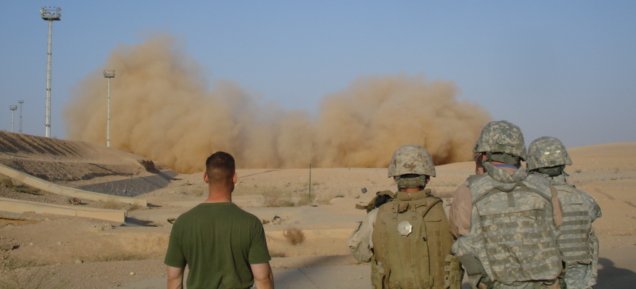
Below is my last Marine Air helo. It is in that cloud of dust.
I am not sure what to do with this blog. I enjoy writing and will probably keep on posting, but it will not be as interesting most of the time. I cannot continue to use the title “Matel in Iraq.” I was thinking of putting a period to the sentence and calling it “Victory in Iraq,” since that is what I believe America has achieved here. It would be a stand alone, historical webpage. One of my colleagues thought that would be a bad idea because it was too strident. He may be right. We have achieved success here, but victory has that WWII feel of having it settled and the war on terror is not settled. Your suggestions are welcomed.
FYI – I will have left Al Asad by the time you read this and will leave Iraq entirely in a few days. I have some free time. I look forward to seeing my family again and just being in Virginia. I want to get up to Milwaukee for a while and Mariza and I will attend the national tree farmer convention in Portland, Oregon. I also need to look at my own trees. We are applying biosolids to 132 acres. That should make my little trees shoot up next year and improve the soil stability.
I start my new job as director of policy issues at International Information Programs in November, after taking the senior executive training course at FSI. I think that will be fun. I have to get my bike fixed so I can do that commute on the bike trail.
has been fun talking to you all for the past year. This is not my last post, or even my last post from Iraq, but it is the end of the era. The posts will just be more prosaic with more about forestry and living in the USA. Of course, I still have to do my big looking back pontification.
Last year I thought I would jump for joy when I got out of Iraq. While I am still very happy to look forward to the good things I mention above, I have come to enjoy my work here and I will miss my colleagues and friends I have made here. I have enjoyed the experience. Whodathunkit?
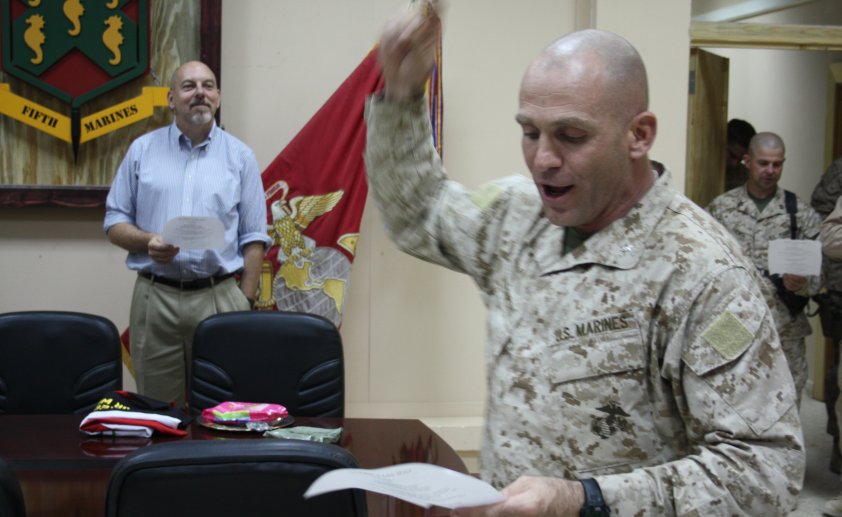
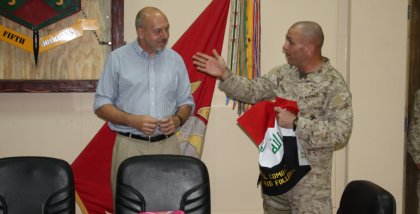
I think that I prefer “drunken” (from the original song) to “fighting”, although I have done neither in Iraq. The Marines sang the song below at my going away. It is based on an old Johnny Cash song. I am flattered that they took the time. The Marines don’t make fun of people they don’t like.
The Ballad of John Matel John Matel… John Matel…
[CHORUS:] Call him fighting John Matel He won’t answer anymore Not the whiskey drinkin’ Ambassador Nor the Diplomat who went to war
Gather round me people there’s a story I would tell About a brave old civil servant you should remember well From the land of beer and bratwurst In old Wisconsin land
Who joined the Department of State to serve his Uncle Sam Now John served in all the world’s hemispheres
The North, South, East, and West It was his hardship tour in Rio That he enjoyed the best
[CHORUS:] Call him fighting John Matel He won’t answer anymore Not the whiskey drinkin’ Ambassador Nor the Diplomat who went to war
John Matel volunteered to serve in harm’s way, In the country of Iraq While his peers looked at him with a sense of awe, As they chose to remain back He served with the Marines of worldwide acclaim In the Western Al Anbar Hinterland Rubbing shoulders with Mayors and Sheikhs In the dust, the dirt, and sand
[CHORUS:] Call him fighting John Matel He won’t answer anymore Not the whiskey drinkin’ Ambassador Nor the Diplomat who went to war
He traversed the battlefield in the air and on the road Airborne in the Osprey, on road by MRAP He was fine with the air-land insert, It was the road movements he thought were crap
[CHORUS:] Call him fighting John Matel He won’t answer anymore Not the whiskey drinkin’ Ambassador Nor the Diplomat who went to war
[CHORUS:] Call him jumping John Matel He won’t answer anymore Not the whiskey drinkin’ Ambassador Nor the Diplomat who went to war
Yeah, call him fighting John Matel And his legacy will go far With the Sheikhs, the Mayors, and common man In the whole of Western Anbar
The Plant manager, who has worked the phosphate plant for thirty-three years and been the general manager since 1997, told us that the Phosphate Plant employs roughly 50-60 permanent workers. A full operating work force would be around 200-250 full time employees. He explained how the plant works.
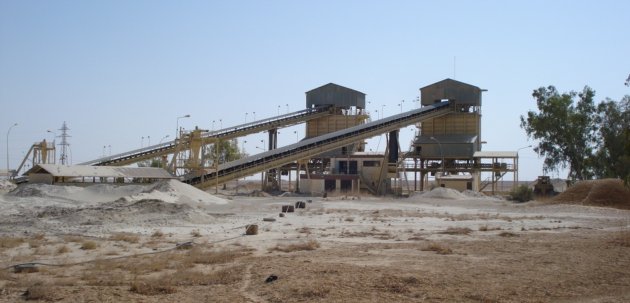
After the phosphate comes from the quarry it is crushed and mixed. The various layers of phosphate have different levels of purity. The Al Qaim phosphate plant requires a purity level of 20%, so the Akashat plant crushes and blends the material to reach that mix. You can see the operation above. This will be loaded onto trains and sent to the Al Qaim Phosphate PlantA short digression: the phosphate quarry and primary processing operation was in business before the phosphate plant in Al Qaim, which got going in 1984. Production there was seriously disrupted by the UN sanctions after 1991 and the 2003 war essentially stopped it from working. It is now operating at around 10%. The plant in Al Qaim is clean and still well kept (which is different from the Akashat operation), but there are serious structural and technology problems. The Phosphate Plant is actually a complex of several facilities. In theory, it produces phosphoric acid, sulfuric acid, ammonia, three types of fertilizer, aluminum fluoride/cryolite, and freon production. The plant is working only at around 10% of capacity and fertilizer is the only product it still makes.
After years of sanctions and neglect, it might make more sense just to build a new “greenfield” factory complex (although around here open fields are khaki.) There is a lot of open space, after all.
Short of War?
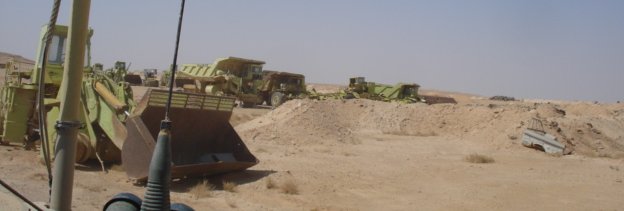
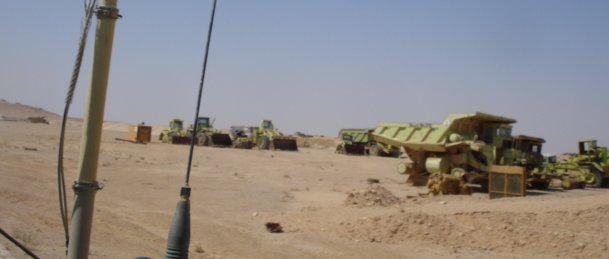
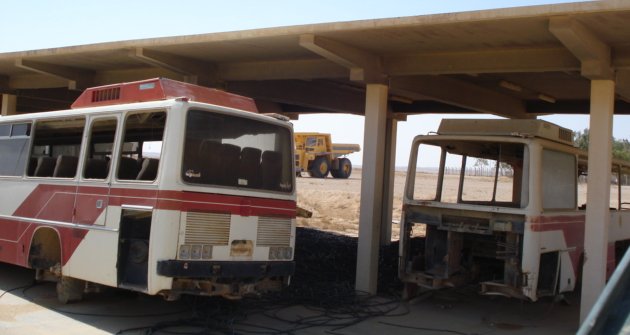
The phosphate quarry was largely undamaged by the Iraq war in 2003, but suffered mightily from UN sanctions in the 1990 until 2003. We drove through ghost parking lots full of buses and heavy equipment. They originally stopped working for want of spare parts. Many of them are now too far gone to repair, even if parts became available. I assume all that scrap must be worth a lot, however.
It does make you wonder about sanctions, however. War is brutal business, but in some cases sanctions can cause similar or worse damage. It might be better in the case of this quarry to start completely over. The old equipment will just get in the way.
In human terms, I have seen how sanctions caused breakdowns in the health and education systems. People certainly died as the result of the UN sanctions, which prevented medicines and machines from getting to hospitals. The environment was harmed as bad practices spread and new techniques were foreclosed. This is Saddam’s fault. There were ways to get food and medicine in Iraq, but Saddam Hussein abused & corrupted the oil for food program and refused to let the sanctions interfere with his political ambitions and he directed most of the money to his palaces. How do you deal nasty and dangerous dictators short of war when sanctions hurt everybody else more than the bad guys? Sometimes peace hurts more than war.
Model Railroad
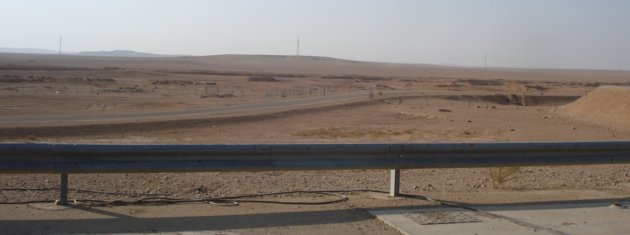
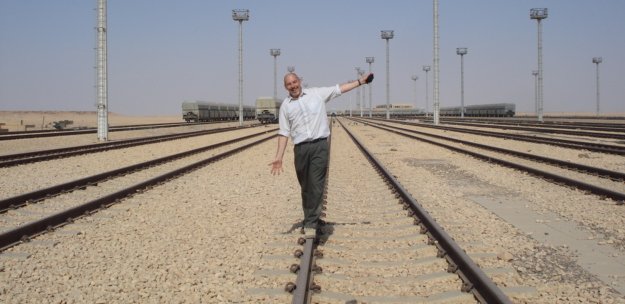
The railroad tracks stretch all the way east to Hadithah where they connect in the south to the Persian Gulf and northward eventually to Europe (remember the Kaiser’s Berlin to Baghdad RR dream). But just west of Akashat they run into the featureless desert and that is the end of them. The station in Akashat is deceptive. It looks like a hub, but a terminus is what it is really. There are plans, actually at this point more like aspirations, to link this line to Syria and Jordan. The director of the phosphate quarry told us that in the early 1980s there were firm plans to connect the rail line with Jordan, but the war with Iran, followed by the war with Kuwait, the war with the UN, UN sanctions and the invasion by CF derailed this project. Saddam’s adventures were not good for business.
The tracks are beautiful. They are well made, well installed and well maintained, or more correctly they require little maintenance out here in the desert w/o significant traffic. Most of the people who ran the railroad are still around. They have the skills to do it again. The sleepers are concrete, each emblazoned with the Iraqi Rail Road logo. The road beds are leveled and supplemented by the right size gravel. You have everything needed to run a railroad, except running trains because there is nothing much to carry.The phosphate quarry sporadically sends a trainload of raw material to Al Qaim. Empty cars return. Even if/when the phosphate and cement operations in Al Qaim are working full out there still won’t be much to carry. The tracks leading nowhere often carry nothing.
Practically, this situation is easily remedied. If these tracks were extended west across Jordan to the Red Sea or the Med, Akashat would be in the middle and this track would carry a prodigious amount of freight. I have heard estimates that containerized cargo going from the Med to Southern Iraq and the Persian Gulf could cut eight days off a trip through the Suez Canal around the Arabian Peninsula, not to mention the simple beginning of a distribution network for the whole of the Middle East. Iraq is shaped like a keystone and it is the geographical keystone of the region. Of course, political would far outweigh engineering challenges in this venture.
As I travel Iraq, I am always bolstered by the energy of people but saddened by the opportunity lost. This country is rich in many ways – water, soil, location, oil – but so much was wasted by dictators and bad choices. We did the right thing in removing Saddam. I am certain of that. I don’t know if the people of Iraq, the region and the world will make the most of the opportunity we have now, but it would be a shame to waste it again.
I was worried that Akashat was a place I would never see. This would have kept me in the company of almost everybody else on earth with the only difference being that I wanted to go. I planned to go to Akashat on a couple of occasions and ran into bad weather. I went to Akashat today. Hallelujah. Life in Iraq is now complete and I have visited everyplace in Western Anbar that I heard was worth visiting.
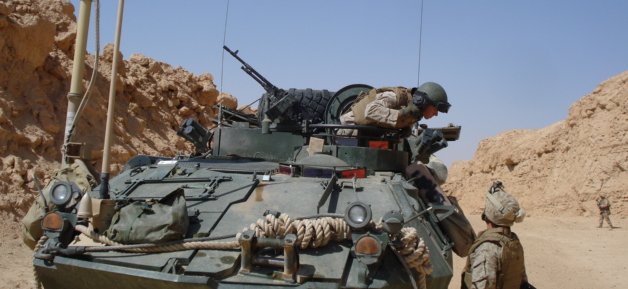
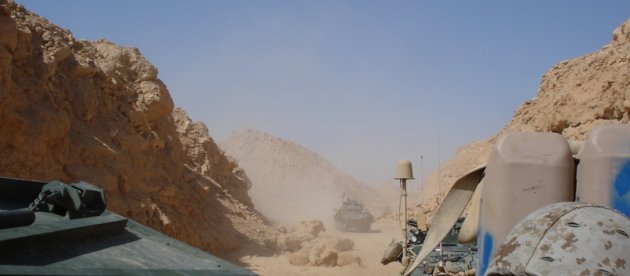
We traveled in the Light Armored Vehicles, shown below. You have to stand and look over the top. They are good for short distances. Notice the boat-like shape. They float … in theory. Of course, there are no rivers or lakes anywhere nearby to test that out.
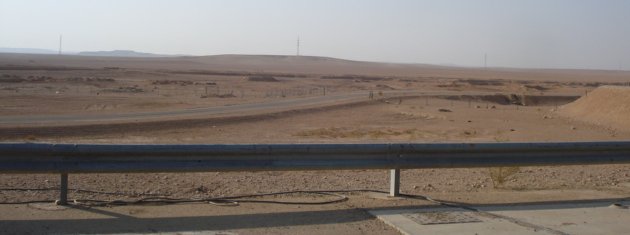
If the world was flat and there was an edge of the world, Akashat would teeter on that edge. I would have to say that Akashat is worth seeing, but may not really be worth going to see. It looked a lot like lots of other places in Iraq built along the railroad tracks. It is nice (in the Iraqi context) but unremarkable.
Akashat is a sub-district of Waleed, which is a sub-district of Rutbah, which is a district of Anbar, which is one of eighteen Iraqi provinces. You get the idea. In true sons of liberty style, however, the citizens of Akashat elected the town councils w/o approval from Baghdad, Ramadi, Al Qaim Rutbah or Waleed. The council is more active than most town councils we have seen, but they are not recognized as legitimate by GoI, since Akashat is a company town – a fully owned subsidiary of the Department of Industry. You have to respect their gumption.
We stopped into the city hall, which is being renovated with CERP funds, and met the City Council Chairman and his colleagues. He is educated as a lawyer. He seems very intelligent and honestly interested in the good of his people. We also talked to a contractor interested in practical money-making enterprises. He is a Kharbouli, which is the biggest local tribe. This extends his power and his reach into city politics and development.According to what we learned, Akashat gets a little shortchanged because it falls between jurisdictions. It was built as an industrial village in 1985, attached to the local phosphate quarry and administered by the Ministry of industry. As an official part of Waleed, Akashat gets its police, security and political direction from Rutbah. Economically, however, it looks to Al Qaim, where it does most of its business and where its parent phosphate plant – the place where all the raw material from the quarry goes – is located. The director general of education from Al Qaim, not Rutbah, funds and supplies the schools in Akashat.
Akashat also benefits from the ambiguity. Local officials admit trying to get something from each jurisdiction. The stakes are potentially higher than who controls the village on the edge of nowhere, since there are reports of massive nature gas deposits under the flat and forbidding local landscape.
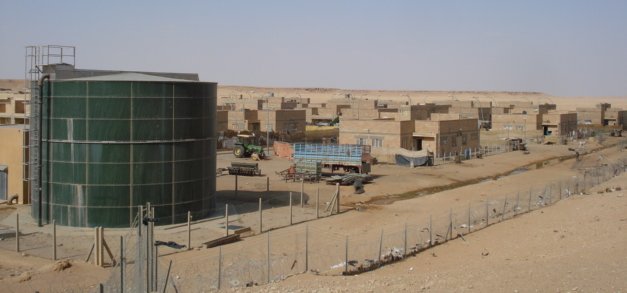
We really don’t have a precise idea how many people live in Akashat. Officially there are around 5000. A short look around the town indicates that is an inflated figure. On the other hand, greater Akashat (there really is such a thing) is supposed to have 12000 residents. I saw a couple of sub villages, such as the garden community of Sikak (below). No matter which figure you use, Akashat is much bigger than its “parent,” Waleed that has a permanent population of only around 500.
Akashat is built on relatively high ground, so the climate is more pleasant (i.e. noticeably cooler) than most of the rest of Iraq. Nevertheless, there is nothing there but the phosphate operation and the railroad. This reason for the city’s existence might not be reason enough for all its citizens.
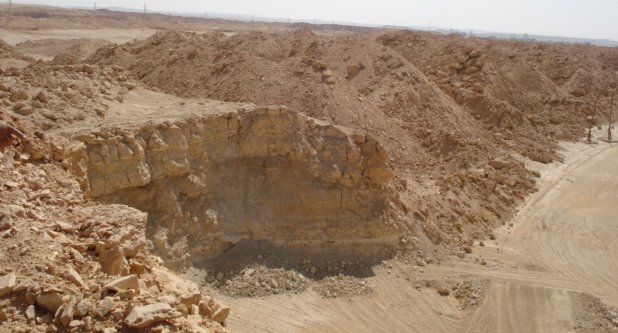
We visited the Akashat phosphate quarry. There are actually two separate quarries, one and five kilometers from the loading plant respectively. We observed no productive activity, but there were fresh vehicle tracks, so some work had been done not long ago.
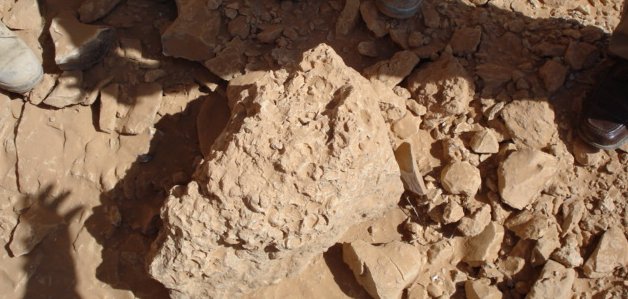
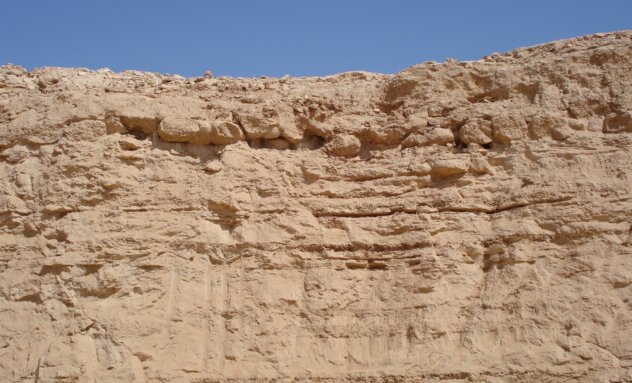
I am not an expert on fossils, but I did notice the Paleozoic brachiopods in the rocks. They looked like the Ordovician fossils I used to collect when I was a kid. I wouldn’t bet on the dating, but there was a big extinction event that wiped out most of the species in the seas at the time, including most types of brachiopods. They call tit the Cambrian-Ordovician extinction event and it took place around 488 million years ago. It was one of five big extinction events. The biggest was the Permian which killed (I just looked it up) 97% of all marine species and 70% of the terrestrial ones. Gee, and there were no humans around to blame.
(BTW – further research indicates that I didn’t have any idea what I was looking at. These deposits are from the Cretaceous period of the Mesozoic Era. I don’t really know.
This is the clearest (believe it or not) I could find.
Events Surrounding the Rutba Uplift in Western Iraq Saad Zair Jassim1
(1) GETECH, Leeds University, Leeds, West Yorkshire, United Kingdom
The Rutba Uplift refers to a broad region covering W Iraq, NE Jordan and NE Syria and represents an Early Triassic inversion of a very pronounced Paleozoic basin in which the full Paleozoic sequence might be present. The shape of the uplift fluctuated between elonagted N-S and NE-SW high throughout the Triassic and Jurassic and ENE-WSW oriented high throughout the Cretaceous. Against the popular belief, the Rutba uplift is neither related to Mardin nor to Hail uplifts in Turkey and Saudi arabia respectively.
A combination of repeated tectonic uplift and eustatic changes in sea level charcterized the uplift from Late Triassic to Cenomanian. Tweleve transgressive-regressive cycles within the above time frame can be distinguished and correlated with basinwise sedimentary cycles.During Campanian-Maastrichtian to M Eocene, the uplift was influenced by N-S and E-W tectonism which was associated with upwelling and phosphorite deposition due to disturbance in the basin resulting from Late Cretaceous obduction along the Zagros suture. The uplift was finally abandoned by the sea from the Late Eocene and remained tilted towards the NE till the present.
Due to low Mesozoic and Tertiary sedimentary cover, only Paleozoic petroleum systems can be expected as proven by drilling in W Iraq, SE Syria and NE Jordan.)
Anyway, this shows how phosphates are deposited. They accumulated in sedimentary rocks at the bottoms of ancient oceans and appear in the rocks in horizontal layers. In this particular quarry the phosphates are located between limestone layers. The limestone is a waste product; they call it overburden. It other types of mining, they call it slag.
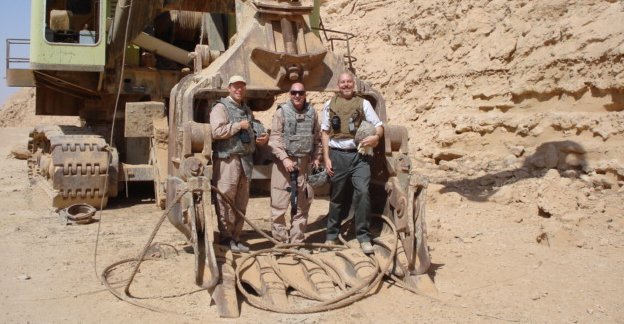
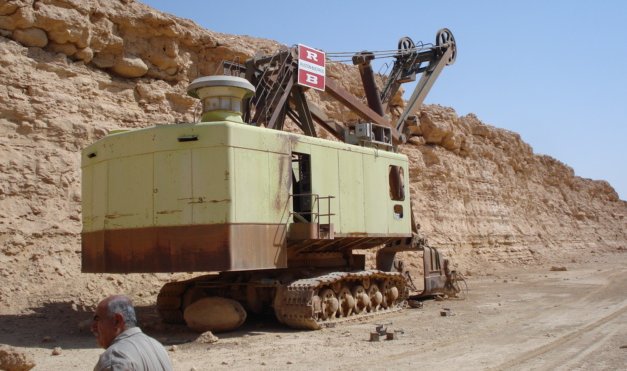
Phosphate crumbles in your hands and you can break it off by hand. When the phosphate plant was working at capacity, it had some big shovels and lots of trucks. They also used explosives to knock down whole cliffs. The big shovels and trucks are not working and they are currently not allowed to use explosives.
Those are some of the reasons why the quarry is producing only 5% of theoretical capacity, which is 3.4 million tons/year. There is a lot of phosphate in the quarry. The director told us that it would produce phosphate for at least fifty years at the theoretical capacity. This quarry, however, has NEVER produced at theoretical capacity. In its best years, in the middle 1980s, it produced 2.4 million tons. Since the 1990s, it has not even come close to that.
Above – The behemoth sits powerless. It has not worked for years and now is just a menace to travel on the road.
This is enough for the time being, since the phosphate plant in Al Qaim is not working at capacity. But there is a great and growing demand for fertilizer. The Akashat quarry has easy to reach deposits. I expect there will be a lot of activity here a short time from now.