
Lifecycle Funds

NPR featured an article about lifecycle funds.  These are mutual fund that are supposed to automatically adjust to your age and time before retirement by balancing your stocks, bonds and other assets.   Conventional wisdom tells us that your portfolio should be “aggressive” when you are younger, so that you can take advantage of the long term growth potential of stocks.   But as you get closer to retirement, you want to get more conservative, since you won’t have a chance to make up a downturn of the kind we recently experienced.    

Stocks will yield better returns in the long run, but in the long run we are all dead, as the famous economist John Maynard Keynes once quipped. Markets are always rational in the long run, but they can remain irrational longer than you can remain solvent.

The lifecycle fund is simple. You just decide which year you expect to retire and then let the fund do the rest.   The theory is good, but the practice has a couple of flaws. For one thing, a lifecycle fund usually has higher management fees because it is actively managed. People don’t work for nothing and if you give the management to somebody else, you pay for it.  If the market is doing really well, you might not care. The big stock gains may not be the rule of the future, so fees will be a bigger part of your thinking. But the biggest flaw of the lifecycle fund is the psychological trap. 

People buy into these funds and then outsource their brains and judgment to somebody else.  When I talk to colleagues who have put their portfolio into lifestyle funds, they seem to have more certainty than I think is warranted. There is the idea that when they retire, they will have the projected amount of money waiting for them.

Prospectuses always warn that future returns might not resemble the past.   We cannot know the future and we can only predict it imperfectly by trying to project patterns from the past into the future. Lifecycle funds do this too.  Most of us like certainty, especially when thinking about retirement.   The problem is that we cannot have it.  At best we can get ranges of results with different probabilities connected to them.

The good thing about the lifecycle funds is that they might keep you in the market during hard times and keep you from doing silly things during boom times. Many investors do exactly the opposite of what they should. They buy risky investments and stocks when these things are going up and the prices are high. When prices decline, they sell.  That means that they buy high and sell low. If you have confidence that the fund is taking care of the risk for you, you may be less tempted to do this.

I do my own lifecycle investments, sort of.  I don’t think you can really time the market.  I meet lots of people who claim that they can, but they don’t seem to have the piles of money earned by smart investing that you would expect if they really could.  

I just rely mostly on index funds.  I used to think I could pick stocks well, but I was mistaken.

It is not a smart idea to have all your money in financial investments (i.e. stocks, bonds). Real estate is a good thing too, and with the recent decline in prices it might even be a good time to buy.  Of course, I have my own unusual investment in forestry.   You could call forestry a subset of real estate, but since it has the agricultural production aspect, it is significantly different.


Rise & Fall of Great Powers

I cannot really recall if Paul Kennedy came in person or if I “met” him on an electronic program, but I do recall having him for a program on his book the Rise & Fall of the Great Powers.  That was back in 1989 and the general idea then was that the U.S. was about to be overtaken by Japan as the great power.   It seems pretty absurd in retrospect. Japan doesn’t have the resources or the demographic strength to challenge the U.S. in the long-term.  Of course now we talk about China and India, maybe even Brazil.

The decline & fall of the United States was a very popular topic back in the 1980s.  Actually, it is always a popular topic.   Different commentators emphasize different things at different times.   Back in the 1970s when I first became aware of the genre, the favorite danger was ecological collapse.  We have come back to that one somewhat today.   Running out of energy is also a perennial favorite.   But the one that encompasses them all is political-economic failure.   That is the one that Kennedy talks about.

I hadn’t thought much about him in the last decade but I was reminded when I saw him on the PBS Newshour. He explained that the timing of his U.S.decline, replaced by Japan hypothesis was a bit off. Japan was the one that went into decline. The Soviet Union unexpectedly collapsed relieving the U.S. of the superpower competition.  American productivity (and so wealth) jumped as communications technologies began to be applied to business. He didn’t add, but I will, that American business went through revolutionary change and reorganization. The economy he was thinking of in the 1970s was not the same one he was living with when he wrote the book in the late 1980s.

It is easy to miss the dynamism of the American economy and academics who look at the “big trends” are often the ones who miss it the most. One reason is that they are trying to impose patterns, often anthropomorphic patterns, on complex systems.   

It is hard not to view societies or civilizations in human terms of birth, growth, maturity, decline and ultimate death. The depressing German historian Oswald Spengler made an explicit science of this with specific stages of growth and decline.  Each civilization had a life span of 1000 years. He thought that civilizations have as much chance of changing or extending this lifespan as you or I do with our physical bodies. Spengler codified what lots of other people thought but he really hit a rich intellectual vein. Lots of people who never heard of Spengler implicitly follow his ideas. Spengler is compelling and very interesting, as well as being completely wrong.

Countries and civilizations do not have life spans analogous to people. The only reason we think they do is because of the extreme power of the pattern that we see in our own lives. It is true that countries and civilizations have some beginning and ending but they can copy from others and they have almost endless capacity for change and renewal. They also morph and combine.

The U.S. has been declining RELATIVE to the rest of the world since the end of World War II.  This should be a cause for celebration, not fear. After World War II, most of the world was either in ruins as a result of war or just poorly developed. They had to catch up and the general growth of wealth has helped us too, as others have begun to pull their own weight and contribute to the general welfare. In some ways, prosperity is natural if you just stop doing stupid things. The biggest success story of recent decades is China. As they shifted from their benighted communist system, their economy developed. While they are now a rival in a way we never thought possible, they are also a source of wealth for us as well as themselves. Imagine if they had continued along the Maoist lines.  Is it better to face a rapidly developing China that is a good, if over clever trading partner; or would we prefer a communist state near Malthusian collapse and destabilizing the entire world?

We feel a little nostalgia for the good old days, but they weren’t really that good.  We are better off NOT being the sole superpower, or being the only game in town. If we imagine the world 50 years hence, we will be wrong in detail, but you can see some trends.

The U.S. will still be the most important country in the world in 2060, but we will have several peers including China, India, the EU and maybe Brazil.  You can imagine some regional groupings, but there is nothing currently in the cards.  China has enjoyed a fantastic growth rate, but it will hit some ecological and demographic speed bumps soon.   The same goes for India.  Russia is the power of the past.  In 2060, it will have a smaller population than it does today unless it changes fundamentally, in which case it might no longer be Russia.  The EU will also have a smaller population, but since it starts with so much economic and social capital it will still be important. 

The country I am most interested in (besides the U.S.) is Brazil. The old joke was that Brazil was the country of the future and always would be, but reforms, good decisions and some luck have brought the future to us now.  The U.S. and Brazil share an important characteristic – they are American in the New World sense.  Both our countries were built by immigrants and have been very open to outside influences, techniques and technologies.   Both Brazil and the U.S. are large, resource rich countries with the demographic weight to be powerful into the future.

But I hope and believe that by 2060 the national power will be less acute in the sense of rivalry and it will matter less which country has the biggest economy or the most powerful military. Paul Kennedy talked about the “Concert of Europe” where the great powers more or less cooperated or at least coexisted.  Of course, there were lots of problems with that specific formulation.  Historians can and have written whole books talking about them and of course, we can do better now with our improved technologies and the benefit of the experience that our ancestors didn’t have. 

Having one single country as the “leader” is not the only way there is.  From the fall of the Roman Empire until the end of World War II, there wasn’t really a predominant power in the Western World.   We can have diverse and dispersed power centers within a globalized network.

Intellectual Property

I finished the first module of the distance learning course on intellectual property rights today and I thought I might put make a short write up of some of the take-aways.  Intellectual property rights give the holders the exclusive rights through things like patents, trademarks, geographical indications, copyright, trade secrets and other undisclosed information.

The idea is to increase sharing of ideas and innovations, while protecting the rights of those who came up with them for specified amounts of time.  Without protections, most people either will not work very hard to come up with new things or they will try to keep their innovations a secret.   This is exactly what happened in times past and still happens in places where intellectual property protections are weak.   

The U.S. was an early leader in the specific protection of intellectual property.   It is written into the first article of our Constitution (Article 1, Section 8, and Clause 8) and it is one of the contributing factors to our nation’s rapid progress in the sciences and practical technologies.   Ben Franklin, a prolific inventor, was at the Constitutional Convention.    He invented (or perfected) bifocals, the lighting rod and the Franklin stove, among other things, but he refused to patent any of them, preferring to share them with all of mankind.  He had already made enough money by then and was devoting himself to public service.  However, he and others clearly saw that most inventors and innovators would not find themselves in Franklin’s happy condition or mindset. The dual need to share and protect is reflected in patent law.   A patent give the holder the exclusive right to structures and methods that result from his idea, but only for a specific time and only on the condition that the inventor publicize the specifications.   Beyond that, the patent protects the physical manifestations, not the idea itself.

Copyright refers to the rights of authors and composers to control their work and it is under a lot of strain these days.    You have always been allowed “fair use”.  That means I can quote or take ideas from an author’s work if it is used as part of a new work and it not just copying the whole thing.   This worked well enough until it became easier to copy with Xerox and got even worse with the easy cut and paste or computers.  Now we have a whole new artistic/literary/musical genre of “mash-up.”  It is hard to tell where one work leaves off and another starts.  Beyond that, some artists don’t like their work to be altered.   The details of this are beyond my expertise (and frankly generally beyond my interest) but it makes a difference to some people.   Some countries give authors & artists the rights to control their work long after it has left their hands.   They often call these “moral rights.”  That was part of the controversy when Ted Turner wanted to colorize the classics.  I can see both sides in this case.  It is more fun to watch a movie in color and many of the kids will not even look at one in black and white.  But the techniques of color are different from those of black and white.   It may become a significantly different work when it is colorized.

Trademarks and trade secrets are a little different.  These things usually are not very profound, although they are the things most familiar to us.   You have the golden arches, Colonel Sanders’ face, or the unique way Coca-Cola is written.  They are meant only as a means to differentiate products.  The most famous trade secret is the formula for Coca-Cola.    As much as l like the stuff, the world would not end if it was disclosed, but it would make it a lot harder to know I was getting something I liked to drink or some knockoff.   A trade secret can be held indefinitely. 

I have a little more trouble with geographical indications. The Europeans tend to be much more interested in those things than we are, maybe because they have a lot more geographical distinctions. Many of the foods that we call by ordinary names are actually geographical indications. Champagne or Bordeaux come from a specific place in France. Products from other places should not be called by those names. The same goes for Bologna, Prosciutto, Colby, Munster, Parmesan, or Romano cheese. Lots of things have names that indicate their original region.  Many have become generic and we hardly think of them anymore. But others have retained the geographical protection. That is why you might find something Parmesan or Champagne modified by style.  A more recently important and even more confusing piece of “intellectual property” is folklore or customs. So far nobody has been able to properly define this, since folklore and customs tend to cross national and regional borders and it is probably impossible to identify the original sources.   I suppose the Greeks could try to get a cut each time someone mentions a Homeric Hero (e.g. Ajax cleanser) or even Homer Simpson. Of course, the original Homer probably lived in what is now Turkey.  Go back more than a couple generations and it all becomes the common heritage of mankind and that is why I don’t think much good will come of this aspect of intellectual property.

I have five more modules on this particular course.  I suppose they will get harder.

Moon Light Drive

I was drove Alex back to Harrisonburg and dreaded making the return trip alone in the dark, but with the full moon providing just the right amount of softly silver light and a good audio program to listen to (I am finishing Donald Kagan’s Greek history series) , it was actually very pleasant.

Alex is doing well at college, but it is a tough transition for him. He started in the spring semester, as a junior and got stuck in the dorm farthest away from campus.  It is an overflow dorm.  It used to be a hotel and is not actually on the JMU campus at all.    These types of things make a big difference and he just had bad luck with all of them.   He is doing well in classes, however, and I think he will adapt all right.  I think what he really misses is his job at Home Depot.   That gave him contact with people and something useful to work on.   They really seemed to like him there.  I hope he can get the job back for the summer.  

The picture up top shows Alex at Cracker Barrel, where we stopped in Woodstock along I-81. They sell good old fashioned food. I had a good pot roast with mushrooms.  Alex had sirloin steak. It feels like home.  They had a wood fire burning in the fireplace.  It is a nice smell. They sell that old fashioned candy shown in the middle picture. 

At the bottom is the sushi shop at Tysons.  It is not related to the other pictures or text.  The conveyor is in constant motion.  I don’t know how they can tell who takes what and how much they should pay.  It reminds me of those old cartoons portraying modern times.

From Where You Sit

A person’s outlook often changes more based on the perceived future than on the present reality.   That has certainly been true for me ever since I found out about my assignment in Brazil and I think this is very good.   I have been much more aware of the consequences of our Washington actions and products on our posts overseas and on our ultimate audiences there.   It is very easy to get cosseted into the Washington mind-set.   But so much of what we do here never really gets out.   We meet with each other and discuss our own urgent issues.  We sometimes provide wonderful products and services that nobody can use. 

It is very easy to be sure you know how to do something when you know you won’t really have to do it. I was aware from my past experience in overseas public diplomacy.   But my future as a public affairs officer – where I will have to USE the kinds of things we talk about here in Washington – has focused my mind on the more pragmatic aspects.    

I don’t have much confidence in the “new media” as a disembodied force.   It has to be tied to programs, people, goals and content.  But it is so easy to seek the immediate gratification of reaching large numbers of people.   It is similar to video games in that way & it is no coincidence that gaming is one of the driving forces behind new media.   The games give you immediate feedback and seem to show immediate results.  But this can be true whether or not you are making legitimate progress.   You can easily have the experience of achieving an online goal and then wondering why you spent all that time to get there.    There is a good South Park episode on World of Warcraft.  Watch it to the end. 

The combination is the key. A live speaker program, along with Co.Nx, along with Facebook or other social media, announced on twitter, with a blog about the speaker’s journey, and followed by the posting of online materials, that would work. I would also add that we would need to prepare the ground by making contacts in advance and reinforce the results by keeping up and following up later. 

Public Diplomacy is not rocket science, but it does require a diligence and a holistic approach that is continued over time and adjusted to local realities and changing conditions.  This is simple to say, but really hard to implement.    It is much easier to shortcut with social media, claim you have reached thousands and have some kind of automated response follow-up.    The short term results look great, it probably looks better in the immediate term than the holistic approach which takes time to bear fruit.   That is the seductiveness of these kinds of short cuts.

Our system encourages the short term by demanding prompt reports.   We generally write up the report of an event the next day.   What information do we have at that time?  We can count numbers of participants and the reach of the immediate placement, but we have no idea whatsoever if anybody actually thought about the program or if it opened some minds.   And our reports never follow up because the next urgent report pushed all thoughtfulness aside.    And assessing public diplomacy requires thoughtfulness.   Much of what we accomplish is indirect.  A person not at the event might have heard from a friend and that provoked an important idea.  

And time is the major factor.  It takes time for an idea to develop and mature.   I wrote about how I was influenced by a public diplomacy contact twenty-five years ago.  No measuring system would ever catch that, yet it was lasting and profound.

I know that it is a tough balance especially because in the present, you live off the work others did before you.  In the future others will benefit from what you created.

Understanding Radicals

If we want to understand radicals and counter their influence, we have to get beyond pedantic debates about words. That is one of the ideas I took away from a discussion with Ghaffar Hussein, a representative of the Quilliam Foundation, a UK think tank that studies radicalization and how to prevent it.

Not getting bogged down in terms is the first step in making progress. It is good to have common understandings of terms, but some terms are too loaded for a common agreement. Radical is one such word. And it is worse than mere misunderstanding. Some people use linguistics as an offensive weapon to prevent real discussion. Mr. Hussein says that when he gets into these kinds of word-bogs, he just describes the behaviors and tells the person to call it whatever he wants. This pragmatic approach to distinctions reminded of the William James anecdote about the squirrel.

So readers can feel free to substitute what terms they want. I am going to use the words Mr. Hussein did to describe the concepts. BTW – I am using his talk as a starting off point and the basic ideas are his. However, I am riffing off them, not reporting, so I will take the position that the good ideas are probably his and the bad ones are more likely my extrapolations. I gave Mr. Hussein the URL for the blog and I hope that he writes in if I say anything too egregiously out there. Islamism describes an ideology, not a faith, because the ties with traditional Islam are sometimes tenuous and superficial. Islamism wears the clothes of Islam, but its operative ideology is borrowed eclectically from European totalitarian “revolutionary socialism” philosophies of Marxism and fascism. (Baathists, of which Saddam Hussein was the most famous, freely and openly borrowed from both Hitler and Stalin.) These kinds of ideas appeal to committed radicals, who embrace violence as a tactic and are small in number but seek to use masses of people instrumentally to totally change societies. Lenin and Hitler provided roadmaps that they can use.

Like the earlier European models, they tap into a sense of grievance. Of course, grievance alone is not revolutionary. Everybody has grievances and some peoples have been horribly oppressed for centuries w/o doing much of anything about it. You need a grievance as a push, but ideology is the pull. Hitler used the real grievances in postwar Germany and combined them with bogus ones about Jews and others, but w/o some unifying ideology to make it operational, you would just have had a lot of people grumbling and/or they might have worked through their problems and come out at a better place. A radical ideology is truly the serpent in the garden. They don’t want problems solved or mitigated because the grievances are the ostensible justifications that animate their movements. We talked a little about the profile of a radical. Although Marc Sageman wrote a good book profiling some of terrorists called Understanding Terror Networks, there isn’t one profile that fits them all.  And we should make the distinction between the activists and what we might call the foot soldiers. Most of those involved with radical organizations probably have not made a reasoned choice. In places like Pakistan or Afghanistan, many do to make a little money or they just drifted into it for circumstantial reasons. There are some correlations among activists, however, and perhaps some keys to motivation could be found there.

Sageman pointed out that most of the terrorists were not from the poorer parts of society. In fact, many were very well off. They also generally had not grown up in particularly religious households; they were not especially well-versed in the details of theology and many were not living very pious lifestyles. He suggested that some may even have got into being radicals as a result of a type of cognitive dissonance, since they are living a fairly non-pious lifestyle and they may see their radical behavior s a way of atoning. Many radical activists are well-educated in the secular way and most have hard science or engineering background. You can speculate as to why this would be true. Foreign students studying in Western universities often study science and engineering. It might just be that they are a subset of that. But it could also be that science tends to have specific rules, which appeals to someone who sees the world in yes/no form. They may think that this sort of thinking should also apply to human events, society and politics. One question that has interested observers for years is why members of U.S. Muslim community seem so much less subject to radicalization than those in Europe. Some recent events might call this premise into question, but we can still address some of the differing factors.

One reason is the type of immigrant is very different. U.S. Muslim immigrants have tended to be professional and educated and enjoy a higher median household income than the average non-Muslim American. The Muslim community in America also contains a large number of Iranians who fled the Ayatollahs. They are less inclined to view radicalism with much enthusiasm given their intimate experience with it. In contrast, immigrants to Europe tended to be lower skill and lower income workers. When the first waves came in the 1960s, many intended to return home and did not integrate into the local societies. This group was leavened by more radical elements, who couldn’t safely practice their brand of Islam in their native countries. It created a volatile mix. There is also the different nature of the host societies. The United States and Canada are countries of immigration. Immigrants can fairly easily adopt an American identity and find a place in the American mosaic. European countries were and still are to some extent more nation/ethic-states. Nobody has any trouble assuming a person can become American by choice and most Americans trace their own ancestry to an immigrant who did just that. It is harder to think of someone just choosing to become German, Italian or Danish, since there are lots of other things that go along with that designation. Mr. Hussein thinks that is changing, but it still hasn’t changed. Although he was born in the UK, he is still often considered an “immigrant” in Europe.

Another factor is the sheer size of the U.S. and Canada. Immigrants spread out over North America, while in more constrained European countries they tend to pool into homogenous communities. There is also a generational phenomenon. The risky time is the second generation. The immigrant generation knows what their native country is like. While they might not be perfectly at home in their new country, they don’t harbor as many illusions about what they exchanged for what they left behind. The second generation has to search for identity in more ways. They may feel that they are in, but not of, their new home country but they also don’t have much experience with the old one. They may seek to find or create “roots” and so may be susceptible to radical ideas purporting to do that for them. This may be exacerbated by parents, especially fathers, who really don’t address their concerns.

While I have no close experience of this with Muslim immigrants, I remember the phenomenon with European immigrant fathers in Wisconsin and some of their kids around my age. I bet the general conversation is similar. “What are you complaining about? You’ve got it easy. When I was growing up back in ____ we …” The difference was there was no radical ideology to appeal my Polish/Irish/Italian playmates back in the 1960s. As we discussed above, everybody has grievances, but without the ideology to pull them along, nothing may come of them but grumbling. We didn’t really talk about the “so what do we do?” question.  Read about this on the Quilliam Foundation webpage. I am not an expert on these things and never will be, but I found this a very interesting talk and thought I would write it down to share with others.

Various Things Around Washington

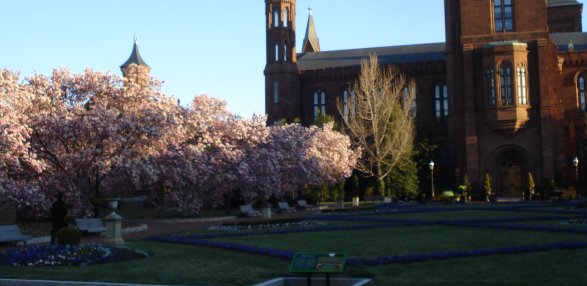
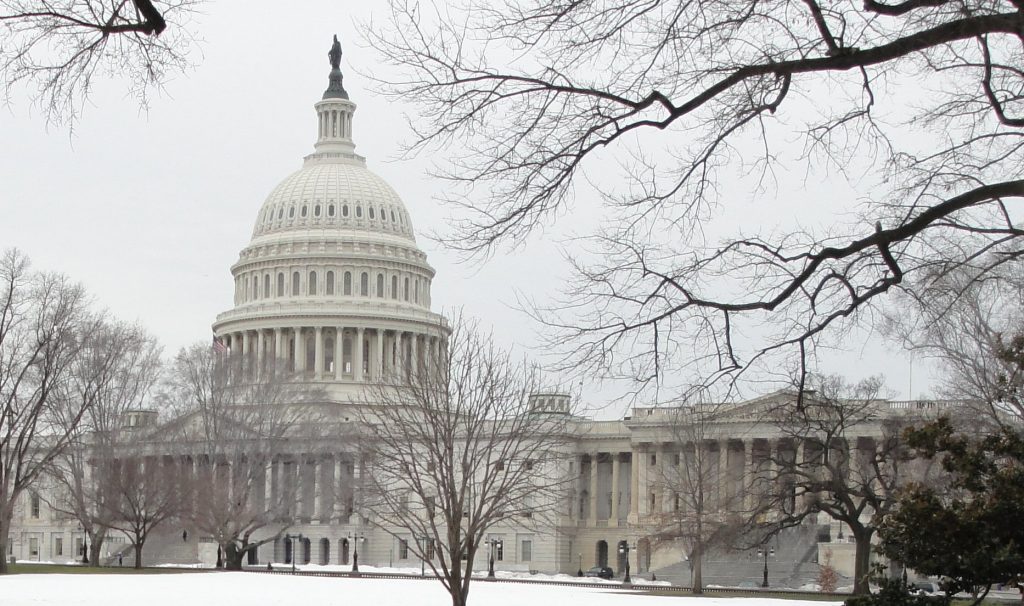
The snow is melting, but more is expected tomorrow to replace it.  It is hard to believe that within a month the flowers will be blooming.   The picture above is from March 23 of last year – a month from now.   I will appreciate spring more after this especially snowy and cold winter.

Above is a protest on 22nd St. outside the State Department. I think they are Eritreans. I was in a bit of a hurry so I just took the picture and kept on walking, so I don’t really know what was bothering them. About a hundred showed up to chant for passersby and a good time was had by all except the taxi drivers who were annoyed that the street was blocked.

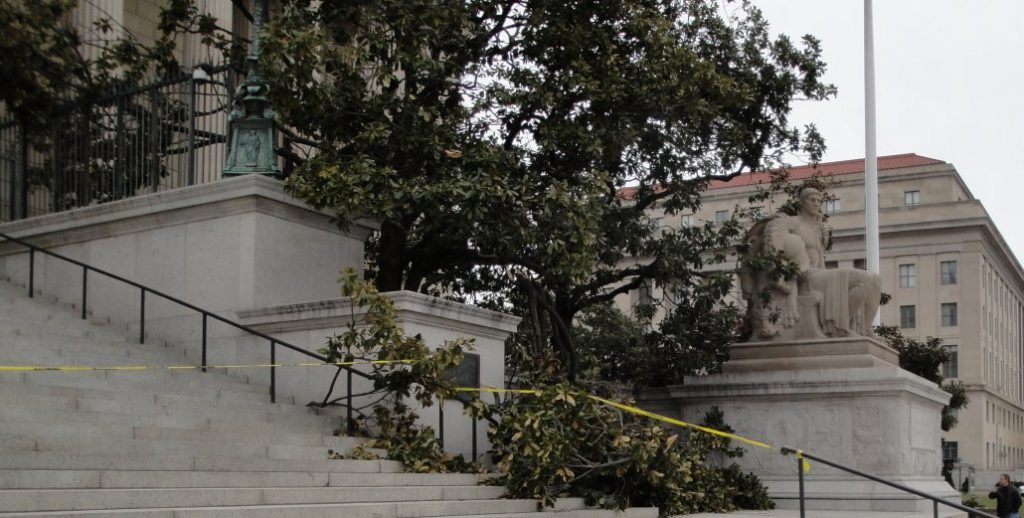
Above are broken magnolia trees outside the Archives. The snow is hard on these sorts of southern trees and there are lots of broken branches & trees around here.  The snow weighs heavy on their leathery evergreen leaves. You can see why trees from colder climates would adapt strategies other than holding onto their broad leaves all winter.

Becoming a Good American

Most private and all public universities were founded in part to help educate good citizens. They really aren’t doing a great job of it, if you assess what students learn about America’s government, business, institutions and society. Take this simple test. The questions are based on our citizenship exam. Lucky for most Americans that we were born here, because 71% of us probably couldn’t pass the test to become citizens.

College graduates do better than the general population (49% to 57%) but adjusting for demographic characteristics (income, age, region etc) college students get only 3.8% better over their four-year tenure & some big name universities managed to produce “negative knowledge.” Seniors at Cornell scored 4.95% lower than freshmen. Yale, Duke, Princeton, Rutgers & Berkeley also went negative. Harvard seniors scored best at 69.56%. Maybe it will stoke Yale-Harvard rivalries. Yale freshmen beat Harvard freshmen (68.94 to 63.59%), but after Yale’s loss and Harvard’s gain, Harvard won in the end.

Read the rest of the report here. You can see the discussion of the reports at this link

Of course, there is some debate as to how much civic knowledge a citizen really needs. Our democracy relies on the wisdom of crowds. Each person has some bits of knowledge, which are presumably aggregated to produce a good result. It is not necessary for everybody to know what the Scopes trial was about, be able to name the three parts of the Federal government or even be able to name the countries who were our enemies in World War II, as long as some people know important things and we are generally wise enough to know when when know and when we don’t. The problem that I see is that sometimes the ignorant also have very high self-esteem. Recalling the lines from Yeats, “The best lack all conviction, while the worse are full of passionate intensity.” Modern education may feed this.

There is an old saying that you are entitled to your own opinion but not your own facts. Not everybody believes that anymore. Some people think it is important to teach critical thinking and not pay much attention to the facts. But if you don’t have any facts, what are you thinking critically about?

IMO the more you know about American history and institutions, the more you appreciate them. Thomas Jefferson believed that an educated citizenry was crucial to the working of democracy, which is why he founded the University of Virginia. Building good citizens was one of the founding justifications for the public school system.

I got one wrong on the test and I will advance the lame excuse that I wasn’t paying attention. But when I thought about the questions, a lot of what I learned I didn’t learn directly in school. Education doesn’t/shouldn’t stop when you graduate from college and college isn’t/shouldn’t be the only place you get education, especially civic education. I think we need to emphasize our heritage, for everybody in our lives every day, lest it slip away. Knowledge lives only in living people, not locked in books we never read. And the person who doesn’t read is really no better off than the person who can’t.

It is not all locked in the written word, however. One of the places I learned some of these facts is from television – yes television. Much of television is indeed crap, but there is a lot of good too. There is a very good PBS series called The American Experience. The episodes about FDR were on last week. He was an amazing man with an amazing education. He came from what is as close to an American ruling class as we can get, but it is true that we Americans don’t have a ruling class. They are us. We are our own “rulers” and so we have to train a new set of them each generation. We produced truly great generations of leadership. Let’s hope that we are not just living off and using up the capital that they created for us and let’s work to make sure that is not the case.

Maybe we should take citizenship a little more seriously.

Tysons Corner

Chrissy & I went to the movies at the AMC at Tysons Corner today.   We saw “From Paris with Love” with John Travolta. It was one of those action thrillers where you have to suspend belief in human behaviors and the normal rules of physics. It was worth going but not real good.   I wouldn’t recommend it if you have other things to do. There were just not good options, even with multiple cinemas. I wanted to see that Jeff Bridges movie, “Crazy Heart” but it wasn’t showing.

Cinema tickets are getting expensive.  It was $18 for two.  I am still a cheapskate and I remember when they were a lot cheaper, but the “theater experience” is worth it once in a while.  We got popcorn and soda too. Everything is big.

We rarely go to the Mall anymore. When the kids were little, we were more frequent customers.  It was a form of entertainment as well as shopping. We bought a lot of useless crap. Malls are better avoided when possible. You are tempted to buy stuff you can’t really use and food you don’t want. 

Today I had real trouble resisting Cinnabon. They have a fan that wafts the scent out into the Mall.   The funny thing is that I don’t like Cinnabon that much. They are too sticky and not worth the trouble of eating them. Nevertheless, the scent is enticing and difficult to resist.

Tysons is the biggest city in Virginia.  It is really a massive complex of malls and offices.   They are building the Metro out to Tysons, which is a little ironic but also positive.  Tysons was the ultimate car center, but that is becoming unsustainable.