Putting the Forest Back Together Again

It is obvious that a 100 acre forest ecosystem separated into ten parcels is not the same as one that is fully intact. Even a lightly traveled road cutting through forests may be hard for wildlife to cross. Watch a turtle or a salamander cross a road.  Roads divide and can destroy local reptile and amphibian populations as well as change drainage patterns, accelerating runoff and worsening erosion. Small forests also mean practical management and harvest problems. Maybe it is just worth it to deploy a crew or expensive equipment to harvest a few scattered trees.   Unfortunately, dividing forests into smaller and smaller units – forest fragmentation – is a continuing problem in Virginia and throughout America.  With populations continuing to expand and development continuing to spread out, the situation will only get worse, so we in the forestry community better come up with ways to adapt and maybe even benefit from the trend.

That is why I was interested to hear that Jenifer Gagnon, from Virginia Tech, was developing a program to help real estate agents in Virginia take forestry into account when showing and selling properties to customers who may not have any experience with forestry and who may not ever have even thought about it. The program will give Realtors, land brokers, closing agents and others who deal with rural and large-lot sales continuing education opportunities explaining how important well-managed, healthy forests are to Virginia.  It will also include information that helps make a sale, providing sources of cost-share assistance, identifying yard trees, and giving real estate professionals what they need to talk about site quality and productivity  Whether they are talking about 100 acres ten, good forest management makes a difference as do the benefits of forest certification programs such as the American Tree Farm System (ATFS) that help connect individual owners to those who can help manage the forests as well as add the value of certification to any timber harvested from the property.  

Real estate professionals will also get New Landowner Packets to give their clients (for free).  These packets have  information about forests in Virginia, describing the services provided by state and federal natural resources agencies and contact information, include information on Tree Farm and the American Forest Foundation, Virginia Forests magazine, and DOF tree ID book.   In other words, all they need to get started on good forestry management. 

This will not stop forest fragmentation, but it may bring many more landowners into the system of sound and responsible forestry.   And when people become aware of the resource and its value, they are better stewards of the land.  They may also team up with neighbors to jointly manage, or at least understand the plans of others, which might mitigate the negative effects of fragmentation.
 
Working with this new type of owner will mean that it is not forestry practiced as usual or as it can be in more isolated rural areas.  Forest fragmentation and the likely relatively dense human presence around and within forest parcels will make it more difficult to harvest, spray burn or do many of the things good forestry practices would recommend.   On the other hand, having many more landowners involved with and supporting forestry is great.  The new forest owners, at least at first, will be on but not of the land, i.e. they will not have the long experience and history with the places they live.  But their voices will be increasingly important in protecting and prospering forestry in general.  As development creeps farther and farther into the forest, we better hope and work toward the goal that the people, the voters, who come into these new developments understand that trees can be harvested sustainable and that each cutting or thinning does not mean the end of the forest, but rather just another step in its continuing healthy development.
 
Many people want to live on a working and living landscape; they want to be part of it, not mere separate sojourners.  Our modern world makes this harder and harder to do.  It is harder to make the connection with the living land if you see trees only as decorations outside your windows.  Programs that integrate humans into their surroundings, giving them some feeling of having a stake in the future, are a winning formula all around.  Having hundreds of acres under good forestry management is an excellent and tested way to grow timber sustainably while protecting the water, soil and wildlife that lives on the land.  We know how to do that.  But we will increasingly have to also know how to integrate people into this system.  We prefer not to have our forest land fragmented and we should do our best to protect larger tracts whenever we can.   But when we can’t, we need to manage the smaller parts right.
 
All the time I was writing this posting, I kept on thinking of the old Humpty-Dumpty story. You know the one – “Humpty-Dumpty sat on a wall; Humpty Dumpty had a great fall; all the kings horses and all the kings men, couldn’t put Humpty together again.”  But I don’t think that is true of forests. Forests are living and adaptive systems. We can adapt too if we just figure out how.
I was at FSI last week taking the seminar in new trends in public diplomacy.  I didn’t get that many new insights, but it is clear that some of the infatuation with the new media is wearing off, or maybe just becoming more routine.   The new media is an essential tool, but we all recognize that it is not the panacea that it seemed to be.   Most importantly, you still need something interesting to say.

It was a tough few days, since I took the seminar during the day but still had to do my promotion panel assessments.  I could work from home via computer (another great thing re technology) but it was like having two almost full time jobs.  But it was worth the time to get involved.  You never know how much you learn because very often once you hear something related to what you know you think you just knew it already.

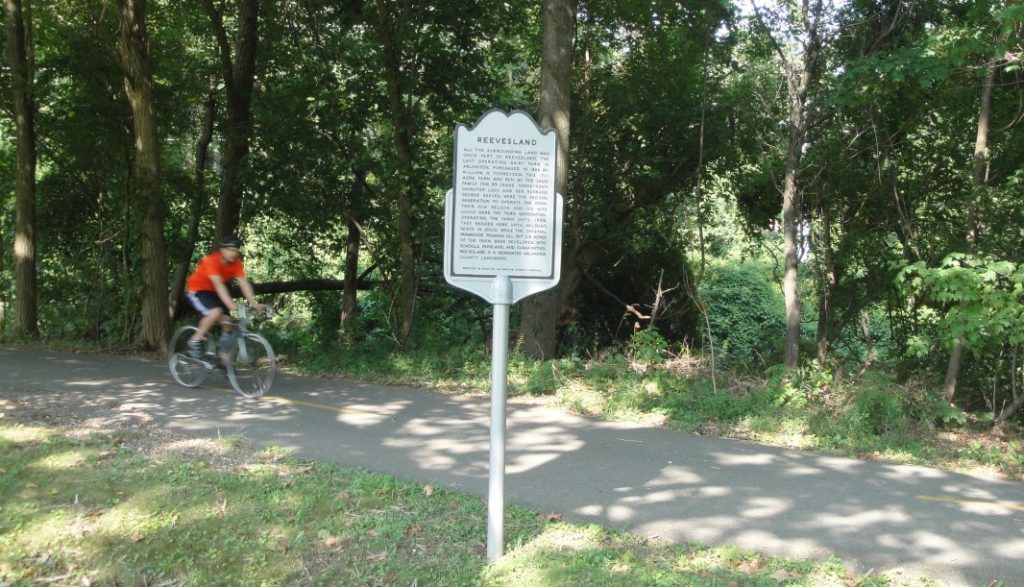
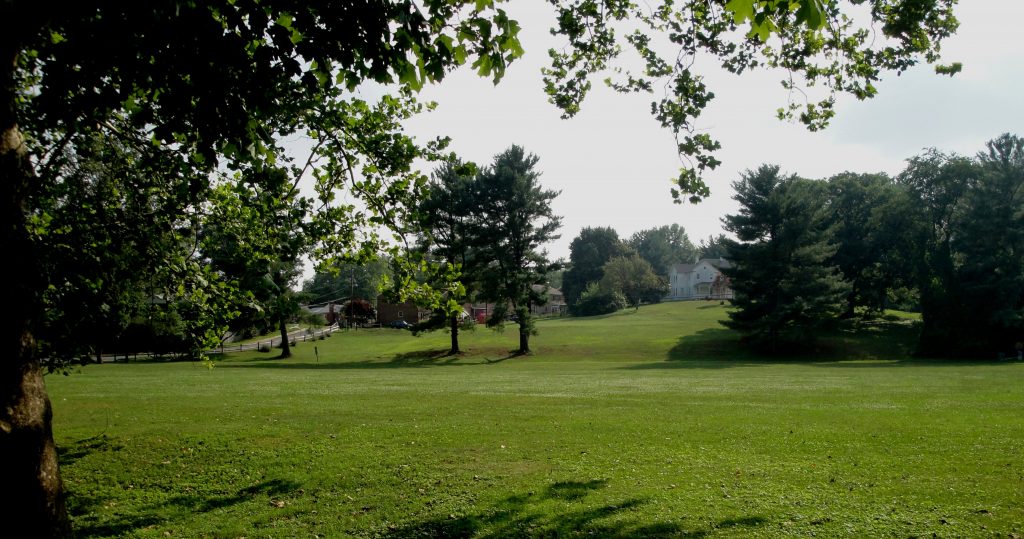
I keep going longer on the bike trail when I ride my bike to FSI and this time I took the more round about way that I used to use before the built a kind of bike bypass.   They put up a new sign explaining that this particular part of the park had been a dairy farm until 1955.  It was the last working dairy farm in Arlington.  Some of the local homeowners have a sweet deal.  They live right up against the park, which gives them a really big backyard that they don’t have to mow or pay for.  I suppose the downside is you cannot kick people out.

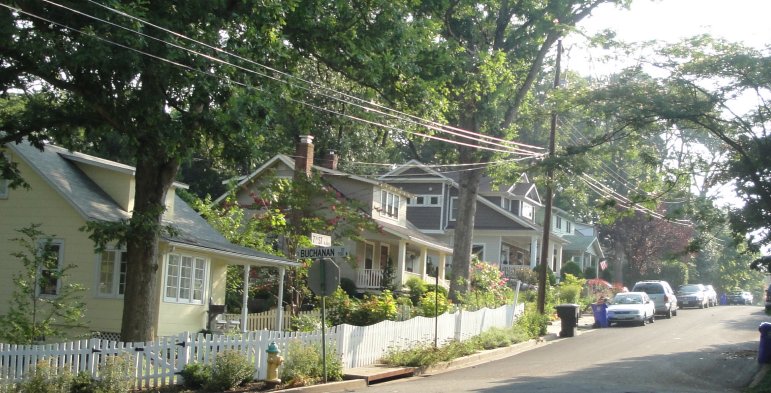
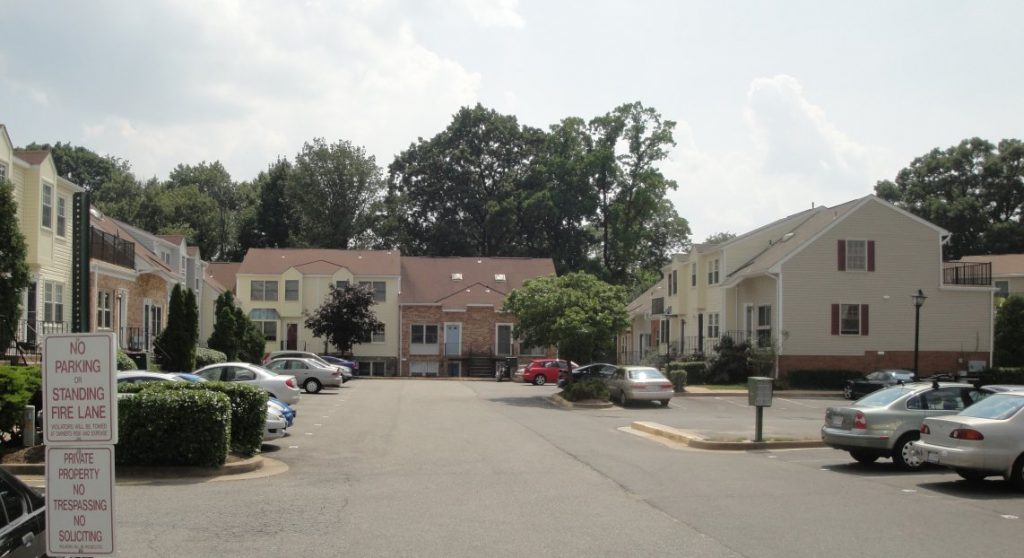
Arlington is a pleasant area.   Above is one of the streets on the way to FSI. Below is the place where Chrissy & I lived when I first came into the FS. We lived in the downstairs apartment, one bedroom. We thought it was really luxurious, but it really wasn’t.  The back is up against a park trail, so it was very nice.

Trust is the Key

I read Amity Shlaes’ book “the Forgotten Man” a couple of years when it first came out, just before the big economic downturn.  Her timing was excellent in the light of subsequent events and the insights for the Great Depression have been helping me understand the events of the great recession.
 
History doesn’t repeat itself, but it does rhyme, as Mark Twain quipped, and some of the arguments of the 1930s seem very contemporary indeed.   One of the themes most pervasive in Shlaes’ book was the importance of confidence, consistency and trust. These things are the true basis of a prosperous economy, but they are impossible to measure accurately and so are often overlooked or downplayed.

Why are you willing to exchange your real labor or goods for a piece of paper with the picture of a dead president?  It is backed by nothing but trust.  I lived in Brazil during a time of hyperinflation. People didn’t trust that their money would hold its value or their government not to be capricious (and they were right) so to protect themselves they had had to devise all sorts of tricks and techniques that were often wasteful and destructive to the system as a whole. And once trust breaks down in something as important as money itself, it spreads to other areas, creating a general state of uncertainly and feelings of helplessness.
 
One of the most important functions of government is to create as much certainty and predictability in society so that people can plan for the future and feel secure in their transactions with each other.   When fails in its duty to maintain stability or, worse, when government itself comes to be viewed as unpredictable, arbitrary or capricious, the bonds of society begin to erode.
 
Some actually welcome this.  Disorder reduces the aggregate level of wealth but often has the effect or redistributing income, or at least distributing pain since people who cannot properly plan cannot do better than those who just wouldn’t. Making opportunity generally less available tends to equalize outcomes by negating the cumulative value of hard work, talent and foresight.
 
What the FDR administration did to harm economic recovery was to create uncertainty, according to Shlaes. She gives many examples.  The one I like best is the Schechter chicken case.  Part of the New Deal legislation, regulated poultry prices, making it illegal to offer discounts or allow customers to choose their own chickens. The Schechter brothers, a couple of kosher butchers, were accused of doing these things and of “destructive price cutting.” They were found guilty, given a fine of $7424 (big money in those days) and tossed in jail for a couple months. When the full weight of Federal power can come down on kosher butchers for selling a chicken and they can get jail time for doing business as they always have, you have significant uncertainty.
 
The relevant New Deal Federal laws were declared unconstitutional when the case reached the Supreme Court.  Justice Louis Brandeis took aside one of Roosevelt’s aides and told him, “This is the end of this business of centralization, and I want you to go back and tell the president that we’re not going to let this government centralize everything.”
 
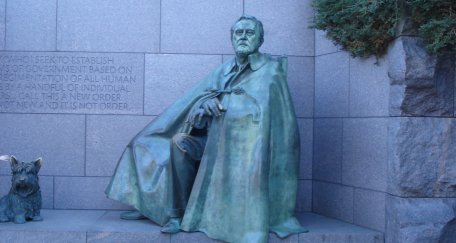
Most of the New Deal programs & ideas did not survive the test of time or the courts. The reason we don’t understand that is we look back at it now with a kind of “survivor bias,” i.e. we judge it by those that did survive – a relatively small and more successful subset.  But what really saved the New Deal’s reputation was the onset of World War II. To his eternal credit, Roosevelt saw the trouble on the horizon and he understood that he would have to harness the power of the United States – all of its power – to fight the threat of totalitarianism. So the always pragmatic president chucked or let fall away many of the more radical New Deal programs and much of the anti-enterprise rhetoric into the dust bin of history, much to the chagrin of his more radical associates, such as Harry Hopkins and his wife Eleanor.  We kept the songs, murals, myths and lots of mixed feelings.

My father grew up during the Depression and always took a kind of pride in the fact that he could trump any contemporary hard times stories.  No matter what happened, he could say, “You are lucky.  When I was growing up things were a lot worse.”  And he was always right.  You just couldn’t argue with the old man when he played the “Great Depression card.”

Random Thoughts

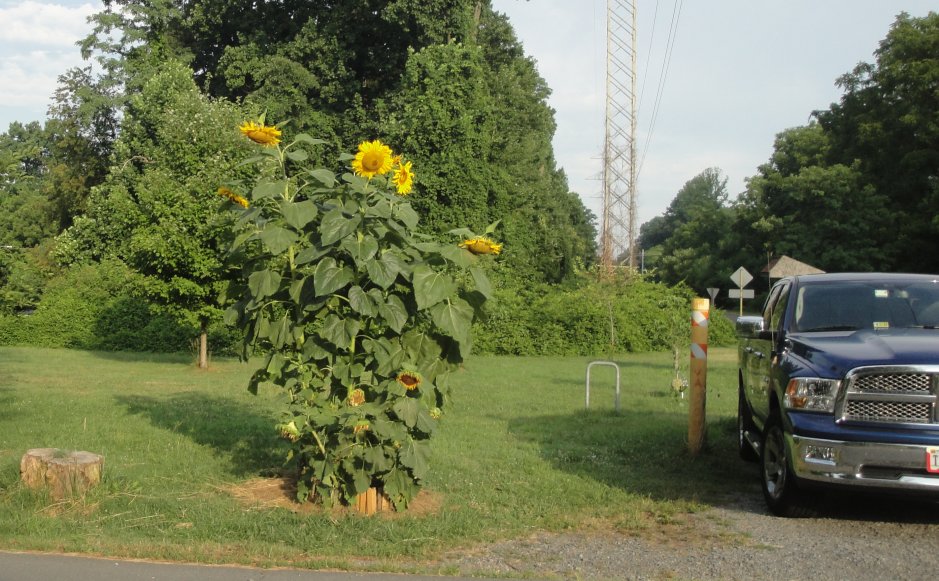
Below are sunflowers planted near my bike trail.  The thing that is important to notice about them is that they are there at all.  Somebody planted them and nobody knocked them down, despite the fact that dozens of people pass each minute.   I think that says something about the neighborhood. 

There are some tip-offs about the quality of a neighborhood.  Flowers are an indicator on the plus side, as is general neatness and lack of litter.  It also is a good sign if you don’t see lots of security fences or signs warning about loitering or trespassing. The character of the dominant dog population also makes a difference.  Labradors, golden retrievers and terriers are good; pit bulls and Rottweilers not so much.  I am suspicious of places where there are bars or sliding screens on shops, especially liquor stores. Being able to see more than one liquor store from any one spot is also a red flag. Lots of advertisements for lottery tickets is a bad sign and a big clue that you have crossed into a less desirable part of town are those places that cash checks 24 hours a day or give payday loans.  If you see storefronts advertising bail bonds, get the heck away from that neighborhood.   But sunflowers are good.

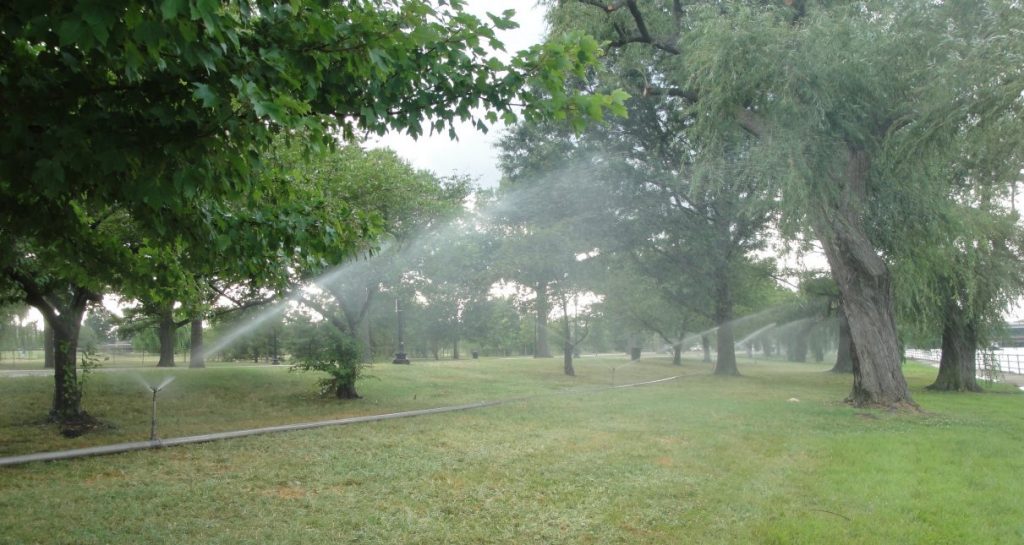
Above are sprinklers near the Potomac.  I found a place right in the rain shadow of a couple trees so that the water didn’t get to me.  I sat there a few minutes enjoying the peaceful sound of the spraying water until it started to rain.  That evening we got more than an inch of rain.  If you sprinkle your lawn or wash your car it evidently increases the chances of rain.

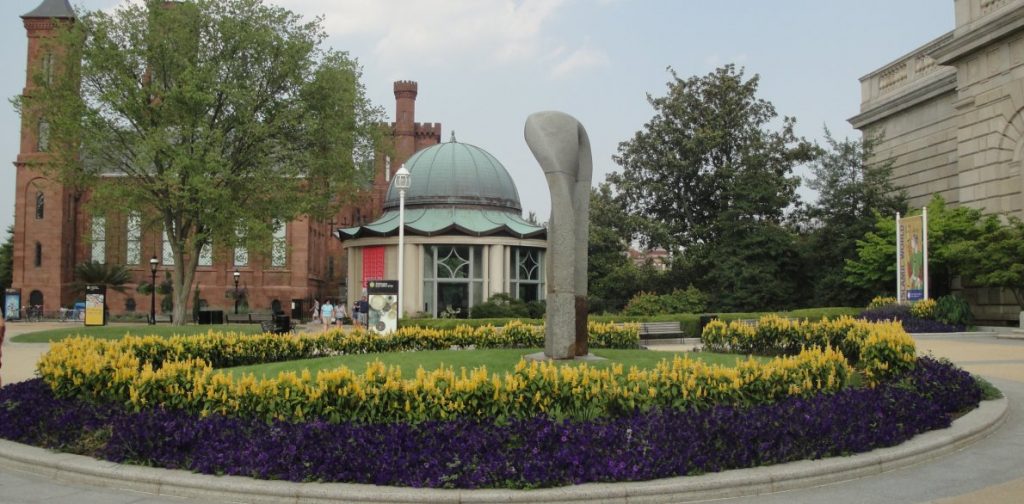
Above it the Ripley Center at Smithsonian, where they often hold the lectures I attend. It is like the tip of an iceberg.  That little structure is the entrance to a vast underground complex of halls and museums. They didn’t want to put lots of buildings up on the Mall, so they put them under.  

Imagined Muscular Morality

Yesterday I watched an episode of “Law & Order –Criminal Intent” that featured a murderer obsessed with proving that people were not moral.  He captured loving couples and forced them into situations where one killed the other to save his/her own life.  Today I read about criticisms of “To Kill a Mockingbird.”  Evidently modern activists feel Atticus was not sufficiently outraged by the racism around him.   As different as these seem to be, they are both based on pernicious and self-indulgent interpretation of human morality, an interpretation that is superficially perceptive and intelligent, but is in fact just sophomoric.

I understand that my own interpretation will sound shallow compared with the deep thinking that some of the chattering classes do about historical transgressions like racism or the Holocaust, but I think it has the advantage of being more useful.   It has to do with capacities, and sometimes going beyond what we can expect of ourselves and other humans.

There are two types of judgments that are worthless: standards that are so high that nobody can pass and standards so low that everybody can.  Both, unfortunately, are attractive because we can alternatively claim to have high standards or to be inclusive. I was on the swim team in HS, but I cannot swim as fast as Olympic champion Michael Phelps. But there are two sorts of swimming contests where I am his equal.   If the test is simply the ability to swim 100 yards w/o any reference to the time involved in getting there, both of us can do it. If the test is to swim across Lake Michigan, neither of us can make it.   It sounds silly when I put it in these terms, but that is what we constantly do in our moral judgments of others, especially when we are thinking historically.

If you prove that Michael Phelps cannot swim across Lake Michigan, have you proven that he is a poor swimmer?  Of course not.   What if you put a person into an impossible moral situation?  You might conclude that this person is morally lacking, and you would be wrong.  You might conclude that all humans were morally lacking and you would be right by the standard you set up, but it is a stupid standard.   If nobody can succeed, the test is useless.  Why do people insist on postulating such things?  I think it is because it makes them feel better about their own personal moral shortcomings.  

Just as a reasonable person – even a great swimmer – would avoid jumping off the car-ferry in the middle of Lake Michigan because he knows that he cannot swim forty miles to the other side, so a moral person avoids situations where he will be pushed beyond his breaking point.   This is the moral thing to do.  You need to anticipate challenges and take steps in advance to address them.  In my experience, people who constantly get in trouble are not always worse at resisting temptation, but they are very clumsy about falling into situations where they cannot.   Taken to a higher level, a good society is one that permits and facilitates moral choices.  One of the biggest crimes committed in un-free societies is that they corrupt good people by making it very difficult for to make moral choices, or even recognize that there is a moral choice to be made.   As they are threatened or enticed into poor moral choices, they slip farther down the slope.

I am not arguing for moral relativism when I say that we have to judge people’s choices in the context of their situations.   There are standards we should uphold, but we have to recognize that when you are sitting in a comfortable chair in the safety of your home it is easier to postulate that you would make the right choice than if the Gestapo was asking you whether or not you saw someone hiding in a shed.   

There is also the element of knowledge and experience.  I know that I have become more interested in acting ethically as I have become older.  I don’t think it is merely age.   As I experienced more and learned more, my feeling of responsibility has grown.   Some of us like to idealize children as innocents who instinctually know right from wrong.   This is not true.  It is just that we cut them a lot of slack and we don’t expect them to make the really hard choices.  IMO, true ethics requires learning and introspection.  In a similar vein, I am not a big believer in the noble savage ideal.  I think Roseau was full of shit and besides his occasionally stirring phrases; he was harmful to the ethical development of humanity.

Time Real & Imaginary

We all understand the concept of time … until we have to explain it. Time progresses at an even pace (at least in our local reality) but time is not experienced the same by everybody or in every situation.   A poem by Samuel Taylor Coleridge sums it up well. I have included it at the end.  Chrissy & I got some more scientific insights at a lecture at Smithsonian by neuroscientist Richard Restak called Time & the Brain.  Some would have been obvious  to Coleridge, but it is interesting to get it from the science perspective.

Restak started by talking about “real” time, the kind we measure. Our machines can measure it in nanoseconds, but we don’t perceive it at that level. Events have to be communicated and interpreted by our brains before we can “see” them.  That takes time and in the interpretation time is experienced.  Uncommon or exciting events seem to last longer.  These are times when events seem to unfold in slow motion.  It is an artifact of memory.   When the memories are packed tightly, we have more to remember and we tend to perceive it as a longer time.

This accounts for a paradox is excitement and boredom.  Restak talked about an experiment where some people watch an exciting movie, while others languish in a waiting room. For the people in the movie, time flies by, while it drags for those in the waiting room. However, when both groups are asked to estimate the time actually spent in each activity, the people who watched the movie estimate 10% too high.    That explains why people whose life is boring say that the days drag, but the years fly by.  I recall when I worked at Medusa Cement loading bags for twelve hours a day.  Each day seemed interminable, but  when I think back about each summer it went by quickly. That is because not much changed.  This is also why you tend to remember things that happen early on a job or task, when you are learning it.

Restak explained that in memory past, present and future are not always distinct and if you cannot picture yourself in the past, you cannot project into the future.  That is a problem for people with Alzheimer’s disease.  They cannot envision the future because they cannot recall themselves in the past. There is no longer a continuous identity.   This is also a problem for people experiencing depression. They just cannot envision a brighter future, which affects their perception of the past and the present.

Different cultures perceive time differently.  An important factor in the material success of the West has been our ability to control, or at least to parcel time.  Before the industrial revolution, there was no much need for clocks to have minute hands. Processes were uncoordinated and time was “wasted”.  Even today, not everybody has the concept of time and some people don’t really think we should. 

Our time has become maybe too regimented.  Because of our devices like mobile phones and computers, we always have the possibility of doing something.   It takes away from leisure, but also from time to contemplate and think.  Thinking takes time and if you move from one event or quick decision to the other, you may never have time to understand the purposes and connections.  That is a modern curse.  I remember when the Marine at TQ explained to me that I had to embrace the suck. What that really means is to take the time you have.

Anyway, Calvin Coolidge said that you should always leave when they still want you to stay.  The Q&A lasted a bit too long, with some people just trying to demonstrate their erudition in front of a groups of strangers.   I have been having a little  problem with sciatica and I just cannot sit still for more than an hour, so we slunk out.  Always get a chair convenient to the exit.   I think we got all we could from the talk anyway.

This is the Coleridge poem:

Time Real & Imaginary

On the wide level of a mountain’s head,

(I knew not where, but ’twas some faery place)

Their pinions, ostrich-like, for sails out-spread,

Two lovely children run an endless race,

A sister and a brother!

This far outstripp’d the other;

Yet ever runs she with reverted face,

And looks and listens for the boy behind:

For he, alas! is blind!

O’er rough and smooth with even step he passed,

And knows not whether he be first or last.

Turning, Turning We Come Round Right

“Vice President Joe Biden told POLITICO after a three-day trip to Baghdad that the American people will see President Barack Obama’s Iraq policy as a success when the “combat mission” ends on schedule on Aug. 31. Biden said the administration “will be able to point to it and say, ‘We told you what we’re going to do, and we did it.’”  Yes. That is pretty much what we wrote about such things more than two years ago, when it was a little less fashionable. 

I like what the VP said. He is right. I think the title of my article two years ago could have had the same title, “We told you what we were going to do, and we did it.”

I also wrote about two years ago, “The proper answer for the erstwhile surge opponents is to say that they were seriously wrong last year, but that they see the error in light of events and will work with conditions to take advantage of the success brought about by policies they opposed. “

War – The father of us all

In early human societies, and among the less technologically advanced until now, war is/was endemic.  Simple societies are warrior societies that live in a constant state of lethal conflict. These are small fights, murder raids & minor skirmishes, but they are never ending. The “noble savage” was kept in top form by the exigencies of war.  We cherish a myth about people before civilization – that they lived in harmony with each other and with nature. The fact is that it was more like road warrior, with death, capture and rape a constant reality. The only protection was the ability to defend yourself or hide in vast spaces. It was constant war and disease that kept the population below the carrying capacity of the land. It didn’t take long for our brainy ancestors to control or kill most of our erstwhile predators, but man preys on man. This is not an optimistic view of our species, but it comports well with the facts. Fortunately, people respond to challenges and especially to challenges perceived as threats. What is more challenging or threatening than war?  In many ways our civilized institutions are responses to the endemic conflicts of our ancestors. War is the father of us all.

Alex and I went to see Victor Davis Hanson speak at the Smithsonian last week.  He was one of the most engaging speakers I have ever seen.  He was also very un-PC, as you can infer from the ideas up top that I took from the talk. He is one of the few historians that still characterizes himself as a military historian. Hanson points out that military history is extraordinarily popular. If you go to any bookstore, you see that a very part of the history section consists of accounts of wars and biographies of war leaders. Series like “the Civil War,” “Band of Brothers” or “the Pacific” win big audiences.  But being popular with people in general and being accepted in academic history circles are different and often mutually exclusive things. I wrote about that before here, here, here and here

Today people prefer to study peace, assuming that war is some kind of aberration and that peace is the natural human state. History does not back this up.  As I mentioned above, our ancestors lived in a constant state of unrelenting war.   Most of us personally live much more peaceful lives, but we live in a world that is still always at war somewhere. The ancient Greeks, Hanson says, recognized the ubiquity of war and didn’t give it much of a second thought. We can avoid some wars if we recognize what the Greeks knew and address the causes of war. So what are the causes of war? Hanson disagrees that they are primarily economic, although economics is a necessary part of most wars, it is not sufficient.  Modern states do not have to conquer others to enjoy their resources.  Albert Speer warned Hitler about invading the Soviet Union.  He pointed out that as an ally Stalin was already supplying the Nazis with all the Soviet raw materials that they could expect to get by conquest and that he was doing it at a significantly lower price than the Germans would have to pay if they did it themselves. Speer was right and the Germans were never able to get as many resources from the Soviet Union after the invasion as they easily got before.  Hitler invaded the Soviet Union for ideological or “honor” reasons.  Economically, everybody knew it was a loser.

The same goes for our “war for oil” in Iraq.  It makes absolutely no sense to view the conflict in these economic terms.  Saddam Hussein was willing – even eager – to sell all the oil he could and he did it at a discount.  After the war, we do not get more oil from Iraq and we did not take over any oil fields.  If it was a war for oil, we forgot to pick up the prize. Some people might wish it was indeed a war for oil, because it is was we would have the oil.  But we don’t. War is caused by a combination of many factors, such as fear, greed, honor and ambition.  But these things are kept in check by deterrence of the power of others.  Hanson says wars break out when there is a decline in the perception of deterrence.  Put simply, people don’t go to war unless they think they have a reasonable chance of winning.  It doesn’t mean that their perception is accurate or that they define winning in the same sense that we do, but war is not a random act and it is almost never the result of the oppressed just rising up, so we cannot solve the conflict by attacking the “root causes” if we find them in oppression and injustice.

Conflicts also require fuel. Consider the case of the Palestinians and the Israelis. This conflict has been going on since the 1940s (and before).  The ostensible cause is that Palestinians were dispossessed of their land and they remain aggrieved.  We take it for granted, but it is not the whole truth. In the late 1940s lots of people lost their ancestral lands. Around 15 million Germans were kicked out of places their ancestors had lived for centuries.  The same happened to Poles, Ukrainians, Hungarians … the list goes on and on.  Among the peoples dispossessed in the 1940s, the Palestinians were a fairly small group and not poorly treated in relation to the other examples. In fact, much more recently ancient Jewish & Christian communities were driven out of homes in Arab countries, where their ancestors had lived a thousand years before the coming of the Arabs or Islam. Why is it that after all these years only the Palestinian problem remains an open wound?  Why doesn’t the Silesian liberation organization highjack airplanes? Where is the Galician liberation army?  The simple answer is that they had nobody to bankroll their misery and encourage them to continue the fight. They were also allowed to resettle. Other Arab countries could have solved the Palestinian problem years ago by simply doing what Poland, Germany, Hungary, Ukraine, Finland and many others did with refugees associated with their countries.  Why they didn’t can be explained by their perceptions of deterrence and their long-term perception of the chances of achieving their goals through conflict.

Anyway, both Alex and I enjoyed the talk.  It gave us something to think about. One of the things l like best about Washington is the many opportunities we have to go to these sorts of things.

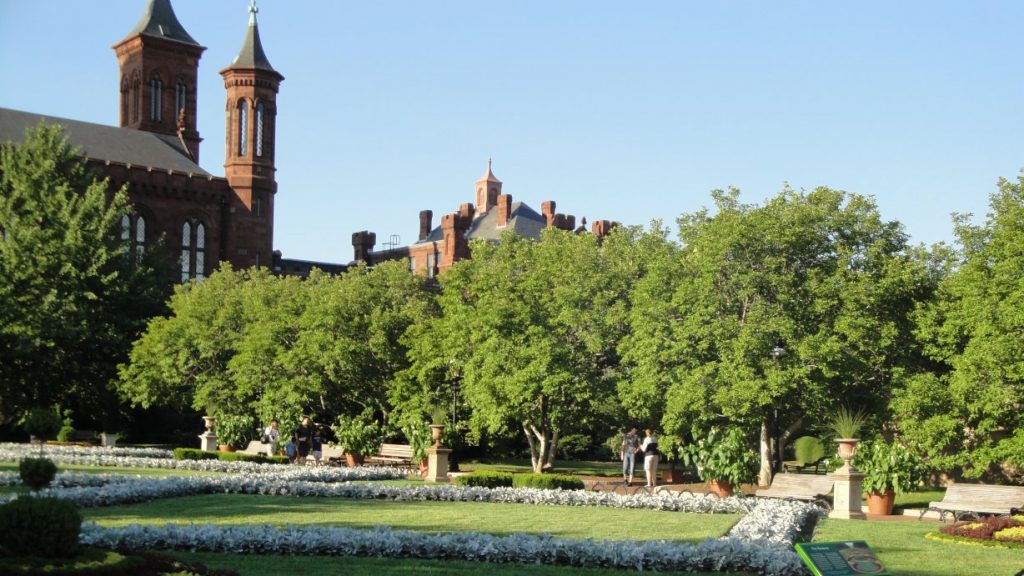
BTW – The picture up top is the Smithsonian castle looking NE on June 30 at around 6pm. It is what Alex and I saw as we headed for the lecture.  

National Parks

Brazilian television had a report  about their parks and how they are poorly maintained.  It was a good PR for the U.S. The headline says “[Brazilian] parks are abandoned.” The subhead makes the comparison that “Preservation of the national heritage in the USA is a tradition that goes back to the 18th Century.” They praised our park system and said that it would be good if the Brazilian parks became more like ours. 

The American National Park system is the oldest and the best in the world. We sometimes take our parks and national forests for granted until we think about it or compare it with others.

One of my goals when I get to Brazil is to visit their national parks.  I have already been to three of them:  Iguacu falls, Aparados da Serra & Lagoa do Peixe. But that was before I took decent pictures or wrote up my experience. Anyway, there are thirty-two national parks in Brazil.  That shouldn’t be impossible to see all of them in three years, but some are very remote. (I have to admit that I have not visited all, or even most, of our parks in America. Of course, we have more of them. That may be something to do when I retire. You can even get a special old folks’ pass.)  

I think that I may perform a useful service if I visit Brazilian parks and do a reasonably good job of documenting the visit. There just is not a lot of good information available about some of them, especially in English. A big problem for the Brazilian parks is money. They evidently have a kind of moral dilemma about charging for admission and letting private profit-making firms have concessions within the parks. Some people think this is a task government should do. But, since it is clear that the government cannot or will not support the maintenance of the parks and the infrastructure to support visitors, Brazilians are looking for other models. Despite the fact that we also complain about lack of money, the American mixed system works.

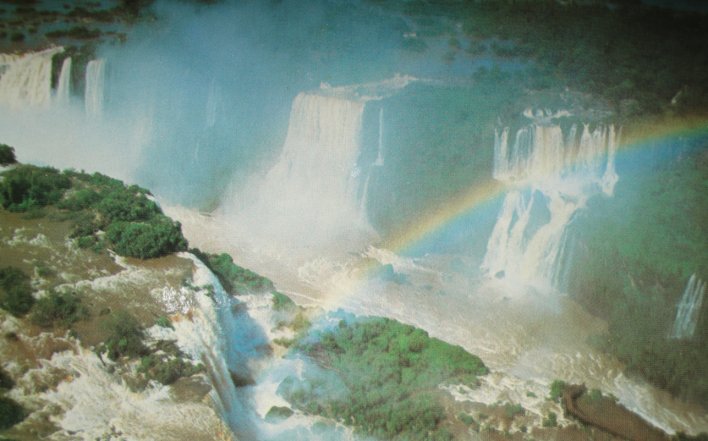
One of the persons interviewed said that the only thing worse than charging admission and letting private concessions make money at the parks is not doing that and letting the parks decay and go unused by the people. The Brazilian model for making the parks work is the Foz da Iguacu. This is one of the biggest waterfall in the world (maybe the biggest, depending on how you measure), so it starts off with many advantages for attracting tourists.  (You can see how pretty it is from the picture up top) At this park they charge admission and have granted concessions to hotels, helicopter tour operators etc. As a result, it is a nice place to visit and a model for others.

Chrissy & I visited the falls back in 1987. As I recall, the infrastructure was okay, but not great. Like so many other things in Brazil, it seems that they really have come a long way. My memory of the time is hazy. I wasn’t there very long. I was coming down from Brasilia and got stuck in Curitiba airport for a long time, so Chrissy got there first and saw more of the place. I remember best a little trivia. More water flows over these falls than over any other in the world, but it is not really one falls, more a series. The year-around warm weather, wet conditions and constant spray makes the area around the falls is a paradise for frogs. But the swift water isolates frog populations on islands and peninsulas, so that many species and sub-species have developed. If you are interested in frogs, this is the place to be. For the herpetologist the impressive waterfalls are just a bonus.

Some Thoughts on Immigration

My grandfather was an immigrant who came to this country w/o particular skills. Back in those days there were lots of jobs that didn’t require skills and his education was about the same as that of the average American at the time. Today we can still use immigrants, but maybe not those uneducated masses like grandpa.

We should allow MORE legal immigrants,but we should choose the types of people we want and need. Literally millions of smart & skilled people would bring their skills here within days if we would let them. There is no shortage of applicants. WE should choose who gets to come to our country. Sorry, grandpa. Today you need at least a HS education or comparable tech background and you need to speak English if you want to make yourself useful.

People say that we need somebody to do the dirty work that we don’t want to do. This is only partly true. We still need some temporary farm workers, given the seasonality of that work. But there is no reason why these guys cannot go home at the end of the season. If we had a system that allowed them to come when needed and then come back again, I think many would indeed choose to do just that. Besides that, cheap labor is a mixed blessing.

Cheap unskilled labor creates its own demand. We employ lots of people doing crap jobs like blowing leaves because they work cheap. If we didn’t have cheap labor, we wouldn’t bother doing many of these jobs or we would use machines to do them. Cheap labor makes it less profitable to invest in new technologies to replace labor. We “need” cheap immigrant labor because we have cheap labor. Many jobs could be restructured or replaced by machines if we had to pay more for workers. It is a fairly simple equation.

I used to load cement bags. They had a dozen of us piling bags on pallets. Now they have one guy with a machine. We used to work twelve hour days; this guy doesn’t even come in to work every day. They don’t even use the bags at all most of the time. Now they just load cement directly. Dozens of dirty jobs have been eliminated by redesign. Some smart guy’s ideas replaced our many dirty and blistered hands. But if labor had been really cheap, nobody would have bothered doing that. Cheap labor retards development in anything but they very short run.

The fact is that you don’t get prosperous by hard work and there is nothing virtuous about working hard at low productivity. That is just for people who don’t know any better or are doing it for the exercise. People in the past worked physically harder than we do now and people in many poor countries still do but none of us wants to trade places with them. The key to prosperity is managing the connections, understanding the exchanges and working smarter. That is why we pay so little for unskilled labor. It is not worth very much. Knowing what to do and how to do it better is almost always worth more than actually performing the task. Brains won the battle with brawn long ago, even if some still ain’t heard the word.

Some jobs cannot be automated, but many of those jobs now done by immigrants used to be done by American teenagers or college students and could be again. I worked at McDonald’s, Burger King and several Italian restaurants whose names I cannot recall when I was in HS and college. My kids had trouble finding work at fast food places because they were competing with immigrants who would work almost full time. I say almost full time because employers are very careful not to let them work 40 hours where they would get benefits. Employers prefer immigrants to American young people because they are more reliable and easier to exploit. These are not indispensable reasons and may not even be good ones.

I don’t want my country to be competitive in low-wage industries, so I prefer not to import low-wage workers. I like the guys who come to America and open businesses, make software or do some things that create wealth. Immigrants account for about a third of the tech workforce in Silicon Valley. These guys make the big bucks and they create jobs in America. Good. Let’s have more of them and fewer of the cheap ones.