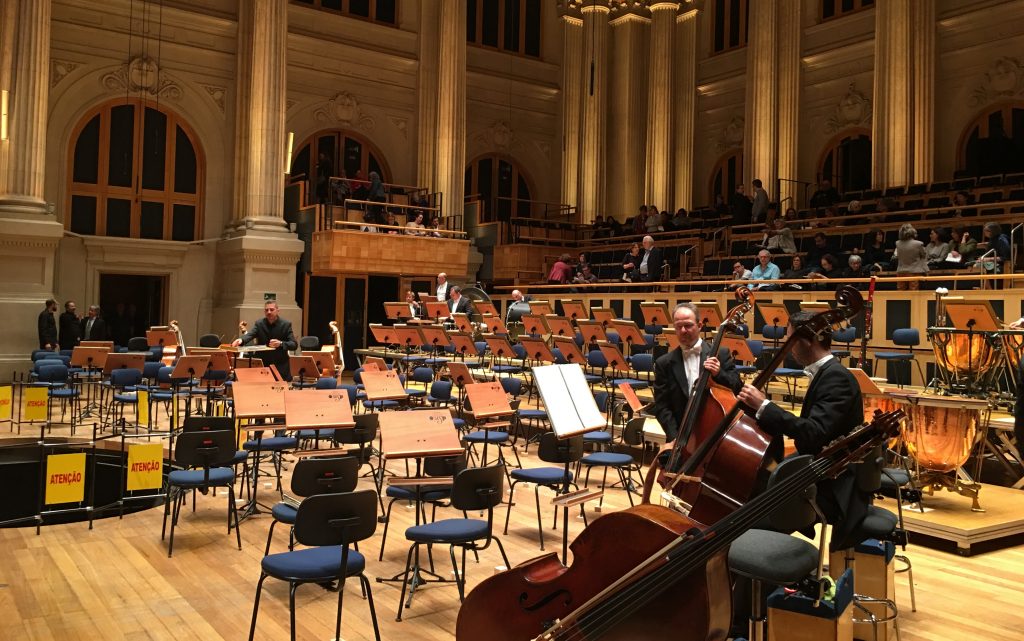
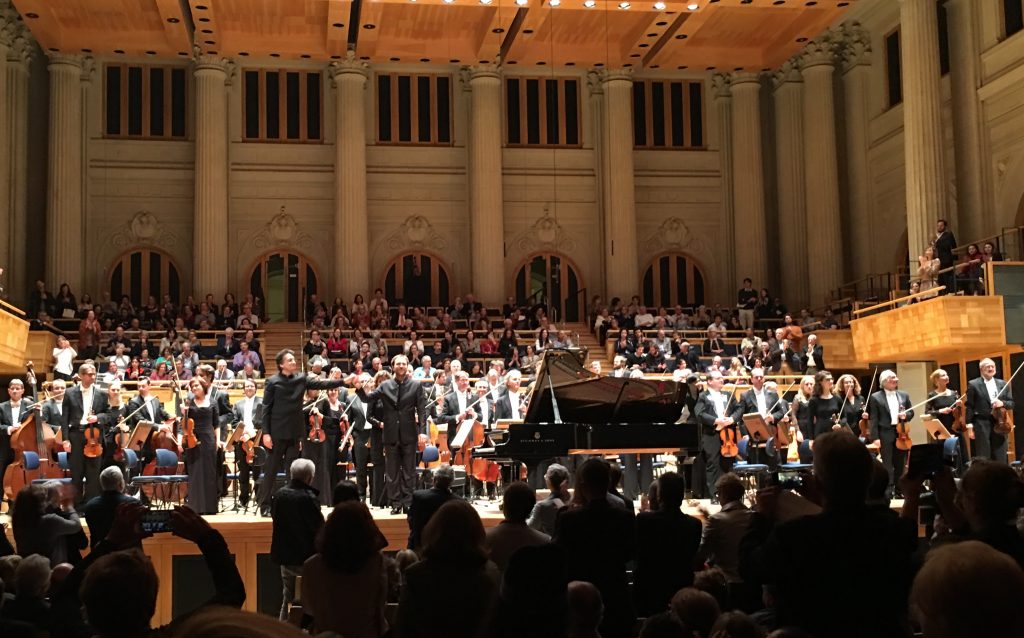
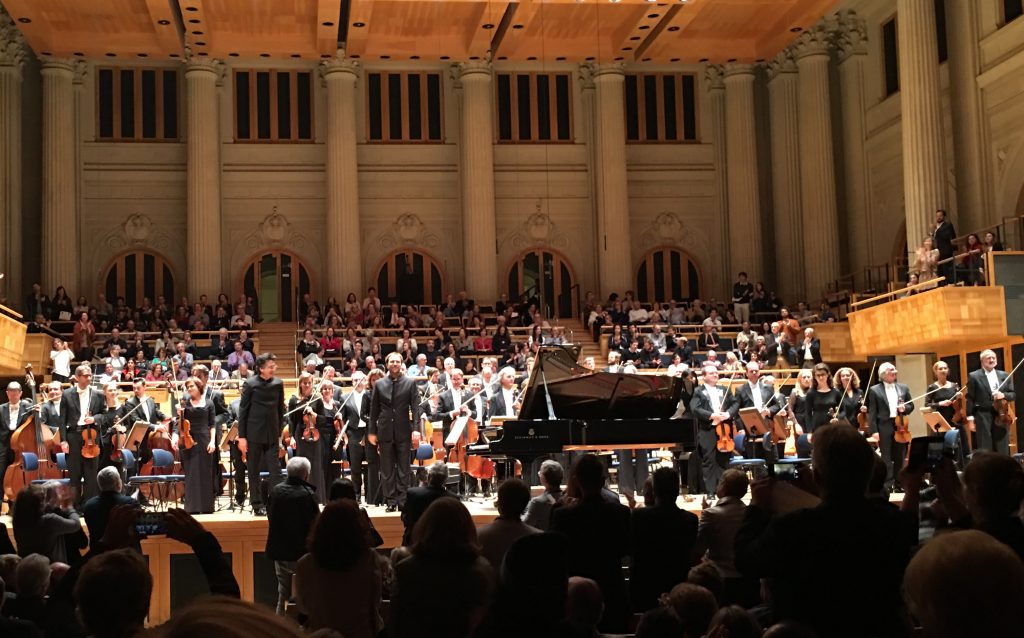
Went with CG to a concert by the Dresden Philharmonic. They played Beethoven, Mozart and Shostakovitch. The big star, IMO, was pianist Herbert Schuch. That boy can play. I was watching him most of all and thinking of the sheer physical stamina needed to produce that beautiful music.
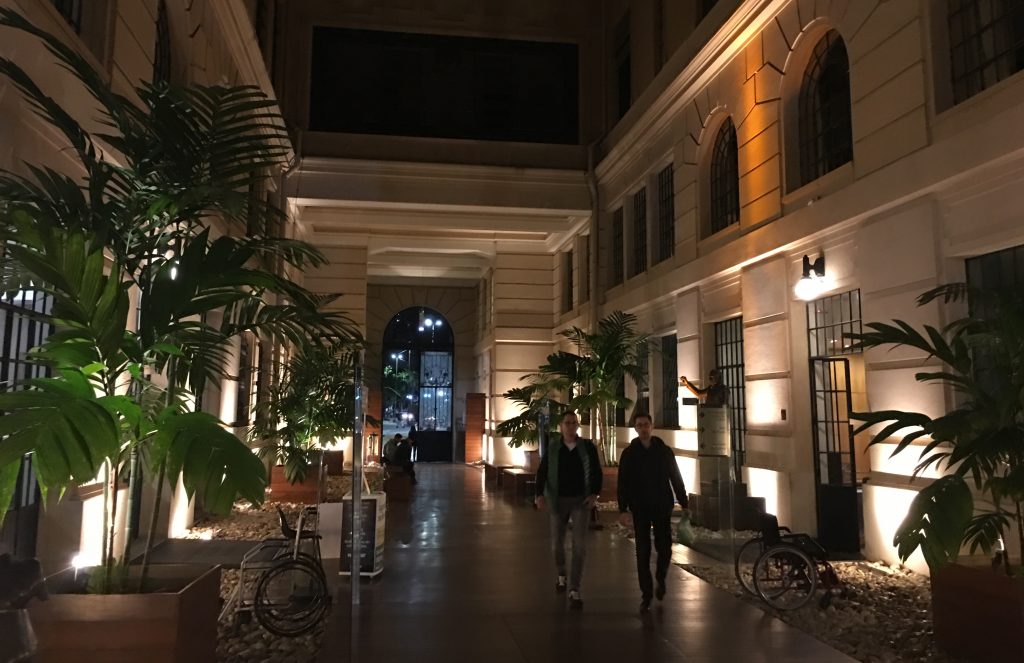
The concert was staged in the Aula, which used to be a train station. It is beautifully done, with lots of wonderful woodwork, see the pictures. Unfortunately, the neighborhood around is a cracolândia, The CG had a driver and an armored vehicle, but it still was scary going through. Actually more tragic than scary, when you imagine the desperate lives those people lead.
The first four pictures show the venue. Last is supper. We ate at Coco Bambu before the concert.
I am a hypocrite and I proudly so. Hypocrisy is a prerequisite for civilization and the basis of courtesy. Hypocrisy is the tribute that vice plays to virtue, since hypocrisy implies acceptance of the value you pretend to have.
Diplomacy, Politics & Courtesy are Hypocrisy Codified All good diplomats, all good statesmen & most good people are hypocrites. They must work productively with people whose values they do not share, often with people they personally dislike. Would it be nobler to be sincere and express their “true” feelings, presuming they have thought through what the true feeling even are? It sure would not get more done.
The right question is to ask what people CAN do, not what they can’t. Effective people look for common goals among opponents and common aspirations even among enemies. You need not agree on everything to work together on something.
Look for Agreement In my diplomatic career, I have usually followed the maxim that – “You make friends shoulder to shoulder not face to face,” i.e. working together on common aspirations is better than talking about your problems. I do not want to disparage dialogue, but you should be looking for shared aspiration, not just airing grievances. Just talking about differences as often leads to finding more differences rather than resolving those you have already. “What can we do together?” is better than “Why don’t you like me?”
When I meet someone, I look for common aspirations – looking for the doors or windows – the ways in – not the stone walls that keep us out. This just makes sense. I do not know why you would do anything else. Yet, I find more-and-more people rejecting this. I hear people saying that they cannot talk to “those people” because “they” are unreasonable. Yeah. They say this w/o seeing the irony.
I joke that when I was serving in Iraq (2007-8) I ate lunch with guys who would have – maybe tried to kill me only weeks before. I do not think it was always just a joke. I have found common aspirations with communists, religious radicals, former (maybe current) criminals and lots of people who just hated people like me or what I represented. It was rarely pleasant at first and often never got better, but sometimes we found something we both wanted and could set aside our dislike to get it.
Feeling Righteous or Being Right It is satisfying to be self-righteous, to assume that you or your group has a monopoly on “the good.” We all want to think we are fighting the good fight. After the fight, however, how many times have you regretted the need for the violence (real or intellectual). Surveying the carnage and destruction after the battle of Waterloo, his great victory that he had anticipated for a decade, the Duke of Wellington reportedly said, “The only thing worse than a battle lost is a battle won.”
If we can (and should) look for common ground with foreign enemies, we certainly cannot deny this to our fellow American opponents.
It is NOT a betrayal of principles to work with opponents and find common purpose with enemies. In fact, it is affirming a greater principle of inclusiveness. It is how civilization works. Let’s maybe be less indulgently sincere. Hypocrites often get more done and almost always are more pleasant to be around.
And if you look for it, you may sincerely find good in those you think hate you and maybe you can hate the a little less and maybe learn not to hate at all.
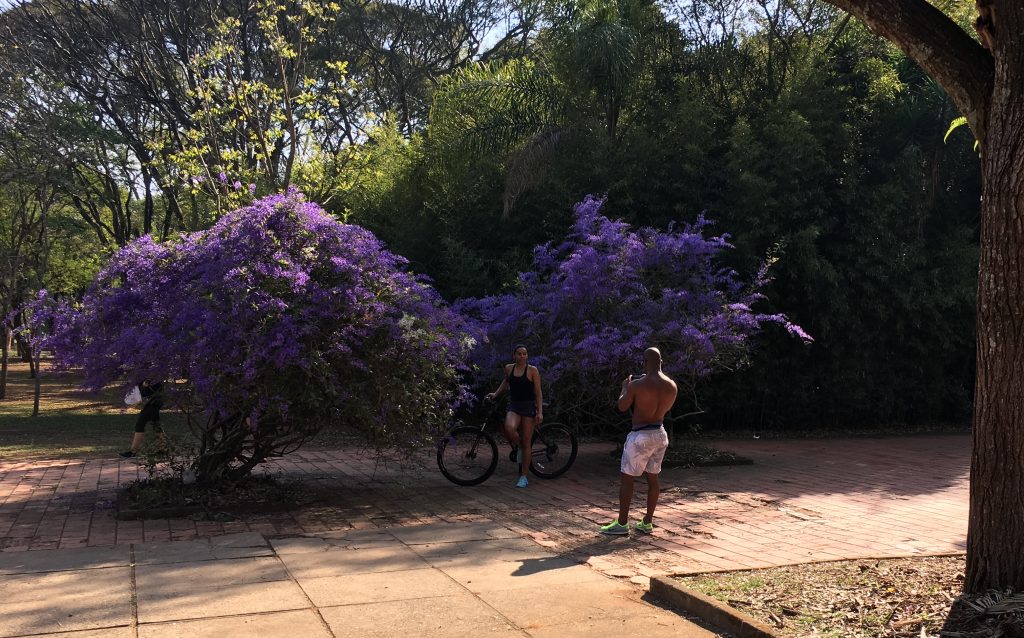
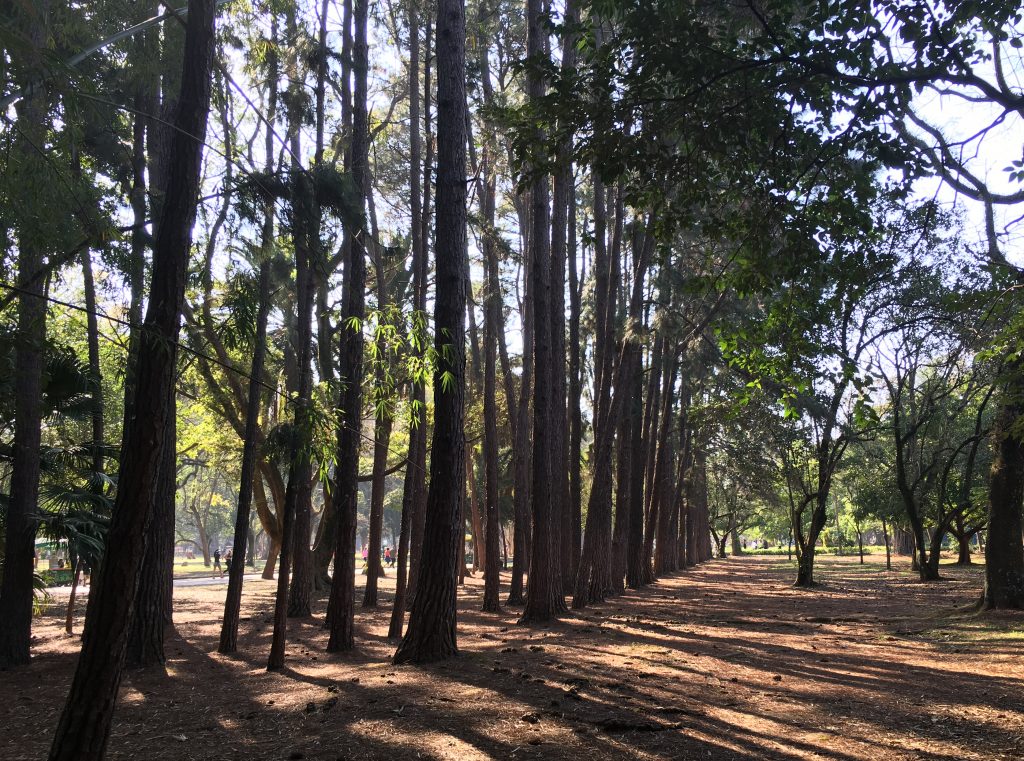
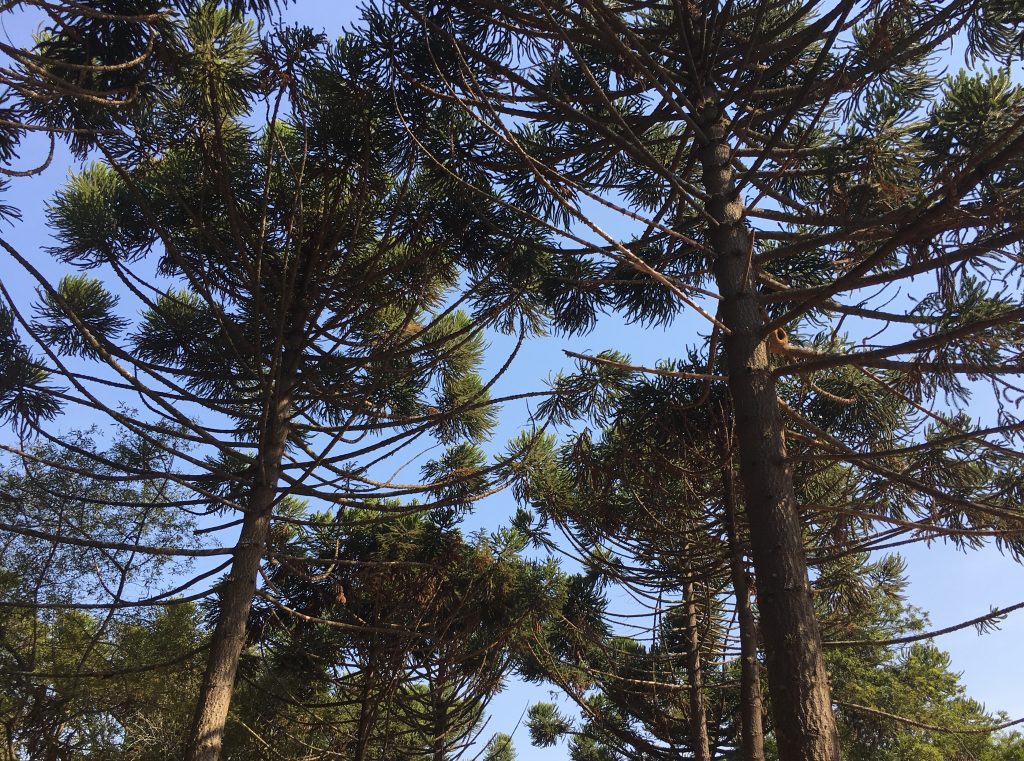
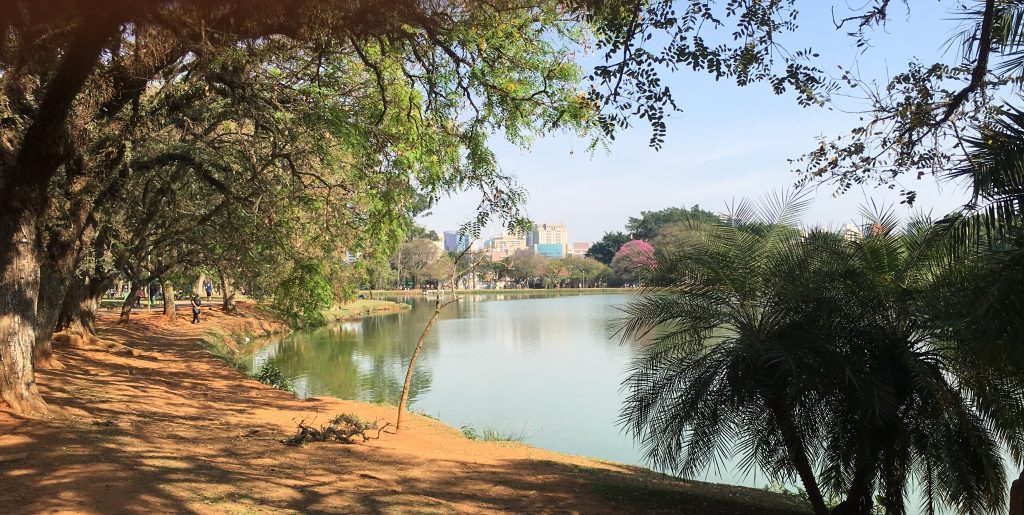
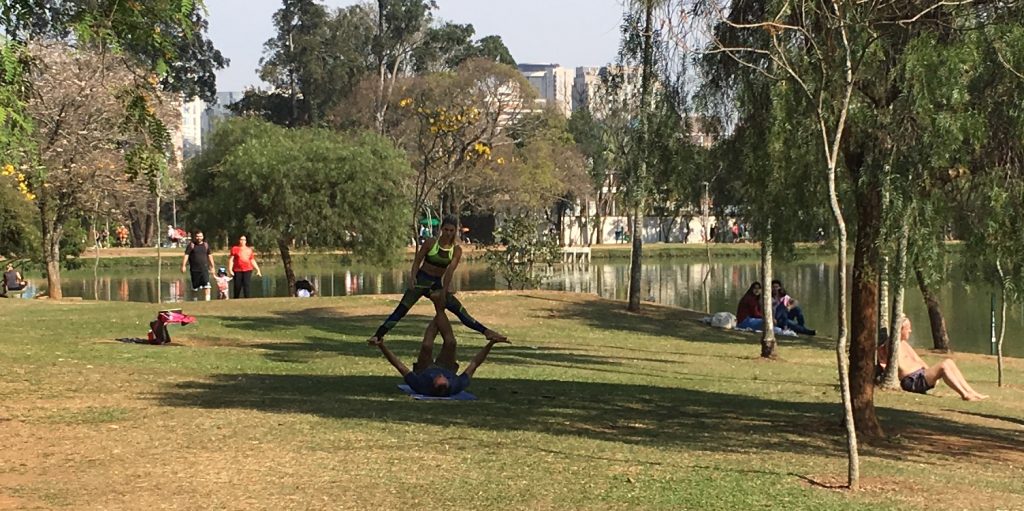
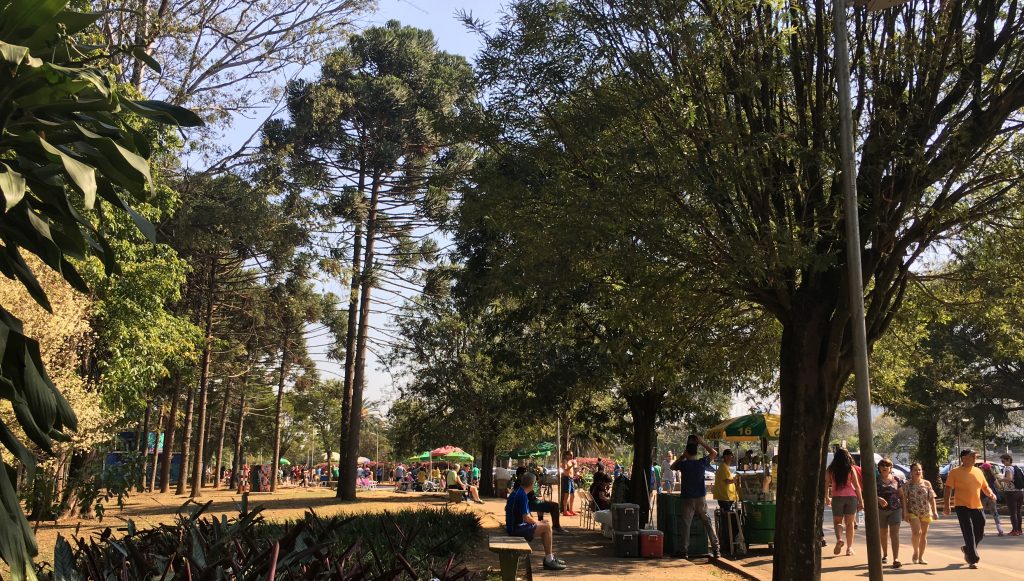
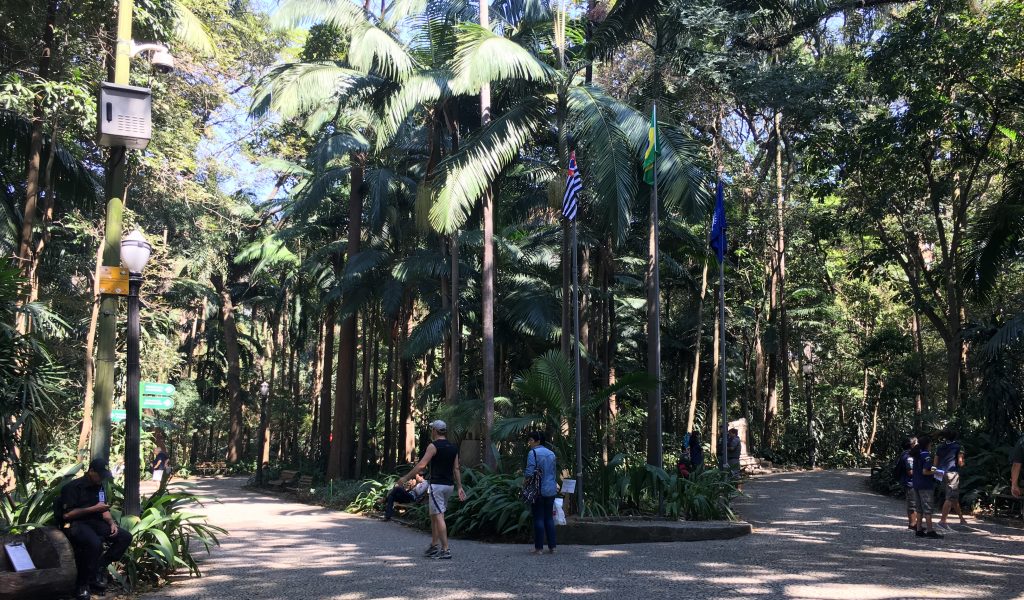
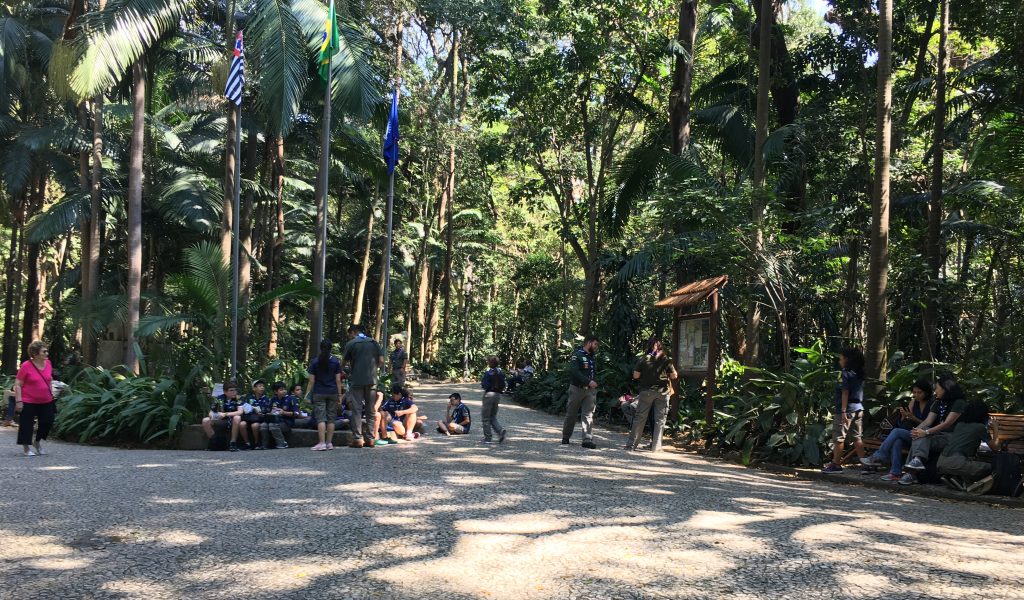
I am getting down to my “lasts” as my São Paulo narrative winds down. Today is my last Sunday, so I went over to Ibirapuera Park, where I had walked on my first day here. I got there a lot faster, since I walked straighter route. It also seems less time spent when you are more familiar. Usually when I walk I listen to my audio books. This morning I just forgot. It was one of those “lost in thoughts” days. Not sure what I was usually thinking about, although I do have a few pictures to remind me.
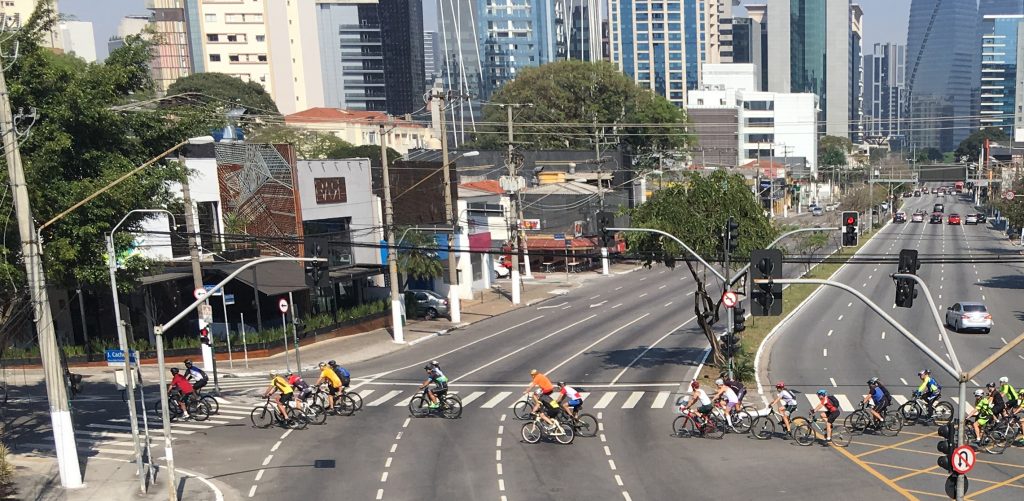
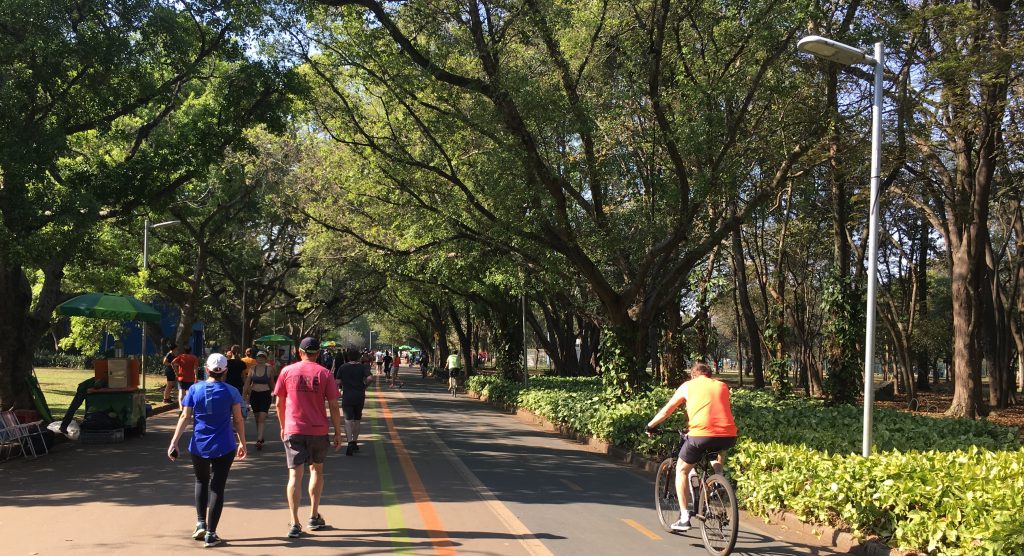
Went to the hypermarket to get my last week’s supply of Coke and beer. Lots of bike riders around. The other pictures are left over from the park visit, mentioned above.
One persistent thought was just the appreciation for the joy people were taking in their park. Ibirapuera Park is crowded with people walking, biking, talking and just hanging around. I recall not always being so happy with this sort of thing. When I used to run, I disliked the crowds that got in my way. I was probably a kind of running a-hole. Some like I used to be were out running today – too serious about finishing their workout. I tried to stay out of the way, but I know that I disturbed at least one run as a fit young man almost ran into me as I looked up at some pine trees.
My first picture is kind of a meta-picture, i.e. a picture of a guy taking a picture. next are some araucaria angustifolia, the Paraná pine. These are from southern Brazil, beautiful trees. They are not true pines, however. There are no true pines (genus pinus) extant in Brazil. Next picture shows pines (of course not the tree in the middle). I could not tell if they were loblolly. They kind of smelled like loblolly. Could be slash pine or even Monterrey pine (pinus radiata). I just am not so good at telling pines from each other. I often rely on geography for hints, i.e. if I see a pine in northern Arizona it is likely ponderosa, but here that does not work. I know they are not longleaf, since the cones are too small and the needles too short. I cannot dislike pines, but many Brazilian ecologists do. They are considered invasive here. They do grow well here. Monterrey pines grow much better in the Southern Hemisphere than they do in their native range. Next picture shows some runners and the park pond.
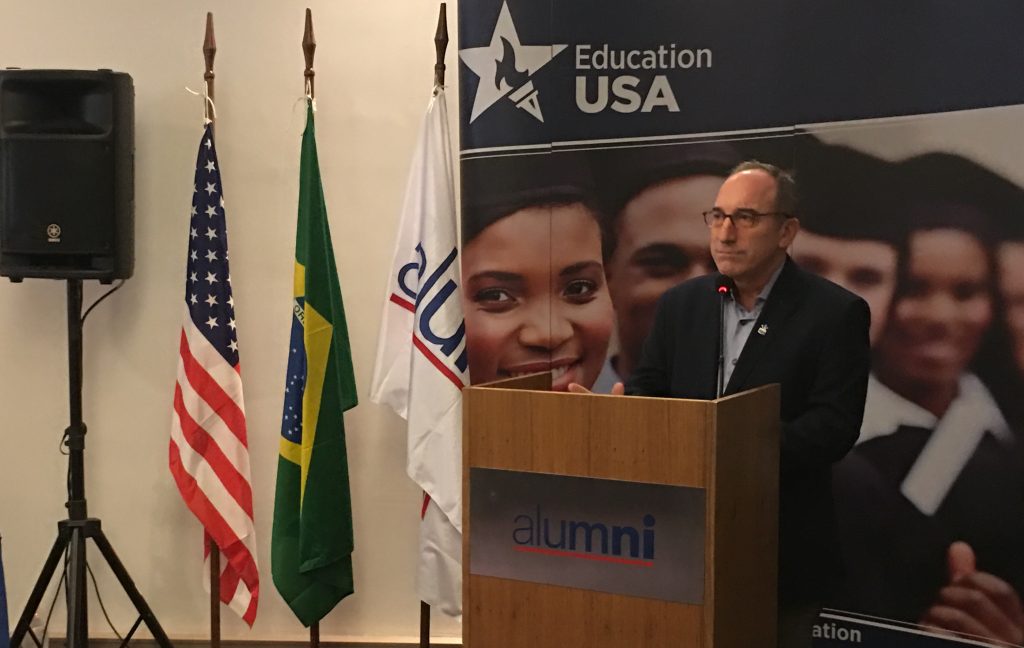
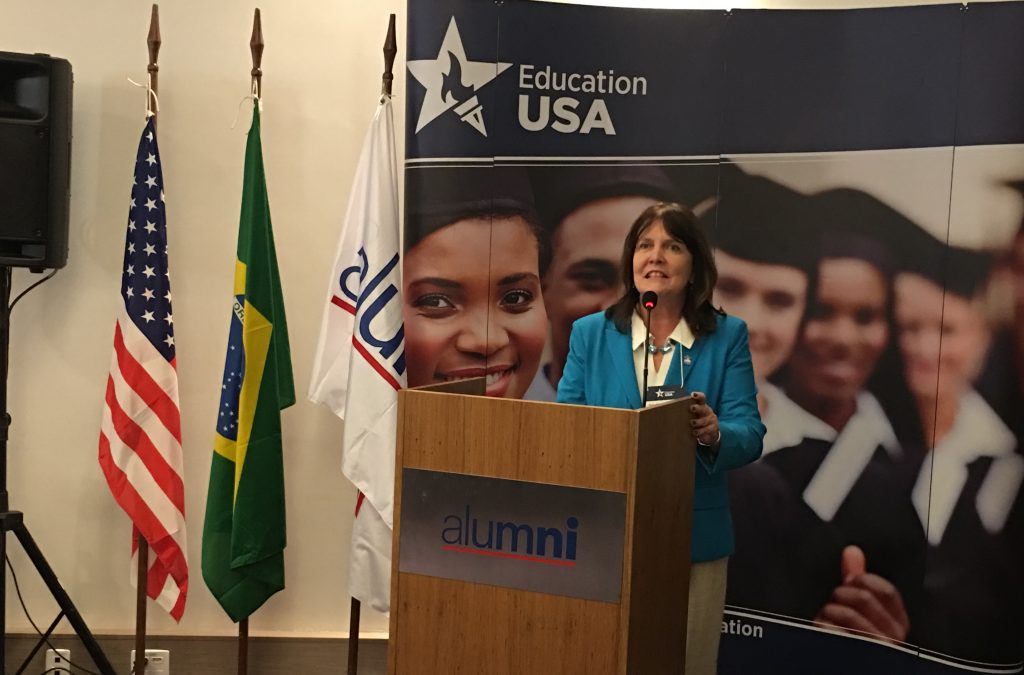
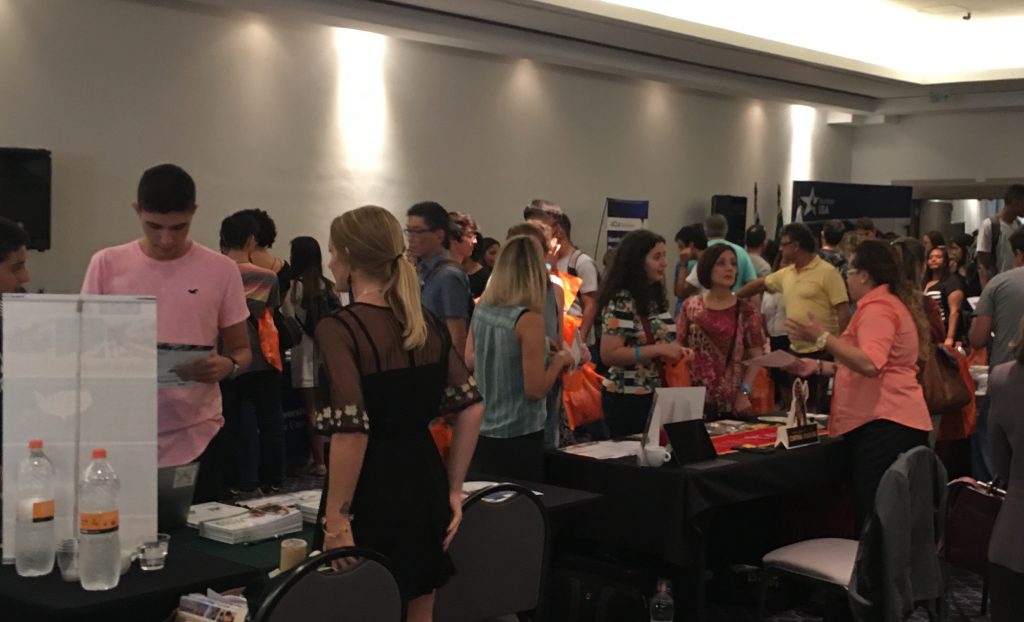
Went to the São Paulo EducationUSA today. We suffered a little when Science w/o Borders went away, but now interest in studying in the USA is coming back. I don’t recall the number that they said had registered, but the place was packed.
Education was the big thing when I was PAO in Brazil. I made it our top priority, so that we could take advantage of the Science w/o Borders program and we ended up getting more than 30,000 Brazilians to the USA in that program. This added something like $1.2 billion to the American education economy and had immeasurable benefit to the lives of those involved and scholarship in general. I do not regret but am still annoyed that the State Department inspectors marked me down for putting too much emphasis on that one aspect of our work. Please excuse my complaint, but I guess it still rankles a bit. They had the right to write that report and I had the right to think they were full of crap.
Science w/o Borders was a once-in-a-lifetime opportunity. It was well worth it to “unbalance” the program for a short time. It was like a guy digging for silver who finds gold. You don’t just ignore it because it was not on the agenda. Well, that is my complaint. My Ambassador Tom Shannon and others supported me, so the bad report did me no lasting harm and I am convinced that pushing for that education did some lasting good.
My old friend and colleague Rita Moriconi was at the fair. She had/has the education portfolio for Brazil, Paraguay, Chile and Argentina and provides the power that keeps these kinds of things running. The São Paulo fair is sponsored by the local Binational Center – Alumni. They have been sponsoring for more than fifteen years.
Our new Consul-General Adam Shub gave welcoming remarks. It is good to have high level support.
To recycle a little text from last time I did a fair – Rita Moriconi can correct me if I am wrong – EducationUSA fairs are self-supporting, i.e. the schools and others who take part pay the full cost. Presumably participants think that the return is worth it. Each Brazilian student brings in around $55,000 in direct benefits into the American economy for each year they are studying (not counting all the intangibles and long term), so if a school attracts only one or two it more than pays for the effort. The USG outlay is only for some incidentals and our time, which is free to the USG, since we get paid the same anyway.whether we work on Saturday or not.
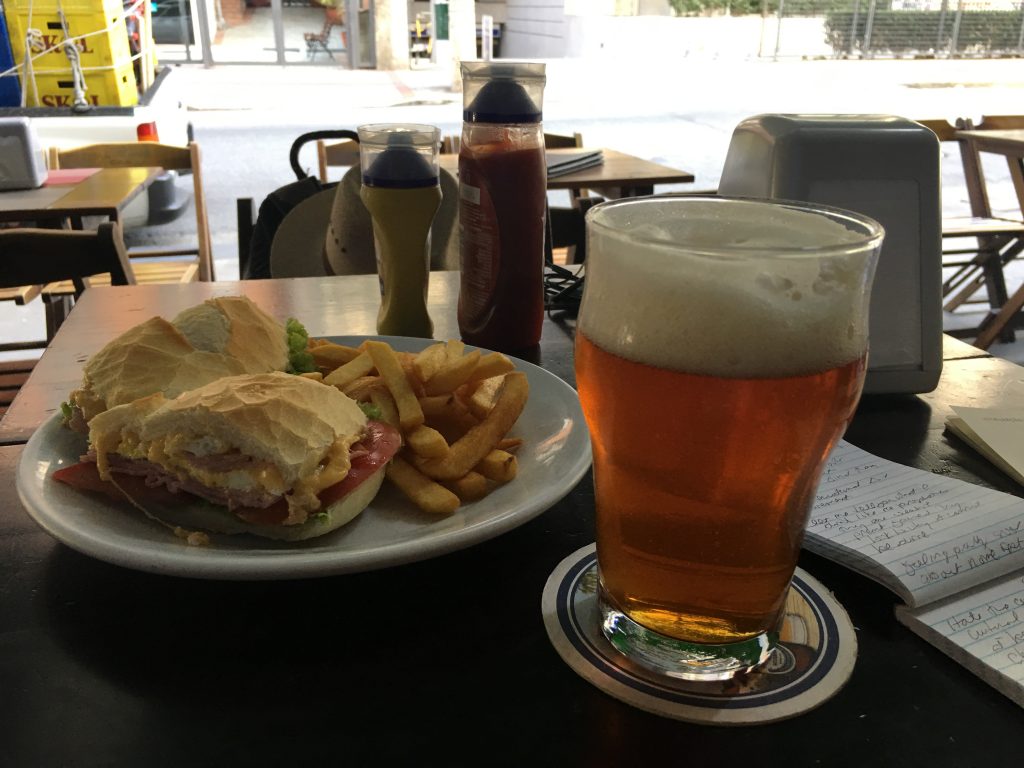
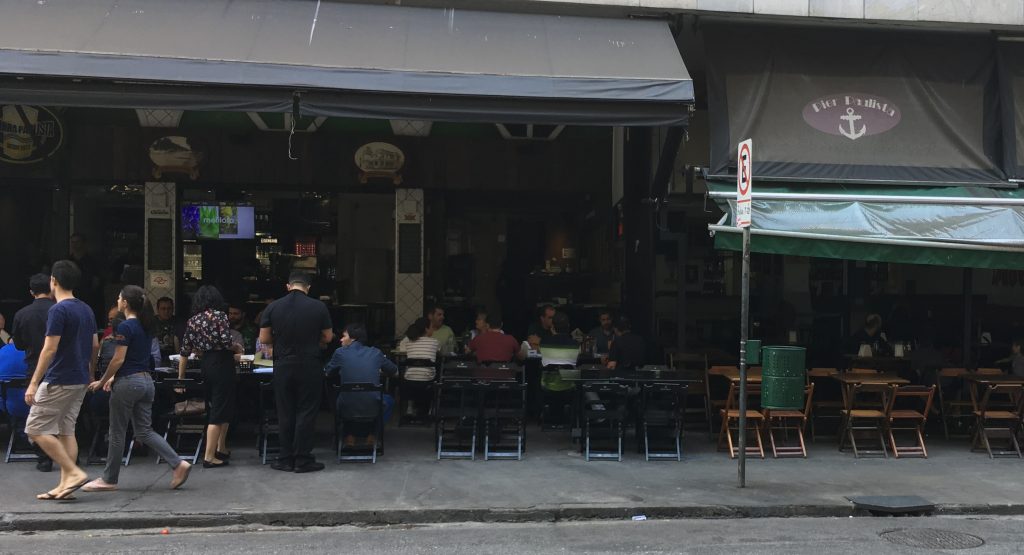
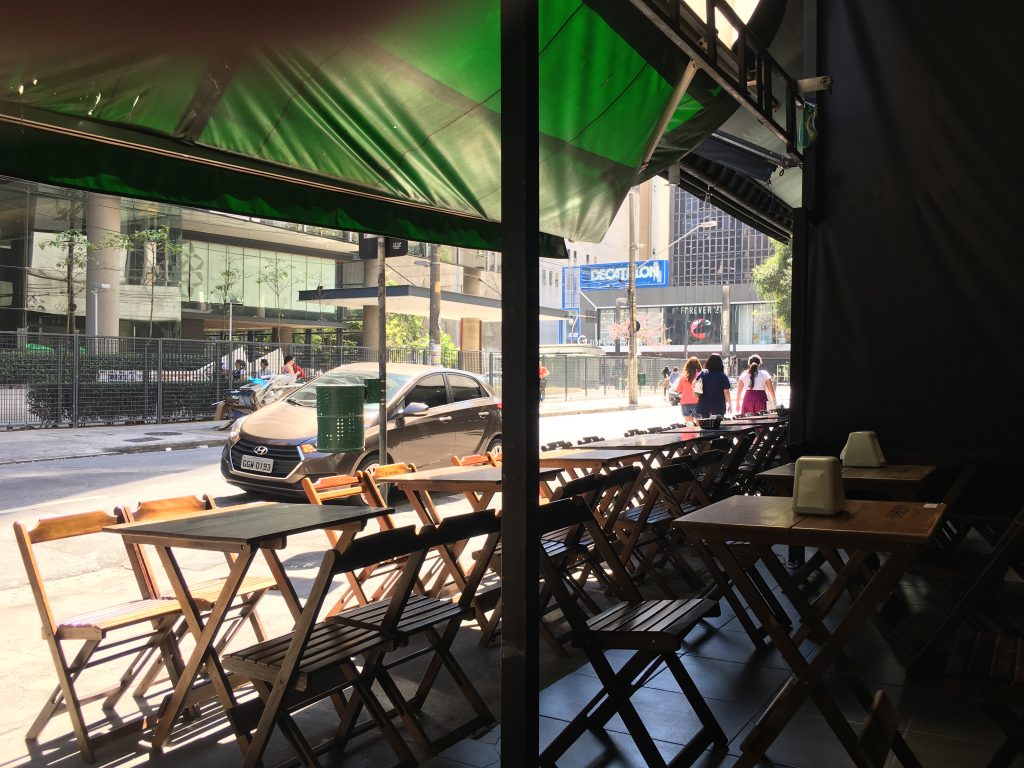
Missing Chrissy and prefer not to drink alone, but I did find a place to get a good IPA. In Brazil you do not say I P A. You make one word out of it ipa.
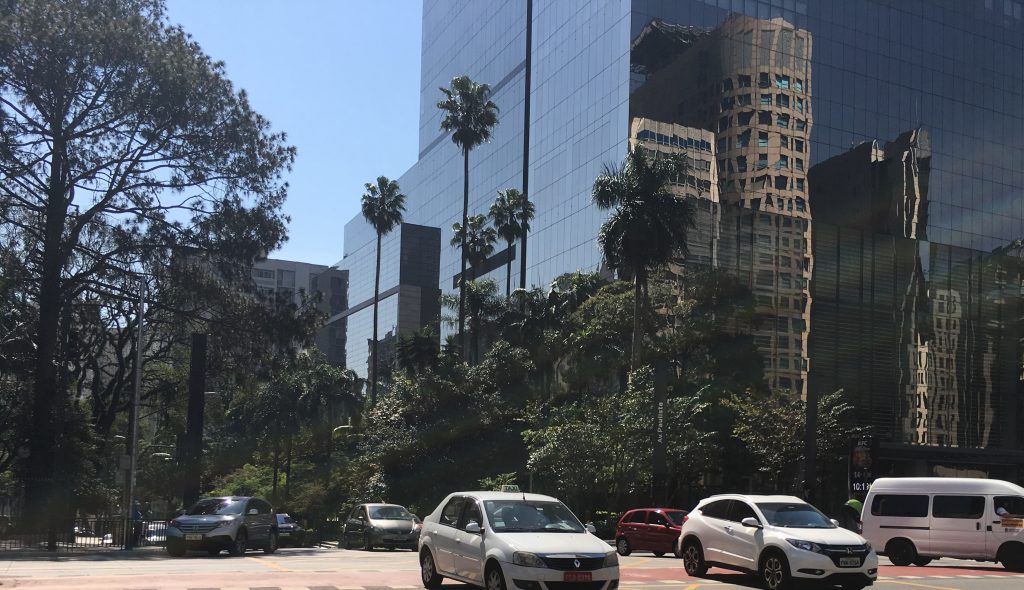
I walked up to Av Paulista for EducationUSA. This place was right off that main street and called “Pier Paulista.” It was interesting to sit there and watch people walk by.
This is my last Saturday in Brazil. I felt pensive, but not sad. I love being in Brazil, but I really want to go home. I like to be moving, but I am nostalgic for more familiar and permanent things. I guess there is no cure for these contradictions. A couple of beers make you consider them.
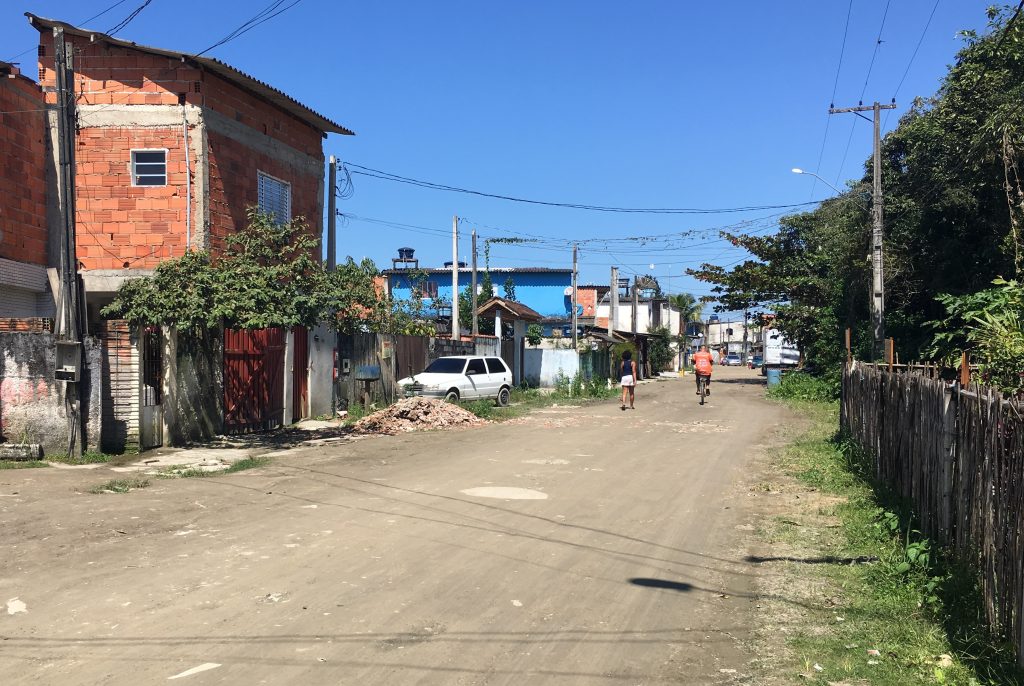
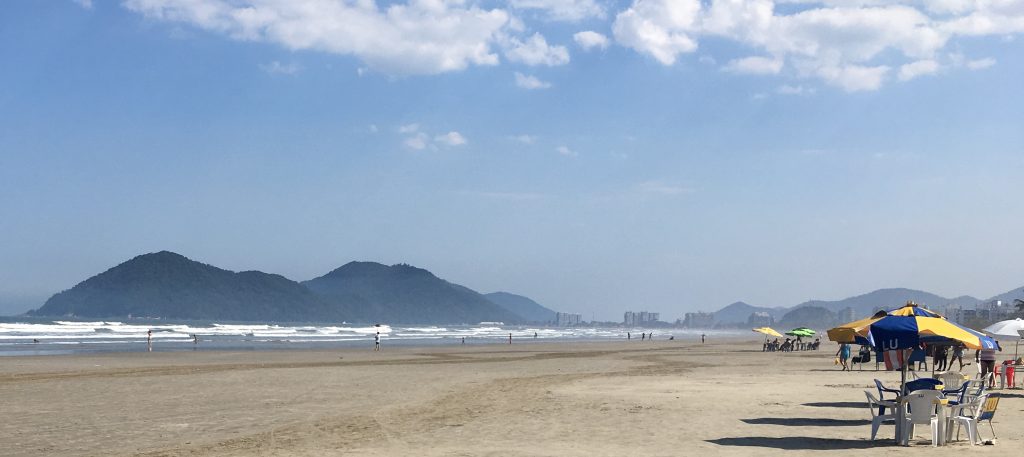
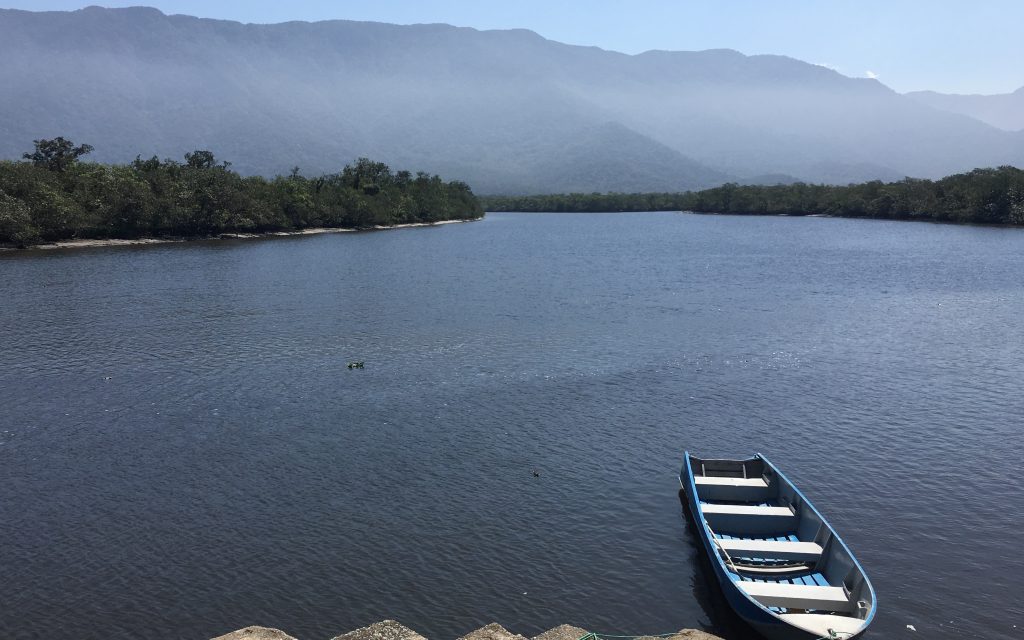
Bertioga, São Paulo, Brazil The preserve is in the middle of the town of Bertioga, a town with a population of around 60,000. It is a long and narrow municipality, hemmed in by the mountains (Serra do Mar) on one side and the Atlantic Ocean on the other. It is a place of great natural beauty, but not so much wealth. This makes it more challenging to conserve nature, since local people might want to use the forest or even occupy parts of it. This was how favelas got started in Rio with unfortunate social and ecological ramifications. The nearby picture shows the road right on one of the preserve edges and gives an idea of the possible challenge.
Partners in Preservation SESC officials, like Juarez recognized this challenge and made it a virtue. Their philosophy is that people should be integrated into the natural community and that natural communities should be integrated into human ones, so rather than fence off the forest, SESC invited the local people to participate. They did outreach to find out what the local people thought and what they wanted. Most of the local people appreciated the forest and wanted to conserve it and they are a strong force for protection. One thing that people wanted was a community garden, which SESC helped build on the fringe of the area of conservation. There are also plans for “agro-forestry” within the preserve. This will mean that in some places there will be food for people. All this means that the people living near the forest have become partners in preservation rather than adversaries to be excluded. This is a model of how it can work.
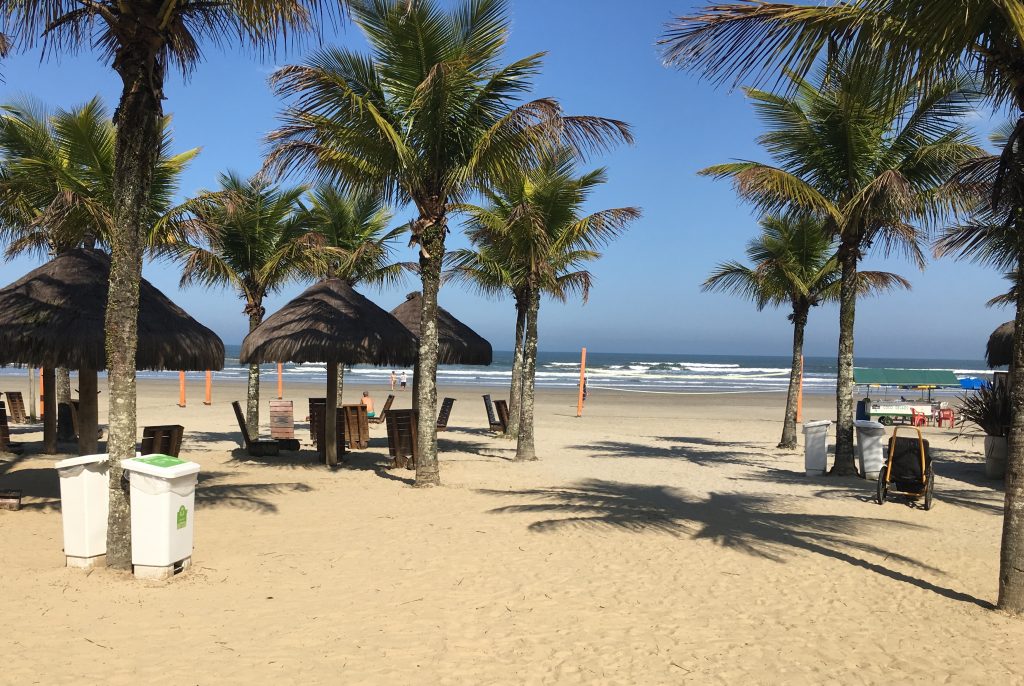
Restoring the Magnificent Atlantic Forest Brazil’s Atlantic forests were magnificent and parts of it still are, but since the Atlantic forests were first to be exploited and now are more densely occupied, protecting what is left is important and restoring some other what can be restored imperative. One of the features that makes Brazil’s coast so spectacular and beautiful is that the green mountains sweep down to the sea. Among the most preciously rare in this already preciously rare ecology are the thin strips of forests between the beaches and the uplands. This is mostly flat land. If you are going to try to grow something, this is a logical place to start. If you want to build a beach front home or hotel, this is the place to do it – above the high tide and not subject to the shifting ground of the hills. SESC’s forest is on precisely this ground and it is precisely why it is surrounded by human habitation.
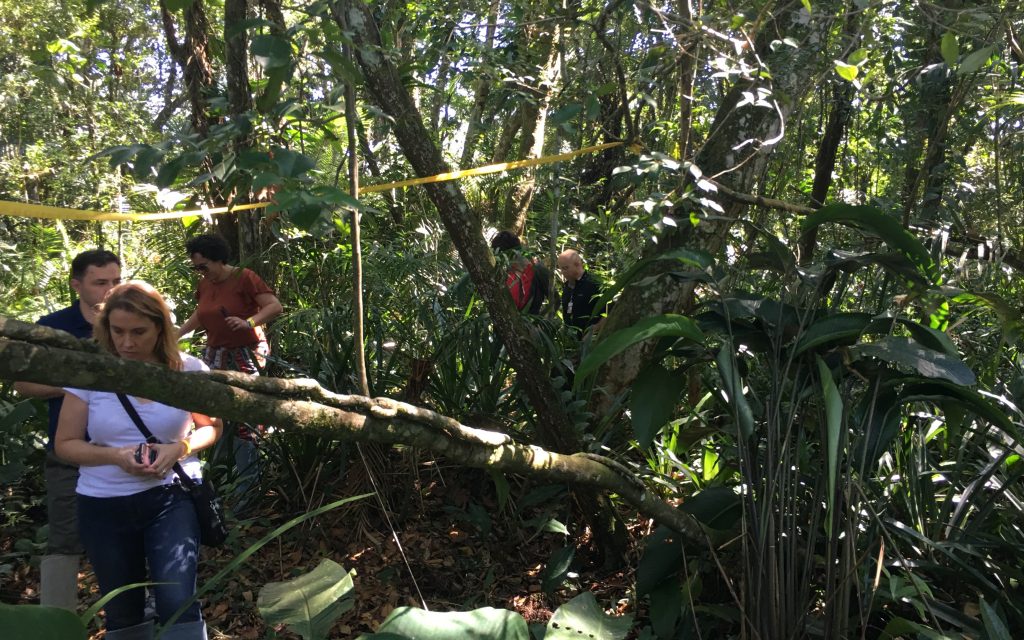
SESC employed scientist and naturalist to study the flora and fauna of their preserve and found it rich in the diversity of both. It is very unlikely that this forest patch was never cut, but SESC has owned it since 1947 and it has been intact at least since then. The trees rarely grow to great height, as they do farther inland, since the sandy soil does not support the kinds of root systems that can hold them up. As we walked through the wood, we saw wind throws that revealed just how shallow the root systems could be even for big trees. My guess is that this is a more ephemeral ecology. This provides some advantages for restoration. The fabled triple canopy forests take many more years to restore.
Mangroves SESC also owns a significant amount of riparian land along the Itapanhau River estuary. Here the brackish tidal water supports mangrove thickets. Mangroves are the classic edge community. Edge ecosystems are often among the most diverse, since they combine two or more environments. They usually punch well above their weight and are crucial to the larger ecosystem they join. Mangroves are amphibious trees that grow between high and low tide. They are sensitive to frost. In the U.S., they grow only in south Florida, and a few places in Louisiana so we went to see some in the Florida Keys. The tangle of roots and branches help hold soil and protect the coast from erosion and storms. They also provide cover for fish and wildlife to breed. Mangroves are also a threatened ecosystem, since people often want to “develop” the places they occupy and the very tangle that makes them such a formidable ecology is annoying to people wanting to get around. Removing mangrove, however is almost always a mistake, as with them go the wildlife benefits mentioned above and also protection from storms. The mangroves provide a flexible and self-repairing protection that no feat of engineering can match.
Doing the Right Things for the Right Reasons Make Sustainable I was mighty impressed with what SESC is doing. They are integrating natural and human communities into their developments from the start, as the crucial parts of the project that they are, rather than as something to be tacked on at the end. Juarez credits the long-view taken by SESC management and the resource they are willing to commit to the long term. It is a model.
The Complexity and Power of Networks I connected Jeremy Buzzell with Juarez Michelotti, from SESC São Paulo at the request of then former State Department colleagues, former since this was 2016 and I had just retired from FS. For me it was a simple matter of looking up on the internet making a few calls. USG is USG no matter the branch. I did not know the particular people at the Park Service, but I know how the system works generally. It was harder for Brazilian friends. Imagine how it would be to find similar Brazilian officials for someone outside the structure. Anyway, I called Mr. Buzzell, made the connection and mostly forgot about it. I did keep in sporadic contact with Juarez, however, because of my personal interest in his work of ecological restoration of Brazil’s Atlantic forests and when I came on my sojourn to São Paulo, I got in touch to with him to meet him in person and maybe see the forests. So my colleague Joyce Costa and I arranged to go. With the date set Juarez gave me the good news that coincidentally Mr. Buzzell would also be there. Back to the main narrative.
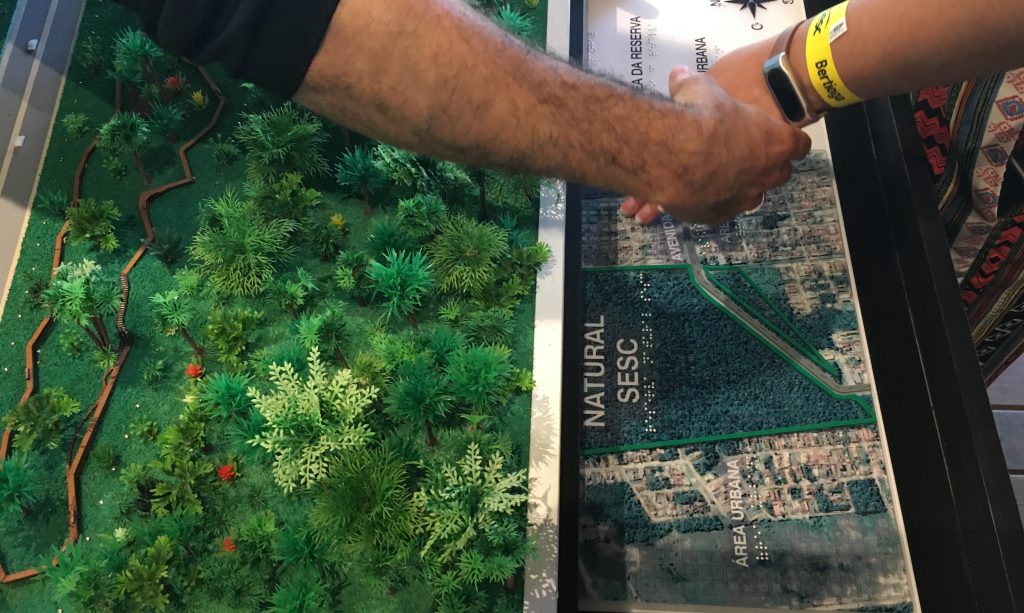
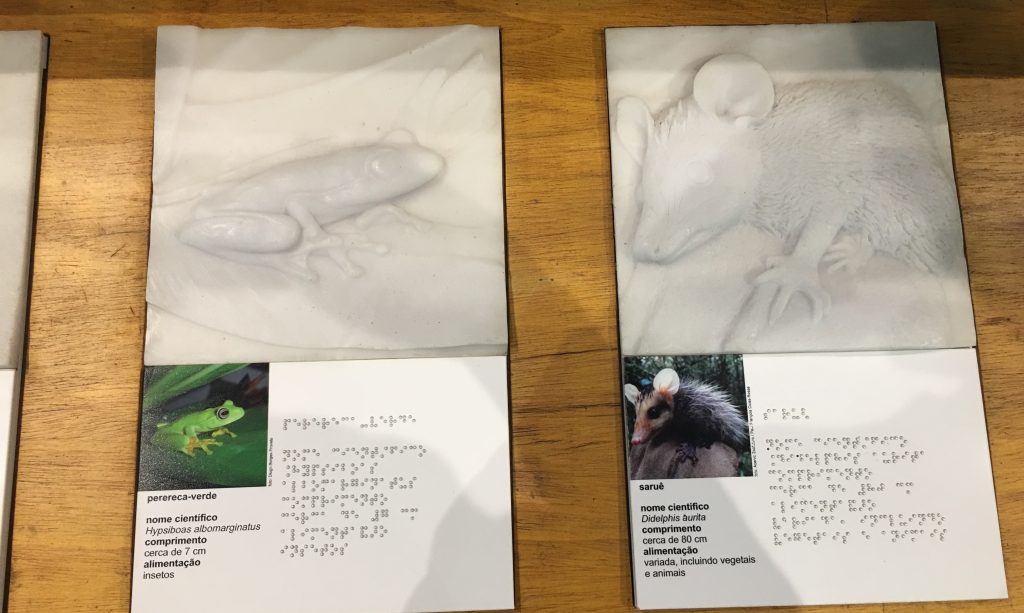
Making Nature Accessible to All Mr. Buzzell was helping SESC Bertioga make their nature preserve accessible. The accessible trail will be a boardwalk, wheelchair friendly, with stations that allow participants to enjoy and understand using a variety of the senses. The trail will feature experience of sight, smell, touch. We tried out some of the features to give access to people with no or low vision. I tried it out blindfolded. They feature boxes with various natural items to be identified. The SESC folks assured us that none of the boxes harbored spiders or snakes. They also featured 3-D (but flat) animals and plants. I managed to get correct only a fish and a bird, as I found a fin and a beak. It is hard to identify even familiar objects by touch alone. You need someone to guide you and someone to help with the narrative, but I imagine that you would get more adept with experience.
The trail features places to stop and to turn around, so that participants can get a little or get a lot. It has secure rails and gentle slopes. Besides the boardwalk, there will also be dirt trails. A large percentage will be graded to allow for easier walking and wheelchair use. The preserve is divided by a highway and there will be a footbridge connecting the sections. This is also accessible, with gently sloping entrances.
It seemed to me that the SESC folks were doing everything right, but I am not an expert. Mr. Buzzell, who is an expert, shared the opinion, so I think it must be right.
I visited the São Paulo SESC resort in Bertioga. I will write more later.
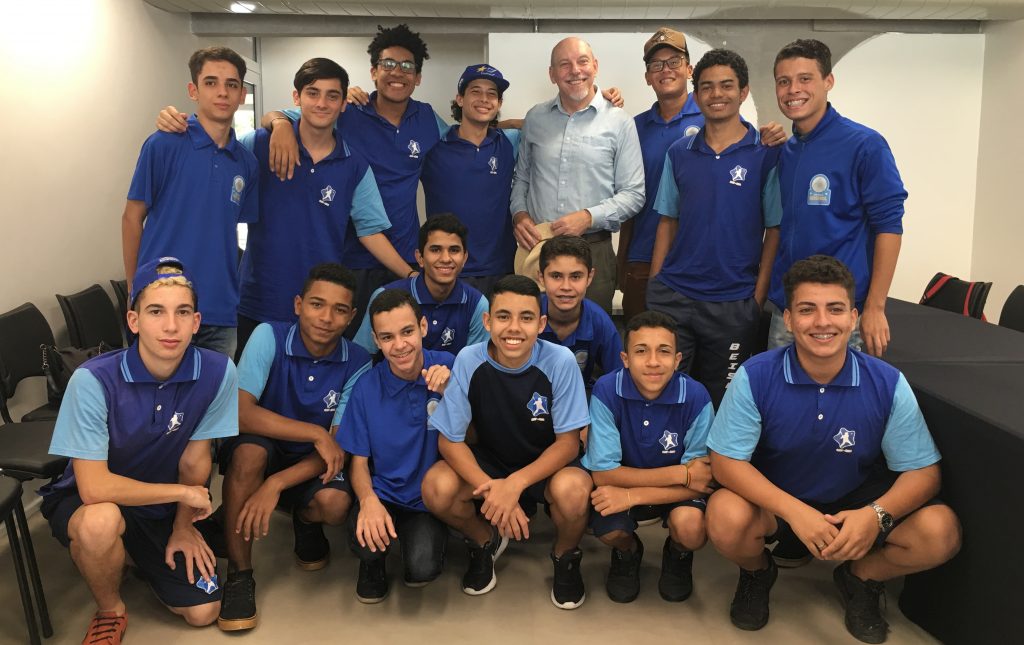
My picture shows a SESC program we (the Consulate) co-sponsored. You might call it “English learning through sports” – in this case baseball. The boys in the picture play baseball AND study English. I talked to the team for about an hour. They were a little scared to speak English at first, but a few minutes in they were asking questions. The English in their questions sounded good. I cannot properly judge how well they understood, but they seemed to laugh at the right times. None of the question was hard. They asked a few questions about the USA but rather more about things that I liked or did not like in Brazil. Since I am very fond of Brazil, I think they liked the answers. I dodged questions about my favorite Brazilian football team. Well … I told the truth, that I did not know enough about the teams to have favorites. They just thought it was a joke. The only significant pushback came when I told them that I did not like açaí, a palm fruit that, IMO, tastes like dirt. They all liked açaí, but as we talked we came to understand that we were talking about different things. They like a kind of sherbet. It is frozen and has lots of sugar and other flavors. That is okay. I used to get the purer version of it when I traveled in the Amazon. It is not so good w/o the added ingredients.
I enjoy these sorts of encounters and I think kids do too. The kids are very familiar with America through the media, but these kids, fairly underprivileged, are likely to have few contacts with living Americans. They are surprised, and I think they are pleased that an American diplomat wants to talk to them. I learn from the sorts of questions they ask and their reactions to what I say. It is one of those ground truth checks.
These contacts have ripple effects, in that they talk to their friends and family about the encounter and I know that there is staying power. I sometimes meet people who tell me about times we met a few years ago. During my years in diplomacy, I must have spoken to thousands of young people in these sorts of engagements. It is one of the parts of my old job I liked best.
A little background – I am not sure you could call SESC an NGO, since it has mandatory contributions by members of the service industry. SESC along with SESI (industries) and transport SEST (Serviço Social do Transporte). These were established by government fiat back in 1946 and the president of SESC is nominated by the president of Brazil. On the other hand, SESC is private and non-profit. Since it is supported by contributions by the commercial industry, it is not open to all Brazilians. It is a membership organization. Only workers in the covered industries and their families are eligible to participate.
SESC, SESI & SEST work in similar fashion, so I describe one with the stipulation that the others resemble it. Each Brazilian state and the DF have their own SESC and there is significant autonomy and diversity among them, not least because their budgets come from local industrial contributions.
We don’t have anything like SESC in the U.S. and I think that this system is unique to Brazil. They are sort of like a YMCA on steroids. They provide social services, health, education, leisure and cultural activities as well as programs to promote good citizenship. They have swimming pools, gyms & theaters.
The praise was a bit embarrassing, and I am not sure I liked how it was tactically deployed, but the masters of ceremony held up the USA as the paragon of volunteerism. They gently disparaged the Brazilian audience, pointing out that only around 4% of Brazilians were involved in volunteer activities.
The Importance of Volunteerism “Do you know what that number is in the USA?” the MC asked the audience. A few hands went up with guesses ranging from 10-40%. Then she dropped the brick. “84%,” she said. I would not vouch for the accuracy of that number. I think we are dealing with various definitions of volunteerism and different durations of the activities. There is no doubt, however, that Americans are remarkable in the amount of their time and money that they voluntarily donate, and this is a consistent thread that runs through our history. But all his is a narrative for a different place.
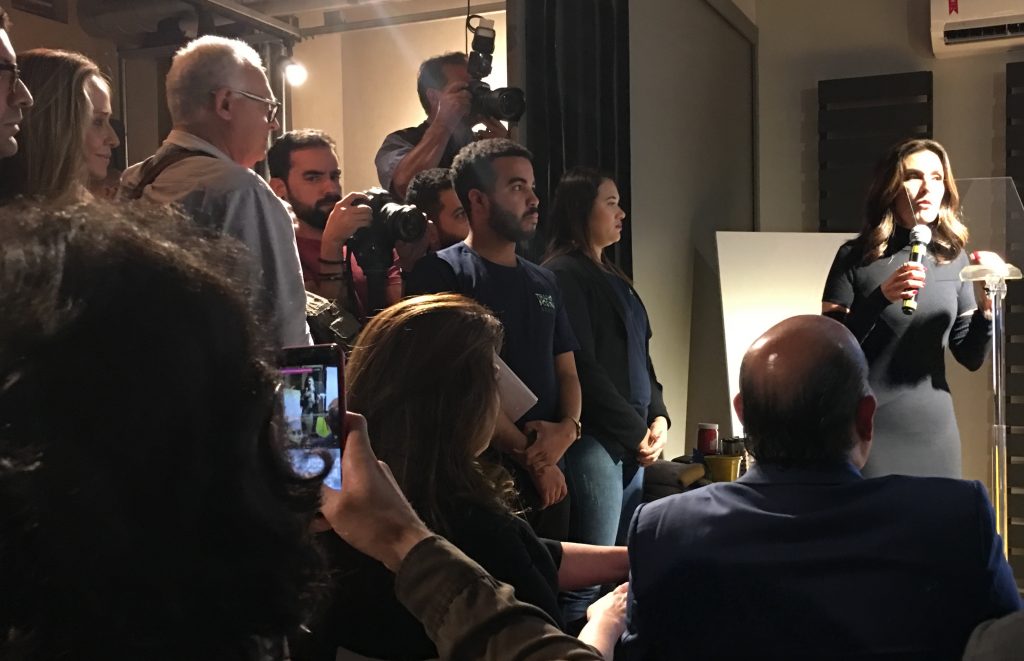
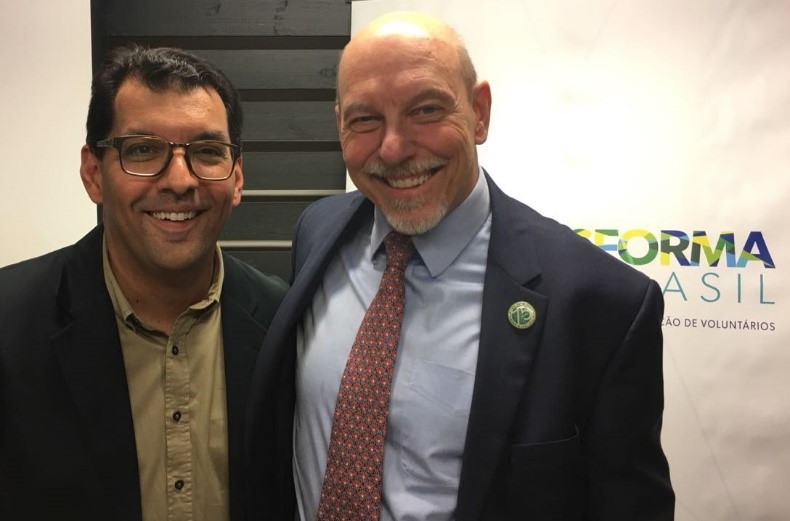
My colleague Wesley Oliveira and I were at the kickoff of “Transforma Brasil,” an interactive web platform that connects volunteers with opportunities and aims to register 5 million volunteers and 20k non-profit organizations by 2022.
A Big Launch for a Big Idea And what an event it was. The auditorium at Civi-co São Paulo was packed. Talk show host Fátima Bernardes (who Wesley tells me is the “Oprah of Brazil,” absent the car giveaways) introduced the program, emphasizing that she and all the other people present were volunteers. The obligatory reading of honored guests included mayors and high officials, the Governor of São Paulo and three presidential candidates, although we actually saw only one of these.
Transforma Brasil is the creation of Fábio Silva, who is a 2014 IVLP alumni from Recife. It was this connection and the specific request from our colleagues in Recife that moved us to attend this event. I am sure glad that we did. This had most of the important aspects of public diplomacy. We saw and were seen (we were among the honored guests mentioned), made and renewed contacts and gained insights into a developing trend in Brazil. Volunteerism, at least the idea of it, is trending in Brazil, as evidenced by the high-level of interest in this event. Some of this result from a need to fill in gaps left by government services, but much of the real power comes from a realization that citizenship in a democracy means involvement beyond voting and demanding that others do something. Fábio Silva was aware of volunteerism statistics and seeing advantage to Brazilians society to improve them, as a social entrepreneur he decided to create organizations that could be platforms to help connect would-be volunteers with appropriate NGOs. The idea was not only to raise awareness and encourage volunteers, but provide those encouraged with practical ways to get involved, i.e. turn aspirations into useful actions. I like to think that this was at least partly an insight he got from his IVLP visit, that specifically addressed volunteerism and how to move people from indifference, to aspiration to action. If people do not know how to do something, they usually will do nothing. It is a primarily tenet of marketing, both of products and ideas (although I stipulate that some object to the use of marketing in this context, I find it apt) that the initial inspiration and call to action must be closely followed by a simple answer to the question, “So wadda we do next?”
In Recife it Began Fábio Created his first version of a platform in his native city of Recife in 2015, and in cooperation with others, similar platforms have been installed in Campinas (São Paulo), Petrópolis (RJ), Cuiabá (MT) and Campina Grande (PB). “Transforma Recife” has already registered 120,000 volunteers and 400 NGO, registering more than a million hours of volunteer work in Recife. Recife features a Voluntariômetro, an outdoor tabulator that counts the volunteer hours in the state of Pernambuco in something like real time. Fábio Silva was already an active social entrepreneur before he was nominated for IVLP. That is how we found him and why we wanted to help. We cannot claim that the program turned his life around, but we can say, as he does, that the program greatly accelerated and facilitated his progress and gave him ideas. In other words, our program was part of a web of factors responsible for success. A logician might say that the program was necessary although not sufficient to these great results we are seeing. Even if it sounds like faint praise to some, I consider this one of the greatest compliments. All great things are accomplished in cooperation with others, which means that many are necessary, but none are sufficient, even if some like Fábio play the lead role. Fábio expressed this sentiment well in his own remarks.
If you want to make great things happen, play your role and help others play theirs and let something bigger than the sum of the parts emerge. This seems to have happened here. Media attention to the event
Innovation is hard to measure and nearly impossible to anticipate. After all, innovation means something new or at least different. If it is not discontinuous to previous developments, it is not much of an innovation, after all.
All of the returning Young Leaders of the Americas (YLAI) alumni were practicing entrepreneurs in Brazil and all of those about to embark on their exchange program hoped to be. I will not explain the YLAI program here, since you can get information more directly from the YLAI Link. For our purposes here, it is enough to know that we were attending a reception for alumni and those just going out.
This was a network opportunity, in keeping with the YLAI goals of creating and maintaining networks. I talked to both returnees and outgoing YLAI, rather more returnees, since I was interested in their experiences in the USA and since their return. The returnees were very enthusiastic about talking. They took their networking seriously. People I talked with had been to Kansas City, Atlanta, Palo Alto & Charlottesville, among other places.
They were interested in talking about their projects, but sometimes not as hopeful as I had hoped. One woman averred that America had spoiled her a bit. It was harder in Brazil, she said. Not only was there less access to capital for true start-ups, but the Brazilian society was less tolerant of failure. Still, everybody had some sort of working business. I suppose it might be an example of selection bias, since successful entrepreneurs would be more likely to show up for the reception.
The American appetite for risk is something I have heard about during my entire FS career. Everybody seems to notice it and many returnees comment. This was as true in my other posts as in Brazil. It is not always portrayed as a positive. There is an undertone that Americans are a little too insouciant.
But America tends to be the land of many chances. If you think you only have one shot, you tend to be much more cautious. I am not sure if this can be easily duplicated elsewhere. It comes not from programs that can be copied, but maybe from a more mobile society. We have a tradition, or at least a national myth, that we can pick up and move farther west or down the road. Form the time of the pioneers to Route 66, we are movers. I read that Americans are moving less than we did in the past. I wonder how this will affect our tolerance for failure.
I thought about my networking in the USA as compared to Brazil. Since I am here only a short time, I think I get only the one touch. I followed up with emails, but it is not the same as long term. In the USA, I have developed the “book gift” system. When I talk to someone, I often bring up a book I read about whatever we are discussing and in that age of Amazon, I can easily send them the book (providing a get an address). I am not sure if they really read the book, and I suspect most do not, but it is a powerful reminder and a commitment tailored to the needs of the person.
One of the most flattering things you can say to someone is, “I have been thinking about what you said, and you are right.” This says that in double. If I was going to be a full-time diplomat again, I would think of the equivalent.
have been enjoying my time in Brazil immensely, but I am getting a little tired. The daily (many times a day often) are rewarding but intense. I love it here. Brazilians are wonderful people, but will be ready to go home when my time is done.
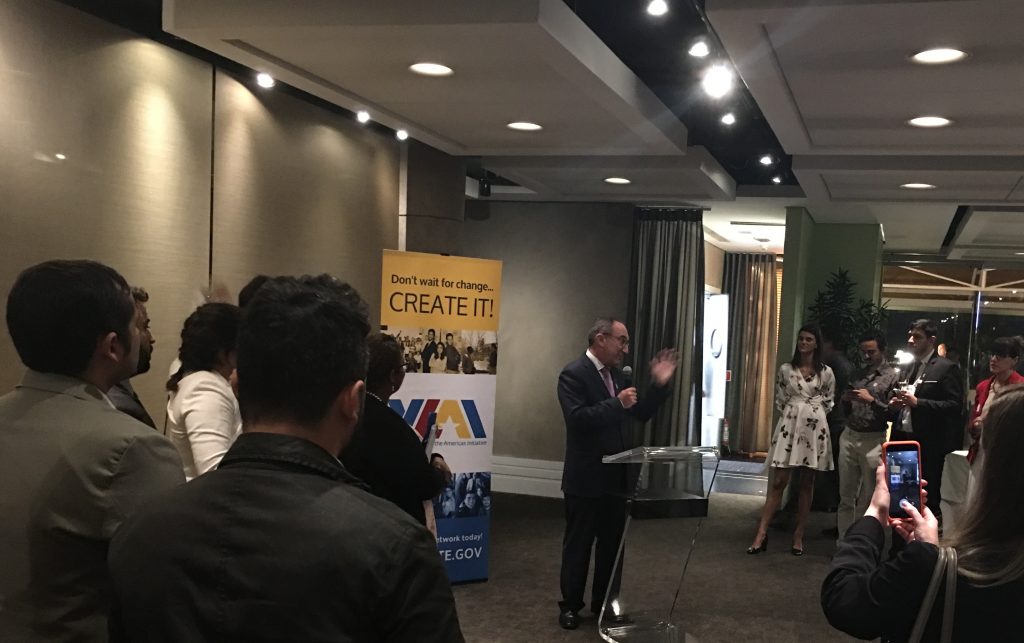
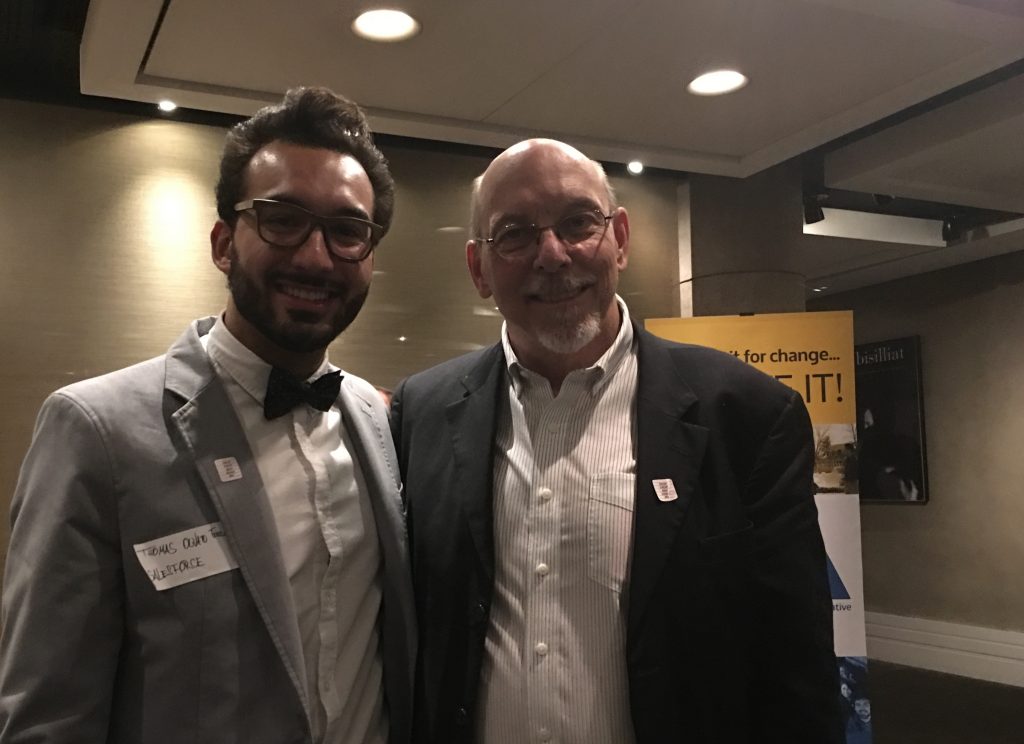
My picture shows the new CG getting ready to address the YLAI meeting and me with one of the participants. I took a lot more pictures, at least I thought I did, but they seem not to be on my camera. Sorry.
Interesting subplot to the CG picture. Later in the evening I was speaking to the woman in the picture. We were speaking in Portuguese. She mentioned how hard it was for her to speak in English, which she was doing in the picture. I thought her English was fine. I had not noticed, which is the ultimate compliment (I told her) to someone speaking a foreign language. I guess we never feel comfortable, no matter how good we get.